No to UNJUST evictions!
October 31, 2011
Stonewall Jackson Homes
5751 Airport Rd
Charlotte, NC 28208
In June 2011, the company TriTex bought the Stonewall Jackson Homes Community. Now they are trying to evict us all, to sell the property. At the same time, when they bought the property, they stopped giving tenants 12 month leases. If they knew at this time that they were going to sell the community, why didn’t they let us know? They waited until the beginning of October to tell us we had 30 days to leave. Included in this mass evictions are families with leases that have not expired. This is a violation of the law. Now they are kicking everyone out with no options on where to go. This is a violation of our human rights! REOCCUPY OUR HOMES!
Enough with the attacks on poor families!
Enough with the attacks against immigrant families!
Let us say NO to the abuses & YES to our dignity!
Let us say NO to the abuses & YES to our children!
They will not evict my family nor my neighbors’ families!
UPDATE: We've decided to cancel the protest. The tenants will be able to stay. Thanks to everyone who put in hard work to help these renters. Thanks to everyone who supports them. Thank you Creative Loafing for such a great article. This definitely helped.
In 2 weeks, we will hold a party to celebrate this great victory and to acknowledge the hard work that these tenants put in and their development as great leaders for their community.
For more information:
704.244.1100
Showing posts with label housing. Show all posts
Showing posts with label housing. Show all posts


Americans swap homes for hotels as recession bites
By Jason Szep, Reuters, July 10, 2009
CAMBRIDGE, Massachusetts (Reuters) - Some Americans are swapping homes for motels as the ranks of the homeless swell during the recession, crowding out shelters and forcing cities and states across the country to find new types of housing.
In Massachusetts, a record number of families are being put up in motels due to high unemployment and the rising number of homes going into foreclosure, costing taxpayers $2 million per month but providing a lifeline for desperate families.
"I feel like this has saved my life," said Tarya Seagraves-Quee, a 37-year-old former nurse.
Seagraves-Quee has lived in a cramped one-bedroom suite in a hotel in Cambridge, Massachusetts, with three of her four children for nearly two months. "I'm managing the best way possible. I've learned to make things in the microwave oven."
In Massachusetts, homeless shelters are at capacity. State law requires temporary accommodation for those without shelter, leading authorities to place 830 families, including 1,125 children, in 39 motels -- an unprecedented number.
"This truly is the highest we have ever seen it," said Nancy Paladino, director of the family team for the Boston Health Care for the Homeless.
Other cities are noticing a similar trend. In Indianapolis, Indiana, overcrowded homeless shelters are turning families away, forcing growing numbers to seek vouchers for hotels provided by nonprofit groups such as United Way.
"Anecdotally, it's increased," said Michael Hurst, director of the Coalition for Homeless Intervention and Prevention Indianapolis. The advocacy group started to compile statistics on the number of homeless families living in hotels this year after noticing signs of an increase.
"The hotel owners will tell you it has increased. The homeless service providers and the school officials will say we know there are more people living in hotels and putting their kids in school because that is the address they are giving us."
'JUST A STEPPING STONE'
In the Dallas-Fort Worth metropolitan area, the large Wilson family turned to a budget motel as a weeklong transition between a homeless shelter and an apartment.
"Each step we're going it's just a stepping stone," said 42-year-old Frederick Wilson as he sat with his wife, Annette, in a one-bedroom suite they share with four of the six children in their care, including a grandchild.
Called by God, they said, to move from Minnesota to Texas, the family has rapidly made a shift from homeless status to paid employment. Annette has just landed a job as a bus driver, while Frederick said he will work in an office that offers clerical support to Medicaid patients.
They spent two-and-a-half weeks in a homeless shelter in Dallas and were preparing to move into an apartment from the motel. The Urban League, an organization that helps struggling African Americans, is paying the $204 cost of their suite, which does not include sheets, pillows or toilet paper.
In Phoenix, demand for emergency accommodation is swamping available services as the recession and spiraling foreclosures turn even more families out of their homes.
One nonprofit bought two former hotels -- a Days Inn and a Super 8 -- in a gritty downtown neighborhood to provide emergency accommodation for homeless and low income families. When the $23 million project is finished in September, it will be able to house 156 families, up from 112 now.
"We've seen a whole new subset of homeless families due to job loss and foreclosures, and our waiting list has doubled in the past year," said Nichole Barnes, chief fund development officer of the UMOM New Day Centers.
"Some were previous homeowners. Due to the housing market out here, they'd got into a mortgage with a flexible interest rate. Some were working full time, but lost their jobs, went through their savings trying to save their home, and then found themselves without a home due to foreclosure," she said.
FORECLOSURES AND FAMILIES
In many cities, foreclosures are a big part of a spike in homeless and rise in families living in hotels or motels.
Nearly 80 percent of homeless services providers and advocacy agencies say at least some clients became homeless as a result of a foreclosure, according to a joint report by four of the largest U.S. homeless advocacy groups.
Staying with family or friends and in emergency shelters were the most common post-foreclosure living conditions, followed by hotels or motels, according to the June report.
"In many areas shelters are now completely full, so the only option to keep their families together is to rent a motel room for $200 a week. That's pretty standard for many who lost their homes to foreclosure," said Michael Stoops, executive director of the National Coalition for the Homeless.
Unlike Massachusetts, most states do not pick up the tab. "People are spending 80 percent of their total income on hotels," he said. "And food costs are higher because they can't cook."
In Cambridge, Massachusetts, Seagraves-Quee found refuge at a budget hotel after losing her job in Georgia more than a year ago and going without health care for 10 months. She suffers from multiple sclerosis, anemia and lupus, and was recently found to have two cancer spots on her breast. Two of her children, aged 16 and 6, are autistic.
She spent $700 -- almost all her savings -- on plane tickets to Boston, where she had relatives. Soon the family was in a shelter.
Local authorities later moved her to the hotel and Seagraves-Quee was given medical treatment as part of a program carried out by Boston Health Care for the Homeless.
"Right now, I am picking up from where I left off in Georgia 10 months ago. When I got here I was in really bad health," she said. "I've heard some people say 'Oh that is a ghetto shelter.' But to me it's a wonderful place."
(Additional reporting by Ed Stoddard in Dallas and Tim Gaynor in Phoenix; Editing by Doina Chiacu)

CAMBRIDGE, Massachusetts (Reuters) - Some Americans are swapping homes for motels as the ranks of the homeless swell during the recession, crowding out shelters and forcing cities and states across the country to find new types of housing.
In Massachusetts, a record number of families are being put up in motels due to high unemployment and the rising number of homes going into foreclosure, costing taxpayers $2 million per month but providing a lifeline for desperate families.
"I feel like this has saved my life," said Tarya Seagraves-Quee, a 37-year-old former nurse.
Seagraves-Quee has lived in a cramped one-bedroom suite in a hotel in Cambridge, Massachusetts, with three of her four children for nearly two months. "I'm managing the best way possible. I've learned to make things in the microwave oven."
In Massachusetts, homeless shelters are at capacity. State law requires temporary accommodation for those without shelter, leading authorities to place 830 families, including 1,125 children, in 39 motels -- an unprecedented number.
"This truly is the highest we have ever seen it," said Nancy Paladino, director of the family team for the Boston Health Care for the Homeless.
Other cities are noticing a similar trend. In Indianapolis, Indiana, overcrowded homeless shelters are turning families away, forcing growing numbers to seek vouchers for hotels provided by nonprofit groups such as United Way.
"Anecdotally, it's increased," said Michael Hurst, director of the Coalition for Homeless Intervention and Prevention Indianapolis. The advocacy group started to compile statistics on the number of homeless families living in hotels this year after noticing signs of an increase.
"The hotel owners will tell you it has increased. The homeless service providers and the school officials will say we know there are more people living in hotels and putting their kids in school because that is the address they are giving us."
'JUST A STEPPING STONE'
In the Dallas-Fort Worth metropolitan area, the large Wilson family turned to a budget motel as a weeklong transition between a homeless shelter and an apartment.
"Each step we're going it's just a stepping stone," said 42-year-old Frederick Wilson as he sat with his wife, Annette, in a one-bedroom suite they share with four of the six children in their care, including a grandchild.
Called by God, they said, to move from Minnesota to Texas, the family has rapidly made a shift from homeless status to paid employment. Annette has just landed a job as a bus driver, while Frederick said he will work in an office that offers clerical support to Medicaid patients.
They spent two-and-a-half weeks in a homeless shelter in Dallas and were preparing to move into an apartment from the motel. The Urban League, an organization that helps struggling African Americans, is paying the $204 cost of their suite, which does not include sheets, pillows or toilet paper.
In Phoenix, demand for emergency accommodation is swamping available services as the recession and spiraling foreclosures turn even more families out of their homes.
One nonprofit bought two former hotels -- a Days Inn and a Super 8 -- in a gritty downtown neighborhood to provide emergency accommodation for homeless and low income families. When the $23 million project is finished in September, it will be able to house 156 families, up from 112 now.
"We've seen a whole new subset of homeless families due to job loss and foreclosures, and our waiting list has doubled in the past year," said Nichole Barnes, chief fund development officer of the UMOM New Day Centers.
"Some were previous homeowners. Due to the housing market out here, they'd got into a mortgage with a flexible interest rate. Some were working full time, but lost their jobs, went through their savings trying to save their home, and then found themselves without a home due to foreclosure," she said.
FORECLOSURES AND FAMILIES
In many cities, foreclosures are a big part of a spike in homeless and rise in families living in hotels or motels.
Nearly 80 percent of homeless services providers and advocacy agencies say at least some clients became homeless as a result of a foreclosure, according to a joint report by four of the largest U.S. homeless advocacy groups.
Staying with family or friends and in emergency shelters were the most common post-foreclosure living conditions, followed by hotels or motels, according to the June report.
"In many areas shelters are now completely full, so the only option to keep their families together is to rent a motel room for $200 a week. That's pretty standard for many who lost their homes to foreclosure," said Michael Stoops, executive director of the National Coalition for the Homeless.
Unlike Massachusetts, most states do not pick up the tab. "People are spending 80 percent of their total income on hotels," he said. "And food costs are higher because they can't cook."
In Cambridge, Massachusetts, Seagraves-Quee found refuge at a budget hotel after losing her job in Georgia more than a year ago and going without health care for 10 months. She suffers from multiple sclerosis, anemia and lupus, and was recently found to have two cancer spots on her breast. Two of her children, aged 16 and 6, are autistic.
She spent $700 -- almost all her savings -- on plane tickets to Boston, where she had relatives. Soon the family was in a shelter.
Local authorities later moved her to the hotel and Seagraves-Quee was given medical treatment as part of a program carried out by Boston Health Care for the Homeless.
"Right now, I am picking up from where I left off in Georgia 10 months ago. When I got here I was in really bad health," she said. "I've heard some people say 'Oh that is a ghetto shelter.' But to me it's a wonderful place."
(Additional reporting by Ed Stoddard in Dallas and Tim Gaynor in Phoenix; Editing by Doina Chiacu)
Hundreds Of Calif. Homeless March For Land Rights
By Richard Gonzales, NPR, July 2, 2009
click here to listen to audio
It has been about three months since city officials shut down a large "tent city" occupied by Sacramento's homeless people.
Now, some of the tent city's residents say they feel like refugees, with no place to go. They staged a loud demonstration Wednesday, in hopes of pressuring Sacramento officials to find them a new place to camp.
'Where Am I Supposed To Live?'
Philip Grice, 45, has been on the move ever since the tent city closed.
"When we moved out, we moved over to a private area two fields over. They wanted us off of there too. Just like shuttling cattle, that's all it is," said Grice, a carpenter by trade, who wears a T-shirt that reads, "Where am I supposed to live?" "We're supposed to be the eyesore, but actually we're citizens and we're human beings. We're supposed to have rights like everybody else; it don't matter what we have in our pockets."
Grice joined about 250 other homeless people and their supporters for a march through the northern end of Sacramento.
Their action coincided with the closure this week of a temporary shelter where many of the tent city residents had found a roof for the winter. Now these individuals say they need a year-round legal camp on what they call "safe ground."
Rodney Frazier, 43, a single father and disabled brick mason, participated in the march.
"A lot of these people are brick masons, they are tile setters, they are dentists, they had some very nice jobs," said Frazier. "They contribute to the world, to society, and they had a downfall in life. They need help getting up."
No Legal Place To Sleep
The march ended up in a hot and dusty city-owned lot next to a police station, where organizers set up a symbolic occupation. Val Jon Farris, founder of a group called iCare America, set up a tent on the lot.
"There is no legal place for people to live unless they own, rent or lease a home. So if you're homeless it's illegal to exist. You can't even lay your head anywhere without getting arrested, prosecuted or criminalized," said Farris. "So this is a demonstration in order to create a civil liberty that ought to already exist, which is [that] people have the right to be, to live without the threat of being incarcerated in their own country."
Sacramento police officer Mark Zoulas, who has served on the homeless beat for the past decade, said a legal campground makes sense to him.
"You need something for that immediate need," said Zoulas. "I like the winter shelter. I'm not saying that's the best answer in the world necessarily. But at least it gives you a choice. And that's now closed and everyone using it is out. And that leaves, for the minute, nothing, and nothing is never the answer."
The idea of a safe ground for homeless campers divides officials in city hall. The mayor, Kevin Johnson, has been receptive, but others, including the city manager, Ray Kerridge, is not. There is also a disagreement over how much it will cost at a time when the city and county are already slashing basic services.
What is not in dispute is that this week Sacramento has 200 more people with no place to sleep.
click here to listen to audio
It has been about three months since city officials shut down a large "tent city" occupied by Sacramento's homeless people.
Now, some of the tent city's residents say they feel like refugees, with no place to go. They staged a loud demonstration Wednesday, in hopes of pressuring Sacramento officials to find them a new place to camp.
'Where Am I Supposed To Live?'
Philip Grice, 45, has been on the move ever since the tent city closed.
"When we moved out, we moved over to a private area two fields over. They wanted us off of there too. Just like shuttling cattle, that's all it is," said Grice, a carpenter by trade, who wears a T-shirt that reads, "Where am I supposed to live?" "We're supposed to be the eyesore, but actually we're citizens and we're human beings. We're supposed to have rights like everybody else; it don't matter what we have in our pockets."
Grice joined about 250 other homeless people and their supporters for a march through the northern end of Sacramento.
Their action coincided with the closure this week of a temporary shelter where many of the tent city residents had found a roof for the winter. Now these individuals say they need a year-round legal camp on what they call "safe ground."
Rodney Frazier, 43, a single father and disabled brick mason, participated in the march.
"A lot of these people are brick masons, they are tile setters, they are dentists, they had some very nice jobs," said Frazier. "They contribute to the world, to society, and they had a downfall in life. They need help getting up."
No Legal Place To Sleep
The march ended up in a hot and dusty city-owned lot next to a police station, where organizers set up a symbolic occupation. Val Jon Farris, founder of a group called iCare America, set up a tent on the lot.
"There is no legal place for people to live unless they own, rent or lease a home. So if you're homeless it's illegal to exist. You can't even lay your head anywhere without getting arrested, prosecuted or criminalized," said Farris. "So this is a demonstration in order to create a civil liberty that ought to already exist, which is [that] people have the right to be, to live without the threat of being incarcerated in their own country."
Sacramento police officer Mark Zoulas, who has served on the homeless beat for the past decade, said a legal campground makes sense to him.
"You need something for that immediate need," said Zoulas. "I like the winter shelter. I'm not saying that's the best answer in the world necessarily. But at least it gives you a choice. And that's now closed and everyone using it is out. And that leaves, for the minute, nothing, and nothing is never the answer."
The idea of a safe ground for homeless campers divides officials in city hall. The mayor, Kevin Johnson, has been receptive, but others, including the city manager, Ray Kerridge, is not. There is also a disagreement over how much it will cost at a time when the city and county are already slashing basic services.
What is not in dispute is that this week Sacramento has 200 more people with no place to sleep.
June 26: The 5th Annual NYC Trans Day of Action for Social and Economic Justice
On June 26, 2009, Trans and Gender Non Conforming People of Color and allies will take to the streets of NYC once again and demand justice to let the world know, that on the 40th anniversary of Stonewall, the rebellion is not over and we will continue fighting for justice, raising our voices until we are heard. We call on all activist and organizers for justice, both local and organizations around the country and world to endorse this call to action and to build contingents to march in solidarity together. Below and attached are the points of unity which hold together the purpose of this march.
To endorse TDOA 2009, send an email to endorsetdoa@alp.org
For more info contact - info4tdoa@alp.org or Mya at 718-596-0342 x 23.
SAVE THE DATE – Trans Day of Action – June 26, 2009 – Starting Rally 3PM
The 5th Annual NYC Trans Day of Action for Social and Economic Justice
POINTS OF UNITY
Initiated by TransJustice of the Audre Lorde Project, a Lesbian, Gay, Bisexual, Two-Spirit, Trans and Gender Non-Conforming People of Color Center for Community Organizing.
We call on Trans and Gender Non-Conforming (TGNC) communities and our allies from many movements to join us for the 5th Annual Trans Day of Action (TDOA) for Social and Economic Justice. As TGNC People of Color (POC) we recognize the importance of working together alongside other movements to build the world we want to see. Much has changed since last year’s TDOA, the election of a new US President has brought hope to many of our communities, however we still live in a time when people of color, immigrants, youth, elders, rural communities, people living with disabilities and poor people are disproportionately underserved, face higher levels of discrimination, heightened surveillance and experience increased violence at the hands of the state. In fact, due to the growing financial crisis conditions have worsened. As a result, it is even more critical that we unite and work together towards ending the transphobia, racism, classism, sexism, ageism, ableism, homophobia and xenophobia within our movements for justice. We call for an end to the continued single issue platform of gay marriage over TGNC justice by our movements. Let’s come together to let the world know that TGNC justice will not be undermined and together we will not be silenced! These are the points of unity, which hold together the purpose of this march:
• We demand that all people receiving public assistance (welfare) including TGNC People of Color, be treated with respect and dignity. We are in solidarity with all people living on public assistance. TGNC POC face transphobic harassment and discrimination when applying for and seeking to access public assistance/welfare. For over three years TGNC communities in NYC have called on the Human Resources Administration (HRA), the NYC agency responsible for public assistance, to address these systemic problems. After initially ignoring requests for a meeting, due to community pressure raised by TDOA, last year HRA agreed to meet. As a result, this past year TransJustice and a committee of organizations and community members including the Sylvia Rivera Law Project, Housing Works, Queers for Economic Justice, and others have worked with HRA to develop a new HRA procedure to prevent transphobic discrimination including TGNC cultural competency training. To date we are currently awaiting HRA’s final approval of the procedure and anticipate a response by Trans Day of Action.
• We demand an end to the profiling, discrimination, harassment, brutality and murders that occur at the hands of the Police. Communities of color continue to face rampant police harassment and brutality. Last month two lesbians of color were brutally beaten by police officers in front of a club in Brooklyn, NY. In 2006 a Transgender woman of color was assaulted and harassed by an employee at a McDonald’s, when the police arrived they arrested and abused her. We are in solidarity with all people impacted by police violence including supporters of Iman Morales, the family of Sean Bell and the Jersey 4. Like other oppressed communities, TGNC people are targeted, profiled and brutalized by the police daily. We demand an end to the brutality and harassment and call for Justice for all people impacted by police violence. We call for an independent prosecutor for all cases of police violence (www.peoplesjustice.org). To improve TGNC people’s safety in interactions with the police we demand that Commissioner Ray Kelly implement changes in NYPD policies and adopt the “Proposed Policy for the Treatment of Transgender People in NYPD Custody” and the associated changes to the NYPD patrol guide, submitted to the NYPD in April 2009. (www.ipetitions.com/petition/NYPDTransPolicy/)
• We demand an end to the violence and harassment faced by women and LGBTSTGNC communities in the NYC public transportation system (MTA). Women and LGBTSTGNC communities face rampant violence and harassment in the NYC public transportation system. In 2005, a woman was sexually assaulted in a subway station in full view of a train conductor and a station agent. In 2006, a transgender woman was harassed by an MTA worker using anti-transgender slurs - bystanders joined in the harassment. We call on the MTA to be accountable and work proactively to end the violence and harassment that occurs in their transit system and to comply with Local Law 3 which prohibits gender identity/expression discrimination. (nyersforsafetransit.wordpress.com & newyorklawschool.typepad.com/leonardlink/2008/02/brooklyn-court.html)
• We demand the full legalization of all immigrants. In the last year, violence towards immigrants has increased. We oppose all forms of enforcement, which target people trying to survive a deepening global economic crisis, and are in solidarity with migrant rights organizations around the world. We oppose any immigration reform proposal that includes a registration process, more militarization at the border and further criminalization of undocumented people. TGNC people deserve the right to access competent and respectful immigration services. We demand that the consulates of all countries respect and honor our identities and issue passports and other documentation that accurately reflects who we are.
• We are in solidarity with all prisoners, especially the many TGNC people behind the walls who are often invisible to our movements. We call attention to the under-reported accounts of severe violence and rape that our community faces at the hands of correction officers and other prisoners. We demand an end to the torture and discrimination TGNC prisoners face. We demand that all TGNC prisoners receive competent and respectful healthcare. We oppose the continued growth of the prison industrial complex that targets our communities, yet we recognize that TGNC people need access to services and facilities that lessen our vulnerability to violence within the present jails and prisons. We call attention to the criminal injustice system that increasingly puts POC, immigrants, TGNC and poor people behind bars - further criminalizing our communities and our lives.
• We demand that TGNC people have access to respectful and safe living spaces. Many TGNC people face discrimination from landlords and housing administrators displacing us from our homes due to gender identity or expression. A disproportionate number of TGNC people have been or are currently homeless and face discrimination when trying to access shelters and other assisted living programs. NYC law and the Department of Homeless Services (DHS) state that people will be placed in shelters according to gender identity and that discrimination based on gender identity will not be tolerated. We demand that all DHS shelter administrators continue to provide adequate Trans sensitivity trainings for all personnel and enforce clear non-discrimination policies that respect all homeless people.
• We demand that TGNC people have equal access to employment and education opportunities. We are outraged by increasing unemployment facing all communities, particularly TGNC POC. TGNC people continue to face blatant discrimination and harassment from employers due to systemic transphobia. Few TGNC people have access to opportunities for learning in a safe school environment. We demand that employers and educational institutions implement non-discrimination policies and comply with Local Law 3.
• We demand that all people, including TGNC people, have access to essential health and human services. We are in a period of ongoing budget cuts to critical services such as HIV/AIDS, youth, LGBT, etc. We call on Governor Paterson and Mayor Bloomberg to stop the budget cuts to essential health and human services and restore funding. The Piers have been a safe space for our community, particularly LGBTSTGNC youth of color for years. In solidarity with FIERCE, we demand the establishment of a 24hour LGBT youth center at the Piers. (www.fiercenyc.org)
• We demand that children and youth under jurisdiction of the Administration of Children Services (ACS) and Private Foster Care Agencies, have the right to freedom of gender expression/identity. In 2002 it was established that NYC’s foster care system cannot discriminate against TGNC children and youth nor force them to only wear clothing associated with birth gender. ACS and private foster care agencies must be accountable for the health of people under their care including TGNC people. After organized community pressure ACS established an anti-discrimination policy for TGNC people. We demand that ACS fully implement this policy.
• We oppose all the public and hidden wars of the U.S. the continued occupations of Afghanistan and Iraq, and the expansion of U.S. militarization. We are appalled by the ongoing attacks on the people of Palestine through the denial of equal rights inside Israel, division through the wall, economic isolation, blockades of supplies and imports, escalating militarization throughout the occupied territories, and the continued refusal of Palestinian refugees’ right of return. We support organizations intensifying efforts through boycott, divestment, and sanction strategies. We oppose escalating military activities everywhere. We demand the immediate removal of all U.S. troops from all countries under occupation and demand an end of use of U.S. dollars to cultivate and sponsor wars against people in the U.S. and abroad.
• We demand justice for the many TGNC people who have been beaten, assaulted, raped, and murdered. These incidents continue to be silenced, misclassified or blamed on TNGC people. The police and media continue to criminalize us even when we try to defend ourselves. An increase in hate crime laws will not solve the problem but will give increased power to the state to put more people in jail. Instead we call for a unified effort for all of us to address the root causes of why these incidents happen. As a society that seeks social justice we seek to find ways of preventing attacks on TGNC people by building strong and knowledgeable communities and using transformative justice to hold people accountable.
We commemorate Amanda Milan, Sakia Gunn, Ruby Ordeñana, Gwen Araujo, Erika Keels, Victoria Arellano, Lawrence King, Saneesha Stewart, Duanna Johnson, Angie Zapata, Teish Cannon, Taysia Elzy and the many others we have lost, who struggled and lived fearlessly, being true to who they were. They keep the fire of struggle burning within all of us.
On June 26, 2009, TGNC POC and allies will take to the streets of NYC once again and demand justice to let the world know, that on the 40th anniversary of Stonewall, the rebellion is not over and we will continue fighting for justice, raising our voices until we are heard. We call on all activist and organizers for justice, both local and organizations around the country to endorse this call to action and to build contingents to march in solidarity together. To endorse TDOA 2009, send an email to endorsetdoa@alp.org, for more info contact - info4tdoa@alp.org or Mya at 718-596-0342 x 23.
To endorse TDOA 2009, send an email to endorsetdoa@alp.org
For more info contact - info4tdoa@alp.org or Mya at 718-596-0342 x 23.
SAVE THE DATE – Trans Day of Action – June 26, 2009 – Starting Rally 3PM
The 5th Annual NYC Trans Day of Action for Social and Economic Justice
POINTS OF UNITY
Initiated by TransJustice of the Audre Lorde Project, a Lesbian, Gay, Bisexual, Two-Spirit, Trans and Gender Non-Conforming People of Color Center for Community Organizing.
We call on Trans and Gender Non-Conforming (TGNC) communities and our allies from many movements to join us for the 5th Annual Trans Day of Action (TDOA) for Social and Economic Justice. As TGNC People of Color (POC) we recognize the importance of working together alongside other movements to build the world we want to see. Much has changed since last year’s TDOA, the election of a new US President has brought hope to many of our communities, however we still live in a time when people of color, immigrants, youth, elders, rural communities, people living with disabilities and poor people are disproportionately underserved, face higher levels of discrimination, heightened surveillance and experience increased violence at the hands of the state. In fact, due to the growing financial crisis conditions have worsened. As a result, it is even more critical that we unite and work together towards ending the transphobia, racism, classism, sexism, ageism, ableism, homophobia and xenophobia within our movements for justice. We call for an end to the continued single issue platform of gay marriage over TGNC justice by our movements. Let’s come together to let the world know that TGNC justice will not be undermined and together we will not be silenced! These are the points of unity, which hold together the purpose of this march:
• We demand that all people receiving public assistance (welfare) including TGNC People of Color, be treated with respect and dignity. We are in solidarity with all people living on public assistance. TGNC POC face transphobic harassment and discrimination when applying for and seeking to access public assistance/welfare. For over three years TGNC communities in NYC have called on the Human Resources Administration (HRA), the NYC agency responsible for public assistance, to address these systemic problems. After initially ignoring requests for a meeting, due to community pressure raised by TDOA, last year HRA agreed to meet. As a result, this past year TransJustice and a committee of organizations and community members including the Sylvia Rivera Law Project, Housing Works, Queers for Economic Justice, and others have worked with HRA to develop a new HRA procedure to prevent transphobic discrimination including TGNC cultural competency training. To date we are currently awaiting HRA’s final approval of the procedure and anticipate a response by Trans Day of Action.
• We demand an end to the profiling, discrimination, harassment, brutality and murders that occur at the hands of the Police. Communities of color continue to face rampant police harassment and brutality. Last month two lesbians of color were brutally beaten by police officers in front of a club in Brooklyn, NY. In 2006 a Transgender woman of color was assaulted and harassed by an employee at a McDonald’s, when the police arrived they arrested and abused her. We are in solidarity with all people impacted by police violence including supporters of Iman Morales, the family of Sean Bell and the Jersey 4. Like other oppressed communities, TGNC people are targeted, profiled and brutalized by the police daily. We demand an end to the brutality and harassment and call for Justice for all people impacted by police violence. We call for an independent prosecutor for all cases of police violence (www.peoplesjustice.org). To improve TGNC people’s safety in interactions with the police we demand that Commissioner Ray Kelly implement changes in NYPD policies and adopt the “Proposed Policy for the Treatment of Transgender People in NYPD Custody” and the associated changes to the NYPD patrol guide, submitted to the NYPD in April 2009. (www.ipetitions.com/petition/NYPDTransPolicy/)
• We demand an end to the violence and harassment faced by women and LGBTSTGNC communities in the NYC public transportation system (MTA). Women and LGBTSTGNC communities face rampant violence and harassment in the NYC public transportation system. In 2005, a woman was sexually assaulted in a subway station in full view of a train conductor and a station agent. In 2006, a transgender woman was harassed by an MTA worker using anti-transgender slurs - bystanders joined in the harassment. We call on the MTA to be accountable and work proactively to end the violence and harassment that occurs in their transit system and to comply with Local Law 3 which prohibits gender identity/expression discrimination. (nyersforsafetransit.wordpress.com & newyorklawschool.typepad.com/leonardlink/2008/02/brooklyn-court.html)
• We demand the full legalization of all immigrants. In the last year, violence towards immigrants has increased. We oppose all forms of enforcement, which target people trying to survive a deepening global economic crisis, and are in solidarity with migrant rights organizations around the world. We oppose any immigration reform proposal that includes a registration process, more militarization at the border and further criminalization of undocumented people. TGNC people deserve the right to access competent and respectful immigration services. We demand that the consulates of all countries respect and honor our identities and issue passports and other documentation that accurately reflects who we are.
• We are in solidarity with all prisoners, especially the many TGNC people behind the walls who are often invisible to our movements. We call attention to the under-reported accounts of severe violence and rape that our community faces at the hands of correction officers and other prisoners. We demand an end to the torture and discrimination TGNC prisoners face. We demand that all TGNC prisoners receive competent and respectful healthcare. We oppose the continued growth of the prison industrial complex that targets our communities, yet we recognize that TGNC people need access to services and facilities that lessen our vulnerability to violence within the present jails and prisons. We call attention to the criminal injustice system that increasingly puts POC, immigrants, TGNC and poor people behind bars - further criminalizing our communities and our lives.
• We demand that TGNC people have access to respectful and safe living spaces. Many TGNC people face discrimination from landlords and housing administrators displacing us from our homes due to gender identity or expression. A disproportionate number of TGNC people have been or are currently homeless and face discrimination when trying to access shelters and other assisted living programs. NYC law and the Department of Homeless Services (DHS) state that people will be placed in shelters according to gender identity and that discrimination based on gender identity will not be tolerated. We demand that all DHS shelter administrators continue to provide adequate Trans sensitivity trainings for all personnel and enforce clear non-discrimination policies that respect all homeless people.
• We demand that TGNC people have equal access to employment and education opportunities. We are outraged by increasing unemployment facing all communities, particularly TGNC POC. TGNC people continue to face blatant discrimination and harassment from employers due to systemic transphobia. Few TGNC people have access to opportunities for learning in a safe school environment. We demand that employers and educational institutions implement non-discrimination policies and comply with Local Law 3.
• We demand that all people, including TGNC people, have access to essential health and human services. We are in a period of ongoing budget cuts to critical services such as HIV/AIDS, youth, LGBT, etc. We call on Governor Paterson and Mayor Bloomberg to stop the budget cuts to essential health and human services and restore funding. The Piers have been a safe space for our community, particularly LGBTSTGNC youth of color for years. In solidarity with FIERCE, we demand the establishment of a 24hour LGBT youth center at the Piers. (www.fiercenyc.org)
• We demand that children and youth under jurisdiction of the Administration of Children Services (ACS) and Private Foster Care Agencies, have the right to freedom of gender expression/identity. In 2002 it was established that NYC’s foster care system cannot discriminate against TGNC children and youth nor force them to only wear clothing associated with birth gender. ACS and private foster care agencies must be accountable for the health of people under their care including TGNC people. After organized community pressure ACS established an anti-discrimination policy for TGNC people. We demand that ACS fully implement this policy.
• We oppose all the public and hidden wars of the U.S. the continued occupations of Afghanistan and Iraq, and the expansion of U.S. militarization. We are appalled by the ongoing attacks on the people of Palestine through the denial of equal rights inside Israel, division through the wall, economic isolation, blockades of supplies and imports, escalating militarization throughout the occupied territories, and the continued refusal of Palestinian refugees’ right of return. We support organizations intensifying efforts through boycott, divestment, and sanction strategies. We oppose escalating military activities everywhere. We demand the immediate removal of all U.S. troops from all countries under occupation and demand an end of use of U.S. dollars to cultivate and sponsor wars against people in the U.S. and abroad.
• We demand justice for the many TGNC people who have been beaten, assaulted, raped, and murdered. These incidents continue to be silenced, misclassified or blamed on TNGC people. The police and media continue to criminalize us even when we try to defend ourselves. An increase in hate crime laws will not solve the problem but will give increased power to the state to put more people in jail. Instead we call for a unified effort for all of us to address the root causes of why these incidents happen. As a society that seeks social justice we seek to find ways of preventing attacks on TGNC people by building strong and knowledgeable communities and using transformative justice to hold people accountable.
We commemorate Amanda Milan, Sakia Gunn, Ruby Ordeñana, Gwen Araujo, Erika Keels, Victoria Arellano, Lawrence King, Saneesha Stewart, Duanna Johnson, Angie Zapata, Teish Cannon, Taysia Elzy and the many others we have lost, who struggled and lived fearlessly, being true to who they were. They keep the fire of struggle burning within all of us.
On June 26, 2009, TGNC POC and allies will take to the streets of NYC once again and demand justice to let the world know, that on the 40th anniversary of Stonewall, the rebellion is not over and we will continue fighting for justice, raising our voices until we are heard. We call on all activist and organizers for justice, both local and organizations around the country to endorse this call to action and to build contingents to march in solidarity together. To endorse TDOA 2009, send an email to endorsetdoa@alp.org, for more info contact - info4tdoa@alp.org or Mya at 718-596-0342 x 23.
Second Round Of Homelessness For Katrina Victims As FEMA Prepares To Enforce June 1 Eviction Date
Press Release
US Human Rights Network Condemns Federal Government’s Move to Repossess Trailers and Leave Thousands Homeless
Atlanta, May 29, 2009 - In response to the Federal Emergency Management Agency’s decision to repossess temporary housing from survivors of Hurricane Katrina on June 1, the US Human Rights Network issued the following statement:
The move by FEMA to enforce the June 1st eviction date for Gulf Region residents who live in temporary trailers not only lacks basic compassion but is also a derogation of the government’s responsibilities to uphold fundamental human rights. If FEMA moves forward with the Bush administration's plan to forcefully evict people living in temporary housing, it will make a mockery of the Gulf Region recovery promised by President Obama and Congress.
Earnest Hammond is a 70 year-old retired truck driver who received no assistance after Hurricane Katrina destroyed his home. He took matters into his own hands and by collecting aluminum cans, raised thousands of dollars to repair his badly damaged house. He is eager to move back but can’t restore his home by the June 1st deadline, and is facing eviction. “I have nowhere to go if they take my trailer. It’s hard to believe I have to go through this again.”
Instead of carrying out the former administration’s callous plan for eviction, the Obama administration and Congress should apply the United Nations’ Guiding Principles on Internal Displacement, a human rights policy that, for several years, has guided our government in providing temporary and permanent homes for people in foreign countries who become displaced by earthquakes, typhoons, and flooding.
Ajamu Baraka, Executive Director of the US Human Rights Network, said: “Secretary of State Hillary Clinton recently announced that our government will be applying the human rights policy that governs internally displaced people to the homeless in Afghanistan. It is unconscionable to hold our own population to a lower standard and subject displaced Americans to evictions before permanent housing has been secured.”
Hurricane Katrina displaced over a million people, many of whom have yet to fully recover as a result of the government’s failure to honor the UN Guiding Principles and human rights treaties ratified in the US. Gulf Region residents, both renters and homeowners, have worked tirelessly to access safe, permanent housing and should have the support that our government provides under basic standards of human rights law.
###
CONTACT: Riptide Communications, Inc. (212) 260-5000 or Ajamu Baraka (404) 588-9761 (after 2pm on May 29)
The US Human Rights Network is made up of more than 250 organizations and over a thousand individuals working to bring the United States into compliance with the Universal Declaration of Human Rights and other internationally recognized human rights instruments by applying the standards and principles within those instruments to domestic and foreign policy priorities. To learn more about USHRN, please visit: www.ushrnetwork.org
US Human Rights Network Condemns Federal Government’s Move to Repossess Trailers and Leave Thousands Homeless
Atlanta, May 29, 2009 - In response to the Federal Emergency Management Agency’s decision to repossess temporary housing from survivors of Hurricane Katrina on June 1, the US Human Rights Network issued the following statement:
The move by FEMA to enforce the June 1st eviction date for Gulf Region residents who live in temporary trailers not only lacks basic compassion but is also a derogation of the government’s responsibilities to uphold fundamental human rights. If FEMA moves forward with the Bush administration's plan to forcefully evict people living in temporary housing, it will make a mockery of the Gulf Region recovery promised by President Obama and Congress.
Earnest Hammond is a 70 year-old retired truck driver who received no assistance after Hurricane Katrina destroyed his home. He took matters into his own hands and by collecting aluminum cans, raised thousands of dollars to repair his badly damaged house. He is eager to move back but can’t restore his home by the June 1st deadline, and is facing eviction. “I have nowhere to go if they take my trailer. It’s hard to believe I have to go through this again.”
Instead of carrying out the former administration’s callous plan for eviction, the Obama administration and Congress should apply the United Nations’ Guiding Principles on Internal Displacement, a human rights policy that, for several years, has guided our government in providing temporary and permanent homes for people in foreign countries who become displaced by earthquakes, typhoons, and flooding.
Ajamu Baraka, Executive Director of the US Human Rights Network, said: “Secretary of State Hillary Clinton recently announced that our government will be applying the human rights policy that governs internally displaced people to the homeless in Afghanistan. It is unconscionable to hold our own population to a lower standard and subject displaced Americans to evictions before permanent housing has been secured.”
Hurricane Katrina displaced over a million people, many of whom have yet to fully recover as a result of the government’s failure to honor the UN Guiding Principles and human rights treaties ratified in the US. Gulf Region residents, both renters and homeowners, have worked tirelessly to access safe, permanent housing and should have the support that our government provides under basic standards of human rights law.
###
CONTACT: Riptide Communications, Inc. (212) 260-5000 or Ajamu Baraka (404) 588-9761 (after 2pm on May 29)
The US Human Rights Network is made up of more than 250 organizations and over a thousand individuals working to bring the United States into compliance with the Universal Declaration of Human Rights and other internationally recognized human rights instruments by applying the standards and principles within those instruments to domestic and foreign policy priorities. To learn more about USHRN, please visit: www.ushrnetwork.org
Homeowner dies resisting eviction
Cops enforce illegal bank foreclosure
By Kris Hamel, Workers World, May 27, 2009
Detroit - Mark D. Fussner died May 22 after an hours-long shoot-out with police following the bailiff’s unsuccessful attempt to evict the 44-year-old homeowner. Two 24th District Court officers had come to Fussner’s home on Anne Street, in the working-class downriver Detroit suburb of Allen Park, to carry out a writ of eviction after foreclosure.
Fussner reportedly ordered the bailiffs to leave his property and said he would open fire to defend his home. They left but returned with armed cops determined to carry out the eviction. The bailiffs’ provocation led to the shoot-out.
Fussner was the author of the 2004 book “The Zen of Permanent Weight Loss,” which chronicled his struggle and method of conquering obesity. A short biography of the author on Amazon.com states: “Educated in public schools, Mark designed his first invention at 16 years of age. In 1989 he received an Associate’s [degree] in Science from Henry Ford Community College. Working his way up from the bottom, he has made his career in Design and Project Engineering. ... He has owned and co-owned several businesses.”
After a five-hour stand-off, Fussner was found dead in his basement from a gunshot wound. It is not yet clear if the fatal injury was self-inflicted or if a police bullet killed him. The homeowner had barricaded himself inside his dwelling and exchanged dozens of rounds with cops from at least five cities, including Detroit’s “special response teams” and Michigan State Police. An Allen Park police officer was shot in the arm, leg and stomach early in the stand-off and was released from the hospital the same day. (Detroit News, May 23)
Neighbors and cops reported anywhere from several dozen to hundreds of shots fired by Fussner and police during the incident. People were told to stay in their homes, and schools in the area were put on lock-down. The state police have taken over the investigation, and the Wayne County Medical Examiner’s office will perform an autopsy on Fussner.
Moratorium must be enforced
What is missing from the limited stories in the big-business local media is that Fussner’s death and the entire eviction situation should not have happened under the law.
On May 20, two days before the visit from the eviction bailiffs and the ensuing gun battle that ended Fussner’s life, President Barack Obama signed public law no. 111-22, the Helping Families Save Their Homes Act of 2009. By placing a moratorium on subject foreclosures, the law enhances provisions of the Making Home Affordable Program instituted in March.
The MHAP already requires Fannie Mae, Freddie Mac and other major lenders–which together hold approximately 75 percent of home mortgages in the U.S. and which have been bailed out with hundreds of billions of taxpayers’ dollars—to work out loan modifications in order to avoid foreclosure. These lenders are to lower at-risk homeowners’ monthly payments—including property taxes and insurance—to no more than 31 percent of gross income.
Some of the 14 banks and lenders included under the program are Bank of America, Chase Home Finance, CitiMortgage, Countrywide, Ocwen and Wells Fargo. The MHAP guidelines apply to any homes that are owner-occupied, including homes that are already in foreclosure. (financialstability.gov)
Section 401 of the Helping Families Save Their Homes Act states that it is “the sense of the Congress” that there be a “foreclosure moratorium” in that “mortgage holders, institutions, and mortgage servicers should not initiate a foreclosure proceeding or a foreclosure sale on any homeowner until the foreclosure mitigation provisions” of the Hope for Homeowners program and Obama’s “Homeowner Affordability and Stability Plan” have “been implemented and determined to be operational by the Secretary of Housing and Urban Development and the Secretary of the Treasury.” (thomas.loc.gov)
Where were the headlines on May 21 in the capitalist-owned press about the just-signed Helping Families Save Their Homes Act and its foreclosure moratorium? There were none or very few.
Jerry Goldberg, a Detroit-based attorney who represents homeowners and renters in foreclosure and eviction cases, told Workers World: “The Register of Deeds records show that Mark Fussner’s mortgage was owned by Chase Bank, which had a duty under federal law to work out a solution that should have prevented the bailiff from coming to his home on May 20 to evict him.
“This eviction should not have happened. Fussner’s death should never have happened. It was entirely preventable except that banks and lenders don’t follow the law until they are forced to.”
It took a protracted struggle by activists around the country to win the new federal moratorium on foreclosures. It will take even more struggle to publicize this law and stop more deaths from occurring, as well as other drastic actions by homeowners who face the life-altering, heart-wrenching process of losing their homes in record numbers to foreclosure and eviction.
E-mail: khamel@workers.org.
By Kris Hamel, Workers World, May 27, 2009
Detroit - Mark D. Fussner died May 22 after an hours-long shoot-out with police following the bailiff’s unsuccessful attempt to evict the 44-year-old homeowner. Two 24th District Court officers had come to Fussner’s home on Anne Street, in the working-class downriver Detroit suburb of Allen Park, to carry out a writ of eviction after foreclosure.
Fussner reportedly ordered the bailiffs to leave his property and said he would open fire to defend his home. They left but returned with armed cops determined to carry out the eviction. The bailiffs’ provocation led to the shoot-out.
Fussner was the author of the 2004 book “The Zen of Permanent Weight Loss,” which chronicled his struggle and method of conquering obesity. A short biography of the author on Amazon.com states: “Educated in public schools, Mark designed his first invention at 16 years of age. In 1989 he received an Associate’s [degree] in Science from Henry Ford Community College. Working his way up from the bottom, he has made his career in Design and Project Engineering. ... He has owned and co-owned several businesses.”
After a five-hour stand-off, Fussner was found dead in his basement from a gunshot wound. It is not yet clear if the fatal injury was self-inflicted or if a police bullet killed him. The homeowner had barricaded himself inside his dwelling and exchanged dozens of rounds with cops from at least five cities, including Detroit’s “special response teams” and Michigan State Police. An Allen Park police officer was shot in the arm, leg and stomach early in the stand-off and was released from the hospital the same day. (Detroit News, May 23)
Neighbors and cops reported anywhere from several dozen to hundreds of shots fired by Fussner and police during the incident. People were told to stay in their homes, and schools in the area were put on lock-down. The state police have taken over the investigation, and the Wayne County Medical Examiner’s office will perform an autopsy on Fussner.
Moratorium must be enforced
What is missing from the limited stories in the big-business local media is that Fussner’s death and the entire eviction situation should not have happened under the law.
On May 20, two days before the visit from the eviction bailiffs and the ensuing gun battle that ended Fussner’s life, President Barack Obama signed public law no. 111-22, the Helping Families Save Their Homes Act of 2009. By placing a moratorium on subject foreclosures, the law enhances provisions of the Making Home Affordable Program instituted in March.
The MHAP already requires Fannie Mae, Freddie Mac and other major lenders–which together hold approximately 75 percent of home mortgages in the U.S. and which have been bailed out with hundreds of billions of taxpayers’ dollars—to work out loan modifications in order to avoid foreclosure. These lenders are to lower at-risk homeowners’ monthly payments—including property taxes and insurance—to no more than 31 percent of gross income.
Some of the 14 banks and lenders included under the program are Bank of America, Chase Home Finance, CitiMortgage, Countrywide, Ocwen and Wells Fargo. The MHAP guidelines apply to any homes that are owner-occupied, including homes that are already in foreclosure. (financialstability.gov)
Section 401 of the Helping Families Save Their Homes Act states that it is “the sense of the Congress” that there be a “foreclosure moratorium” in that “mortgage holders, institutions, and mortgage servicers should not initiate a foreclosure proceeding or a foreclosure sale on any homeowner until the foreclosure mitigation provisions” of the Hope for Homeowners program and Obama’s “Homeowner Affordability and Stability Plan” have “been implemented and determined to be operational by the Secretary of Housing and Urban Development and the Secretary of the Treasury.” (thomas.loc.gov)
Where were the headlines on May 21 in the capitalist-owned press about the just-signed Helping Families Save Their Homes Act and its foreclosure moratorium? There were none or very few.
Jerry Goldberg, a Detroit-based attorney who represents homeowners and renters in foreclosure and eviction cases, told Workers World: “The Register of Deeds records show that Mark Fussner’s mortgage was owned by Chase Bank, which had a duty under federal law to work out a solution that should have prevented the bailiff from coming to his home on May 20 to evict him.
“This eviction should not have happened. Fussner’s death should never have happened. It was entirely preventable except that banks and lenders don’t follow the law until they are forced to.”
It took a protracted struggle by activists around the country to win the new federal moratorium on foreclosures. It will take even more struggle to publicize this law and stop more deaths from occurring, as well as other drastic actions by homeowners who face the life-altering, heart-wrenching process of losing their homes in record numbers to foreclosure and eviction.
E-mail: khamel@workers.org.
The Human Rights Situation in Occupied Palestine
By Stephen Lendman, GlobalResearch.ca, May 25, 2009
On March 15, 2006, the UN General Assembly voted overwhelmingly 170 to 4 (with only the US, Israel, the Marshall Islands and Palau against) "to establish the Human Rights Council (HRC), based in Geneva, in replacement of the Commission on Human Rights, as a subsidiary organ of the General Assembly....responsible for promoting universal respect for the protection of all human rights and fundamental freedoms for all, without distinction of any kind and in a fair and equal manner."
HRC "is an inter-governmental body within the UN system made up of 47 states responsible for strengthening the promotion and protection of human rights around the globe."
At its tenth session this year, HRC prepared a report titled: "Human Rights Situation in Palestine and other Occupied Arab Territories" and delivered it on March 20. It deals mainly with grave human rights violations in Occupied Palestine, especially due to Operation Cast Lead against Gaza.
It states that the "Occupied Palestinian Territory, particularly the Gaza Strip, has been affected by protracted conflict and occupation policies for decades." However, Operation Cast Lead caused "a dramatic deterioration of the living conditions of (a) civilian population" already reeling under an oppressive "20-month-long" siege. An estimated 80% of Gazans, especially women and children, were already dependent on humanitarian aid prior to the conflict's onset.
When it ended, an estimated 91% needed help as it gravely exacerbated current conditions for all 1.5 million Gazans with regard to food, health, housing, education, transportation, electricity and gas, agriculture, and virtually all other aspects of life. Even after the January 18 ceasefire, attacks continued, the siege remained, and free movement restrictions hampered recovery efforts and a return to normalcy. Gazans still suffer gravely in the aftermath of a three-week conflict worsening an already catastrophic humanitarian situation compounded by continued hostilities and a complete blockade - in gross violation of international law.
The Territory's complete dependence on external aid, by whatever means and in whatever amounts obtainable, makes Gazans vulnerable to political manipulation and a deepening crisis of poverty and desperation.
International Humanitarian Law
This writer discusses it often, especially the binding standards under Fourth Geneva relative to the Protection of Civilian Persons in Time of War. Also the Hague Regulations, obligations under Geneva's Common Article 3, and principles of distinction and proportionality:
-- distinction between combatants and military targets v. civilians and non-military ones; attacking latter ones are war crimes except when civilians take direct part in hostilities; and
-- proportionality prohibitions against disproportionate, indiscriminate force likely to cause damage to or loss of lives and objects.
In addition, parties to a conflict must make take all precautions to avoid and minimize incidental loss of civilian life, injury to civilians, and damage to non-military sites. To alert civilians, "effective advance warning" must also be given, under Fourth Geneva; "neutralized zones" must be available to protect them as much as possible; and using human shields is strictly prohibited.
Other Fourth Geneva provisions prohibit:
-- collective punishment "for an offence he or she has not personally committed;"
-- the destruction of private or public property unrelated to military operations;
-- torture, cruel, inhuman or degrading treatment at all times, under all circumstances, with no allowable exceptions;
-- assuring the population of adequate food and medical supplies and providing relief by all available means; and
-- allowing free passage of all "consignments" intended for civilian purposes.
Israel is a signatory to major human rights treaties relevant to the current situation and thus bound by their strict provisions:
-- Article 2 of the International Covenant on Civil and Political Rights obligates parties to respect and ensure the rights of all persons in a territory;
-- according to the International Court of Justice (ICJ), applicable also are the International Covenant on Economic, Social and Cultural Rights and the Convention on the Rights of the Child among other binding laws;
-- UN human rights treaty bodies also affirm that as a party to international laws, Israel must fulfill its human rights obligations in Occupied Palestine as long as it maintains jurisdiction; they include ensuring free movement; various economic and social rights, especially the right to food, medical care, the highest attainable standard of physical and mental health, adequate housing, education, and freedom from discrimination.
Gaza's Deepening Crisis
Years of Israeli incursions and blockade devastated Gaza's infrastructure, environment, and lives of 1.5 million people. The World Bank estimates that 98% of industrial operations are inactive, and around 70,000 workers lost their jobs since 2007. In December 2008, the UN's Office for the Coordination of Humanitarian Affairs (OCHA) estimated that 18 months of siege caused a 50% rise in unemployment, especially for women with only 11.5% of them employed in 2007, one of the world's lowest rates.
Suspending financial aid and tax transfers and revenues interrupted regular salary payments. Also, restrictions on currency transport caused a liquidity crisis enough to disrupt basic social services deliveries, forcing people to survive by any means possible.
During Operation Cast Lead, Israel inflicted destructive terror against a defenseless civilian population affecting vast numbers of non-military sites - hospitals and other health facilities, water and sanitation infrastructure, land and cellular communications networks, schools, universities, mosques, residential and government buildings, factories, commercial enterprises, farms, fishing boats, roads, bridges, transportation, power, UN buildings, and any living being that moved - all in gross violation of international laws.
Israel also willfully obstructed humanitarian personal leaving the poor, injured, and others without basic food, medical, and other essential services - crimes of war and against humanity under international law. Also, after hostilities ceased, the IDF continues obstructing humanitarian aid by maintaining its siege and restricting the work of civil society and human rights organizations.
HRC states that for Gaza and its population to revive, "all of (its) entry points must be opened to ensure freedom of movement for all, the free inflow of industrial and agricultural inputs and cash and the export of products" to buyers outside the Territory. Also that urgently needed fuel, construction materials, spare parts, and other essential supplies and services be allowed to be received normally.
Further, recovery depends on Gazans having income-generating work, including inside Israel and the West Bank as available, and access to education at all levels at home and abroad. The many thousands of injured, homeless, and displaced require special attention and aid, so far not forthcoming because Israel won't allow it and international leaders are silently complicit.
Besides the above-listed needs, HRC stresses that "to improve the lives of (Gazans) living in poverty, psychosocial support....is urgently needed," especially for children who've been severely traumatized by months of deprivation and conflict. "The rights of the victims of human rights violations to have access to remedy and reparations must also be respected.
Adequate Housing As Part of An Acceptable Standard of Living
Inadequate housing far predates Operation Cast Lead in Gaza and the West Bank - characterized by overcrowding, lack of sanitation, exacerbated by repeated incursions, home demolitions, construction restrictions, an oppressive military occupation, and the willful targeting of thousands of residences during the recent conflict. Destroyed were 4240 houses with another 44,300 damaged and mostly uninhabitable without extensive rehab - in total, over 20% of the Territory's housing affecting up to 90,000 people left homeless, many forced to live in the open.
Numerous Gazan communities are virtually uninhabitable. In urban areas and several refugee camps, entire neighborhoods were destroyed. The vast amount of damage gravely reduced the housing stock, remaining unrehabed because Israel prohibits the import of essential construction materials.
HRC expressed deep concern about "persisting impediments to the entry of reconstruction material," either by prohibition or protracted administrative delays, at a time when "international support for the reconstruction and rehabilitation of homes and neighborhoods is urgently needed." As a result, destitution and human suffering are deeper and the cycle of violation exacerbated.
The Fundamental Human Right to Food
Israel gravely violates this right while, at the same time, Dov Weisglass, advisor to former prime minister Ehud Olmert, talked of "putting Gazans on a diet" and deputy defence minister Matan Vilnai spoke of "a bigger shoah" to starve them - referring to the Nazi holocaust against the Jews. Against Muslims it's "acceptable."
According to various human rights organizations on the ground, Gaza's farmland and greenhouses were extensively bombed. The result was a devastating impact on the population to produce enough food for sustenance or trade. The Palestinian Central Bureau of Statistics estimated that Operation Cast Lead damaged around 80% of agricultural land and crops. Also, sewage spills and toxic munitions contaminated vast areas of arable land.
OCHA reported that extensive destruction disrupted commercial enterprises and public infrastructure, including Gaza's largest flour mill and food processing plants. These are grave international law violations, exacerbated by Gaza remaining under siege. Border crossings are blocked. Little of anything gets in or out, and, as a result, severe shortages of everything afflict the Territory and people. A nutritional crisis and starvation affect a sizable per cent of the population and little is done for relief.
Currently, "the number of hungry people without access to basic food necessary" to survive remains at dangerously high levels. According to a December 18, 2008 Palestine Monitor Factsheet, 75% of Gazans eat less overall and 89% survive on less nutritious, cheaper diets than pre-siege and before food prices rose sharply in 2008. As a result, chronic malnutrition is rampant, especially for children. Up to half of them under age two suffer from anemia. Two-thirds of them are vitamin A deficient, and stunted growth affects 10% of them. Gazans are slowly being starved to death while world leaders collude with Israeli crimes.
The Right of Everyone to the Highest Attainable Standard of Physical and Mental Health
The long-standing Israeli-Palestinians conflict, Gaza siege, and Operation Cast Lead "resulted in grave violations of the right to" achieve adequate food and nutrition, clean water and sanitation, proper housing, and a healthy environment.
Gazans are trapped and gravely vulnerable to deteriorating physical and mental health as well as outbreaks of highly infectious diseases such as measles, polio, and hepatitis - exacerbated by Operation Cast Lead's destruction of vast infrastructure, including medical personnel and facilities:
-- 16 medical workers were killed and another 25 injured;
-- 15 hospitals, 43 primary health centers and 29 ambulances were targeted and destroyed; and
-- only 44 of 56 primary health care centers still operate.
As a result, basic facilities are inadequate for public needs, and the WHO estimates that 40% of chronically ill patients have no health care centers available for help. Nor is it available abroad as border crossings remain closed with entries and exits blocked.
The Right to Education
The siege and recent conflict severely impaired education - within and outside Gaza. School facilities suffered extensive damage and destruction, and minimal repairs only are possible as long as Israel blocks construction materials from entering.
UN schools were also hit. So was the American International School near Beit Lahiya and the Islamic University's science and engineering labs, Gaza's oldest and largest higher education facility, affecting over 20,000 students.
During the three-week Operation Cast Lead period, schools at all levels shut down, causing 540,000 students to miss nearly a month of classes. Then for many, there was no school to attend.
Even before the conflict, conditions were grossly inadequate with the Territory under siege:
-- overcrowding caused restricted school hours to accommodate morning and afternoon shifts for 450,000 students;
-- 200,000 refugee camp children at UN schools were especially impacted;
-- according to UNICEF, power shortages meant no heat or electricity for classrooms, and the blockade caused shortages of everything, including books, paper, pencils, chalk, and other essential materials and teaching aids; and
-- as a result, enrollment rates dropped, effective teaching was impaired, and student performance suffered hugely - with failure rates of 80% in grades four to nine and for mathematics up to 90%.
Causes and Consequences of Violence against Women
HRC called the "scale of civilian deaths, injuries and destruction during (Operation Cast Lead) unprecedented by all accounts," including its affect on women:
-- 116 killed and another 800 injured.
Women suffered critical injuries from bombings, artillery shells, rockets, live ammunition, willful targeting at chose range, being shot in their homes, and from use of illegal weapons like white phosphorous. Some injuries caused maiming and amputations, and for 40,000 pregnant women endangerment to their unborn and numerous cases of premature labor and delivery because of trauma from continuous bombing and shelling. Also, a UNFPA finding showed a 40% rise in miscarriages, a 50% increase in neonatal deaths, and a sharp increase in premature births.
A UNFPA February 2009 survey highlighted the psychological impact on women:
-- extreme fear and insecurity;
-- depression and sadness;
-- overall debilitation making them feel unfit as mothers and care-givers; and
-- vulnerability to violence and depravation in a "precarious and traumatic environment."
The Human Rights of Internally Displaced Persons
For nearly 42 years, Israel's occupation policies have gravely harmed the human rights of Palestinians and caused "large-scale forced displacement....within the Occupied Palestinian Territory," even prior to Operation Cast Lead. Displacement results from:
-- incursions;
-- military clearing operations;
-- home demolitions and evictions;
-- land expropriation;
-- settlement expansions;
-- the Separation Wall;
-- settler violence and harassment;
-- closures, barriers, and checkpoints that deny free movement;
-- revocation of East Jerusalem residency rights; and
-- denial of construction permits to build on one's own land.
Operation Cast Lead alone left about 72,000 persons displaced, according to a shelter/Intern Development Programme preliminary report - conducted in 45 Gaza localities several days after the conflict ended.
International law prohibits forced displacement, yet Israel caused it by targeting densely populated areas with bombings, shellings and ground assaults. Thousands fled to UN shelters in terror. They, too, were then attacked.
Currently tens of thousands remain displaced because their homes were destroyed, and no materials are available to rebuild them. As a result, they're staying in poor, overcrowded areas in the open, or when possible, with members of extended families - already overstretched by impoverishment, inadequate food, water, electricity, and basic non-food items and facilities like mattresses, blankets, and enough space for new arrivals. The overall humanitarian situation is far more dire than before hostilities began given the vast amount of destruction, deaths and injuries over the three-week period.
On February 9, 2009, the Office for the Coordination of Humanitarian Affairs reported that international agencies faced "unprecedented denial of access" to Gaza since the previous November, and that condition hasn't abated.
Extrajudicial, Summary or Arbitrary Executions
HRC reported that "All killings during the Gaza conflict that violated applicable human rights and humanitarian law norms come within the mandate of the Special Rapporteur on extrajudicial, summary or arbitrary executions." Best estimates put the number at around 1440 people, the great majority being civilians.
Further, "strong and credible reports" indicate grievous war crimes and other international violations occurred that beg for accountability. None so far are in prospect. The alternative is de facto impunity that "mocks the international legal order, makes hollow the international obligations undertaken and reaffirmed by the parties, increases the likelihood of more flagrant (future) violations, and poisons the prospects for an eventual solution to the conflict."
Disturbingly, that's where things now stand with Israel absolving itself of war crimes and refusing to cooperate when HRC investigators arrive in the region to begin their independent work. In a May 8 issued statement, the Richard Goldstone headed team said:
HRC Recommendations
Briefly they include:
-- Israel's cooperation with HRC investigators;
-- ending the siege;
-- allowing unimpeded access and safe passage for humanitarian aid, including food, medicines, fuel, agricultural inputs, construction materials, and whatever else is needed to sustain, rebuild, and revive the shattered Territory;
-- let sick and injured persons be treated abroad and in Israel;
-- let those wishing to do so travel and study abroad; and
-- end all violations of binding international laws and commit no breaches thereof - to include:
*********************
Stephen Lendman is a Research Associate of the Centre for Research on Globalization. He lives in Chicago and can be reached at lendmanstephen@sbcglobal.net.
Also visit his blog site at sjlendman.blogspot.com and listen to The Global Research News Hour on RepublicBroadcasting.org Monday - Friday at 10AM US Central time for cutting-edge discussions with distinguished guests on major world and national issues. All programs are archived for easy listening.
On March 15, 2006, the UN General Assembly voted overwhelmingly 170 to 4 (with only the US, Israel, the Marshall Islands and Palau against) "to establish the Human Rights Council (HRC), based in Geneva, in replacement of the Commission on Human Rights, as a subsidiary organ of the General Assembly....responsible for promoting universal respect for the protection of all human rights and fundamental freedoms for all, without distinction of any kind and in a fair and equal manner."
HRC "is an inter-governmental body within the UN system made up of 47 states responsible for strengthening the promotion and protection of human rights around the globe."
At its tenth session this year, HRC prepared a report titled: "Human Rights Situation in Palestine and other Occupied Arab Territories" and delivered it on March 20. It deals mainly with grave human rights violations in Occupied Palestine, especially due to Operation Cast Lead against Gaza.
It states that the "Occupied Palestinian Territory, particularly the Gaza Strip, has been affected by protracted conflict and occupation policies for decades." However, Operation Cast Lead caused "a dramatic deterioration of the living conditions of (a) civilian population" already reeling under an oppressive "20-month-long" siege. An estimated 80% of Gazans, especially women and children, were already dependent on humanitarian aid prior to the conflict's onset.
When it ended, an estimated 91% needed help as it gravely exacerbated current conditions for all 1.5 million Gazans with regard to food, health, housing, education, transportation, electricity and gas, agriculture, and virtually all other aspects of life. Even after the January 18 ceasefire, attacks continued, the siege remained, and free movement restrictions hampered recovery efforts and a return to normalcy. Gazans still suffer gravely in the aftermath of a three-week conflict worsening an already catastrophic humanitarian situation compounded by continued hostilities and a complete blockade - in gross violation of international law.
The Territory's complete dependence on external aid, by whatever means and in whatever amounts obtainable, makes Gazans vulnerable to political manipulation and a deepening crisis of poverty and desperation.
International Humanitarian Law
This writer discusses it often, especially the binding standards under Fourth Geneva relative to the Protection of Civilian Persons in Time of War. Also the Hague Regulations, obligations under Geneva's Common Article 3, and principles of distinction and proportionality:
-- distinction between combatants and military targets v. civilians and non-military ones; attacking latter ones are war crimes except when civilians take direct part in hostilities; and
-- proportionality prohibitions against disproportionate, indiscriminate force likely to cause damage to or loss of lives and objects.
In addition, parties to a conflict must make take all precautions to avoid and minimize incidental loss of civilian life, injury to civilians, and damage to non-military sites. To alert civilians, "effective advance warning" must also be given, under Fourth Geneva; "neutralized zones" must be available to protect them as much as possible; and using human shields is strictly prohibited.
Other Fourth Geneva provisions prohibit:
-- collective punishment "for an offence he or she has not personally committed;"
-- the destruction of private or public property unrelated to military operations;
-- torture, cruel, inhuman or degrading treatment at all times, under all circumstances, with no allowable exceptions;
-- assuring the population of adequate food and medical supplies and providing relief by all available means; and
-- allowing free passage of all "consignments" intended for civilian purposes.
Israel is a signatory to major human rights treaties relevant to the current situation and thus bound by their strict provisions:
-- Article 2 of the International Covenant on Civil and Political Rights obligates parties to respect and ensure the rights of all persons in a territory;
-- according to the International Court of Justice (ICJ), applicable also are the International Covenant on Economic, Social and Cultural Rights and the Convention on the Rights of the Child among other binding laws;
-- UN human rights treaty bodies also affirm that as a party to international laws, Israel must fulfill its human rights obligations in Occupied Palestine as long as it maintains jurisdiction; they include ensuring free movement; various economic and social rights, especially the right to food, medical care, the highest attainable standard of physical and mental health, adequate housing, education, and freedom from discrimination.
Gaza's Deepening Crisis
Years of Israeli incursions and blockade devastated Gaza's infrastructure, environment, and lives of 1.5 million people. The World Bank estimates that 98% of industrial operations are inactive, and around 70,000 workers lost their jobs since 2007. In December 2008, the UN's Office for the Coordination of Humanitarian Affairs (OCHA) estimated that 18 months of siege caused a 50% rise in unemployment, especially for women with only 11.5% of them employed in 2007, one of the world's lowest rates.
Suspending financial aid and tax transfers and revenues interrupted regular salary payments. Also, restrictions on currency transport caused a liquidity crisis enough to disrupt basic social services deliveries, forcing people to survive by any means possible.
During Operation Cast Lead, Israel inflicted destructive terror against a defenseless civilian population affecting vast numbers of non-military sites - hospitals and other health facilities, water and sanitation infrastructure, land and cellular communications networks, schools, universities, mosques, residential and government buildings, factories, commercial enterprises, farms, fishing boats, roads, bridges, transportation, power, UN buildings, and any living being that moved - all in gross violation of international laws.
Israel also willfully obstructed humanitarian personal leaving the poor, injured, and others without basic food, medical, and other essential services - crimes of war and against humanity under international law. Also, after hostilities ceased, the IDF continues obstructing humanitarian aid by maintaining its siege and restricting the work of civil society and human rights organizations.
HRC states that for Gaza and its population to revive, "all of (its) entry points must be opened to ensure freedom of movement for all, the free inflow of industrial and agricultural inputs and cash and the export of products" to buyers outside the Territory. Also that urgently needed fuel, construction materials, spare parts, and other essential supplies and services be allowed to be received normally.
Further, recovery depends on Gazans having income-generating work, including inside Israel and the West Bank as available, and access to education at all levels at home and abroad. The many thousands of injured, homeless, and displaced require special attention and aid, so far not forthcoming because Israel won't allow it and international leaders are silently complicit.
Besides the above-listed needs, HRC stresses that "to improve the lives of (Gazans) living in poverty, psychosocial support....is urgently needed," especially for children who've been severely traumatized by months of deprivation and conflict. "The rights of the victims of human rights violations to have access to remedy and reparations must also be respected.
Adequate Housing As Part of An Acceptable Standard of Living
Inadequate housing far predates Operation Cast Lead in Gaza and the West Bank - characterized by overcrowding, lack of sanitation, exacerbated by repeated incursions, home demolitions, construction restrictions, an oppressive military occupation, and the willful targeting of thousands of residences during the recent conflict. Destroyed were 4240 houses with another 44,300 damaged and mostly uninhabitable without extensive rehab - in total, over 20% of the Territory's housing affecting up to 90,000 people left homeless, many forced to live in the open.
Numerous Gazan communities are virtually uninhabitable. In urban areas and several refugee camps, entire neighborhoods were destroyed. The vast amount of damage gravely reduced the housing stock, remaining unrehabed because Israel prohibits the import of essential construction materials.
HRC expressed deep concern about "persisting impediments to the entry of reconstruction material," either by prohibition or protracted administrative delays, at a time when "international support for the reconstruction and rehabilitation of homes and neighborhoods is urgently needed." As a result, destitution and human suffering are deeper and the cycle of violation exacerbated.
The Fundamental Human Right to Food
Israel gravely violates this right while, at the same time, Dov Weisglass, advisor to former prime minister Ehud Olmert, talked of "putting Gazans on a diet" and deputy defence minister Matan Vilnai spoke of "a bigger shoah" to starve them - referring to the Nazi holocaust against the Jews. Against Muslims it's "acceptable."
According to various human rights organizations on the ground, Gaza's farmland and greenhouses were extensively bombed. The result was a devastating impact on the population to produce enough food for sustenance or trade. The Palestinian Central Bureau of Statistics estimated that Operation Cast Lead damaged around 80% of agricultural land and crops. Also, sewage spills and toxic munitions contaminated vast areas of arable land.
OCHA reported that extensive destruction disrupted commercial enterprises and public infrastructure, including Gaza's largest flour mill and food processing plants. These are grave international law violations, exacerbated by Gaza remaining under siege. Border crossings are blocked. Little of anything gets in or out, and, as a result, severe shortages of everything afflict the Territory and people. A nutritional crisis and starvation affect a sizable per cent of the population and little is done for relief.
Currently, "the number of hungry people without access to basic food necessary" to survive remains at dangerously high levels. According to a December 18, 2008 Palestine Monitor Factsheet, 75% of Gazans eat less overall and 89% survive on less nutritious, cheaper diets than pre-siege and before food prices rose sharply in 2008. As a result, chronic malnutrition is rampant, especially for children. Up to half of them under age two suffer from anemia. Two-thirds of them are vitamin A deficient, and stunted growth affects 10% of them. Gazans are slowly being starved to death while world leaders collude with Israeli crimes.
The Right of Everyone to the Highest Attainable Standard of Physical and Mental Health
The long-standing Israeli-Palestinians conflict, Gaza siege, and Operation Cast Lead "resulted in grave violations of the right to" achieve adequate food and nutrition, clean water and sanitation, proper housing, and a healthy environment.
Gazans are trapped and gravely vulnerable to deteriorating physical and mental health as well as outbreaks of highly infectious diseases such as measles, polio, and hepatitis - exacerbated by Operation Cast Lead's destruction of vast infrastructure, including medical personnel and facilities:
-- 16 medical workers were killed and another 25 injured;
-- 15 hospitals, 43 primary health centers and 29 ambulances were targeted and destroyed; and
-- only 44 of 56 primary health care centers still operate.
As a result, basic facilities are inadequate for public needs, and the WHO estimates that 40% of chronically ill patients have no health care centers available for help. Nor is it available abroad as border crossings remain closed with entries and exits blocked.
The Right to Education
The siege and recent conflict severely impaired education - within and outside Gaza. School facilities suffered extensive damage and destruction, and minimal repairs only are possible as long as Israel blocks construction materials from entering.
UN schools were also hit. So was the American International School near Beit Lahiya and the Islamic University's science and engineering labs, Gaza's oldest and largest higher education facility, affecting over 20,000 students.
During the three-week Operation Cast Lead period, schools at all levels shut down, causing 540,000 students to miss nearly a month of classes. Then for many, there was no school to attend.
Even before the conflict, conditions were grossly inadequate with the Territory under siege:
-- overcrowding caused restricted school hours to accommodate morning and afternoon shifts for 450,000 students;
-- 200,000 refugee camp children at UN schools were especially impacted;
-- according to UNICEF, power shortages meant no heat or electricity for classrooms, and the blockade caused shortages of everything, including books, paper, pencils, chalk, and other essential materials and teaching aids; and
-- as a result, enrollment rates dropped, effective teaching was impaired, and student performance suffered hugely - with failure rates of 80% in grades four to nine and for mathematics up to 90%.
Causes and Consequences of Violence against Women
HRC called the "scale of civilian deaths, injuries and destruction during (Operation Cast Lead) unprecedented by all accounts," including its affect on women:
-- 116 killed and another 800 injured.
Women suffered critical injuries from bombings, artillery shells, rockets, live ammunition, willful targeting at chose range, being shot in their homes, and from use of illegal weapons like white phosphorous. Some injuries caused maiming and amputations, and for 40,000 pregnant women endangerment to their unborn and numerous cases of premature labor and delivery because of trauma from continuous bombing and shelling. Also, a UNFPA finding showed a 40% rise in miscarriages, a 50% increase in neonatal deaths, and a sharp increase in premature births.
A UNFPA February 2009 survey highlighted the psychological impact on women:
-- extreme fear and insecurity;
-- depression and sadness;
-- overall debilitation making them feel unfit as mothers and care-givers; and
-- vulnerability to violence and depravation in a "precarious and traumatic environment."
The Human Rights of Internally Displaced Persons
For nearly 42 years, Israel's occupation policies have gravely harmed the human rights of Palestinians and caused "large-scale forced displacement....within the Occupied Palestinian Territory," even prior to Operation Cast Lead. Displacement results from:
-- incursions;
-- military clearing operations;
-- home demolitions and evictions;
-- land expropriation;
-- settlement expansions;
-- the Separation Wall;
-- settler violence and harassment;
-- closures, barriers, and checkpoints that deny free movement;
-- revocation of East Jerusalem residency rights; and
-- denial of construction permits to build on one's own land.
Operation Cast Lead alone left about 72,000 persons displaced, according to a shelter/Intern Development Programme preliminary report - conducted in 45 Gaza localities several days after the conflict ended.
International law prohibits forced displacement, yet Israel caused it by targeting densely populated areas with bombings, shellings and ground assaults. Thousands fled to UN shelters in terror. They, too, were then attacked.
Currently tens of thousands remain displaced because their homes were destroyed, and no materials are available to rebuild them. As a result, they're staying in poor, overcrowded areas in the open, or when possible, with members of extended families - already overstretched by impoverishment, inadequate food, water, electricity, and basic non-food items and facilities like mattresses, blankets, and enough space for new arrivals. The overall humanitarian situation is far more dire than before hostilities began given the vast amount of destruction, deaths and injuries over the three-week period.
On February 9, 2009, the Office for the Coordination of Humanitarian Affairs reported that international agencies faced "unprecedented denial of access" to Gaza since the previous November, and that condition hasn't abated.
Extrajudicial, Summary or Arbitrary Executions
HRC reported that "All killings during the Gaza conflict that violated applicable human rights and humanitarian law norms come within the mandate of the Special Rapporteur on extrajudicial, summary or arbitrary executions." Best estimates put the number at around 1440 people, the great majority being civilians.
Further, "strong and credible reports" indicate grievous war crimes and other international violations occurred that beg for accountability. None so far are in prospect. The alternative is de facto impunity that "mocks the international legal order, makes hollow the international obligations undertaken and reaffirmed by the parties, increases the likelihood of more flagrant (future) violations, and poisons the prospects for an eventual solution to the conflict."
Disturbingly, that's where things now stand with Israel absolving itself of war crimes and refusing to cooperate when HRC investigators arrive in the region to begin their independent work. In a May 8 issued statement, the Richard Goldstone headed team said:
"In the course of its work, the mission intends to conduct visits to affected areas of southern Israel and the Occupied Palestinian Territories, including Gaza, and has requested the cooperation of Israel in this regard."Goldstone stressed he would take a "law-based approach," not a political one to achieve "an objective assessment of the issues....in the interest of all parties (to) promote a culture of accountability (that can) serve to promote greater peace and security in the region."
HRC Recommendations
Briefly they include:
-- Israel's cooperation with HRC investigators;
-- ending the siege;
-- allowing unimpeded access and safe passage for humanitarian aid, including food, medicines, fuel, agricultural inputs, construction materials, and whatever else is needed to sustain, rebuild, and revive the shattered Territory;
-- let sick and injured persons be treated abroad and in Israel;
-- let those wishing to do so travel and study abroad; and
-- end all violations of binding international laws and commit no breaches thereof - to include:
(1) abiding by the principles of distinction, proportionality, and precaution;HRC also calls on UN entities to assess Palestinian needs and contribute to the wide-scale reconstruction of Occupied Palestine, including the vast amount of damage done to Gaza. It also asks the international community for help through the Security Council, International Court of Justice, and UN human rights mechanisms - and for all states to abide by international humanitarian law and work to restore a battered Palestine. Holding Israel accountable for its war crimes is a good way to start.
(2) ending the killing of civilians;
(3) no longer using human shields;
(4) ending extrajudicial assassinations;
(5) terminating the use of illegal weapons like white phosphorous; and
(6) prohibiting attacks on medical personnel, ambulances, hospitals, schools, civilian infrastructure, UN buildings, and other non-military sites.
*********************
Stephen Lendman is a Research Associate of the Centre for Research on Globalization. He lives in Chicago and can be reached at lendmanstephen@sbcglobal.net.
Also visit his blog site at sjlendman.blogspot.com and listen to The Global Research News Hour on RepublicBroadcasting.org Monday - Friday at 10AM US Central time for cutting-edge discussions with distinguished guests on major world and national issues. All programs are archived for easy listening.
Report from April 3 & 4 - On to May Day!
April 3 & 4: People Need Jobs!
Protesters March on Wall Street Demanding:
Bail Out People, Not Banks!
In an early sign of what promises to be a growing movement, 1,000 people defied a torrential downpour to rally on Wall Street on Friday, April 3 in response to a national call from the Bail Out the People Movement. The central demands of the demonstration were: 1) a real jobs program; and 2) an immediate moratorium on foreclosures and evictions.
The protest began with a rally began at Wall Street and Broadway, the center of the financial district, at 1 p.m. on a busy Friday. Participants included unions, community groups, youth and students from Detroit, Boston, Baltimore, Philadelphia, Buffalo and dozens of organizing centers throughout the country.
Larry Holmes, a leader of the Bail out the People Movement and a co-chair of the rally, said, “This is the opening of a serious nationwide struggle for a jobs program.” The Bail Out the People Movement is calling for a jobs program similar to the Work Projects Administration of the 1930’s, which employed millions of people.
Speakers repeatedly denounced the $10 trillion that has been given to banks over the past year.
While the government has given banks trillions of dollars, 4.4 million people have lost their jobs since the economic downturn began in December 2007, more than half of them in the last five months. Thousands have lost their homes in foreclosures and evictions.
As the rain began to let up about halfway through the rally, several members of the youth group FIST (Fight Imperialism, Stand Together) began walking down Broadway. The police wanted to keep everyone off Wall Street, but members of FIST were determined to march through the financial nerve center. The police converged on them and pushed them onto the sidewalk. Four youth were arrested and charged with disorderly conduct. One of them was pushed around by the cops and also charged with resisting arrest. He was held in jail for nine-and-a-half hours while the others were released after three hours.
Meanwhile, the police ignored the real criminals, who were in the boardrooms and executive offices overlooking the streets. One speaker at the rally, New York City Council Member Charles Barron, said that the crooks who have received $10 trillion that has been given to banks over the past year, “should be looking for bail money to get out of jail.”
LeiLani Dowell, a member of FIST and a rally co-chair, described how the economic crisis was hurting youth and explained that the hardships they face are inherent to the system itself. The other rally co-chairs were Brenda Stokely, a leader of the Million Worker March Movement, and Sara Flounders, co-coordinator of the International Action Center.
Other speakers included Chris Silvera, secretary –treasurer of Local 808 International Brotherhood of Teamsters; Charles Jenkins, Local 10 Transport Workers Union; a representative of the Stella D’oro strikers campaign; Sandra Hines, of Detroit’s Moratorium Now! Coalition to Stop Foreclosures & Evictions; and Monica Moorehead, of Workers World Party.
Following the rally, the Bail Out the People Movement took their message directly to the banks, marching down Pine Street to AIG, which has received a total of $170 billion in bailout money, chanting “Jobs for All” and “Jail ‘Em, Don’t Bail ‘Em.” Protesters marched through the narrow streets of the financial district, confronting financial giants like Citigroup, Fidelity, AIG, American Express, the Federal Reserve and the New York Stock Exchange. They then proceeded on to Water Street, stopping at another AIG building, and then went under the Brooklyn Bridge to Foley Square for a closing rally.
Organized labor came out in full force marching behind their banners. There were contingents from the Coalition of Black Trade Unionists; District 37 Locals 375 and 768; Teamsters Local 808; United Federation of Teachers Local 2; UFT Local 37-901; striking Stella D’oro workers; BCT Local 50 from the Bronx; and New York City Labor Against the War. Others on the march included members of District 1199 New England; Harvard Union of Clerical and Technical Workers/AFSCME; United Autoworkers Local 100 of Detroit; and Transit Workers Union of NYC.
The April 3 march was held on the anniversary of the assassination of Martin Luther King Jr., who called for a right to a job or income for all. The following day, the United for Peace and Justice Coalition held another march on Wall Street which went down Broadway and ended at Battery Park. The Bail Out the People Movement held a brief rally overlooking the New York Stock Exchange and joined the march as it went by.
UPCOMING ACTIONS - CHECK OFTEN FOR UPDATES
May Day in NYC, LA and cities across the U.S.
http://www.may1.info
Detroit People’s Summit at Grand Circus Park from June 14-17
http://www.moratorium-mi.org
Bail Out the People Movement
Solidarity Center
55 W. 17th St. #5C
New York, NY 10011
212.633.6646
http://www.BailOutPeople.org
Protesters March on Wall Street Demanding:
Bail Out People, Not Banks!
In an early sign of what promises to be a growing movement, 1,000 people defied a torrential downpour to rally on Wall Street on Friday, April 3 in response to a national call from the Bail Out the People Movement. The central demands of the demonstration were: 1) a real jobs program; and 2) an immediate moratorium on foreclosures and evictions.
The protest began with a rally began at Wall Street and Broadway, the center of the financial district, at 1 p.m. on a busy Friday. Participants included unions, community groups, youth and students from Detroit, Boston, Baltimore, Philadelphia, Buffalo and dozens of organizing centers throughout the country.
Larry Holmes, a leader of the Bail out the People Movement and a co-chair of the rally, said, “This is the opening of a serious nationwide struggle for a jobs program.” The Bail Out the People Movement is calling for a jobs program similar to the Work Projects Administration of the 1930’s, which employed millions of people.
Speakers repeatedly denounced the $10 trillion that has been given to banks over the past year.
While the government has given banks trillions of dollars, 4.4 million people have lost their jobs since the economic downturn began in December 2007, more than half of them in the last five months. Thousands have lost their homes in foreclosures and evictions.
As the rain began to let up about halfway through the rally, several members of the youth group FIST (Fight Imperialism, Stand Together) began walking down Broadway. The police wanted to keep everyone off Wall Street, but members of FIST were determined to march through the financial nerve center. The police converged on them and pushed them onto the sidewalk. Four youth were arrested and charged with disorderly conduct. One of them was pushed around by the cops and also charged with resisting arrest. He was held in jail for nine-and-a-half hours while the others were released after three hours.
Meanwhile, the police ignored the real criminals, who were in the boardrooms and executive offices overlooking the streets. One speaker at the rally, New York City Council Member Charles Barron, said that the crooks who have received $10 trillion that has been given to banks over the past year, “should be looking for bail money to get out of jail.”
LeiLani Dowell, a member of FIST and a rally co-chair, described how the economic crisis was hurting youth and explained that the hardships they face are inherent to the system itself. The other rally co-chairs were Brenda Stokely, a leader of the Million Worker March Movement, and Sara Flounders, co-coordinator of the International Action Center.
Other speakers included Chris Silvera, secretary –treasurer of Local 808 International Brotherhood of Teamsters; Charles Jenkins, Local 10 Transport Workers Union; a representative of the Stella D’oro strikers campaign; Sandra Hines, of Detroit’s Moratorium Now! Coalition to Stop Foreclosures & Evictions; and Monica Moorehead, of Workers World Party.
Following the rally, the Bail Out the People Movement took their message directly to the banks, marching down Pine Street to AIG, which has received a total of $170 billion in bailout money, chanting “Jobs for All” and “Jail ‘Em, Don’t Bail ‘Em.” Protesters marched through the narrow streets of the financial district, confronting financial giants like Citigroup, Fidelity, AIG, American Express, the Federal Reserve and the New York Stock Exchange. They then proceeded on to Water Street, stopping at another AIG building, and then went under the Brooklyn Bridge to Foley Square for a closing rally.
Organized labor came out in full force marching behind their banners. There were contingents from the Coalition of Black Trade Unionists; District 37 Locals 375 and 768; Teamsters Local 808; United Federation of Teachers Local 2; UFT Local 37-901; striking Stella D’oro workers; BCT Local 50 from the Bronx; and New York City Labor Against the War. Others on the march included members of District 1199 New England; Harvard Union of Clerical and Technical Workers/AFSCME; United Autoworkers Local 100 of Detroit; and Transit Workers Union of NYC.
The April 3 march was held on the anniversary of the assassination of Martin Luther King Jr., who called for a right to a job or income for all. The following day, the United for Peace and Justice Coalition held another march on Wall Street which went down Broadway and ended at Battery Park. The Bail Out the People Movement held a brief rally overlooking the New York Stock Exchange and joined the march as it went by.
UPCOMING ACTIONS - CHECK OFTEN FOR UPDATES
May Day in NYC, LA and cities across the U.S.
http://www.may1.info
Detroit People’s Summit at Grand Circus Park from June 14-17
http://www.moratorium-mi.org
Bail Out the People Movement
Solidarity Center
55 W. 17th St. #5C
New York, NY 10011
212.633.6646
http://www.BailOutPeople.org
May Day Rally for Jobs, Housing, Workers, & Immigrants Rights
YES to: Jobs, Housing, Pro-Worker Immigration Reform & Money for the People!
NO to: Raids, Deportations, 287(g), Imprisonment, Forced migration, Labor export, racism, Foreclosures, Bank Bail Outs!
Friday, May 1, 2009
Noon
Bank Of America HQ
Trade St & Tryon St
Charlotte, NC
March to Charlotte Mecklenburg Government Center & Mecklenburg Co Jail - Central around 6:00pm
On May 1st, join us and help build a movement to fight for the rights of working people. Join billions around the world who also demonstrate on May Day to build a powerful global movement that fights against the dire economic and social crisis people face here and around the world.
For more info email may1charlotte@gmail.com or call (704) 492-5226.
Immigrant Workers Rights Project
http://immigrantworkers.blogspot.com
Action Center For Justice
http://charlotteaction.blogspot.com
NO to: Raids, Deportations, 287(g), Imprisonment, Forced migration, Labor export, racism, Foreclosures, Bank Bail Outs!
Friday, May 1, 2009
Noon
Bank Of America HQ
Trade St & Tryon St
Charlotte, NC
March to Charlotte Mecklenburg Government Center & Mecklenburg Co Jail - Central around 6:00pm
On May 1st, join us and help build a movement to fight for the rights of working people. Join billions around the world who also demonstrate on May Day to build a powerful global movement that fights against the dire economic and social crisis people face here and around the world.
For more info email may1charlotte@gmail.com or call (704) 492-5226.
Immigrant Workers Rights Project
http://immigrantworkers.blogspot.com
Action Center For Justice
http://charlotteaction.blogspot.com
One in 8 U.S. households late paying or in foreclosure
Lynn Adler, Reuters, March 5, 2009
NEW YORK (Reuters) – About one in every eight U.S. households, a record share, ended 2008 behind on their mortgage payments or in the foreclosure process as job losses intensified a housing crisis spawned by lax lending practices, the Mortgage Bankers Association said on Thursday.
With unemployment at a 16-1/2-year high and rising, more borrowers will be late paying or fall into foreclosure this year, said the group's chief economist Jay Brinkmann.
"While California, Florida, Nevada, Arizona and Michigan continue to dominate the delinquency numbers, some of the sharpest increases we saw last quarter in loans 90 days or more delinquent were in Louisiana, New York, Georgia, Texas and Mississippi, signs of the spreading impact of the recession," he said.
U.S. President Barack Obama's $275 billion housing stimulus program will standardize modifications for distressed loans and pave the way for more refinancing.
That should smooth differences caused by various moratoria by states and companies that temporarily curbed the surge in foreclosures in the fourth quarter, Brinkmann said.
"But keep in mind that there are three drivers to the housing problem, and this program of course addresses mostly the first one," relating to loan structure, underwriting quality and fraud, Brinkmann said.
The two other problems still loom large -- an oversupply caused by overbuilding and foreclosures, and unemployment.
Having one in eight households late paying or in foreclosure is "unacceptable in a country like ours," said Nicholas Bratsofolis, senior managing director of structured refinance at mortgage bank LendAmerica in Melville, New York.
"Instead of wringing our hands, I think we should start utilizing the tools that the government has given to us to remedy the ills that are facing many of these homeowners," he said. The administration housing rescue won't be a quick fix, however, he added.
A record 11.18 percent of loans on one-to-four unit residences were at least one payment past due or in the foreclosure process in 2008.
The delinquency rate jumped 2.06 percentage points from a year ago to a record 7.88 percent. The share of loans in the foreclosure process leaped 1.26 percentage point in the year to a record 3.30 percent. MBA started tracking the data in 1972.
Housing has yanked down the U.S. economy growth after being a key driver of it earlier this decade. In a vicious cycle, a weakening economy is now further siphoning demand for homes.
"In a recession like this, housing is never just about housing," said Jed Kolko, associate research director at the Public Policy Institute of California in San Francisco. "Unemployment leads to foreclosures, foreclosures contribute to lower tax revenues, less consumer spending -- it's all related."
MORE STATES WITH MORE PROBLEMS
As the economy sours, more states have joined the five that had been primary trouble spots for late payments and foreclosures.
"We see New York being influenced by the layoffs that we've been seeing on Wall Street and some of the rest of the industry associated with that," he noted.
"Some of the Southern states that had construction-related unemployment, whether it was forest product or plywood manufacturing. Some of the tourism industry is now being hit, certainly in Mississippi with the casinos, and in Florida."
Subprime adjustable-rate loans and prime ARM loans still drive the late payments, but that is shifting.
"We will continue to see, however, a shift away from delinquencies tied to the structure and underwriting quality of loans to mortgage delinquencies caused by job and income losses," Brinkmann said.
Of particular concern, he said, is a sharp pickup in joblessness among people with college educations.
By the end of last year, "we saw some sharp pickups in delinquency rates with prime loans and I think that's now going to continue as long as we see unemployment continue to climb among the people most likely to own homes," Brinkmann said.
How high unemployment in that segment of the population gets and how long it stays there will "determine ultimately how long the prime fixed loan delinquencies continue to climb," he said. "Some of these people do have adequate reserves to last maybe six months or a year without a job, but the longer this thing goes on the quicker they then run through those reserves and their loans go delinquent."
(Editing by Chizu Nomiyama)
NEW YORK (Reuters) – About one in every eight U.S. households, a record share, ended 2008 behind on their mortgage payments or in the foreclosure process as job losses intensified a housing crisis spawned by lax lending practices, the Mortgage Bankers Association said on Thursday.
With unemployment at a 16-1/2-year high and rising, more borrowers will be late paying or fall into foreclosure this year, said the group's chief economist Jay Brinkmann.
"While California, Florida, Nevada, Arizona and Michigan continue to dominate the delinquency numbers, some of the sharpest increases we saw last quarter in loans 90 days or more delinquent were in Louisiana, New York, Georgia, Texas and Mississippi, signs of the spreading impact of the recession," he said.
U.S. President Barack Obama's $275 billion housing stimulus program will standardize modifications for distressed loans and pave the way for more refinancing.
That should smooth differences caused by various moratoria by states and companies that temporarily curbed the surge in foreclosures in the fourth quarter, Brinkmann said.
"But keep in mind that there are three drivers to the housing problem, and this program of course addresses mostly the first one," relating to loan structure, underwriting quality and fraud, Brinkmann said.
The two other problems still loom large -- an oversupply caused by overbuilding and foreclosures, and unemployment.
Having one in eight households late paying or in foreclosure is "unacceptable in a country like ours," said Nicholas Bratsofolis, senior managing director of structured refinance at mortgage bank LendAmerica in Melville, New York.
"Instead of wringing our hands, I think we should start utilizing the tools that the government has given to us to remedy the ills that are facing many of these homeowners," he said. The administration housing rescue won't be a quick fix, however, he added.
A record 11.18 percent of loans on one-to-four unit residences were at least one payment past due or in the foreclosure process in 2008.
The delinquency rate jumped 2.06 percentage points from a year ago to a record 7.88 percent. The share of loans in the foreclosure process leaped 1.26 percentage point in the year to a record 3.30 percent. MBA started tracking the data in 1972.
Housing has yanked down the U.S. economy growth after being a key driver of it earlier this decade. In a vicious cycle, a weakening economy is now further siphoning demand for homes.
"In a recession like this, housing is never just about housing," said Jed Kolko, associate research director at the Public Policy Institute of California in San Francisco. "Unemployment leads to foreclosures, foreclosures contribute to lower tax revenues, less consumer spending -- it's all related."
MORE STATES WITH MORE PROBLEMS
As the economy sours, more states have joined the five that had been primary trouble spots for late payments and foreclosures.
"We see New York being influenced by the layoffs that we've been seeing on Wall Street and some of the rest of the industry associated with that," he noted.
"Some of the Southern states that had construction-related unemployment, whether it was forest product or plywood manufacturing. Some of the tourism industry is now being hit, certainly in Mississippi with the casinos, and in Florida."
Subprime adjustable-rate loans and prime ARM loans still drive the late payments, but that is shifting.
"We will continue to see, however, a shift away from delinquencies tied to the structure and underwriting quality of loans to mortgage delinquencies caused by job and income losses," Brinkmann said.
Of particular concern, he said, is a sharp pickup in joblessness among people with college educations.
By the end of last year, "we saw some sharp pickups in delinquency rates with prime loans and I think that's now going to continue as long as we see unemployment continue to climb among the people most likely to own homes," Brinkmann said.
How high unemployment in that segment of the population gets and how long it stays there will "determine ultimately how long the prime fixed loan delinquencies continue to climb," he said. "Some of these people do have adequate reserves to last maybe six months or a year without a job, but the longer this thing goes on the quicker they then run through those reserves and their loans go delinquent."
(Editing by Chizu Nomiyama)
Number of homeless students in CMS rising
The increase is expected to continue amid the declining economy and surge in foreclosures
Clay Barbour, charlotte.com, Sept. 24, 2008
Every morning she arrives at Walter G. Byers Elementary School to find it just as she left it, in the back, near the computer.
In her world, stability – no matter how small – is badly needed. J.D., whose name is withheld to protect her identity, is homeless.
She is part of a disturbing trend at Charlotte-Mecklenburg Schools. As of June, CMS reported 2,493 homeless students, a 35 percent increase from just two years ago.
Those numbers are likely to increase. Local advocate Annabelle Suddreth said officials expect the subprime housing crisis and declining economy to push that number above 3,000.
“People who have never thought they would deal with this are now a check or two from being homeless,” she said. “I shudder to think how many children will find themselves in this situation now.”
Suddreth is executive director of A Child's Place, a local nonprofit that works with CMS to help homeless children and their families. In the past four years, she has watched the homeless population explode.
It's a trend taking place across the country. Officials with the National Coalition for the Homeless said there are more than 250,000 homeless children in the U.S. on any given day. Michael Stoops, the organization's acting executive director, said he expects those numbers to leap as schools start dealing with more victims from the nation's foreclosure crisis.
“It's sort of like waiting for a hurricane,” he said. “We know it's coming. It's just a matter of when.”
Homeless students wrestle with discipline problems and poor grades. They are twice as likely to miss school for sickness. They are typically two grades behind. And they suffer from anxieties and depression three times as often.
“These children have a whole lot on their plate,” Suddreth said. “They wrestle with issues that no child should have to deal with.”
J.D. – the child's initials – moved to Charlotte from Kansas with her mother in June. They were supposed to stay with her grandmother in Mount Holly, but family troubles pushed them out the door within days of arriving.
The two found shelter at the Center of Hope Women and Children's shelter, run by the Salvation Army. Every day J.D. waits in front of the shelter for the bus that takes her and about 20 other shelter students to school.
Officials send the bus early. It takes the children straight to school, then heads out for the other students. Officials do this to help the homeless kids avoid the stigma associated with homelessness.
“Kids can be mean,” said J.D.'s mother, who also wanted her name withheld. “I wanted to shelter her from this experience as much as possible.”
Officials say homeless students come from all over. Some live in shelters. Some stay in cars. Other stay in motels or live with relatives.
“And those are just the ones we know of,” Suddreth said. “Not everybody is willing to raise their hands and say, ‘I'm homeless.'“
A Child's Place works with CMS in 10 schools, helping homeless families where they can.
Caring for homeless students is not easy. They are frequently shy and withdrawn. They often feel isolated and disconnected from school. As a result, homeless students are likely to have lower self-esteem and higher levels of anxiety than their peers.
“It's a challenge,” said Byers Elementary Principal Terri Edmunds-Heard. “They don't always understand what has happened to them.”
Byers Elementary has more than 100 homeless students, about 20 percent of its student body, the result of its proximity to the Salvation Army shelter.
Edmunds-Heard said this means her teachers have become accustomed to dealing with keeping the students' home life in mind.
They often don't have the supplies needed for homework. They come to school hungry and upset. Teachers have to be part educator, part counselor and sometimes, part parent.
But Edmunds-Heard said the most important thing they can do for homeless children is provide stability.
“They don't have it in their home life and they need to have it somewhere,” she said.
Clay Barbour, charlotte.com, Sept. 24, 2008
...As of June, CMS reported 2,493 homeless students, a 35 percent increase from just two years ago.The closest thing 7-year-old J.D. has to a permanent address is her desk in Ms. Dougherty's second-grade class.
Those numbers are likely to increase. Local advocate Annabelle Suddreth said officials expect the subprime housing crisis and declining economy to push that number above 3,000.
Every morning she arrives at Walter G. Byers Elementary School to find it just as she left it, in the back, near the computer.
In her world, stability – no matter how small – is badly needed. J.D., whose name is withheld to protect her identity, is homeless.
She is part of a disturbing trend at Charlotte-Mecklenburg Schools. As of June, CMS reported 2,493 homeless students, a 35 percent increase from just two years ago.
Those numbers are likely to increase. Local advocate Annabelle Suddreth said officials expect the subprime housing crisis and declining economy to push that number above 3,000.
“People who have never thought they would deal with this are now a check or two from being homeless,” she said. “I shudder to think how many children will find themselves in this situation now.”
Suddreth is executive director of A Child's Place, a local nonprofit that works with CMS to help homeless children and their families. In the past four years, she has watched the homeless population explode.
It's a trend taking place across the country. Officials with the National Coalition for the Homeless said there are more than 250,000 homeless children in the U.S. on any given day. Michael Stoops, the organization's acting executive director, said he expects those numbers to leap as schools start dealing with more victims from the nation's foreclosure crisis.
“It's sort of like waiting for a hurricane,” he said. “We know it's coming. It's just a matter of when.”
Homeless students wrestle with discipline problems and poor grades. They are twice as likely to miss school for sickness. They are typically two grades behind. And they suffer from anxieties and depression three times as often.
“These children have a whole lot on their plate,” Suddreth said. “They wrestle with issues that no child should have to deal with.”
J.D. – the child's initials – moved to Charlotte from Kansas with her mother in June. They were supposed to stay with her grandmother in Mount Holly, but family troubles pushed them out the door within days of arriving.
The two found shelter at the Center of Hope Women and Children's shelter, run by the Salvation Army. Every day J.D. waits in front of the shelter for the bus that takes her and about 20 other shelter students to school.
Officials send the bus early. It takes the children straight to school, then heads out for the other students. Officials do this to help the homeless kids avoid the stigma associated with homelessness.
“Kids can be mean,” said J.D.'s mother, who also wanted her name withheld. “I wanted to shelter her from this experience as much as possible.”
Officials say homeless students come from all over. Some live in shelters. Some stay in cars. Other stay in motels or live with relatives.
“And those are just the ones we know of,” Suddreth said. “Not everybody is willing to raise their hands and say, ‘I'm homeless.'“
A Child's Place works with CMS in 10 schools, helping homeless families where they can.
Caring for homeless students is not easy. They are frequently shy and withdrawn. They often feel isolated and disconnected from school. As a result, homeless students are likely to have lower self-esteem and higher levels of anxiety than their peers.
“It's a challenge,” said Byers Elementary Principal Terri Edmunds-Heard. “They don't always understand what has happened to them.”
Byers Elementary has more than 100 homeless students, about 20 percent of its student body, the result of its proximity to the Salvation Army shelter.
Edmunds-Heard said this means her teachers have become accustomed to dealing with keeping the students' home life in mind.
They often don't have the supplies needed for homework. They come to school hungry and upset. Teachers have to be part educator, part counselor and sometimes, part parent.
But Edmunds-Heard said the most important thing they can do for homeless children is provide stability.
“They don't have it in their home life and they need to have it somewhere,” she said.
Protest Sen. John McCain in Charlotte
Monday, May 5, 2008
5:00 pm
Westin Hotel
601 S. College St
Charlotte, NC 28202
No More War Funding! Bring The Troops Home Now!
Bail Out People Before Banks – Stop Foreclosures & Evictions!
Money for jobs, education, housing, healthcare & the environment!
Join people from around the region to protest pro-war presidential candidate & U.S. Senator John McCain in Charlotte. McCain will be in uptown Charlotte for a $1000 - $2300 a plate fundraiser. We say no to McCain's plans to continue Bush's program of endless war on the people abroad & right here at home.
Organize or join carpools, van or buses from your area: email BringThemOnHome@yahoo.com with "May 5 rides" as the subject or call (704) 492-5226. Let us know if you can offer a ride & how many people you can take, or if you need a ride.
Spread the word: Email info about the protest to others. Flyers will be posted at www.CharlotteAction.org soon.
DONATE to help us organize this protest & other events. Click here to donate online or send to:
Action Center For Justice
7100 Mapleridge Dr
Charlotte, NC 28210
****************************
For more info:
Action Center For Justice
www.CharlotteAction.org
704.492.5226
5:00 pm
Westin Hotel
601 S. College St
Charlotte, NC 28202
No More War Funding! Bring The Troops Home Now!
Bail Out People Before Banks – Stop Foreclosures & Evictions!
Money for jobs, education, housing, healthcare & the environment!
Join people from around the region to protest pro-war presidential candidate & U.S. Senator John McCain in Charlotte. McCain will be in uptown Charlotte for a $1000 - $2300 a plate fundraiser. We say no to McCain's plans to continue Bush's program of endless war on the people abroad & right here at home.
Organize or join carpools, van or buses from your area: email BringThemOnHome@yahoo.com with "May 5 rides" as the subject or call (704) 492-5226. Let us know if you can offer a ride & how many people you can take, or if you need a ride.
Spread the word: Email info about the protest to others. Flyers will be posted at www.CharlotteAction.org soon.
DONATE to help us organize this protest & other events. Click here to donate online or send to:
Action Center For Justice
7100 Mapleridge Dr
Charlotte, NC 28210
****************************
For more info:
Action Center For Justice
www.CharlotteAction.org
704.492.5226
"Mortgage bankers lie and cheat!"
Monica Moorehead, International Action Center, April 16, 2008
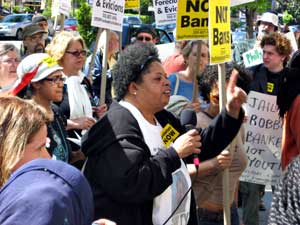
Sandra Hines of Detroit (center), thrown out of her childhood home a week before Christmas due to foreclosure, speaks outside Policy Conference of Mortgage Bankers Association in Washington, D.C., on April 16. Several hundred people got up to the door of the hotel where the bankers were meeting, then picketed for two hours, chanting “Mortgage bankers lie and cheat, people get thrown out on the street!”
The Ad Hoc National Network to Stop Foreclosures & Evictions brought people, many facing foreclosure, from as far away as Boston, Raleigh and Miami. Sharon Black, a Baltimore organizer who chaired the rally, pointed out that the billionaire bankers were in D.C. to lobby for more tax breaks and concessions from Congress. The network has also organized more than 100,000 messages to representatives demanding a moratorium on foreclosures.
Sign Online Petition to House and Senate Banking and Finance Committees demanding a MORATORIUM ON FORECLOSURES AND EVICTIONS NOW!
Sandra Hines of Detroit (center), thrown out of her childhood home a week before Christmas due to foreclosure, speaks outside Policy Conference of Mortgage Bankers Association in Washington, D.C., on April 16. Several hundred people got up to the door of the hotel where the bankers were meeting, then picketed for two hours, chanting “Mortgage bankers lie and cheat, people get thrown out on the street!”
The Ad Hoc National Network to Stop Foreclosures & Evictions brought people, many facing foreclosure, from as far away as Boston, Raleigh and Miami. Sharon Black, a Baltimore organizer who chaired the rally, pointed out that the billionaire bankers were in D.C. to lobby for more tax breaks and concessions from Congress. The network has also organized more than 100,000 messages to representatives demanding a moratorium on foreclosures.
Sign Online Petition to House and Senate Banking and Finance Committees demanding a MORATORIUM ON FORECLOSURES AND EVICTIONS NOW!
The Real Stakeholder's Meeting - Debt, Dinner & a Movie
April 22 The Real Stakeholder's Meeting 12:30 P.M. - 2:00 P.M. at Levine Museum of the New South, 200 E. 7th St, Charlotte, NC. (Free Parking at the 7th St Tower). Listen to testimonies from families hit hardest by the big banks' worst practices and take steps to make sure the big banks treat our communities fairly.
April 22 Debt, Dinner & a Movie 8:00 P.M. Levine Museum of the New South, 200 E. 7th St, Charlotte, NC. (Free Parking at the 7th St Tower). Come to the "Red Carpet Premiere" of the top videos submitted in a national video contest by students from around the country in an effort to warn youth about the dangers of debt.
Charlotte is a center for American banking. But North Carolina families are suffering from banks' bad practices.
Our community is getting together to talk about how the nation's biggest banks like Bank of America and Countrywide are impacting our families and our communities. Join consumers and national advocacy organizations on April 22nd and April 23rd to act together and hold the banks accountable.
Download Flyers to pass out, click here.
For more info on these events contact Estefania San Juan, SEIU (Service Employees International Union) at 704.877.9466, bigbadbanks@gmail.com or see www.bigbadbanks.org.
April 22 Debt, Dinner & a Movie 8:00 P.M. Levine Museum of the New South, 200 E. 7th St, Charlotte, NC. (Free Parking at the 7th St Tower). Come to the "Red Carpet Premiere" of the top videos submitted in a national video contest by students from around the country in an effort to warn youth about the dangers of debt.
Charlotte is a center for American banking. But North Carolina families are suffering from banks' bad practices.
Our community is getting together to talk about how the nation's biggest banks like Bank of America and Countrywide are impacting our families and our communities. Join consumers and national advocacy organizations on April 22nd and April 23rd to act together and hold the banks accountable.
Download Flyers to pass out, click here.
For more info on these events contact Estefania San Juan, SEIU (Service Employees International Union) at 704.877.9466, bigbadbanks@gmail.com or see www.bigbadbanks.org.
May 1 Forum: Save Your Home From Foreclosure
May 1, 2008 at 6:30pm
Little Rock AME Zion Church
7th St & N. McDowell St, Charlotte, NC
Do You Know Someone Who Is facing foreclosure?
Want to Know What Our Political Leaders Can do about this crisis?
Join the Fight to help save Our Communities
Save Your Home From Foreclosure
Come to the Foreclosure Forum. Hosted by Rev. Dr. Dwayne A. Walker
Participants Include:
Working Families Win, ACORN, North Carolina Justice Center , Legal Services of Southern Piedmont, Crisis Assistance Ministries, Little Rock AME Zion Church and Candidates for North Carolina General Assembly.
This Forum is brought to you by WFW.
For Directions or More Information Call Ruth or Beverly at (704) 900-2539 or ruth@wfwin.org.
Little Rock AME Zion Church
7th St & N. McDowell St, Charlotte, NC
Do You Know Someone Who Is facing foreclosure?
Want to Know What Our Political Leaders Can do about this crisis?
Join the Fight to help save Our Communities
Save Your Home From Foreclosure
Come to the Foreclosure Forum. Hosted by Rev. Dr. Dwayne A. Walker
Participants Include:
Working Families Win, ACORN, North Carolina Justice Center , Legal Services of Southern Piedmont, Crisis Assistance Ministries, Little Rock AME Zion Church and Candidates for North Carolina General Assembly.
This Forum is brought to you by WFW.
For Directions or More Information Call Ruth or Beverly at (704) 900-2539 or ruth@wfwin.org.
1 in 33 Homeowners Projected to Be in Foreclosure Within the Next Two Years
Pew Charitable Trusts, earthtimes.org, April 16, 2008
New Report Highlights Actions States Are Taking To Help Mitigate The Mortgage Crisis And Urges Federal Legislation To Take State Efforts Into Account
WASHINGTON, April 16 /PRNewswire-USNewswire/ -- One in 33 homeowners is projected to be in foreclosure primarily over the next two years, as a result of subprime loans made in 2005 and 2006, according to a new report released today by The Pew Charitable Trusts. In some states, the outlook is especially grim; for instance, nearly one in 11 homeowners in Nevada is projected to be in foreclosure and one in 18 Arizona homeowners may face the same circumstance over the next two years.
Homeowners being foreclosed upon may not be the only homeowners affected, according to data cited in the report. An additional 40 million neighboring homeowners may see their property values and their municipalities' tax bases drop by as much as $356 billion, largely over the next two years.
Defaulting on the Dream: States Respond to America's Foreclosure Crisis is the first-ever, comprehensive look at what all 50 states and the District of Columbia are doing to try to address the subprime mortgage fallout. The report finds that more often than not, states are at the forefront of developing policies and programs aimed at preventing more irresponsible loans from being made and improving residents' ability to stay in their homes. The report highlights states that are making headway to strengthen loan underwriting standards and help borrowers avoid foreclosure -- and underscores that any federal legislation must complement the work being done in the states, not compromise it.
The report is a joint effort between the Pew Center on the States and Pew's Health and Human Services Program.
"Stronger standards from federal policy makers could have helped avert this crisis," said Shelley A. Hearne, Managing Director of Pew's Health and Human Services Program. "Future legislation must consider ways to strengthen standards to prevent more troubling loans from being made. Let's make certain federal laws build upon, rather than preempt, the strong and smart state efforts already underway and ensure that states retain flexibility to respond to local circumstances."
States are using a wide range of measures to try to prevent problematic loans from being made in the first place. In North Carolina, lawmakers have passed some of the nation's most aggressive consumer protection laws that help assure that borrowers receive loans that meet their circumstances through strong underwriting standards, such as requiring lenders to assess a borrower's ability to repay, not just at a loan's teaser rate, but also when that introductory rate adjusts. Colorado, Maine, Massachusetts, Minnesota and Ohio have followed North Carolina's lead. Ten states, including Maine, Minnesota and North Carolina, ban most prepayment penalties, which are included in about 70 percent of all subprime loans. At least a dozen states have anti-predatory lending laws that regulate high-cost loans. And nine states, including Arkansas and South Carolina, require mortgage brokers to consider or represent the interests of the borrower when recommending mortgages.
Some states, including several that have been hit hardest by the crisis, also are taking steps to try to help current homeowners avoid foreclosure. Ohio, Michigan and Pennsylvania are among at least nine states with publicly funded refinance programs. Ohio, which accounts for 6 percent of the nation's estimated foreclosures -- loans in the foreclosure process or 90 days past due -- launched a statewide campaign, including a 24-hour hotline, which encourages at-risk borrowers to seek counseling. Earlier this month, the state reached agreement with nine mortgage servicers on a significant effort to modify the terms of adjustable-rate, subprime mortgages.
Although they have not been as severely affected to date, states such as Maryland and Massachusetts are taking similar steps. Maryland recently passed sweeping reforms that extend the foreclosure process from 15 to 150 days and seek to prevent deceptive foreclosure rescue scams. Massachusetts soon will provide borrowers in default on their mortgage payments 90 days to work with their servicers to try to avoid foreclosure. It also recently made $2 million in grants available for foreclosure education, prevention and counseling initiatives.
Finally, 14 states have created statewide foreclosure task forces to bring government, lenders, consumer advocates and experts together to address the crisis.
"State lawmakers who have shown they understand the high stakes involved in the nation's foreclosure crisis -- including the impact on state and local economies -- deserve a lot of credit," said Susan K. Urahn, Managing Director of the Pew Center on the States. "We hope some of the promising practices highlighted in this report can inform federal efforts and inspire others to take action."
Some states with severe problems have lagged behind. California, where one in 20 homeowners is projected to experience foreclosure, primarily over the next two years, issued a notice to loan servicers encouraging them to agree to wholesale loan adjustments, but as of the end of 2007, had provided little additional help to financially distressed homeowners. California has a task force and is exploring other relief, however, and has proposed expanding the types of loans regulated and strengthening the state's underwriting standards for high-cost mortgages to prevent future challenges. Arizona, Florida and Utah, three of six states with the highest projected foreclosures per homeowner in the country, have also not been quick to respond to their states' growing crises.
Pew's research analyzes two principal data sets: the Mortgage Bankers Association (MBA) 4th Quarter National Delinquency Survey and the Center for Responsible Lending's (CRL) foreclosure projections and Subprime Spillover data. (CRL is a partner in Pew's Family Financial Security portfolio, which seeks to advance common-sense solutions to help Americans save for tomorrow and manage debt today.) Both data sets are widely cited and used to understand the nature and magnitude of the nation's foreclosure challenges. Researchers also conducted extensive interviews and used other data sources to identify state action to address the mounting foreclosure challenges facing the country.
Visit http://www.pewtrusts.org/ or http://www.pewcenteronthestates.org/ to download a copy of the complete report and 50 state-specific fact sheets assessing how each state is being affected by and responding to the foreclosure crisis.
The Pew Charitable Trusts (http://www.pewtrusts.org/) is driven by the power of knowledge to solve today's most challenging problems. Pew applies a rigorous, analytical approach to improve public policy, inform the public and stimulate civic life. We partner with a diverse range of donors, public and private organizations and concerned citizens who share our commitment to fact-based solutions and goal-driven investments to improve society.
Pew's Center on the States (http://www.pewcenteronthestates.org/) identifies and advances effective policy approaches to critical issues facing states.
New Report Highlights Actions States Are Taking To Help Mitigate The Mortgage Crisis And Urges Federal Legislation To Take State Efforts Into Account
WASHINGTON, April 16 /PRNewswire-USNewswire/ -- One in 33 homeowners is projected to be in foreclosure primarily over the next two years, as a result of subprime loans made in 2005 and 2006, according to a new report released today by The Pew Charitable Trusts. In some states, the outlook is especially grim; for instance, nearly one in 11 homeowners in Nevada is projected to be in foreclosure and one in 18 Arizona homeowners may face the same circumstance over the next two years.
Homeowners being foreclosed upon may not be the only homeowners affected, according to data cited in the report. An additional 40 million neighboring homeowners may see their property values and their municipalities' tax bases drop by as much as $356 billion, largely over the next two years.
Defaulting on the Dream: States Respond to America's Foreclosure Crisis is the first-ever, comprehensive look at what all 50 states and the District of Columbia are doing to try to address the subprime mortgage fallout. The report finds that more often than not, states are at the forefront of developing policies and programs aimed at preventing more irresponsible loans from being made and improving residents' ability to stay in their homes. The report highlights states that are making headway to strengthen loan underwriting standards and help borrowers avoid foreclosure -- and underscores that any federal legislation must complement the work being done in the states, not compromise it.
The report is a joint effort between the Pew Center on the States and Pew's Health and Human Services Program.
"Stronger standards from federal policy makers could have helped avert this crisis," said Shelley A. Hearne, Managing Director of Pew's Health and Human Services Program. "Future legislation must consider ways to strengthen standards to prevent more troubling loans from being made. Let's make certain federal laws build upon, rather than preempt, the strong and smart state efforts already underway and ensure that states retain flexibility to respond to local circumstances."
States are using a wide range of measures to try to prevent problematic loans from being made in the first place. In North Carolina, lawmakers have passed some of the nation's most aggressive consumer protection laws that help assure that borrowers receive loans that meet their circumstances through strong underwriting standards, such as requiring lenders to assess a borrower's ability to repay, not just at a loan's teaser rate, but also when that introductory rate adjusts. Colorado, Maine, Massachusetts, Minnesota and Ohio have followed North Carolina's lead. Ten states, including Maine, Minnesota and North Carolina, ban most prepayment penalties, which are included in about 70 percent of all subprime loans. At least a dozen states have anti-predatory lending laws that regulate high-cost loans. And nine states, including Arkansas and South Carolina, require mortgage brokers to consider or represent the interests of the borrower when recommending mortgages.
Some states, including several that have been hit hardest by the crisis, also are taking steps to try to help current homeowners avoid foreclosure. Ohio, Michigan and Pennsylvania are among at least nine states with publicly funded refinance programs. Ohio, which accounts for 6 percent of the nation's estimated foreclosures -- loans in the foreclosure process or 90 days past due -- launched a statewide campaign, including a 24-hour hotline, which encourages at-risk borrowers to seek counseling. Earlier this month, the state reached agreement with nine mortgage servicers on a significant effort to modify the terms of adjustable-rate, subprime mortgages.
Although they have not been as severely affected to date, states such as Maryland and Massachusetts are taking similar steps. Maryland recently passed sweeping reforms that extend the foreclosure process from 15 to 150 days and seek to prevent deceptive foreclosure rescue scams. Massachusetts soon will provide borrowers in default on their mortgage payments 90 days to work with their servicers to try to avoid foreclosure. It also recently made $2 million in grants available for foreclosure education, prevention and counseling initiatives.
Finally, 14 states have created statewide foreclosure task forces to bring government, lenders, consumer advocates and experts together to address the crisis.
"State lawmakers who have shown they understand the high stakes involved in the nation's foreclosure crisis -- including the impact on state and local economies -- deserve a lot of credit," said Susan K. Urahn, Managing Director of the Pew Center on the States. "We hope some of the promising practices highlighted in this report can inform federal efforts and inspire others to take action."
Some states with severe problems have lagged behind. California, where one in 20 homeowners is projected to experience foreclosure, primarily over the next two years, issued a notice to loan servicers encouraging them to agree to wholesale loan adjustments, but as of the end of 2007, had provided little additional help to financially distressed homeowners. California has a task force and is exploring other relief, however, and has proposed expanding the types of loans regulated and strengthening the state's underwriting standards for high-cost mortgages to prevent future challenges. Arizona, Florida and Utah, three of six states with the highest projected foreclosures per homeowner in the country, have also not been quick to respond to their states' growing crises.
Pew's research analyzes two principal data sets: the Mortgage Bankers Association (MBA) 4th Quarter National Delinquency Survey and the Center for Responsible Lending's (CRL) foreclosure projections and Subprime Spillover data. (CRL is a partner in Pew's Family Financial Security portfolio, which seeks to advance common-sense solutions to help Americans save for tomorrow and manage debt today.) Both data sets are widely cited and used to understand the nature and magnitude of the nation's foreclosure challenges. Researchers also conducted extensive interviews and used other data sources to identify state action to address the mounting foreclosure challenges facing the country.
Visit http://www.pewtrusts.org/ or http://www.pewcenteronthestates.org/ to download a copy of the complete report and 50 state-specific fact sheets assessing how each state is being affected by and responding to the foreclosure crisis.
The Pew Charitable Trusts (http://www.pewtrusts.org/) is driven by the power of knowledge to solve today's most challenging problems. Pew applies a rigorous, analytical approach to improve public policy, inform the public and stimulate civic life. We partner with a diverse range of donors, public and private organizations and concerned citizens who share our commitment to fact-based solutions and goal-driven investments to improve society.
Pew's Center on the States (http://www.pewcenteronthestates.org/) identifies and advances effective policy approaches to critical issues facing states.
Forum: Save Your Home from Foreclosure!
Saturday, April 26, 2008 from 10:00 am to 3:00 pm.
Foreclosure Fair! On the campus of NC State
Witherspoon Student Center
3810 Cates Ave., Raleigh, NC
Free & open to the public.
ACORN Housing will also be available to provide free advice to first time home buyers or for those facing foreclosures.
And don’t miss our 12:00 pm Education Session on “How to Prevent Foreclosures”.
- Get personal help from non-profit housing counselors
- Learn about refinance opportunities & first-time homebuyer programs
- Meet with your lender about loan restructuring
Raleigh ACORN is proud to help save the homes of hard working families here in North Carolina.
If you know anyone who needs help keeping their home, please urge them to come to this free fair.
Together we can save homes!
To pre-register call (919) 833-6194.
More info: Raleigh Acorn, Phone: 919.833.6194
E-mail: acornraleigh@gmail.com
Foreclosure Fair! On the campus of NC State
Witherspoon Student Center
3810 Cates Ave., Raleigh, NC
Free & open to the public.
ACORN Housing will also be available to provide free advice to first time home buyers or for those facing foreclosures.
And don’t miss our 12:00 pm Education Session on “How to Prevent Foreclosures”.
- Get personal help from non-profit housing counselors
- Learn about refinance opportunities & first-time homebuyer programs
- Meet with your lender about loan restructuring
Raleigh ACORN is proud to help save the homes of hard working families here in North Carolina.
If you know anyone who needs help keeping their home, please urge them to come to this free fair.
Together we can save homes!
To pre-register call (919) 833-6194.
More info: Raleigh Acorn, Phone: 919.833.6194
E-mail: acornraleigh@gmail.com
U.S. seeks enhanced financial authority for Fed
John Poirier and Glenn Somerville, Reuters, March 28, 2008
WASHINGTON (Reuters) - The U.S. Treasury Department will propose on Monday that the Federal Reserve be given sweeping new powers that would make it chief regulator with authority to take actions to ensure market stability.
An executive summary of the proposals published by the New York Times, which Treasury Secretary Henry Paulson will make public on Monday when he unveils a blueprint for regulatory overhaul, says it is vital to fix "regulatory gaps and redundancies" exposed by an ongoing subprime mortgage crisis.
Lax regulation has been widely blamed for permitting a flood of inadequately documented loans to be made during the boom years of a U.S. housing market that has since soured and now threatens to drag the economy into a deep recession.
The proposals say a "market stability regulator" is needed and the Fed best fits that role, suggesting the central bank could use its control over interest rates as well as its ability to provide market liquidity to fulfill its functions.
It proposes that the Fed be given broad authority to require information from all participants in financial markets and a right to collaborate with other regulators in writing the rules that companies and institutions must follow.
NEW FED POWERS
If the Fed finds that the actions of some market participants pose risks for the overall financial system or the economy, "the Federal Reserve should have authority to require corrective action to address current risks or to constrain future risk-taking," the summary said.
Among other recommendations, Treasury suggests merging the Securities and Exchange Commission, the U.S. markets watchdog, with the Commodity Futures Trading Commission that oversees the activities of the futures market.
It also recommends getting rid of a Depression-era charter for thrifts that was intended to make it easier to obtain mortgage loans, saying it is no longer necessary. That would mean closing up the Office of Thrift Supervision and transferring its duties to the Office of the Comptroller of the Currency that oversees national banks.
Treasury officials refused on Friday to reveal details of the proposals but numerous trade groups had been invited to a speech by Paulson on Monday at Treasury and speculation quickly swelled that its long-awaited prescription for streamlining regulation was at hand.
Treasury said it has been working on its proposals since March last year, well before calls for an overhaul began to intensify in the wake of the subprime mortgage crisis that began to wreak havoc last summer on financial markets.
Paulson had signaled some of the direction the proposals would take earlier this week when he said that since the Fed had taken the exceptional step of permitting investment banks access to its discount window for loans -- the first time it has done so for any financial entities besides commercial banks since the 1930s -- it should have some authority over the investment banks.
ACCESS BRINGS RULES
"Certainly any regular access to the discount window should involve the same type of regulation and supervision," he said in a speech to the U.S. Chamber of Commerce.
Another proposal would provide an option for insurance companies to obtain a charter to do business under federal regulation, though it says the current state-based system would continue for any that did not get a federal charter.
Most of the financial services industry in the United States is regulated by federal authorities except insurance, which the states supervise. For years, big insurance companies, however, have been calling for an optional federal charter.
The chairman of the House Financial Services Committee, Democratic Rep. Barney Frank, last week said Congress should seriously consider giving a federal agency the power to monitor all risk in the financial system and act when necessary, regardless of its corporate form.
Frank suggested one possibility would be to empower the fed as "Financial Services Risk Regulator," an idea that Treasury's proposals appear to broadly embrace.
Many analysts and some Treasury officials have said they don't expect recommendations made during the current administration to become law but hope it will be used a springboard for the next resident of the White House.
(Reporting by John Poirier and Glenn Somerville; Editing by Louise Heavens)
WASHINGTON (Reuters) - The U.S. Treasury Department will propose on Monday that the Federal Reserve be given sweeping new powers that would make it chief regulator with authority to take actions to ensure market stability.
An executive summary of the proposals published by the New York Times, which Treasury Secretary Henry Paulson will make public on Monday when he unveils a blueprint for regulatory overhaul, says it is vital to fix "regulatory gaps and redundancies" exposed by an ongoing subprime mortgage crisis.
Lax regulation has been widely blamed for permitting a flood of inadequately documented loans to be made during the boom years of a U.S. housing market that has since soured and now threatens to drag the economy into a deep recession.
The proposals say a "market stability regulator" is needed and the Fed best fits that role, suggesting the central bank could use its control over interest rates as well as its ability to provide market liquidity to fulfill its functions.
It proposes that the Fed be given broad authority to require information from all participants in financial markets and a right to collaborate with other regulators in writing the rules that companies and institutions must follow.
NEW FED POWERS
If the Fed finds that the actions of some market participants pose risks for the overall financial system or the economy, "the Federal Reserve should have authority to require corrective action to address current risks or to constrain future risk-taking," the summary said.
Among other recommendations, Treasury suggests merging the Securities and Exchange Commission, the U.S. markets watchdog, with the Commodity Futures Trading Commission that oversees the activities of the futures market.
It also recommends getting rid of a Depression-era charter for thrifts that was intended to make it easier to obtain mortgage loans, saying it is no longer necessary. That would mean closing up the Office of Thrift Supervision and transferring its duties to the Office of the Comptroller of the Currency that oversees national banks.
Treasury officials refused on Friday to reveal details of the proposals but numerous trade groups had been invited to a speech by Paulson on Monday at Treasury and speculation quickly swelled that its long-awaited prescription for streamlining regulation was at hand.
Treasury said it has been working on its proposals since March last year, well before calls for an overhaul began to intensify in the wake of the subprime mortgage crisis that began to wreak havoc last summer on financial markets.
Paulson had signaled some of the direction the proposals would take earlier this week when he said that since the Fed had taken the exceptional step of permitting investment banks access to its discount window for loans -- the first time it has done so for any financial entities besides commercial banks since the 1930s -- it should have some authority over the investment banks.
ACCESS BRINGS RULES
"Certainly any regular access to the discount window should involve the same type of regulation and supervision," he said in a speech to the U.S. Chamber of Commerce.
Another proposal would provide an option for insurance companies to obtain a charter to do business under federal regulation, though it says the current state-based system would continue for any that did not get a federal charter.
Most of the financial services industry in the United States is regulated by federal authorities except insurance, which the states supervise. For years, big insurance companies, however, have been calling for an optional federal charter.
The chairman of the House Financial Services Committee, Democratic Rep. Barney Frank, last week said Congress should seriously consider giving a federal agency the power to monitor all risk in the financial system and act when necessary, regardless of its corporate form.
Frank suggested one possibility would be to empower the fed as "Financial Services Risk Regulator," an idea that Treasury's proposals appear to broadly embrace.
Many analysts and some Treasury officials have said they don't expect recommendations made during the current administration to become law but hope it will be used a springboard for the next resident of the White House.
(Reporting by John Poirier and Glenn Somerville; Editing by Louise Heavens)
Protesters enter Bear Stearns building in New York
Karen Brettell, Reuters, March 26, 2008
NEW YORK (Reuters) - About 60 protesters opposed to the U.S. Federal Reserve's help in bailing out Bear Stearns (BSC.N) entered the lobby of the investment bank's Manhattan headquarters on Wednesday, demanding assistance for struggling homeowners.
Demonstrators organized by the Neighborhood Assistance Corporation of America chanted "Help Main Street, not Wall Street" and entered the lobby without an invitation for around half an hour before being escorted out by police.
"There are no provisions for homeowners in this deal. There are people out there struggling who need help," said Detria Austin, an organizer at NACA, an advocacy group for home ownership.
Bear Stearns employees were amused and perplexed, some taking pictures. One man in the lobby applauded.
"Homeowners, that's more than $1 trillion (in mortgage debt), you're crazy," another man in a suit screamed at a protester on the street.
The protesters blamed Bear Stearns and JPMorgan Chase & CoCo (JPM.N) employees for helping fuel the mortgage crisis.
Demand for mortgage debt from investment banks including Bear Stearns encouraged lenders to drop standards to create new loans. Some lenders resorted to scams and fraud to initiate loans.
The banks repackaged and resold the debt to investors.
"Blame the mortgage tsunami on Bear Stearns," read one sign. Another read, "Bear Stearns employees aren't worth $2."
After leaving Bear Stearns, the crowd moved to JPMorgan.
"We will go to their neighborhood, we will educate their children on what their parents do. They should be ashamed," NACA founder Bruce Marks said of employees at both banks.
On March 16, JPMorgan Chase & said it would acquire its rival the Bear Stearns Co Inc. for $2 per share, in a deal brokered by the Federal Reserve aimed at heading off a bankruptcy and a spreading crisis of confidence in the global financial system.
On Monday, JPMorgan raised its offer to about $10 a share to appease angry stockholders who vowed to fight the original deal. Bear Stearns traded at $11.25 a share at 3:30 p.m. on Wednesday, up 2.8 percent.
As part of the deal, the Fed agreed to guarantee up to $29 billion of Bear Stearns assets.
The agreement has raised concerns that the U.S. government is prepared to help rescue a failing Wall Street bank while declining to bail out millions of home owners facing the possibility of foreclosure.
(Editing by Daniel Trotta and Cynthia Osterman)
NEW YORK (Reuters) - About 60 protesters opposed to the U.S. Federal Reserve's help in bailing out Bear Stearns (BSC.N) entered the lobby of the investment bank's Manhattan headquarters on Wednesday, demanding assistance for struggling homeowners.
Demonstrators organized by the Neighborhood Assistance Corporation of America chanted "Help Main Street, not Wall Street" and entered the lobby without an invitation for around half an hour before being escorted out by police.
"There are no provisions for homeowners in this deal. There are people out there struggling who need help," said Detria Austin, an organizer at NACA, an advocacy group for home ownership.
Bear Stearns employees were amused and perplexed, some taking pictures. One man in the lobby applauded.
"Homeowners, that's more than $1 trillion (in mortgage debt), you're crazy," another man in a suit screamed at a protester on the street.
The protesters blamed Bear Stearns and JPMorgan Chase & CoCo (JPM.N) employees for helping fuel the mortgage crisis.
Demand for mortgage debt from investment banks including Bear Stearns encouraged lenders to drop standards to create new loans. Some lenders resorted to scams and fraud to initiate loans.
The banks repackaged and resold the debt to investors.
"Blame the mortgage tsunami on Bear Stearns," read one sign. Another read, "Bear Stearns employees aren't worth $2."
After leaving Bear Stearns, the crowd moved to JPMorgan.
"We will go to their neighborhood, we will educate their children on what their parents do. They should be ashamed," NACA founder Bruce Marks said of employees at both banks.
On March 16, JPMorgan Chase & said it would acquire its rival the Bear Stearns Co Inc. for $2 per share, in a deal brokered by the Federal Reserve aimed at heading off a bankruptcy and a spreading crisis of confidence in the global financial system.
On Monday, JPMorgan raised its offer to about $10 a share to appease angry stockholders who vowed to fight the original deal. Bear Stearns traded at $11.25 a share at 3:30 p.m. on Wednesday, up 2.8 percent.
As part of the deal, the Fed agreed to guarantee up to $29 billion of Bear Stearns assets.
The agreement has raised concerns that the U.S. government is prepared to help rescue a failing Wall Street bank while declining to bail out millions of home owners facing the possibility of foreclosure.
(Editing by Daniel Trotta and Cynthia Osterman)
Subscribe to:
Posts (Atom)