Pages

Showing posts with label crimes. Show all posts

Top Honduran military lawyer: We broke the law

BY FRANCES ROBLES, MiamiHerald.com, July 3, 2009

TEGUCIGALPA -- The military officers who rushed deposed Honduran President Manuel Zelaya out of the country Sunday committed a crime but will be exonerated for saving the country from mob violence, the army's top lawyer said.

In an interview with The Miami Herald and El Salvador's elfaro.net, army attorney Col. Herberth Bayardo Inestroza acknowledged that top military brass made the call to forcibly remove Zelaya -- and they circumvented laws when they did it.

It was the first time any participant in Sunday's overthrow admitted committing an offense and the first time a Honduran authority revealed who made the decision that has been denounced worldwide.

''We know there was a crime there,'' said Inestroza, the top legal advisor for the Honduran armed forces. ``In the moment that we took him out of the country, in the way that he was taken out, there is a crime. Because of the circumstances of the moment this crime occurred, there is going to be a justification and cause for acquittal that will protect us.''

Zelaya was ousted in a predawn raid at his house Sunday after he vowed to defy a court order that ruled a nonbinding referendum to be held that day illegal. The leftist wealthy rancher had clashed with the attorney general, the Supreme Court, Congress and the military he commanded.

But instead of being taken to court to stand trial for abuse of power and treason, the military swept him out of bed at gunpoint and forced him into exile.

Inestroza described weeks of mounting pressure, in which a president who was viewed as allied with Venezuela's Hugo Chávez used soldiers as ''political tools.'' The attorney general's office had ordered Zelaya's arrest, and the Supreme Court, Inestroza said, ordered the armed forces to carry it out.

So when the powers of state united in demanding his ouster, the military put a pajama-clad Zelaya on a plane and sent him to Costa Rica. The rationale: Had Zelaya been jailed, throngs of loyal followers would have erupted into chaos and demanded his release with violence.

''What was more beneficial, remove this gentleman from Honduras or present him to prosecutors and have a mob assault and burn and destroy and for us to have to shoot?'' he said. ``If we had left him here, right now we would be burying a pile of people.''

This week, Deputy Attorney General Roy David Urtecho told reporters that he launched an investigation into why Zelaya was removed by force instead of taken to court. Article 24 of Honduras' penal code will exonerate the joint chiefs of staff who made the decision, because it allows for making tough decisions based on the good of the state, Inestroza said.

U.S. State Department lawyers are studying whether the action is legally considered a military coup, even though the person who was constitutionally next in line took power.

Inestroza acknowledged that after 34 years in the military, he and many other longtime soldiers found Zelaya's allegiance to Chávez difficult to stomach. Although he calls Zelaya a ''leftist of lies'' for his bourgeoisie upbringing, he admits he'd have a hard time taking orders from a leftist.

Memories of the 1980s fight against guerrilla insurgents are still fresh in Honduras.

''We fought the subversive movements here and we were the only country that did not have a fratricidal war like the others,'' he said. ``It would be difficult for us, with our training, to have a relationship with a leftist government. That's impossible. I personally would have retired, because my thinking, my principles, would not have allowed me to participate in that.''

And if Zelaya comes back, he'll have to retire anyway.

''I will resign and leave the country, and so would most of the military,'' Inestroza said. ``They would come after us and the other political leaders who were involved in this.''

Zelaya has said he will try to stage a brazen comeback on Sunday. The Organization of American States' secretary general, José Miguel Insulza, arrives in Tegucigalpa Friday to try to lay the groundwork for Zelaya's return. Insulza refuses to meet any member of the new administration led by the former head of Congress, Roberto Micheletti.

''I am 54 years years old,'' Inestroza said. ``I left my youth, my adolescence and part of my adulthood here -- an entire lifetime. You should understand it's very difficult for someone who has dedicated his whole life to a country and an institution to see, from one day to another, a person who is not normal come and want to change the way of life in the country without following the steps the law indicates.''

frobles@MiamiHerald.com

Bookmark and Share

CIA urges judge to keep detainee papers secret

By DEVLIN BARRETT, AP, June 9, 2009

WASHINGTON – CIA Director Leon Panetta told a federal judge Monday that releasing documents about the agency's terror interrogations would gravely damage national security.

Panetta sent a 24-page missive to New York federal judge Alvin Hellerstein, arguing that release of agency cables describing tough interrogation methods used on al-Qaida suspects would tell the enemy far too much about U.S. counterterrorism work.

The CIA director filed the papers in a lawsuit brought by the American Civil Liberties Union. The suit has already led to the unveiling of Bush administration legal memos authorizing harsh methods — among them waterboarding, a type of simulated drowning, and slamming suspects into walls — and a fight over releasing long-secret photos of abused detainees.

"I have determined that the disclosure of intelligence about al-Qaida reasonably could be expected to result in exceptionally grave damage to the national security by informing our enemies of what we knew about them, and when, and in some instances, how we obtained the intelligence," Panetta wrote.

Panetta acknowledges in the court papers that the CIA destroyed 92 videotapes of detainee interrogations that took place in 2002. Officials have previously said that a dozen of those tapes showed the so-called "enhanced interrogation techniques," which critics call torture. The destruction of the videotapes has spurred a criminal investigation into why they were destroyed.

The tapes — and the interrogations — are also an issue in the ACLU's lawsuit.

The CIA is fighting efforts to force release of the documents, including dozens of agency cables. The cables, Panetta said, describe in detail the methods used on terror suspects, the information gleaned from them and what U.S. officials still did not know at the time the suspects were being questioned.

The CIA last month denied a request by former Vice President Dick Cheney to declassify secret memos that detail whether valuable intelligence was gained from the use of the harsh interrogation techniques. Cheney said the documents show that the tactics prevented terrorist attacks and saved lives, contrary to the Obama administration's criticism of the Bush-era policies.

President Barack Obama also said last month he would try to block the court-ordered release of photos showing U.S. troops abusing prisoners, reversing his position out of concern the pictures would "further inflame anti-American opinion" and endanger U.S. forces in Iraq and Afghanistan.

Bookmark and Share

Warriors are taking up arms against abuse

WELLNESS: Storytelling techniques help bring old trauma into the light.
By LISA DEMER, Anchorage Daily News, May 31, 2009

In a small room in a converted apartment building in East Anchorage, it's story time.

Only, these tales aren't for kids.

The grown-ups in this grim circle survived childhoods filled with sexual abuse and violence and shame.

Silent for so long, here they unleash.

One by one, they tell near-strangers some of the worst things that ever happened to them. They talk about being molested, sodomized and beaten, their pleas ignored.

"The first story I remember being told was my mother didn't want me. But a little of my memories are gone. And it's because I was raised with pedophiles," a woman named Margo tells the group.

Some admit bad things they've done. Lost, drunk years. Children given or taken away. Cold, lonely marriages.

Regret.

The group is part of the Family Wellness Warriors Initiative.

It's a training program that targets the ongoing epidemic of abuse, neglect and violence within Alaska Native families. It teaches how to build healthy relationships through techniques rooted in storytelling.

The effort is designed for people in professions such as counseling and health care, but also for the wounded themselves, or anyone who wants to learn how to help. It's for non-Natives as well as Natives and the twist is that it welcomes abusers.

The problem is huge. Alaska in general has alarmingly high rates of child sexual abuse, domestic violence and suicide, and the numbers are even worse among Alaska Native people.

When these storytellers were children, abusers got away with it in isolated villages with little law enforcement and no system of support for damaged families. Normal boundaries were torn away over generations of historical trauma: diseases that wiped out whole generations; culture crushed by misguided missionaries, teachers and bureaucrats; villages where all the children were sent to faraway boarding schools; roles and responsibilities confused by alcohol.

"It all kind of festers into devaluing human beings. Devaluing children. Devaluing yourselves. Devaluing who we are. It easily winds up into we're just things instead of people," said Katherine Gottlieb, who started the program as Southcentral Foundation president and CEO. The foundation is the health-care arm of Cook Inlet Region Inc.

"The damage started years ago," said Rick McCafferty, a training specialist with the program who grew up in Kotzebue, where it seemed as though just about every child he knew was being abused sexually or physically.

It has to stop, says Gottlieb. That means inoculating an entire population against this destructive behavior.

'DON'T EVER SPEAK OF THIS'

In Lisa Dolchok's family, dark stories are spilling out.

She's 69 years old, a great-grandmother, a traditional healer -- and a victim of childhood sexual abuse.

All of those named in this story agreed to speak publicly to shed light on a problem they say has been hidden for too long. They say they want others to get the help they need. Some are identified only by first name.

Dolchok, her husband, a son and a daughter-in-law have become anchors in the elder-led movement to heal families.

For more than 50 years, she felt inferior, dirty and different but always blamed the wrong thing: tuberculosis suffered as a teen; being half Yup'ik, half Filipino; lacking a college degree.

"I was always wanting to be in the background behind somebody else. I didn't want to be up front. And I learned why," Dolchok said. "It's the end path of what happened as a child. At 5 years old you shouldn't be introduced to that world."

A world of tricks and bribes, of lies and threats. Daily betrayal. Almost no one confronted the pedophiles who found easy prey in Alaska villages and hubs.

Forty-one percent of child sexual abuse victims in Alaska are Native, according to the state Office of Children's Services. That's high considering that only about 23 percent of Alaska children and teens are Native. Every set of statistics seems grimmer than the last. One university study found that Alaska Natives in Anchorage were six times more likely to be raped than whites.

"It's almost like a way of life. What an awful thing to say. That's what I hear from women today. It seemed to be an accepted -- not accepted, that's the wrong word. It's just that --," Dolchok said, at a loss for words that made sense. Girls were told that's the way it was and if they thought different, there was nowhere to turn.

As a girl, Dolchok remembers being molested at different times by three different men -- none of them Native -- in villages where she grew up near Dillingham and in the hub itself. The men are all dead now.

She's been part of the warriors initiative almost from its beginnings 10 years ago. She's learned to tell her story to her clients, who come to her as a traditional healer. Nearly every one of her clients has been sexually abused and most of them never talked about it before, she said. She uses talk and prayer and healing touch, whatever they are comfortable with.

One of her abusers, she said, was a friend of her father who assured her that other children, whom he named, let him do it too. Later, he took out his pocketknife and sliced into his hand. If she ever told, he said, "I'll skin your father alive, and I'll tell you where to find him."

Only once, she tried to tell her mother. "She slapped me and said don't ever speak of this again."

Years later as an adult, Dolchok asked her mother why she didn't step in to protect her. "She said she was afraid that my dad would kill this man. I was the oldest of nine living brothers and sisters. There was no welfare and food stamps in those days."

The child kept quiet until the Catholic church arrived in her village. At 12, Dolchok confessed to a priest, who told her it wasn't her sin and made sure she was safe.

Later, a pastor at Mt. Edgecumbe boarding school in Sitka made lewd comments around her, then masturbated in front of her.

"So that's when I thought I really had a mark here that a bad man or a woman could see, that they had the right to do what they did to me," Dolchok said.

A SON'S TURMOIL

Dolchok married at 19. Her husband, Max, came from a childhood of trauma too. He said he was physically and sexually abused at the now-shuttered Wrangell Institute boarding school.

She and Max had four children. The damage done as a child snaked into her new life. Dolchok describes herself in those child-rearing days as overweight, insecure, jealous and seething with misplaced rage -- "a screaming mother." More than once, she flung dishes off the table, relishing the sound of smashing glass.

"In a sense," she said, "that is abuse, to put such fear into my own kids."

Perhaps the worst of it was that, despite all they knew and all they had been through, the Dolchoks couldn't protect some of those closest to them. One son, Max Dolchok, came forward as an adult to reveal that he too had been molested as a child, by older kids.

Dolchok found out at a Wellness Warriors conference in Fairbanks when he asked her if it was OK to speak up. Don't hold back, she told her son.

"I didn't know. I thought, because of my own abuse, I was watchful. ... We never think of baby-sitters or family members or friends would do that."

Yet that's usually who abusers are. It's not the creepy stranger in the park.

Last year at a small training conference in Anchorage, the younger Max told the group how the sexual abuse shaped him. He became a passive "nice guy," the go-to fellow at work, the son who always helps his parents. Now he's learning to assert himself more, he said.

When he finished talking, his father hugged him close.

"For me, before I came here, that was wallowing. My whole life was based on what happened to me as a kid," Max, now 46, said during a break.

The family members now talk from the heart as a result of Wellness Warriors, said his father, who is 71. He used to be really quiet, but now he's a leader, an advocate with the program and chair of the committee that oversees it.

Some in the family never found their way. Some of the victims turned into abusers, the younger Max said.

Another of the Dolchoks' four kids who was molested as a boy suffered from mental illness, alcoholism and addiction as an adult. Family members say he also preyed sexually on children. He died last year from heart disease.

The family says they're working on forgiveness.

The agenda for that day's training was packed: sexual identity, how to relate to others, recovery.

After a bit, Max excused himself to return to his job as an electrical company foreman. He said he'd be back at 6.

"What's at 6?" someone asked.

"Redemption," he said.

BEER BOTTLES ALL AROUND

In front of her employees, other Native leaders and people she's never met, Katherine Gottlieb shares her own disturbing stories.

On the outside, Gottlieb is a highly successful Alaskan, the head of Southcentral Foundation, a mother of six, a grandmother many times over, happily married, winner of a coveted MacArthur Foundation so-called "genius award" for her creativity.

On the inside, she's a victim of childhood sexual abuse and domestic violence.

She tells about a sister who lay down in the snow and froze to death at age 19. A brother who killed himself. An alcoholic mother.

"There were times when we'd be standing outside of a bar because one of our brothers or sisters needed milk and we'd be holding the baby, trying to encourage her to come out, because we didn't have milk in the house," Gottlieb told one conference crowd.

She would come home from kindergarten to find her mother passed out, beer bottles all around. The fourth-oldest of 12 children, she became the mother in the house. She tidied up, scrounged for food. She remembers making macaroni but there was no cheese so she'd try to make a sauce from ketchup and water.

With her mother out of it, her father working, other adults would come and go as they pleased, Gottlieb said.

And, she said, they would do to the children what they pleased. "They were like friends and relatives. It was people we knew. In the family."

When she was about 5, she tried to tell her mother that people were bothering her, touching her in ways she didn't like. Her mother, who died when Gottlieb was 12, called her wicked and slapped her. It was the way the mother often related to her children -- angry, yelling, violent. "She would throw things and throw us around."

Gottlieb grew up thinking she must be bad like her mother said. She thought about becoming a nun, something good and pure. But she couldn't connect with her spiritual side in that way.

She married at 16. She says her husband was abusive, but also that they were both young and troubled. She escaped that marriage and then, in the mid-1990s, her second marriage crumbled too.

"I felt like I didn't want to live anymore. Instead of choosing a way out that I think a lot of people do -- our highest rates of suicide are here in Alaska -- I went to counseling."

'SWIM THROUGH THE PAST'

Soon after she took the Southcentral Foundation's top job in 1991, Gottlieb started looking for a way to address child abuse and domestic violence. One thing led to another. She told her story of childhood abuse at a small church. A missionary from Kodiak, Linda Ross, heard it and began talking to her about hosting a conference.

Then, at a social services meeting, she heard an elder tell her own abuse story. Talking about it tore up the woman. Audience members were emotional too. Gottlieb realized she needed to reach large numbers of damaged souls, people whose problems were too big for a single conference to repair. A committee scoured the country for ideas.

Ross led her to a Michigan-based, Christian group called Open Hearts Ministry and Gottlieb's group then tailored the approach for Alaska Native people.

Family Wellness Warriors Initiative stages various trainings, including five-day conferences around the state. Clinicians are on standby to help anyone in emotional crisis. They use Bible stories and songs to illustrate points, though most sessions aren't steeped in religion.

It's mainly about story, how to use storytelling as a way to clear out the shame and anger and learn to relate to others.

"Swim through the past and come through the other side," Gottlieb says.

Visit the worst of it, but don't linger there, Tanya Dolchok, the younger Max's wife, told a group of leaders in training. "It's dangerous to stay in the darkness too long without coming up for air."

Group leaders create a safe place for people to dig down to the depths of pain, to be totally open and vulnerable, said Bobbi Donadio, program administrator. "Even though we bring people to that difficult point, we also know how to bring them back up to healing and redemption."

Gottlieb said she realized at one conference how she had hurt her children when they were young by yelling about the littlest things. They now are grown with children of their own. She is making amends with them one by one, talking out the past.

She looks differently now at anyone who is angry or in a funk.

"There is a story behind someone's eyes. Don't jump to conclusions," Gottlieb said.

HELEN AND ALFRED

The topic this morning: sexual identity, through the eyes of a long-married couple from Seldovia, Helen and Alfred Quijance.

Helen told a group in training about being abused as a young girl. She didn't want anyone to notice her after that.

Alfred said his mother told him she could do with him what she wished, then molested him repeatedly. His grandmother, who raised him in his early years, beat him, sometimes until he bled or lost consciousness. He felt like nothing. Once, he put the cold barrel of a gun into his mouth.

They've been married for nearly 40 years but much of that time didn't really talk. Alfred always seemed angry, Helen said. Alfred said he wanted Helen silent. "I thought she would leave me if she ever found her voice," he said. He saw her as his mother, his granny, the women who had hurt him.

If they talked, it was about what's for dinner.

"Our home was a tomb where we ate, drank coffee and watched TV," Alfred said.

They became truly close only after opening up about the damage from long ago.

"Before, there would be no talking," Helen said. "He would get louder and I would get quieter."

They now are leaders in the program. Both are on the steering committee that oversees it. Alfred also is on staff as a part-time advocate. He and Helen hope to start their own branch of Wounded Warriors in Seldovia. They call it Quiet Place Ministry.

WHY WARRIORS?

When Gottlieb first pitched the initiative to the Alaska Native Health Board as a way to combat child abuse and domestic violence, she said the men in the group weren't interested. So she crafted a new strategy and went back.

"I said, 'We are calling out the warriors, and we're calling out the men,' " Gottlieb recalled. " 'We need men out here that will stand in the front lines, that will protect their families, fight for us, even die for us, like you did in the old days.' "

She walked away with $350,000 in seed money.

The approach puts men and women into old-fashioned, traditional roles. Some criticize it as sexist.

"The men are doing the crime. They are doing the abuse. They are filling the prisons. The reason we are going after men is so we can help them turn it around, to use their strength to nurture, instead of their strength to harm," said Gene McConnell, training manager for the program.

He knows about transformation. He was sexually abused as a child and became a pornography and sex addict as an adult, which destroyed his marriage. He says he recovered and now can help others get past their childhood abuse and dysfunction.

The program has grown to 19 employees, an annual $1.1 million budget. And just this spring, they moved into a woodsy campus off Tudor Road.

More than 1,500 people have gone through the Wellness Warrior trainings. Nearly half are men. All sorts participate in this total-immersion, rapid-fire approach to healing: Russian Orthodox priests; inmates in the Palmer prison's faith-based unit; addicts at the Salvation Army's Clitheroe Center for substance abuse treatment.

That count doesn't include Southcentral Foundation employees who go through a shortened version.

Abusers are allowed, even encouraged, though not anyone who is still abusing others, Donadio said. If someone reveals recent sexual or physical abuse, program leaders will report it to authorities.

"I hope a lot of people who are harming show up to the conferences. I hope they are hearing," Gottlieb said. She wants them to know the damage. She wants it to stop.

One participant admitted at a conference that he had molested his little sister when he was a teenager. He was scared talking about it.

"I felt like I was a caged lion and very exposed. I was ready to fight anybody who said anything against me," Derek, who lives in the Glennallen area, said in an interview. But those who heard his story didn't lash out. Instead, they remarked that he seemed full of self-contempt, and needed help.

And gradually, he began to work through it. He says he's not looking for excuses but believes turmoil in his childhood may have made him desperate for control of someone weaker than he was.

At 44, he is married and has four young children, plus a good job with an auto repair shop. He's learning to talk things out with his wife.

"I used to fly off the handle with rage before this," he said.

There's evidence this approach is making a difference. Participants surveyed months after attending a conference indicated their families showed improvement in support for one another, the ability to deal with conflict, and the like. They now hope to study whether the approach can prevent child abuse.

And, the movement is spreading. Groups in the Interior and Kodiak have their own versions. Others are working on it.

"What I found was, you could help walk someone through some of the pain and the woundedness of their life and you didn't have to have a Ph.D.," said Linda Ross, the Kodiak missionary who helped bring it to Alaska.

What the experts say:

People with troubled childhoods often find it difficult to form normal bonds later on. The more mangled the childhood, the more likely the adult will become an abuser, according to Mark Erickson, a psychiatrist and medical director of behavioral health for Southcentral Foundation.

Alaska Natives have had more trauma and disruption than most cultures. Just look back 90 years to the influenza epidemic, he said. "Entire villages were wiped out and you had large numbers of people who were left as orphans," Erickson said. "That's a situation in which the early attachment experience is profoundly disrupted."

There's a measured health impact too, according to new research by the U.S. Centers for Disease Control and Prevention.

Studies suggest the more chaotic the childhood home, the greater the risk of cancer, diabetes, heart disease, suicide and other health problems later on, Erickson said. A child who was physically and sexually abused, in a home with domestic violence and alcohol abuse, has nearly double the chance of getting cancer as an adult as other people, some research shows.

LISA DEMER: ldemer@adn.com

Bookmark and Share

Action Center For Justice Condemns The Assassination Of Dr. George Tiller

Justice for Dr. George Tiller!
Shut down Operation Rescue / Operation Save America!


Kan. abortion doc killed in church; suspect held
By ROXANA HEGEMAN, AP, May 31, 2009

WICHITA, Kan. – Dr. George Tiller, one of the nation's few providers of late-term abortions despite decades of protests and attacks, was shot and killed Sunday in a church where he was serving as an usher.

The gunman fled, but a 51-year-old suspect was detained some 170 miles away in suburban Kansas City three hours after the shooting, Wichita Deputy Police Chief Tom Stolz said.

Although Stolz refused to release the man's name, Johnson County sheriff's spokesman Tom Erickson identified the detained man as Scott Roeder. He has not been charged in the slaying and was expected to be taken to Wichita for questioning.

Police did not release a motive for the shooting. But the doctor's violent death was the latest in a string of shootings and bombings over two decades directed against abortion clinics, doctors and staff.

Long a focus of national anti-abortion groups, including a summer-long protest in 1991, Tiller was shot in the foyer of Reformation Lutheran Church. Tiller's attorney, Dan Monnat, said Tiller's wife, Jeanne, was in the choir at the time.

The slaying of the 67-year-old doctor is "an unspeakable tragedy," his widow, four children and 10 grandchildren said in statement. "This is particularly heart-wrenching because George was shot down in his house of worship, a place of peace."

The family said its loss "is also a loss for the city of Wichita and women across America. George dedicated his life to providing women with high-quality health care despite frequent threats and violence."

Stolz said all indications were that the gunman acted alone, although authorities were investigating whether he had any connection to anti-abortion groups.

Tiller's Women's Health Care Services clinic is one of just three in the nation where abortions are performed after the 21st week of pregnancy. The clinic was heavily fortified and Tiller often traveled with a bodyguard, but Stolz said there was no indication of security at the church Sunday.

Anti-abortion groups denounced the shooting and stressed that they support only nonviolent protest. The movement's leaders fear the killing could create a backlash just as they are scrutinizing U.S. Supreme Court nominee Sonia Sotomayor, whose views on abortion rights are not publicly known.

"We are shocked at this morning's disturbing news that Mr. Tiller was gunned down," Troy Newman, Operation Rescue's president, said in a statement. "Operation Rescue has worked for years through peaceful, legal means, and through the proper channels to see him brought to justice. We denounce vigilantism and the cowardly act that took place this morning."

President Barack Obama said he was "shocked and outraged" by the murder. "However profound our differences as Americans over difficult issues such as abortion, they cannot be resolved by heinous acts of violence," he said.

At Tiller's church, Adam Watkins, 20, said he was sitting in the middle of the congregation when he heard a small pop at the start of the service.

"We just thought a child had come in with a balloon and it had popped, had gone up and hit the ceiling and popped," Watkins said.

Another usher came in and told the congregation to remain seated, then escorted Tiller's wife out. "When she got to the back doors, we heard her scream, and so we knew something bad had happened," Watkins said.

He said the service continued even after an associate pastor announced that Tiller had been injured. "We were just really shocked," he said. "We were kind of dumbfounded. We couldn't really believe it had happened."

Tiller had in the past endured threats and violence. A protester shot Tiller in both arms in 1993, and his clinic was bombed in 1985. More recently, Monnat said Tiller had asked federal prosecutors to step up investigations of vandalism and other threats against the clinic out of fear that the incidents were increasing and that Tiller's safety was in jeopardy. Stolz, however, said police knew of no threats connected to the shooting.

In early May, Tiller had asked the FBI to investigate vandalism at his clinic, including cut wires to surveillance cameras and damage to the roof that sent rainwater pouring into the building.

In 1991, the Summer of Mercy protests organized by Operation Rescue drew thousands of anti-abortion activists to this city for demonstrations marked by civil disobedience and mass arrests.

Tiller began providing abortion services in 1973. He acknowledged abortion was as socially divisive as slavery or prohibition but said the issue was about giving women a choice when dealing with technology that can diagnose severe fetal abnormalities before a baby is born.

Nancy Keenan, president of abortion-rights group NARAL Pro-Choice America, issued a statement praising Tiller's commitment.

"Dr. Tiller's murder will send a chill down the spines of the brave and courageous providers and other professionals who are part of reproductive-health centers that serve women across this country. We want them to know that they have our support as they move forward in providing these essential services in the aftermath of the shocking news from Wichita," Keenan said.

The last killing of an abortion doctor was in October 1998 when Dr. Barnett Slepian was fatally shot in his home in a suburb of Buffalo, N.Y. A militant abortion opponent was convicted of the murder.

Tiller's clinic is fortified with bulletproof glass, and Tiller hired a private security team to protect the facility. Once outside the clinic, Tiller was routinely accompanied by a bodyguard.

At a recent trial, he told jurors that he and his family have suffered years of harassment and threats and that he knew he was a target of anti-abortion protesters.

Federal marshals protected Tiller during the 1991 Summer of Mercy protests, and he was protected again between 1994 and 1998 after another abortion provider was assassinated and federal authorities reported finding Tiller's name on an assassination list.

Tiller remained prominent in the news, in part because of an investigation begun by former Kansas Attorney General Phill Kline, an abortion opponent.

Prosecutors had alleged that Tiller had gotten second opinions from a doctor who was essentially an employee of his, not independent as state law requires. A jury in March acquitted Tiller of all 19 misdemeanor counts.

"I am stunned by this lawless and violent act, which must be condemned and should be met with the full force of law," Kline said in a statement. "We join in lifting prayer that God's grace and presence rest with Dr. Tiller's family and friends."

Bookmark and Share

U.S. holds journalist without charges in Iraq

Reuters cameraman Ibrahim Jassam has been held since September. The U.S. military rejected a court order to release him, saying he is a 'high security threat.' No evidence has been presented.
By Liz Sly, Los Angeles Times, May 24, 2009

Reporting from Baghdad -- The soldiers came at 1:30 a.m, rousing family members who were sleeping on the roof to escape the late-summer heat.

They broke down the front door. Accompanied by dogs, American and Iraqi troops burst into the Jassam family home in the town of Mahmoudiya south of Baghdad.

"Where is the journalist Ibrahim?" one of the Iraqi soldiers barked at the grandparents, children and grandchildren as they staggered blearily down the stairs.

Ibrahim Jassam, a cameraman and photographer for the Reuters news agency, stepped forward, one of this brothers recalled. "Take me if you want me, but please leave my brothers." The soldiers rifled through the house, confiscating his computer hard drive and cameras. And then they led him away, handcuffed and blindfolded.

That was Sept. 2.

Jassam, 31, has been in U.S. custody ever since. His case is the latest of a dozen detentions the New York-based Committee to Protect Journalists has documented since 2001.

No formal accusations have been made against Jassam, and an Iraqi court ordered in November that he be released for lack of evidence. But the U.S. military continues to hold him, saying it has intelligence that he is "a high security threat," said Maj. Neal Fisher, spokesman for detainee affairs.

The Obama administration harshly criticized Iran for its imprisonment of Roxana Saberi, the U.S.-Iranian journalist who was convicted of espionage and sentenced to eight years in prison before being freed two weeks ago. Secretary of State Hillary Rodham Clinton criticized Iran's treatment of Saberi as "non-transparent, unpredictable and arbitrary."

Washington also has called upon North Korea to expedite the trial of two U.S. journalists being held on spying charges.

Yet the U.S. has routinely used the arbitrary powers it assumed after the Sept. 11, 2001, terrorism attacks to hold journalists without charge in Iraq, as well as Afghanistan and Pakistan, the Committee to Protect Journalists said.

None of the detained journalists has been convicted of any charge, undermining the United States' reputation when it comes to criticizing other countries on issues of press freedom, committee executive director Joel Simon said.

"The U.S. has a record of holding journalists for long periods of time without due process and without explanation," he said. "Its standing would be improved if it addressed this issue."

Reuters has expressed disappointment over Jassam's detention and has said there is no evidence against him.

Sami Haj, a cameraman for the TV network Al Jazeera, was detained by Pakistani authorities as he tried to cross into Afghanistan in 2001 to cover the offensive against the Taliban. He was turned over to the U.S. military, which held him for six years at the detention facility in Guantanamo Bay, Cuba. He was accused him of being a courier for militant Islamic organizations, but was never charged. He was released a year ago.

In Iraq, Associated Press photographer Bilal Hussein was held for two years without trial before being released in April 2008 on the orders of an Iraqi judge under the terms of an amnesty law. The U.S. military maintained that Hussein had links to insurgents, but the AP said the allegations were based on nothing more than the Pulitzer Prize-winning photographs of insurgents that he had taken on the streets of Ramadi, in western Iraq.

Jassam is the only Iraqi journalist still in U.S. custody, the last to be detained under wartime rules that predated a U.S.-Iraqi security agreement signed in December. Under the new accord, U.S. forces must obtain a warrant before they can arrest an Iraqi citizen.

Jassam was detained without a warrant "as the result of his activity with a known insurgent organization," Fisher said.

No evidence against Jassam was presented at his court hearing in November, Fisher said, because the military intelligence against him had not yet been verified.

Under the wartime rules in place at the time, he said, "there was no requirement to link the military intelligence with rule of law type of evidentiary procedures."

After the court ordered Jassam's release, Fisher said, new evidence came to light that suggested he was a "high security threat."

The CPJ's Simon said it was possible for someone to use the cover of journalism to conduct other activities.

"No one is suggesting that journalists should have a get- out-of-jail-free card," he said. "But if you accuse someone of something there needs to be a fair legal process. That's what we said in the Roxana Saberi case, and that's what we say in the Ibrahim Jassam case."

Jassam will have to wait for the requirements of the security pact to play out before he gets another day in court or his freedom. The agreement states that the U.S. is to release low-threat detainees in a "safe and orderly" way and refer "high threat" cases to the Iraqi Justice Ministry for review.

The decision to release him or transfer him to the Iraqi legal system will be made by the Iraqi government. The only timetable for that step is "by the end of the year," Fisher said. By that time, Jassam will have been in custody for more than a year.

Jassam's brother, Walid, visited him recently in Camp Bucca, the desolate, tented U.S. prison camp in the desert in southern Iraq, and found him close to the breaking point.

"He used to be handsome, but now he's pale and he's tired," said Walid, who says his brother had no ties to insurgents. "Every now and then while we were talking, he would start crying. He was begging me: 'Please do something to get me out of here. I don't know what is the charge against me.'

"I told him we already tried everything."

liz.sly@latimes.com

Times Staff Writer Saif Hameed contributed to this report.


Bookmark and Share

Jeremy Scahill: “Little Known Military Thug Squad Still Brutalizing Prisoners at Gitmo Under Obama”


Jeremy Scahill reports the Obama administration is continuing to use a notorious military police unit at Guantanamo that regularly brutalizes unarmed prisoners, including gang-beating them, breaking their bones, gouging their eyes and dousing them with chemicals. This force, officially known as the Immediate Reaction Force, has been labeled the “Extreme Repression Force” by Guantanamo prisoners, and human rights lawyers call their actions illegal.

Bookmark and Share

U.S. imperialism backs slaughter in Sri Lanka

By Sara Flounders, Workers World, May 6, 2009

The government of Sri Lanka, with U.S. arms and military aid from Israel and Pakistan, is waging a brutal war against the Tamil people of Sri Lanka.

The Tamil population there is a nationally oppressed minority. They have waged a long, strong struggle for self-determination in Sri Lanka, a large island country of 20 million people located southeast of India.

The Sri Lankan government’s present campaign is justified as an effort to destroy, with a so-called “final offensive,” the Liberation Tigers of Tamil Eelam (LTTE). Yet the Sri Lankan army has opened a new attack against the entire civilian population.

The government has moved tens of thousands of Tamil into strategic hamlets and concentration camps. Hundreds of thousands of Tamil civilians have been displaced. Recent military operations include mass arrests of civilians fleeing battle areas, torture and targeted assassinations. Many prohibited weapons designed to create terror among civilians, including napalm, white phosphorus and cluster bombs, are provided to the Sri Lankan military by U.S. military aid.

The Boston Globe reports: “The United Nations estimates that some 6,500 civilians have died and 14,000 have been injured in the government’s merciless offensive against the Tamil Tigers in the northeast of the country. ... 100,000 refugees need medical care, food, and shelter, and another 50,000 are under shelling in a five-square-mile war zone.” (April 25)

Sri Lanka’s military declared on May 1 that their troops had cornered Tamil Tiger rebels, who have been fighting for an independent homeland since 1983, in a five-kilometer-long strip of territory in the northeast and were poised for their final assault. The LTTE has said that they will return to guerilla warfare tactics if they are forced out of the area they have held in the north of Sri Lanka.

On May 2 the Sri Lankan Army fired artillery shells on the only remaining makeshift hospital at Mu’l’li-vaaykkaal, in a government-declared ‘safety zone’ in the Mullaittivu district of the northern war zone. The attack killed at least 64 patients and attendees, including a volunteer doctor, and wounded 87. The online news service TamilNet, the Associated Press and Reuters all reported on this civilian massacre.

Sri Lankan President Mahinda Rajapaksa, who is also commander-in-chief of the country’s armed forces, and Defense Minister Gotabahaya Rajapaksa, his brother, have banned international aid groups, human rights monitors and independent journalists from the entire region. Defense Minister Rajapaksa has dual U.S. and Sri Lankan citizenship. He has often compared the Sri Lankan war against the LTTE to the U.S. “war on terror” against Islamic militants.

Imperialist policies of divide & rule


The problems of Sri Lanka today are rooted in the racist divide-and-rule policies established under British colonial rule of the island, then known as Ceylon. Along with the indigenous Tamil population, the British brought in more than a million Tamils as indentured slaves to work the tea plantations on the island in the late 18th and 19th century. Singhalese chauvinism was encouraged.

When British imperialism was defeated in the whole South Asian subcontinent in 1948, the British handed the government in Sri Lanka to the dominant Sinhalese nationality. The Sinhalese continued the policy of imposing their language as the only official language and limiting access to health care, schools, universities, civil service and all forms of political participation for the impoverished Tamil community.

Repeated attempts by moderate Tamils to effect change were met by fierce government repression. Communal violence by chauvinist Sinhalese, backed by the Sri Lankan government, killed thousands of Tamils in racist pogroms in 1956, 1958, 1977 and 1983. Tamil homes and small businesses were burnt in many villages. These systematic and government-sanctioned attacks led Tamil youths to take up armed struggle as the only means to defend their people.

Just as the U.S. government demonizes national liberation movements in Palestine, Lebanon, the Philippines, Nepal and Colombia as terrorist, the LTTE is on the U.S. list of “terrorist” organizations. But the real terror is the tactics used against nationally oppressed people to suppress justified resistance.

The Tamil diaspora in the U.S., Canada and Europe has condemned the atrocities by the Sri Lankan army against civilians and organized many demonstrations and protests calling for an immediate halt to the brutal offensive being waged by the Sri Lankan army against the Tamil people.

A statement by professor Jose Maria Sison, chairperson of the International League of Peoples’ Struggle, “condemns the criminal use of chemical weapons, nerve gas, cluster bombs and other types of bombs and artillery fire by the Sri Lankan army against the Tamil people. Under the auspices of the U.S., the Sri Lankan regime gets open political support from India and its military acquires its war materiel from Pakistan, a notorious military proxy of the U.S. in the region. The blatant use of banned weapons constitutes a war crime under the Geneva conventions.”

As with many other struggles for self determination and sovereignty, this struggle of the oppressed Tamil nationality deserves international support. It is essential that progressive organizations raise their voices in solidarity with the Tamil struggle and against the brutal U.S.-financed repression in Sri Lanka today.
Articles copyright 1995-2009 Workers World. Verbatim copying and distribution of this entire article is permitted in any medium without royalty provided this notice is preserved.

Workers World, 55 W. 17 St., NY, NY 10011
Email: ww@workers.org
Subscribe wwnews-subscribe@workersworld.net
Support independent news http://www.workers.org/orders/donate.php
http://workers.org

Bookmark and Share

Chrysler to eliminate 789 dealerships across the country

Chrysler targets 800 dealers in reorganization
By TOM KRISHER and KIMBERLY S. JOHNSON, AP, May 14, 2009

DETROIT – In tiny Millerstown, Pa., the owner of the only car dealership in town found out Thursday he was on Chrysler's hit list — one of 789 across the nation that the troubled automaker wants to eliminate.

"It's really, really a blow," Jeff Potter, whose family owns the dealership, said after hearing the news from a customer who spotted the closing list on the Internet. "When you talk about being here 34 years, it's my life."

Chrysler disclosed in a bankruptcy filing Thursday that it wants to close a quarter of its dealers in a matter of weeks, a strategy that might help save the company but would wipe out thousands of jobs.

With General Motors Corp. expected to announce it will close about 1,100 dealerships, the crisis in the auto industry is reaching the front doors of Americans who live far from Detroit.

Millerstown Chrysler will try to survive by selling used cars. Otherwise, the town of 700 will lose one of its largest employers and a major source of tax revenue. And in other communities that depend on dealers for everything from newspaper advertising to Little League sponsorships, the ripple effect could be devastating. Dealerships on the closing list are in every state but Alaska.

The National Automobile Dealers Association says about 40,000 people work at the affected dealerships. Many will keep their jobs, but their dealerships will be left to sell only the other brands in their showrooms, or used cars.

Chrysler said in its filing that sales are too low at many of the dealerships. Half its dealers account for 90 percent of its sales, and the company is trying to cut poor performers that compete for the same customers.

Dealers learned their fates in letters Thursday morning. The effects will go much further than their bottom lines.

Bart Wolf, the general sales manager at Wolf's Motor Car Co. in Plymouth, Wis., estimated he donated an average of $10,000 per year for local high school and middle school events, supporting band trips and athletic activities.

"The way things are going now, that could be cut down to under $2,000," he said. "It's hard to say no to anyone, but this could make things tough."

Local media will feel the pinch, too. The average car dealer spent $341,000 on advertising last year, said Paul Taylor, NADA's chief economist. About a quarter went to newspapers, which are already in a struggle for survival.

The average dealer spends $16.5 million per year in the community, including sales, payroll taxes and charitable contributions, Taylor said. On top of that, laid-off workers will spend less, and towns will suffer from lost tax revenue.

Braintree, Mass., will lose the $24,000 it collects every year from South Shore Chrysler.

"We hate to see businesses close up shop," said Christine Stickney, the town's director of planning and community development. "Anytime that we see a business close like this, there is a trickle-down effect. Those 25 employees may have had lunch in town, bought gas."

NADA's chairman, John McEleney, himself an Iowa auto dealer, said the group understands that dealers have to be consolidated. "We just think the process needs to be slowed down."

Chrysler Vice Chairman Jim Press called the cuts difficult but necessary. He said the list of dealers is final.

"This is a difficult day for us and not a day anybody can be prepared for," Press told reporters during a conference call.

A hearing is scheduled for June 3 for the bankruptcy judge to determine whether to approve Chrysler's motion. Chrysler said it wants to shed the dealerships by June 9.

Chrysler executives said the company is trying to preserve its best-performing dealers. More than half the dealerships being eliminated sell fewer than 100 vehicles per year.

The company is also trying to reduce the number of single-brand dealerships to bring all three Chrysler brands — Jeep, Chrysler and Dodge — under one roof.

The 3.5 million customers who bought cars and trucks from the affected dealers will be notified about the closures, and their warranties will still be honored, said Vice President Steven Landry.

Both Chrysler and GM have dealership networks that were built when they had a much larger share of the U.S. market. As both lost market share to Japanese and other overseas brands, GM and Chrysler ended up with too many dealers. Many are barely getting by and can't afford to upgrade their facilities or hire the best personnel.

Still, some dealers say the firings make no sense because they will ultimately cost the company sales. Some have hired lawyers to fight the decision.

Millerstown, on the east bank of the Juniata River west of Harrisburg, would be devastated if the Potter family had to close up shop, said Billy Roush, the longtime borough council president.

The borough, which provides fire, ambulance and other services to the area, had an annual operating budget of $158,805 last year, a big chunk of it from the Potter dealership.

"In our town," Roush said, "we have very little employment."
___

Associated Press Writers Dan Strumpf in New York, Jacob Adelman in Los Angeles, Deborah Yao in Philadelphia, Rodrique Ngowi in Boston, Ken Thomas in Washington, D.C., and Dinesh Ramde in Milwaukee contributed to this report.


Bookmark and Share

PCJF files Freedom of Information Act Demand About Imprisonment, Interrogation, and Sudden Death of Bush's 'Smoking Gun' Witness

Detainee's statements derived under torture by the Bush administration were used to sell the Iraq invasion to U.S. Senate and United Nations

The Partnership for Civil Justice Fund (PCJF) filed a Freedom of Information Act request (FOIA) yesterday with the CIA, Department of Defense, Department of State and other agencies to reveal information in their possession about the imprisonment, torture, false testimony on Iraq and the circumstances of the recent death of a prisoner whose story may have led inevitably to the prosecution of top officials in the Bush Administration.

Under conditions of extreme torture, the prisoner, Ibn al-Sheikh al-Libi, agreed in 2002 to supply the Bush-ordered interrogators what they sought as a political cover for Bush’s marketing of the pending war of aggression against Iraq. Mr. Libi agreed to tell them whatever they wanted in exchange for an end to the torture. The now famous Torture Memos providing legal cover for the torture were written at the same time starting in the summer of 2002.

Libi’s tortured and knowingly fabricated testimony was the source of information used by Bush to sell the war to the U.S. Senate, and the source for Colin Powell’s bogus and lying presentation to the United Nations in 2003.

Once the torture came to an end Mr. Libi recanted his forced testimony. It is highly likely that the Bush Administration feared that his story would become public. That may well explain why Mr. Libi seemed to disappear and was conspicuously absent when other prisoners were shipped in 2006 from secret detention centers to Guantanamo. He seemed to disappear until human rights investigators found him in a Libyan prison a few weeks ago.

His belated discovery by an international fact-finding team, coming at the same time of the release of the explosive Torture Memos, undoubtedly heightened the fear and apprehension among Bush officials who fear possible prosecutions in Spain, other European countries and here in the United States.

Some believe that Libi’s testimony about his own story at the hands of torturers would be the smoking gun that would reveal that the torture regime was not for “national security” but for the personal political aims of Bush and Cheney.

Libi was found dead, allegedly a suicide. Through years of torture and imprisonment he did not commit suicide.

We have demanded answers. The public has a right to know. The Freedom of Information Act request filed by the Partnership for Civil Justice Fund demands:

All records and documents including but not limited to emails, letters, cables or other communications, memoranda, notes, minutes, photographs, audio recordings, video recordings, digital recordings, flight manifests, intelligence assessments, or other data that relate to or reference Ibn al-Sheikh al-Libi aka Ibn Shaykh al-Libi aka Ali Mohammed al-Fakheri aka Ibn A-Sheikh A-Libi including as an unnamed detainee who was a source for information alleging that Iraq had provided training in chemical or biological weapons to al-Qaeda operatives, or recanting said allegation.

As a matter of clarification but not limitation, your response should include all information related to Libi's capture, detention, custody, including by any other entity; transfers of custody; interrogation; suggested questions for interrogation; requests for information from White House personnel or other Bush Administration personnel or any other government agency or personnel; proposed and/or employed methods of interrogation; information derived from questioning of Libi; assessments of that information; communications providing that information to U.S. government agencies or administration personnel; vetting and preparation of information derived from Libi including for presentation to the U.S. Senate and/or for use in Secretary of State Powell's speech to the United Nations in February 2003; determinations and deliberations as to whether or not to transfer Libi to Guantanamo or any other location including secret detention sites, Egypt, and Libya; information as to the death of Libi.


To read the entire FOIA click here

Please Donate Today

Please help us continue this work by making a donation today. It is the generous support of donors like you that helps make this critical work possible.

Please click this link to donate today
.

Bookmark and Share

Police caught on tape trying to recruit Plane Stupid protester as spy

Climate change activist taped men who offered cash for information about group's members and activities
Paul Lewis, guardian.co.uk, April 24, 2009

Listen to the tapes and read the transcripts

Undercover police are running a network of hundreds of informants inside protest organisations who secretly feed them intelligence in return for cash, according to evidence handed to the Guardian.

They claim to have infiltrated a number of environmental groups and said they are receiving information about leaders, tactics and plans of future demonstrations.

The dramatic disclosures are revealed in almost three hours of secretly recorded discussions between covert officers claiming to be from Strathclyde police, and an activist from the protest group Plane Stupid, whom the officers attempted to recruit as a paid spy after she had been released on bail following a demonstration at Aberdeen airport last month.

Matilda Gifford, 24, said she recorded the meetings in an attempt to expose how police seek to disrupt the legitimate activities of climate change activists. She met the officers twice; they said they were a detective constable and his assistant. During the taped discussions, the officers:

• Indicate that she could receive tens of thousands of pounds to pay off her student loans in return for information about individuals within Plane Stupid.

• Say they will not pay money direct into her bank account because that would leave an audit trail that would leave her compromised. They said the money would be tax-free, and added: "UK plc can afford more than 20 quid."

• Accept that she is a legitimate protester, but warn her that her activity could mean she will struggle to find employment in the future and result in a criminal record.

• Claim they have hundreds of informants feeding them information from protest organisations and "big groupings" from across the political spectrum.

• Explain that spying could assist her if she was arrested. "People would sell their soul to the devil," an officer said.

• Warn her that she could be jailed alongside "hard, evil" people if she received a custodial sentence.

The meetings took place in a Glasgow police station last month and in a supermarket cafe on Tuesday. Gifford used a mobile phone and device sewn into her waistcoat to record what they described as a "business proposal" that she should think of as a job.

They intimated that in return for updates on Plane Stupid's plans she could receive large sums of money in cash.

When lawyers acting for Plane Stupid contacted Strathclyde police this week to establish the identities of the detective constable, they were initially told by the human resources department there was no record of his name.

But when the Guardian contacted the force, they acknowledged officers had had meetings with Plane Stupid activists.

In a statement last night, assistant chief constable George Hamilton said the force had "a responsibility to gather intelligence", and such operations were conducted according to the Regulation of Investigatory Powers Act (RIPA). The force would not comment on the identity of the officers.

"Officers from Strathclyde police have been in contact with a number of protesters who were involved with the Plane Stupid protests including Aberdeen airport," he said. "The purpose of this contact has been to ensure that any future protest activity is carried out within the law and in a manner which respects the rights of all concerned."

Gifford's lawyer, Patrick Campbell, said: "I have very considerable concerns about these events. There appears to be a covert operation that is running in some way with, or using, Strathclyde police's name. There appears to be a concerted effort to turn protesters to informants and possibly infiltrate peaceful protest movements.

He added: "The methods employed are disturbing, and more worrying yet is the lack of any clearly identifiable body responsible for this. These individuals seem to have some kind of police support or at the very least connections with the police – the access to police stations confirms that – but my concern is the lack of accountability and the threat to the individual and her right to protest."

Gifford intended to meet the officers for a third time on Thursday, taking a lawyer with her. But the officers did not appear at the rendezvous. However, she said she was later approached by the detective constable, who said he was disappointed in her. The man got into a car, leaving Gifford feeling shaken and intimidated.

She said last night that the initial approach from the officers was "an opportunity that fell out of the sky". She added: "Recording them seemed like the obvious thing to do. I was keen to find out what they had to offer, what they wanted to find out, and feed that back to the group in case other members of Plane Stupid were approached."

In a statement, Plane Stupid said: "Our civil liberties were invaded and our right to peaceful protest called into question simply to defend the interests of big business."

Listen to the tapes and read the transcripts

Bookmark and Share

Colombia Commits "Crimes Against Humanity" As Free Trade Pacts Are Debated

Dan Kovalik, The Huffington Post, May 13, 2009

Despite the claims of the Colombian government and those in the U.S., Canada and the EU eager to consummate "free trade" pacts with that regime, the human rights situation in that country is deteriorating fast. Indeed, by key measures -- the killing of unionists, extra-judicial killings by the military, and the forced displacement of civilians -- Colombia's human rights situation is amongst the worst in the world and getting worse. In the case of union killings, it remains the very worst.
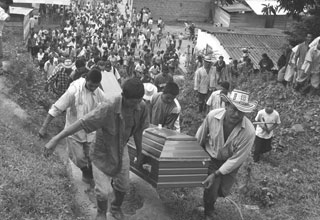
Funeral Procession After Military Massacre of Civilians in San Jose de Apartado (photo from Semana Magazine)

Union Killings and The Hand of the State

So far this year, 17 unionists have been killed in Colombia -- allowing Colombia to maintain its long-running title as "most dangerous country in the world for trade unionists," and putting Colombia on a pace to exceed the figure of union leaders killed last year (49) and the year before (39) - figures which motivated Barack Obama to oppose the Colombia FTA in the first place.

Francisco Javier Ricaurte Gomez, the President of the Labor Section of the Colombian Supreme Court, recently mentioned to me in a meeting we recently held in Pittsburgh, that he sees in these killings "the dark hand of the state." And indeed, the U.S. State Department continues to detail the strong connections between the Colombian state and military and the outlawed paramilitary groups which are largely responsible for these killings, making one wonder if those in charge of negotiating these trade pacts are actually reading their own governments' human rights reports.

According to the most recent 2009 State Department Country Report on Colombia, sectors of Colombia's official armed forces "collaborated with or tolerated the activities of new illegal groups or paramilitary members who refused to demobilize. Such collaboration often facilitated unlawful killings and may have involved direct participation in paramilitary atrocities."

Colombia's Crimes Against Humanity -- Extra-Judicial Killings


The State Department also reported (in its typical understated fashion for countries the U.S. is aligned with) that "[p]olitical and unlawful killings remained an extremely serious problem, and there were periodic reports that members of the security forces committed extrajudicial killings during the internal armed conflict." In fact, according to the AP, around 1,600 civilians have been the victim of extra-judicial killings by the Colombian military itself since President Uribe took over as President in 2002 - a massive increase from Uribe's predecessor. Indeed, the UN High Commissioner for Human Rights recently declared that these extra-judicial killings by the military are on such a scale that they amount to a "crime against humanity."

And, as the State Department explained, many of these killings involved the phenomenon of "false positives" - that is, of "military officials paying illegal groups to forcibly recruit young men, transport them to another town, and turn them over to local brigades who then killed them and presented them as guerillas killed in combat."

The Colombian Military's Role In Forced Displacements


Of equal concern is the continued displacement of Colombians by the Colombian military's aggressive counterinsurgency program. As noted by Garry Leech in the Colombia Journal, the well-respected Colombian human rights group CODHES reported 380,000 more Colombians displaced last year - a 24% increase over the prior year, adding to the already swelling ranks of the 4 million internally displaced Colombians. As it stands, Colombia ranks second only to the Sudan in terms of the number of internally displaced persons.

And, as Leech points out, the Norwegian Refugee Council directly attributes this worsening situation to "[t]he government's military strategy which was intended to be preventive, [but] is instead resulting in an increased displacement of people." Morever, if the U.S. and the E.U. consummate FTAs with Colombia, the problem of displacement (already the second in the world only after the Sudan) will only intensify. This is because the agricultural provisions of the FTA would allow cheap, subsidized farm products from the U.S. and the E.U. to flood Colombian markets tariff-free, undermining the livelihood of small Colombian farmers (who make up 23% of the Colombian population), many of whom will lose their land as a result and join the ranks of the displaced.

We saw this with small farmers in Mexico, 1.3 million of whom were displaced by similar NAFTA provisions - a phenomenon which has led to Mexico's status as a "failed state." The New York Times, in its March 24, 2009 piece entitled, "Nafta's Promise, Unfulfilled," noted this phenomenon, explaining that "Local farmers were priced out of the market by food imported tariff-free. Many Mexican farmers simply abandoned their land and headed north. Although one-quarter of Mexicans live in the countryside, they account for 44 percent of the migrants to the United States."

In short, basic concern for human rights militates against entering into free trade accords with Colombia. In the end, however, the interests of business appear to be trumping human rights in the current discussions over the FTA's, and indeed, businesses themselves continue to fuel the dire human rights situation in Colombia.

U.S. Corporate Complicity For Union Killings

This fact was brought home again last week when it was revealed (at least in the Spanish-speaking press though not in English) that top paramilitary leader Salvatore Mancuso (now in U.S. custody on drug charges) has given testimony to the Colombian Attorney General's office about Alabama-based Drummond Coal Company's connection with the 2001 murders of 3 top unionists by the AUC paramilitaries. Thus, Gerardo Reyes of El Nuevo Herald revealed Mancuso's testimony which confirmed that Drummond, through an individual named "Mr. Jim," paid the AUC paramilitaries to carry out these killings.

Mancuso had previously testified that major companies in Colombia, including U.S. companies Chiquita, Dole and Del Monte had also made payments to the AUC paramilitary group - an illegal group designated as "terrorist" by the U.S. State Department. Sadly, Dole, Del Monte and Drummond have never been charged for their role in supporting this terrorist organization in Colombia. And Chiquita, which admitted to paying paramilitaries over $1.7 million - leading, according to Colombian Attorney General Mario Iguaran, to the killing of over 4,000 civilians -- Chiquita was given the lightest of punishments, being fined $25 million which it was allowed to pay over 5 years.

The continued impunity given these companies, combined with the failure to fully acknowledge the facts about Colombia's worsening human rights crisis, greatly undermines the moral authority of the governments rushing to make a trade deal with Colombia. Those interested in labor and human rights must hold these governments accountable by pressing them to refrain from entering into such deals.

Bookmark and Share

200 Organizations Ask Holder to Appoint a Special Prosecutor for Bush, Cheney, et alia

David Swanson, ProsecuteBushCheney.org, May 12, 2009

Two hundred organizations, including After Downing Street, Democrats.com, the Robert Jackson Steering Committee, the Center for Constitutional Rights, the National Lawyers Guild, the Society of American Law Teachers, Human Rights USA, the American Freedom Campaign, and the Bill of Rights Defense Committee, have signed a joint statement urging Attorney General Eric Holder to appoint a special prosecutor for former top officials of the Bush Administration.

The complete list of organizations can be found at http://specialprosecutor.us

The complete statement reads as follows:

We urge Attorney General Eric Holder to appoint a non-partisan independent Special Counsel to immediately commence a prosecutorial investigation into the most serious alleged crimes of former President George W. Bush, former Vice President Richard B. Cheney, the attorneys formerly employed by the Department of Justice whose memos sought to justify torture, and other former top officials of the Bush Administration.

Our laws, and treaties that under Article VI of our Constitution are the supreme law of the land, require the prosecution of crimes that strong evidence suggests these individuals have committed. Both the former president and the former vice president have confessed to authorizing a torture procedure that is illegal under our law and treaty obligations. The former president has confessed to violating the Foreign Intelligence Surveillance Act.

We see no need for these prosecutions to be extraordinarily lengthy or costly, and no need to wait for the recommendations of a panel or “truth” commission when substantial evidence of the crimes is already in the public domain. We believe the most effective investigation can be conducted by a prosecutor, and we believe such an investigation should begin immediately.

Bookmark and Share

Officer in fatal crash driving 90 mph

Answers sought amid indications blue lights, siren weren't in use
By Steve Harrison and Fred Clasen-Kelly, Charlotte.com, March 31, 2009

The Charlotte-Mecklenburg police officer involved in a wreck that killed a 20-year-old woman was driving his patrol car more than 90mph with the siren off, police Chief Rodney Monroe said Monday.

Multiple witnesses told investigators that the vehicle driven by Officer Martray Proctor also did not have its emergency blue lights on when it collided with a 1991 Ford Escort at a north Charlotte intersection Sunday night, Monroe said.

N.C. law and department rules dictate that officers obey posted speed limits unless their vehicle's blue lights and siren are activated. The speed limit along Old Statesville Road, where the crash occurred, is 45 mph.

Shatona Evette Robinson of Davidson died in the wreck, and her three passengers suffered serious injuries. Police said all the passengers had been released from the hospital by Monday afternoon.

Proctor, 24, remained hospitalized with a broken leg among other injuries, police said.

Robinson's cousin said grieving family members were angry and wanted answers.

Monroe called the death “an unfortunate and tragic incident.” He promised a thorough investigation. “It's not something we take lightly or will investigate lightly.”

Proctor was driving to assist another officer on a routine traffic stop at about 10:15 p.m. when his patrol car collided with the car Robinson was driving. The wreck occurred less than a quarter-mile from the traffic stop, Monroe said.

Asked whether he believed Proctor should have been driving more than 90 mph, Monroe said: “I can find no reason for that.”

“There were no signs of imminent trouble in that (traffic) stop,” he said.

Department policy states that officers responding to emergencies should drive at speeds that are “reasonable and prudent.” Rules require officers to take into account the “seriousness of the call” and their proximity to the emergency.

Monroe said police would continue to investigate the crash and turn over the results to the prosecutor's office, which will decide whether to pursue criminal charges. Officers, he said, will also conduct an internal probe to determine whether any department policies were violated.

Investigators have received conflicting statements about whether the patrol car driven by Proctor had its emergency blue lights on.

But an in-car camera that automatically records when blue lights come on never activated, police said. That means the emergency lights were off or the camera malfunctioned, police said.

The episode is reminiscent of two officer-involved wrecks in 2000.

City officials paid a $785,000 settlement to the family of 23-year-old Sara Gaffney, who died when a patrol car collided with the vehicle she was riding in. Former Charlotte Mecklenburg police Officer Scott Darby, who was speeding without using his emergency lights, pleaded guilty to misdemeanor death by vehicle and resigned.

Craig Gaffney said he heard about the most recent incident Monday and thought about how similar the circumstances were to the crash that killed his daughter.

“It seems CMPD has ignored, or most likely never learned, the lesson,” Gaffney said.

In December 2000, 33-year-old Geoffrey Darwin died after a police cruiser crashed with his van. Former Officer David Nifong, who was driving 30 miles over the speed limit and was not using his vehicle's flashing lights, resigned.

Since then, police say they have improved road safety. Charlotte-Mecklenburg officers were involved in 6.7 wrecks per million miles driven last year, compared with 11 crashes per million miles in 2001, said Sgt. David Thaw, supervisor of driver training.

Proctor, who makes $42,257 a year, joined the force in March 2007. Monroe said the department has not taken disciplinary action against him.

On Monday, Robinson's family members gathered to mourn at her home.

Her two cousins, who were riding in the car with her, recounted the crash. They were leaving the home of Shatona Robinson's mother, who lives on Henderson Circle in northern Charlotte, and heading back to Davidson.

They made a left turn onto Old Statesville – a divided four-lane thoroughfare – when the collision occurred.

The passengers said they did not hear a siren or see flashing lights.

“The car just had its headlights on,” said Wyatt Morrison, 18, who had a swollen lip, a bandage on his head and a cast on his arm. “I didn't know it was a police car.”

A trail of debris along the road suggests the crash pushed Shatona Robinson's Ford Escort about 50 yards to the south. Police said the Escort was taken to a CMPD evidence lot.

Morrison was sitting in the back seat, behind Shatona Robinson. His other cousin, Akeem Robinson, 19, was sitting in the back seat on the passenger side.

Akeem Robinson said the first thing he remembers is that Topaz White, a friend of Shatona Robinson, who was sitting in the front passenger seat, was under him.

“I was sitting on top of Topaz,” Akeem Robinson said. “She was under my leg.”

Robinson said he was holding Wyatt's bleeding head, and that he tried to see whether Shatona Robinson was OK.

“I was calling out her name,” Akeem Robinson said. “She wasn't saying nothing.”

Shatona Robinson worked at The Pines, a nearby nursing home, and was planning to take classes at an online technical college, her cousin Crystal Robinson said. She graduated from North Mecklenburg High.

“We were praying for each other,” Crystal Robinson said. “She was just getting started. Everyone (in this family) is so close. We can't believe she's gone and is not coming back.”

sharrison@charlotteobserver.com frkelly@charlotteobserver.com
http://www.charlotteobserver.com/141/story/633189.html

***************

Editorial: Don't let such a tragedy happen again
Police must be held accountable when they violate the law.
Charlotte.com, March 31, 2009

The investigation into the death of Shatona Robinson is not complete, but Police Chief Rodney Monroe on Monday made this much clear:

Charlotte-Mecklenburg police officer Martray Proctor was driving his cruiser in excess of 90 mph on Old Statesville Road Sunday night when he struck Robinson's car.

Proctor apparently did not have his blue lights or siren on.

He was not responding to an emergency. He was going to assist another officer in a routine traffic stop. Monroe said he has found no reason for Proctor to be driving 45 mph or more over the speed limit.

CMPD needs to conduct a thorough and unbiased investigation. It vows to do so. And District Attorney Peter Gilchrist needs to assess that investigation and charge Proctor with the appropriate crime if the investigation merits.

An even better approach would be for an outside, independent agency to conduct the investigation. As with police shootings, that would give the public more confidence that all facts are being considered and that there's no special treatment.

State law says an officer must have his blue lights and siren on if he is exceeding the speed limit. And CMPD policy says an officer can speed only in an emergency, such as when there is threat of serious injury to an officer or a citizen. Even then, he must drive “with due regard to the safety of others” and his speed must be “reasonable and prudent.”

Those are clear and adequate guidelines. CMPD provides its recruits 56 hours of driving training in academy. A few years ago, it added “scenario-based driving” to its training, better simulating real-life situations. It appears to have paid off: the force had 6.7 crashes per million miles driven in 2008, a drop of about 40 percent compared with 2001. CMPD says that number is lower than many comparable departments.

CMPD should use this tragedy to assess its training further and, perhaps most importantly, vocally and repeatedly remind officers of the need to drive cautiously. Officers are given a gun, the power to arrest and the right to break traffic laws when the circumstances warrant. They must be held to a higher standard when they use those privileges. And there must be clear consequences when they misuse them.

We applaud Monroe and CMPD for being forthright about the facts of this case and for recognizing the responsibility police have to society in using their authority properly. We also applaud his commitment to get the facts and act accordingly.

It shouldn't take a tragedy for CMPD leaders to make sure officers obey law and policy at all times. Monroe needs to send that message to his officers, loud and clear.

http://www.charlotteobserver.com/opinion/story/632595.html

Legal Update on Mumia Abu-Jamal

Date: February 8, 2009
From: Robert R. Bryan, lead counsel
Subject: Mumia Abu-Jamal, death row - U.S. Supreme Court

New case filing in Supreme Court On February 4, 2009, the U.S. Supreme Court docketed and accepted for filing the Petition for Writ of Certiorari, with supporting Appendix, that I had submitted December 19, 2008 on behalf of Mumia Abu-Jamal. (AbuJamal v. Beard, U.S. Sup. Ct. No. 08-8483.) [Go to www.millions4mumia.org to read the pdf of the petition.] The central issue in this case is racism in jury selection. The prosecution systematically removed people from sitting on the trial jury purely because of the color of their skin, that is, being black. The bigotry that killed Martin Luther King, Jr., so many years ago, has been rampant in the case of my client and is a central part of the state's quest to murder him in the name of the law.

Prosecution's separate Supreme Court petition In an entirely separate case (Beard v. Abu-Jamal, Sup. Ct. No. 08-652), the prosecution is seeking to overturn the victory we achieved last year in the U.S. Court of Appeals for the Third Circuit. ( Abu-Jamal v. Horn, 520 F.3d 272 (3rd Cir. 2008).) In that ruling the court ordered a new jury trial on the question of the death penalty. Our Brief In Opposition will be filed in the Supreme Court on February 13, 2009.

Donations for Mumia's Legal Defense The legal defense for Mumia needs help. The costs for our litigation in two case before the Supreme Court are substantial. To help, please make your checks payable to the “National Lawyers Guild Foundation” (indicate "Mumia" on the bottom left). The donations are tax deductible, and should be mailed to:

Committee To Save Mumia Abu-Jamal
P.O. Box 2012
your
New York, NY 10159-2012

Conclusion Mumia remains on Pennsylvania's death row. We are in an epic struggle in which his life hangs in the balance. What occurs now in the Supreme Court will determine whether Mumia will have a new jury trial, or die at the hands of the executioner.

As I have previously pointed out, Mumia is in greater danger than at any time since his 1981 arrest. Your support and activism is needed. This great journalist and author does not belong on death row or in prison. We must not rest until he is free.

Yours very truly,

Robert R. Bryan
Law Offices of Robert R. Bryan
2088 Union Street, Suite 4
San Francisco, California 94123-4117

Lead counsel for Mumia Abu-Jamal
[E-mail: RobertRBryan@aol.com]

Jan. 1 & 3: End Siege & Massacre in Gaza/Palestine

Join the ONLINE PETITION initiated by Ramsey Clark (http://www.iacenter.org/gazapetition)- sign on and send the message to President Bush, President Elect Obama, VP Cheney, VP Elect Biden, Secretary of State Rice, Secretary of State designate Clinton, Congressional leaders, the U.N. Secretary General, Security Council, and key member states, the Israeli President, Prime Minister and cabinet, and members of the world media appealing for Israel to Immediately Cease Its Murderous Bombing, Siege and Threatened Invasion of Palestinian Gaza

************************************
Jan.1, 2009
Vigil to End the Siege & Massacre in Gaza/Palestine
4:00pm
7th St & Pecan Ave, Charlotte, NC

Jan. 3, 2009
Mass Rally & March to End the Siege & Massacre in Gaza/Palestine
12 Noon
Marshall Park
Martin Luther King Jr Blvd & S. McDowell St, Charlotte, NC


Bring signs, banners, candles ( for Jan 1) and your friends, family, neighbors, & co-workers.

While the people of the U.S. suffer from the greatest economic crisis since "The Great Depression", billions of U.S. tax dollars are given to Israel to kill, maim & hurt people and cause irreparable suffering.

Worldwide actions protest Israeli massacre in Gaza
International Action Center (http://www.iacenter.org), Dec. 31, 2009

Dec. 31, 2008. The genocidal U.S.-backed Israeli bombardment of the Palestinian people of the Gaza Strip has had at least one unintended consequence. It has mobilized the anti-imperialist movement and other anti-war forces around the world.

The Washington-Tel Aviv axis might not yet see this as an obstacle to their war crimes. But it is a work in progress, coming as the workers' movements are beginning to get in motion to fight the consequences of the capitalist economic collapse. Even in vast parts of the world where the winter holidays often drain the strength of a social movement, people reacted quickly, angrily and in some places massively to oppose the new Israeli assault.

Groups all over the world made strikingly similar calls for action. There was complete solidarity with the Palestinians of Gaza, a besieged and occupied population that had every right to resist. Most saw the Israelis as the direct criminal, the local gendarme acting as an appendage of world imperialism, especially out of Washington but also out of Brussels.

The immediate demands were to stop the Israeli attacks, lift the blockade of Gaza and for the government involved to break relations with or stop aiding the Zionist state. In some mostly Arab countries—Egypt, for example—the protests also targeted the regime for collaborating with the U.S. and Israel.

People began to hit the streets and squares in protest the day of the first Israeli bombing, Dec. 27, and spread through the world in the next few days. There are still some important gaps in our reports. However, we will list time and place for those protests that we know of that are planned for Jan. 1 or later with enough detail that people can use this information to attend.


North Africa and Asia

Tens of thousands of Lebanese, many supporters of Hezbollah, protested in the southern suburb of Dahiyeh, Lebanon, on Dec. 29 in the pouring rain. In Damascus, Syria, people held Hamas and Hezbollah and Palestinian flags aloft at an anti-Israeli rally. Protesters burned Israeli and U.S. flags in many Arab cities and demanded their governments react to Israeli aggression.

More than 50,000 demonstrated in Egyptian cities on Dec. 28 according to the AFP news agency. The biggest protest was in the southern city of Asyut, led by the Islamist opposition. Some 15,000 also attended a pro-Palestinian demonstration in the Jordanian capital Amman, and there were rallies in many of Jordan's refugee camps that house thousands of displaced Palestinians.

There were demonstrations throughout the West Bank and in Haifa, Jaffa and other towns within the 1967 Israeli borders, and also a protest of 1,000 anti-war people in Tel Aviv. There were also anti-Israeli protests in Sudan and Yemen, where tens of thousands marched in Sanaa.

In Iraq, there were demonstrations in Baghdad, Mosul, Najaf and Kuffa. In Tehran, Iran, thousands of Iranians rallied Dec. 29. In India, there were demonstrations in Kolkata (Calcutta) and a number of other Indian cities. There was a protest of more than 1,000 people in Jakarta, Indonesia on Dec. 30, waving Palestinian and Indonesian flags, and in Tokyo, Japan that same day at the Israeli Embassy.

In South Africa a protest of the Gaza massacre is set for Jan. 2 at 2 p.m. at the U.S. Consulate in Killarney, in Johannesburg.

Latin America

In Argentina, a vigil of hundreds was held the Israeli Embassy in Buenos Aires after a march there on Dec. 29, called by different Argentine-Arab organizations to show solidarity with Palestine. In Puerto Rico, the Socialist Front held a mobilization in solidarity with the Palestinian people and to reject and condemn the crimes of the Israeli state, gathering at the Federal building in San Juan.

Starting at 10 in the morning on Dec. 29, some 200 people protested in front of the Israeli Embassy in Caracas, Venezuela in the second day of protests there. The Communist Party of Venezuela and other social organizations were present. On Dec. 30 people protested before the Israeli Embassy in Mexico City, D.F. There was also a protest in the Colón, Costa Rica on Dec. 30 at the Israeli Embassy.

In addition to these popular actions, statements from the governments of Cuba, Venezuela and Bolivia condemned the Israeli killing of Palestinians.


Europe

In Belgium, there have been local protest rallies in Ghent, Louvain, Brussels and Antwerp the days following the first attack, with a national protest rally on Dec. 31 at 2 pm at the Place de la Monnaie, and moving on to the Place des Martyrs. It is a joint effort of solidarity committees, NGOs, the Workers Party of Belgium and Arab organizations.

In Greece, where there have been youth protests against a police killing since early December, more than 3,000 demonstrators waving Palestinian flags and chanting anti-Israeli and anti-U.S. slogans marched on the Israeli Embassy in Athens. Greek left-wing parties and Arab groups participated. Another demonstration of 1,000 took place in Thessalonika.

In England, Scotland and Wales, as reported by the Stop the War Committee, there have been demonstrations Dec. 28 in London of 700 people at the Israeli Embassy where protesters scuffled with police. Some protesters were seen attempting to climb the gate towards the embassy and also throwing red liquid - to symbolize blood - towards the gate. Respect MP George Galloway and former Labor MP Tony Benn were among those who addressed the crowd. Afterwards Galloway said: "We should treat Israel as we treated South Africa during apartheid. They should be shunned."

Demonstrations are continuing in London at 2 - 4 p.m. outside Israeli Embassy, and on Jan. 2, will move to the Egyptian Embassy 2 - 4 p.m. at 26 South Street, London, W1K 1DW, to call for Egypt to open the border immediately. Also in Bristol opposite the Hippodrome at 3-4 p.m. Jan. 3, and Portsmouth at 11 a.m. at Guildhall Square, and Hull, at 11 a.m. at Queen Victoria Square.

Protests are set for Glasgow, Scotland, on Jan. 3 at 12 noon outside Lloyds TSB St Vincent Street then assemble for demonstration at Blytheswood Square 2 p.m. In Edinburgh, the same time at Foot of the Mound, Princes Street.

There were actions also in Cardiff, Wales, in Nottingham and Southampton.

In Lisbon, Portugal, various organizations concerned about the massacre in Gaza, including mass union and women's and anti-war organizations met Dec. 30 and decided to call a unified demonstration for Jan. 8, with the place and time to be announced later.

In the Spanish state, on Dec. 28, 1,000 demonstrated before Israeli Embassy in Madrid; also demonstrations reported from Barcelona, Bilbao, Coruna and Seville. Further actions are planned in Madrid on Jan. 3 at 12 noon at the Foreign Affairs Ministry at Plaza de Sta. Cruz, and on Jan. 11 at noon at Puerta del Sol. If there is an Israeli land invasion of Gaza, there will be a protest the next day at 8 p.m. at Puerta del Sol. A march is also planned between the squares of Cibeles and Sol on Jan. 17. In Madrid people have initiated a campaign of international solidarity with the Palestinian people by hanging Palestinian flags and scarves from windows and balconies.

In France, there were demonstrations called by a broad coalition of forces Dec. 29 and 30 in Paris, where 1,300 marched, and in Angers, Annecy, Besançon, Bordeaux, Lyon, Marseille, Montpellier, Nîmes, Quimper, Rennes, Roubaix, Rouen, St.Etienne, St.Girons, Thionville and Toulouse.

In Italy, Red Link reports demonstrations at least in Rome and Pisa on Dec. 28 and in Naples and Bologna on Dec. 29. Soccorso Populare in Veneto reports a Dec. 28 protest of 100 in Padua, on Dec. 31 in Venice Mestre, on Jan. 2 in Treviso and on Jan. 3 in Vicenza at 2 p.m. before the Central Train Station. There were also protests in Florence and Genoa and in Cagliari in Sardinia.

A broad national demonstration has been called for Rome on Jan. 3 at 4:30 p.m. at Piazza della Repubblica marching to Piazza Barberini.

In Germany, on Dec. 28 some 50 people gathered downtown spontaneously near the big cathedral in Cologne to demand an immediate end to the massacre. The next day there were actions in Berlin and Dusseldorf.

In Austria there were vigils and protests in Vienna on Dec. 30, when 2,000 people marched through the downtown area. On Jan. 3, at 3 p.m., there will be a demonstration: Stop the Massacre in Gaza! at the Albertina, Albertinaplatz 1, 1010 Vienna. The Gaza Must Live group called further protests for Jan. 2 at 2:30 p.m. at Karlsplatz and on Jan. 9 In Switzerland there were protests in Basel and Geneva.

In Denmark, there were solidarity demonstrations in Copenhagen and Aarhus on Dec. 28, with 1,500 people in Copenhagen at the Israeli Embassy, in Odense on Dec. 29, and again in Copenhagen (Town Hall Square) and other cities on Dec. 30.


United States

From inside the U.S., International Action Center and other activists have sent more detailed reports. In general, most demonstrators at first have come from the Palestinian and Arab/Muslim community. The IAC has helped with organizational and logistical support and outreach to other North Americans in the labor, anti-war and anti-racist movements.

The largest demonstrations reported so far have been in Dearborn, Mich., New York, San Francisco, and Anaheim, Calif., near Los Angeles, all numbering in the thousands.

In Dearborn on Dec. 30, some 5,000 people formed a human chain stretching for blocks in this city near Detroit that probably is home to the largest Arab community in the U.S. Some of the many youth stood on snow banks and waved Palestinian flags, of which there were hundreds of all sizes, and chanted, "1,2,3,4--stop the killing, stop the war; 5,6,7,8: Israel is a terrorist state." Passersby in cars—some also draped with Palestinian flags--honked loudly and repeatedly for the over hour-long action in cold windy weather.

A follow-up action, a candlelight vigil, will be held Jan. 2 at 5 p.m. at the City Hall in Dearborn.

In New York, some 5,000 people gathered in front of Rockefeller Center on 5th Avenue on a very busy shopping day Dec. 28. The demonstration was largely Palestinian, young and very militant, chanting, "From the river to the sea: Palestine will be free." It marched a mile to the Israeli Consulate. Majids in New Jersey towns sent five busloads of people on 24-hours notice. There were other protests on Dec. 29 and 30. A major unified demonstration is planned for Jan. 3 to start at Times Square at 2 p.m.

More than 1,500 people participated on Dec. 29 in Anaheim, just south of Los Angeles. A coalition made up of Al Awda, Muslim Student organizations and many others including the IAC, called the action. The next event was on Dec. 30 in front of the Israeli Consulate in Los Angeles. There was also a demonstration in San Diego.

On Dec. 30, several thousand Palestinians and supporters held a loud and militant march through downtown San Francisco.

In Washington, D.C., on Dec. 30, ANSWER held a demonstration at the State Department.

In Boston, there was a march of 120 people on Dec. 28 from Park Street to Copley Square with strong Palestinian participation, rush hour distributions on Dec. 29 and a demonstration Dec. 30 at the Israeli Consulate. The next action in solidarity with Palestine will be on Saturday, at 12:00 noon at Copley Square, and will march through downtown Boston past the Israeli Consulate in Park Square, Downtown Crossing, the military recruiters on Tremont Street and back to Copley Square for a concluding rally. It is being organized by a broad ad hoc coalition.

Some 80 mostly young people attended an emergency demonstration in Baltimore on Dec. 30, at the War Memorial Plaza. Over 100 people came out for a protest outside the Israeli consulate in Philadelphia Dec. 28, called with less than 24-hours notice.

The Palestinian community in Houston had a huge demonstration Dec. 28 on all four corners of the busiest intersection in town, maybe 750 people. From infants to elders, Palestinians came out with their families, lots of students, and a number of elderly women in beautiful Palestinian traditional clothing. In typical Texas style, pickup trucks filled with Palestinian youth carrying giant Palestinian flags waving in the wind drove up and down the streets honking and yelling. There were other protests during the week with the next action on Jan. 2 at the Israeli consulate.

In Atlanta, Emory Advocates for Justice in Palestine and Athens for Justice in Palestine (UGA) with help from the IAC pulled together an action in less than 18 hours for Dec. 28. More than 100 people came; mostly Palestinian, many college and high school age youth as well as children brought by their parents, with good representation of the anti-war movement.

With help from Hana al-Bayaty for the Middle East, Paola Manduca for Europe, Berta Joubert-Ceci for Latin America and dozens of militant activists around the United States, Europe, Africa, Asia and Japan, John Catalinotto compiled this report


Join the ONLINE PETITION initiated by Ramsey Clark (http://www.iacenter.org/gazapetition)- sign on and send the message to President Bush, President Elect Obama, VP Cheney, VP Elect Biden, Secretary of State Rice, Secretary of State designate Clinton, Congressional leaders, the U.N. Secretary General, Security Council, and key member states, the Israeli President, Prime Minister and cabinet, and members of the world media appealing for Israel to Immediately Cease Its Murderous Bombing, Siege and Threatened Invasion of Palestinian Gaza

*************************************

January 17 FIGHTBACK Conference demanding 'Bail Out the PEOPLE, Not Wall Street' on the 80th Birthday of Dr. Martin Luther King Jr.
Speaker: Stephen Millies, of recent MTA protest fame, will give an update on the mobilization

International Action Center
www.iacenter.org
212-633-6646

******************************
Action Center For Justice
www.charlotteaction.blogspot.com