Occupy Charlotte Facebook
Saturday, March 31st — March, Rally, and General Assembly
Meet at 12pm on The People’s Lawn (600 E Trade St) to march with members of Occupy Charlotte to the Duke Energy building where we will join activists from other organizations for a rally and press conference. After this event, please return with us to The People’s Lawn for the Occupy Charlotte General Assembly.
Greenpeace, the organizer of the Duke event named “Occupy Duke,” says this: “We will be having a rally and press conference to call on Duke Energy to quit coal and supply NC with clean, affordable and safe energy now! Speakers representing different interests including environmental, public health and economic justice will call out Duke Energy for their dirty rate hike and demand more for NC.
Speakers include:
Rev Kojo Nantambu, Charlotte NAACP
Hector Vaca, Action NC
June Blotnick, Clean Air Carolina
Monica Embrey, Greenpeace NC
Craig Glisson, Occupy Charlotte
Ken Davies, Green Party – Charlotte Chapter
Saturday, March 31st
1pm: Rally!
2pm: Press Conference
Duke Energy Headquarters (550 S Tryon, Charlotte, NC 28202)
Showing posts with label environment. Show all posts
Showing posts with label environment. Show all posts


Who Decides if a BP Spill Claim Is Legitimate?
By Bryan Walsh, TIME, June 11, 2010
 Legitimate. It's the word that could come to define the extremely expensive, extremely litigious aftermath of the Gulf of Mexico oil spill. Almost from the beginning, BP has promised to pay what it calls all "legitimate" claims by people and businesses affected by the spill. But legitimate, when it's contained in a print ad as part of BP's new multimillion-dollar campaign or poshly pronounced by CEO Tony Hayward in one of the accompanying TV commercials, sounds very different from the way it sounds coming out of the mouth of a bayou shrimper in Venice, La. What constitutes legitimate is still an open question.
At the very least though, it looks like BP won't be the only one who gets to decide. A day after demanding that the company turn over data about its financial-claim payment process, the Coast Guard reported that BP had pledged to expedite payment to affected businesses in the Gulf. "BP recognized that its previous approach of waiting until after the books have closed for each month to calculate losses will not work," Tracy Wareing of the Federal Emergency Management Agency said at a news conference Thursday. "It won't get dollars quickly enough to the businesses that are struggling on the ground." (See pictures of people protesting against BP.)
And reports are filtering back from Louisiana that BP's lost oil seems to be flowing a lot faster than its cash. David Camardelle, the mayor of Grand Isle in southeastern Louisiana, told a hearing of a subcommittee of the Senate Homeland Security and Government Affairs Committee that he knew of 37 applications from his community still waiting for their $5,000 claims check from BP. "Every day, I have a mom that comes in front of me and asks me, 'Mr. David, how am I going to get food for my kids,'" Camardelle said. "Please, please send us some help." (See photos of victims of the BP oil spill.)
BP has said that it has already paid over $80 million in claims to more than 10,000 individuals in Louisiana, Florida, Alabama and Mississippi, with more coming soon. The company also says that it has opened scores of claims centers around the affected coastline, and that it is trying to process claims in a few days at most. "We'll do this until it's finished," said Darryl Willis, vice president of resources for BP America, in a teleconference with reporters over the weekend.
To aid the company in speeding the payment process, Alabama is considering assigning National Guard troops to work at claims centers — a uniquely effective lever only the government can use. But the very nature of how many people work on the Gulf Coast is going to trump the number that will be answering phones and processing documents. And the very nature of the fishing industry won't help either. Fishing can bring in a lot of money in a very short period of time during the right season, but fishermen might be hard-pressed to provide evidence — bank statements, pay stubs — that can back that up. The same goes for many other businesses: if receipts are dwindling at a restaurant, or guests are cancelling at a resort, how is it possible to prove that the spill alone is responsible? "We're stuck in the middle," says Chris Camardelle, whose seafood restaurant in Grand Isle has been badly hurt by the oil spill. "So it's a tricky situation." (See a brief history of BP.)
The government has insisted repeatedly that BP will pay all the costs of the cleanup and all damages as well — and Washington seems willing to push the oil company as far as it can. But there will surely be limits. President Obama has said that he will push BP to compensate rig workers who have been laid off because of the six-month moratorium on deepwater drilling he instituted to fix the industry's safety standards, but there's skepticism that claim could hold. As BP comes under greater pressure politically in Washington, a backlash is beginning to build in Britain, especially over the question of whether BP will be able to make billions in expected dividend payments to shareholders even as the spill is continuing. "I do think it starts to become a matter of national concern if a great British company is being continually beaten up on international airwaves," London Mayor Boris Johnson told the BBC Thursday.
As the spill worsens, though, the pressure will only increase — and a new scientific estimate of the leak rate shows that Gulf catastrophe could be even worse than we ever imagined. After reviewing better video from the underwater leak, the government's Flow Rate Technical Group estimated on Thursday that the oil was escaping at a rate between 20,000 bbl. and 40,000 bbl. a day, and that was before robots severed the broken riser at the wellhead a week ago, which may have increased the flow by as much as another 20%. That's up from an earlier estimate of between 12,000 bbl. and 19,000 bbl., and an initial number of about 5,000 bbl. a day, though some independent scientists were arguing weeks ago that the flow was far higher than that. And it's still not certain. "Our scientific analysis is still a work in progress," said U.S. geological-survey director Marcia McNutt, the head of the flow-rate team. "In coming days we'll be refining our estimates further. (Read a Q&A on who's liable for the Gulf oil spill.)
The total amount of oil spilled into the Gulf will have an impact on the kind of damages claims the government — and private individuals — can bring against BP. But while it's important to get a fix on the leak, it won't be the final determination of the damage. "Even if we can't be precise about the amount of oil spilled, we can make conservative estimates of the losses suffered here, and they'll be huge," says David Uhlmann, the director of the environmental law and policy program at the University of Michigan Law School and a former prosecutor for the EPA. "But the easy part is going to involve the financial penalties and the civil penalties — the hard part will be restoring the region and making the victims whole."
Indeed, although BP's ubiquitous ads have said repeatedly that the company will "make things right," given the scale of the damages, that might prove impossible. And like with legitimate, the definition of the word right will be up for grabs. It will be defined, ultimately, by the courts; there have already been countless suits filed against BP by private individuals and businesses, and the government is pursuing an investigation of the spill too. "It's gearing up to be the most heavily fought legal battle in history," says Jody Freeman, founding director of the environmental law and policy program at Harvard Law School. So we know that one group will end up better off than when the spill started: the lawyers.
 Legitimate. It's the word that could come to define the extremely expensive, extremely litigious aftermath of the Gulf of Mexico oil spill. Almost from the beginning, BP has promised to pay what it calls all "legitimate" claims by people and businesses affected by the spill. But legitimate, when it's contained in a print ad as part of BP's new multimillion-dollar campaign or poshly pronounced by CEO Tony Hayward in one of the accompanying TV commercials, sounds very different from the way it sounds coming out of the mouth of a bayou shrimper in Venice, La. What constitutes legitimate is still an open question.
At the very least though, it looks like BP won't be the only one who gets to decide. A day after demanding that the company turn over data about its financial-claim payment process, the Coast Guard reported that BP had pledged to expedite payment to affected businesses in the Gulf. "BP recognized that its previous approach of waiting until after the books have closed for each month to calculate losses will not work," Tracy Wareing of the Federal Emergency Management Agency said at a news conference Thursday. "It won't get dollars quickly enough to the businesses that are struggling on the ground." (See pictures of people protesting against BP.)
And reports are filtering back from Louisiana that BP's lost oil seems to be flowing a lot faster than its cash. David Camardelle, the mayor of Grand Isle in southeastern Louisiana, told a hearing of a subcommittee of the Senate Homeland Security and Government Affairs Committee that he knew of 37 applications from his community still waiting for their $5,000 claims check from BP. "Every day, I have a mom that comes in front of me and asks me, 'Mr. David, how am I going to get food for my kids,'" Camardelle said. "Please, please send us some help." (See photos of victims of the BP oil spill.)
BP has said that it has already paid over $80 million in claims to more than 10,000 individuals in Louisiana, Florida, Alabama and Mississippi, with more coming soon. The company also says that it has opened scores of claims centers around the affected coastline, and that it is trying to process claims in a few days at most. "We'll do this until it's finished," said Darryl Willis, vice president of resources for BP America, in a teleconference with reporters over the weekend.
To aid the company in speeding the payment process, Alabama is considering assigning National Guard troops to work at claims centers — a uniquely effective lever only the government can use. But the very nature of how many people work on the Gulf Coast is going to trump the number that will be answering phones and processing documents. And the very nature of the fishing industry won't help either. Fishing can bring in a lot of money in a very short period of time during the right season, but fishermen might be hard-pressed to provide evidence — bank statements, pay stubs — that can back that up. The same goes for many other businesses: if receipts are dwindling at a restaurant, or guests are cancelling at a resort, how is it possible to prove that the spill alone is responsible? "We're stuck in the middle," says Chris Camardelle, whose seafood restaurant in Grand Isle has been badly hurt by the oil spill. "So it's a tricky situation." (See a brief history of BP.)
The government has insisted repeatedly that BP will pay all the costs of the cleanup and all damages as well — and Washington seems willing to push the oil company as far as it can. But there will surely be limits. President Obama has said that he will push BP to compensate rig workers who have been laid off because of the six-month moratorium on deepwater drilling he instituted to fix the industry's safety standards, but there's skepticism that claim could hold. As BP comes under greater pressure politically in Washington, a backlash is beginning to build in Britain, especially over the question of whether BP will be able to make billions in expected dividend payments to shareholders even as the spill is continuing. "I do think it starts to become a matter of national concern if a great British company is being continually beaten up on international airwaves," London Mayor Boris Johnson told the BBC Thursday.
As the spill worsens, though, the pressure will only increase — and a new scientific estimate of the leak rate shows that Gulf catastrophe could be even worse than we ever imagined. After reviewing better video from the underwater leak, the government's Flow Rate Technical Group estimated on Thursday that the oil was escaping at a rate between 20,000 bbl. and 40,000 bbl. a day, and that was before robots severed the broken riser at the wellhead a week ago, which may have increased the flow by as much as another 20%. That's up from an earlier estimate of between 12,000 bbl. and 19,000 bbl., and an initial number of about 5,000 bbl. a day, though some independent scientists were arguing weeks ago that the flow was far higher than that. And it's still not certain. "Our scientific analysis is still a work in progress," said U.S. geological-survey director Marcia McNutt, the head of the flow-rate team. "In coming days we'll be refining our estimates further. (Read a Q&A on who's liable for the Gulf oil spill.)
The total amount of oil spilled into the Gulf will have an impact on the kind of damages claims the government — and private individuals — can bring against BP. But while it's important to get a fix on the leak, it won't be the final determination of the damage. "Even if we can't be precise about the amount of oil spilled, we can make conservative estimates of the losses suffered here, and they'll be huge," says David Uhlmann, the director of the environmental law and policy program at the University of Michigan Law School and a former prosecutor for the EPA. "But the easy part is going to involve the financial penalties and the civil penalties — the hard part will be restoring the region and making the victims whole."
Indeed, although BP's ubiquitous ads have said repeatedly that the company will "make things right," given the scale of the damages, that might prove impossible. And like with legitimate, the definition of the word right will be up for grabs. It will be defined, ultimately, by the courts; there have already been countless suits filed against BP by private individuals and businesses, and the government is pursuing an investigation of the spill too. "It's gearing up to be the most heavily fought legal battle in history," says Jody Freeman, founding director of the environmental law and policy program at Harvard Law School. So we know that one group will end up better off than when the spill started: the lawyers.
Congress Fights to Make Sure BP Pays for Oil Spill
Several Democrats have put forward a bill to get rid of the liability cap
By Kent Garber, U.S. News & World Report, June 15, 2010
 BP says that it's already spent $1.5 billion on its response effort to the Gulf of Mexico spill, and it's repeatedly promised to pay "all legitimate claims" related to the disaster. But that promise has done little to calm fears that it will try to fight tooth and nail, much as Exxon did after the terrible Valdez tanker spill, to limit how much it has to pay out in the future.. [See which members of Congress get the most from the oil industry.]
Those fears have prompted a burst of activity on Capitol Hill, much of it focused on raising—or eliminating—what's known as the "liability cap." According to the Oil Pollution Act of 1990, if a spill occurs, the responsible company has to pay for all cleanup costs, no exceptions. But, in most cases, a company's liability is limited to $75 million for the long-term damage to the local economy, natural resources, and people's livelihoods. The cost of the Gulf spill will vastly exceed that number. [See photos of the Gulf oil spill.]
Last week, the White House voiced support for chucking the cap, saying it wants to make sure BP pays to help states rebuild their coasts and to allow fishermen and businesses to recover. Several Democratic senators agree and have put forward a bill that would get rid of the cap. Over in the House, Speaker Nancy Pelosi says she also favors the cap's removal and wants her chamber to produce legislation by July 4. On a separate track, the White House is now pushing BP to create an escrow account that would cover environmental and economic damages.
But striking the cap, it turns out, isn't going to be a slam-dunk, even amid the populist anger against BP. Several Republicans have argued that removing the cap altogether—which is to say, making oil companies fully liable for the entire cost of a spill—would make it close to impossible for all but the biggest oil companies to drill offshore because the potential financial risks from an accident would be too great. "It would appear to me that if we were to take the cap off altogether, it would institute a de facto ban on offshore drilling," Sen. Jim Inhofe, the Oklahoma Republican, said recently.
Democrats say their goal is not to stop offshore drilling but to make it safer. As Minnesota Democratic Sen. Amy Klobuchar noted, a $75 million cap seems pretty minor compared to the billions in profits oil companies make each year. "How is that an incentive to take safety measures?" she asked in a recent hearing.
In the current situation, these arguments may matter only so much. According to the 1990 law, the $75 million cap doesn't apply if the company is found guilty of "gross negligence or willful misconduct" or of violating "federal safety, construction, or operating regulations." No formal charges of wrongdoing have been leveled against BP yet, but the Justice Department has launched both civil and criminal investigations. With the Exxon Valdez incident, says Lloyd Miller, a lead plaintiffs' attorney in that case, the criminal charges hinged on being able to show that upper management was aware that the skipper of the vessel had a history of drinking on the job. "Once you have the upper management aware," Miller says, the court "can hold the company responsible."
BP, for its part, says that it's acting as if the cap isn't there. Testifying before a House committee this morning, BP America CEO Lamar McKay noted that BP expects to far exceed--and in fact already has exceeded--the cap. But that's providing little reassurance. Exxon has fought the penalties against it for much of the past two decades, and BP may do the same. The Obama administration is clearly hoping otherwise and is having the Coast Guard pressure BP to process claims from fishermen and affected businesses more quickly. That might bring some temporary relief. But the question of how much BP is going to have to pay surely is going to be around for years, if not decades, to come.
* See photos of the Gulf oil spill disaster.
* Check out our editorial cartoons on the Gulf oil spill.
* See who gets the most from the oil industry.
By Kent Garber, U.S. News & World Report, June 15, 2010
BP says that it's already spent $1.5 billion on its response effort to the Gulf of Mexico spill, and it's repeatedly promised to pay "all legitimate claims" related to the disaster. But that promise has done little to calm fears that it will try to fight tooth and nail, much as Exxon did after the terrible Valdez tanker spill, to limit how much it has to pay out in the future.. [See which members of Congress get the most from the oil industry.]Those fears have prompted a burst of activity on Capitol Hill, much of it focused on raising—or eliminating—what's known as the "liability cap." According to the Oil Pollution Act of 1990, if a spill occurs, the responsible company has to pay for all cleanup costs, no exceptions. But, in most cases, a company's liability is limited to $75 million for the long-term damage to the local economy, natural resources, and people's livelihoods. The cost of the Gulf spill will vastly exceed that number. [See photos of the Gulf oil spill.]
Last week, the White House voiced support for chucking the cap, saying it wants to make sure BP pays to help states rebuild their coasts and to allow fishermen and businesses to recover. Several Democratic senators agree and have put forward a bill that would get rid of the cap. Over in the House, Speaker Nancy Pelosi says she also favors the cap's removal and wants her chamber to produce legislation by July 4. On a separate track, the White House is now pushing BP to create an escrow account that would cover environmental and economic damages.
But striking the cap, it turns out, isn't going to be a slam-dunk, even amid the populist anger against BP. Several Republicans have argued that removing the cap altogether—which is to say, making oil companies fully liable for the entire cost of a spill—would make it close to impossible for all but the biggest oil companies to drill offshore because the potential financial risks from an accident would be too great. "It would appear to me that if we were to take the cap off altogether, it would institute a de facto ban on offshore drilling," Sen. Jim Inhofe, the Oklahoma Republican, said recently.
Democrats say their goal is not to stop offshore drilling but to make it safer. As Minnesota Democratic Sen. Amy Klobuchar noted, a $75 million cap seems pretty minor compared to the billions in profits oil companies make each year. "How is that an incentive to take safety measures?" she asked in a recent hearing.
In the current situation, these arguments may matter only so much. According to the 1990 law, the $75 million cap doesn't apply if the company is found guilty of "gross negligence or willful misconduct" or of violating "federal safety, construction, or operating regulations." No formal charges of wrongdoing have been leveled against BP yet, but the Justice Department has launched both civil and criminal investigations. With the Exxon Valdez incident, says Lloyd Miller, a lead plaintiffs' attorney in that case, the criminal charges hinged on being able to show that upper management was aware that the skipper of the vessel had a history of drinking on the job. "Once you have the upper management aware," Miller says, the court "can hold the company responsible."
BP, for its part, says that it's acting as if the cap isn't there. Testifying before a House committee this morning, BP America CEO Lamar McKay noted that BP expects to far exceed--and in fact already has exceeded--the cap. But that's providing little reassurance. Exxon has fought the penalties against it for much of the past two decades, and BP may do the same. The Obama administration is clearly hoping otherwise and is having the Coast Guard pressure BP to process claims from fishermen and affected businesses more quickly. That might bring some temporary relief. But the question of how much BP is going to have to pay surely is going to be around for years, if not decades, to come.
* See photos of the Gulf oil spill disaster.
* Check out our editorial cartoons on the Gulf oil spill.
* See who gets the most from the oil industry.
Documents reveal BP's missteps before blowout
Oil giant engineer describes 'nightmare well' six days before rig explosion
By MATTHEW DALY & RAY HENRY, AP, MSNBC.com, June 14, 2010
 NEW ORLEANS - BP made a series of money-saving shortcuts and blunders that dramatically increased the danger of a destructive oil spill in a well that an engineer ominously described as a "nightmare" just six days before the blowout, according to documents released Monday that provide new insight into the causes of the disaster.
The House Energy and Commerce Committee released dozens of internal documents that outline several problems on the deepsea rig in the days and weeks before the April 20 explosion that set in motion the largest environmental disaster in U.S. history. The committee has been investigating the explosion and its aftermath.
"Time after time, it appears that BP made decisions that increased the risk of a blowout to save the company time or expense. If this is what happened, BP's carelessness and complacency have inflicted a heavy toll on the Gulf, its inhabitants, and the workers on the rig," said Democratic Reps. Henry A. Waxman and Bart Stupak.
The missteps emerged on the same day that President Barack Obama made his fourth visit to the Gulf, where he sought to assure beleaguered residents that the government will "leave the Gulf Coast in better shape than it was before."
The breached well has dumped as much as 114 million gallons of oil into the Gulf under the worst-case scenario described by scientists — a rate of more than 2 million a day. BP has collected 5.6 million gallons of oil through its latest containment cap on top of the well, or about 630,000 gallons per day.
But BP believes it will see considerable improvements in the next two weeks. The company said Monday that it could trap a maximum of roughly 2.2 million gallons of oil each day by the end of June as it deploys additional containment efforts, including a system that could start burning off vast quantities as early as Tuesday. That would more than triple the amount of oil it is currently capturing — and be a huge relief for those trying to keep it from hitting the shore.
Possible 'game changer'
"It would be a game changer," said Coast Guard Chief Petty Officer Mark Boivin, deputy director for near-shore operations at a command center in Mobile. He works with a team that coordinates the efforts of roughly 80 skimming boats gathering oil off the coast.
Still, BP warned its containment efforts could face problems if hoses or pipes clog and engineers struggle to run the complicated collection system. Early efforts at the bottom of the Gulf failed to capture oil.
Meanwhile, congressional investigators have identified several mistakes by BP in the weeks leading up to the disaster as it fell way behind on drilling the well.
BP started drilling in October, only to have the rig damaged by Hurricane Ida a month later. The company switched to the Deepwater Horizon rig and resumed drilling on Feb. 6. The rig was 43 days late for its next drilling location by the time it exploded April 20, costing BP at least $500,000 each day it was overdue, congressional documents show.
As BP found itself in a frantic race against time to get the job done, engineers cut corners in the well design, cementing and drilling mud efforts and the installation of safety devices known as "lockdown sleeves" and "centralizers," according to congressional investigators.
In the design of the well, the company apparently chose a riskier option among two possibilities to provide a barrier to the flow of gas in space surrounding steel tubes in the well, documents and internal e-mails show. The decision saved BP $7 million to $10 million; the original cost estimate for the well was about $96 million.
'Crazy well'
In an e-mail, BP engineer Brian Morel told a fellow employee that the company is likely to make last-minute changes in the well.
"We could be running it in 2-3 days, so need a relative quick response. Sorry for the late notice, this has been nightmare well which has everyone all over the place," Morel wrote.
The e-mail chain culminated with the following message by another worker: "This has been a crazy well for sure."
BP also apparently rejected advice of a subcontractor, Halliburton Inc., in preparing for a cementing job to close up the well. BP rejected Halliburton's recommendation to use 21 "centralizers" to make sure the casing ran down the center of the well bore. Instead, BP used six centralizers.
In an e-mail on April 16, a BP official involved in the decision explained: "It will take 10 hours to install them. I do not like this." Later that day, another official recognized the risks of proceeding with insufficient centralizers but commented: "Who cares, it's done, end of story, will probably be fine."
The lawmakers also said BP also decided against a nine- to 12-hour procedure known as a "cement bond log" that would have tested the integrity of the cement. A team from Schlumberger, an oil services firm, was on board the rig, but BP sent the team home on a regularly scheduled helicopter flight the morning of April 20.
Less than 12 hours later, the rig exploded.
BP also failed to fully circulate drilling mud, a 12-hour procedure that could have helped detect gas pockets that later shot up the well and exploded on the drilling rig.
A spokesman for BP could not immediately reached for comment on the findings, but executives including CEO Tony Hayward will be questioned by Congress on Thursday.
The letter from Waxman and Stupak noted at least five questionable decisions BP made before the explosion, and was supplemented by 61 footnotes and dozens of documents.
"The common feature of these five decisions is that they posed a trade-off between cost and well safety," said Waxman and Stupak. Waxman chairs the energy panel while Stupak heads a subcommittee on oversight and investigations.
By MATTHEW DALY & RAY HENRY, AP, MSNBC.com, June 14, 2010
NEW ORLEANS - BP made a series of money-saving shortcuts and blunders that dramatically increased the danger of a destructive oil spill in a well that an engineer ominously described as a "nightmare" just six days before the blowout, according to documents released Monday that provide new insight into the causes of the disaster.The House Energy and Commerce Committee released dozens of internal documents that outline several problems on the deepsea rig in the days and weeks before the April 20 explosion that set in motion the largest environmental disaster in U.S. history. The committee has been investigating the explosion and its aftermath.
"Time after time, it appears that BP made decisions that increased the risk of a blowout to save the company time or expense. If this is what happened, BP's carelessness and complacency have inflicted a heavy toll on the Gulf, its inhabitants, and the workers on the rig," said Democratic Reps. Henry A. Waxman and Bart Stupak.
The missteps emerged on the same day that President Barack Obama made his fourth visit to the Gulf, where he sought to assure beleaguered residents that the government will "leave the Gulf Coast in better shape than it was before."
The breached well has dumped as much as 114 million gallons of oil into the Gulf under the worst-case scenario described by scientists — a rate of more than 2 million a day. BP has collected 5.6 million gallons of oil through its latest containment cap on top of the well, or about 630,000 gallons per day.
But BP believes it will see considerable improvements in the next two weeks. The company said Monday that it could trap a maximum of roughly 2.2 million gallons of oil each day by the end of June as it deploys additional containment efforts, including a system that could start burning off vast quantities as early as Tuesday. That would more than triple the amount of oil it is currently capturing — and be a huge relief for those trying to keep it from hitting the shore.
Possible 'game changer'
"It would be a game changer," said Coast Guard Chief Petty Officer Mark Boivin, deputy director for near-shore operations at a command center in Mobile. He works with a team that coordinates the efforts of roughly 80 skimming boats gathering oil off the coast.
Still, BP warned its containment efforts could face problems if hoses or pipes clog and engineers struggle to run the complicated collection system. Early efforts at the bottom of the Gulf failed to capture oil.
Meanwhile, congressional investigators have identified several mistakes by BP in the weeks leading up to the disaster as it fell way behind on drilling the well.
BP started drilling in October, only to have the rig damaged by Hurricane Ida a month later. The company switched to the Deepwater Horizon rig and resumed drilling on Feb. 6. The rig was 43 days late for its next drilling location by the time it exploded April 20, costing BP at least $500,000 each day it was overdue, congressional documents show.
As BP found itself in a frantic race against time to get the job done, engineers cut corners in the well design, cementing and drilling mud efforts and the installation of safety devices known as "lockdown sleeves" and "centralizers," according to congressional investigators.
In the design of the well, the company apparently chose a riskier option among two possibilities to provide a barrier to the flow of gas in space surrounding steel tubes in the well, documents and internal e-mails show. The decision saved BP $7 million to $10 million; the original cost estimate for the well was about $96 million.
'Crazy well'
In an e-mail, BP engineer Brian Morel told a fellow employee that the company is likely to make last-minute changes in the well.
"We could be running it in 2-3 days, so need a relative quick response. Sorry for the late notice, this has been nightmare well which has everyone all over the place," Morel wrote.
The e-mail chain culminated with the following message by another worker: "This has been a crazy well for sure."
BP also apparently rejected advice of a subcontractor, Halliburton Inc., in preparing for a cementing job to close up the well. BP rejected Halliburton's recommendation to use 21 "centralizers" to make sure the casing ran down the center of the well bore. Instead, BP used six centralizers.
In an e-mail on April 16, a BP official involved in the decision explained: "It will take 10 hours to install them. I do not like this." Later that day, another official recognized the risks of proceeding with insufficient centralizers but commented: "Who cares, it's done, end of story, will probably be fine."
The lawmakers also said BP also decided against a nine- to 12-hour procedure known as a "cement bond log" that would have tested the integrity of the cement. A team from Schlumberger, an oil services firm, was on board the rig, but BP sent the team home on a regularly scheduled helicopter flight the morning of April 20.
Less than 12 hours later, the rig exploded.
BP also failed to fully circulate drilling mud, a 12-hour procedure that could have helped detect gas pockets that later shot up the well and exploded on the drilling rig.
A spokesman for BP could not immediately reached for comment on the findings, but executives including CEO Tony Hayward will be questioned by Congress on Thursday.
The letter from Waxman and Stupak noted at least five questionable decisions BP made before the explosion, and was supplemented by 61 footnotes and dozens of documents.
"The common feature of these five decisions is that they posed a trade-off between cost and well safety," said Waxman and Stupak. Waxman chairs the energy panel while Stupak heads a subcommittee on oversight and investigations.
BP rig's safety valve failed test before oil spill explosion
The safety valve protecting BP's oil well in the Gulf of Mexico failed a key pressure test just hours before an explosion causing the deaths of 11 people and a growing environmental catastrophe.
By Rowena Mason, telegraph.co.uk, May 12, 2010
BP officials told an official hearing that the rig's safety device - known as a blowout preventer - had highlighted problems before the accident.
The Deepwater Horizon rig operated and owned by contractor Transocean caught fire and sank almost three weeks ago, leaving BP responsible for clearing up the huge spill.
At U.S. congressional hearings this week, BP and Transocean, the contractor, blamed one another for "a cascade of failures" that led to the massive oil spill threatening America's south-eastern coastline. BP continues its efforts to seal the leak, which is gushing 5,000 barrels per day into the ocean.
It emerged yesterday in the testimony of James Dupree, BP's senior vice president for the Gulf, that tests before the blast showed "discrepancies" in pressure levels. These tests are meant to ensure the integrity of cement poured into the well to keep out natural gas. Another contractor, Halliburton, had just finished cement work hours before the blast.
"There was something happening in the well bore that shouldn't be happening," said Steven Newman, Transocean's chief executive officer.
A Democrat member of the committee, Bart Stupak, reported that the blowout preventer "apparently had a significant leak". The device had also been modified in "unexpected ways," he said, and may not have been strong enough to shut the well.
Henry Waxman, the Democrat chairman of the committee, said the case cast doubt over the oil majors' insistence that deepwater drilling is safe.
"BP, one of the largest oil companies, assured Congress and the public that it could operate safely in deep water and that a major oil spill was next to impossible," Waxman said. "We now know those assurances were wrong."
By Rowena Mason, telegraph.co.uk, May 12, 2010
BP officials told an official hearing that the rig's safety device - known as a blowout preventer - had highlighted problems before the accident.The Deepwater Horizon rig operated and owned by contractor Transocean caught fire and sank almost three weeks ago, leaving BP responsible for clearing up the huge spill.
At U.S. congressional hearings this week, BP and Transocean, the contractor, blamed one another for "a cascade of failures" that led to the massive oil spill threatening America's south-eastern coastline. BP continues its efforts to seal the leak, which is gushing 5,000 barrels per day into the ocean.
It emerged yesterday in the testimony of James Dupree, BP's senior vice president for the Gulf, that tests before the blast showed "discrepancies" in pressure levels. These tests are meant to ensure the integrity of cement poured into the well to keep out natural gas. Another contractor, Halliburton, had just finished cement work hours before the blast.
"There was something happening in the well bore that shouldn't be happening," said Steven Newman, Transocean's chief executive officer.
A Democrat member of the committee, Bart Stupak, reported that the blowout preventer "apparently had a significant leak". The device had also been modified in "unexpected ways," he said, and may not have been strong enough to shut the well.
Henry Waxman, the Democrat chairman of the committee, said the case cast doubt over the oil majors' insistence that deepwater drilling is safe.
"BP, one of the largest oil companies, assured Congress and the public that it could operate safely in deep water and that a major oil spill was next to impossible," Waxman said. "We now know those assurances were wrong."
Leaking Oil Well Lacked Safeguard Device
By RUSSELL GOLD, BEN CASSELMAN And GUY CHAZAN, WSJ.com, April 28, 2010
 The oil well spewing crude into the Gulf of Mexico didn't have a remote-control shut-off switch used in two other major oil-producing nations as last-resort protection against underwater spills.
The lack of the device, called an acoustic switch, could amplify concerns over the environmental impact of offshore drilling after the explosion and sinking of the Deepwater Horizon rig last week.
The accident has led to one of the largest ever oil spills in U.S. water and the loss of 11 lives. On Wednesday federal investigators said the disaster is now releasing 5,000 barrels of oil a day into the Gulf, up from original estimates of 1,000 barrels a day.
U.S. regulators don't mandate use of the remote-control device on offshore rigs, and the Deepwater Horizon, hired by oil giant BP PLC, didn't have one. With the remote control, a crew can attempt to trigger an underwater valve that shuts down the well even if the oil rig itself is damaged or evacuated.
The efficacy of the devices is unclear. Major offshore oil-well blowouts are rare, and it remained unclear Wednesday evening whether acoustic switches have ever been put to the test in a real-world accident. When wells do surge out of control, the primary shut-off systems almost always work. Remote control systems such as the acoustic switch, which have been tested in simulations, are intended as a last resort.
Nevertheless, regulators in two major oil-producing countries, Norway and Brazil, in effect require them. Norway has had acoustic triggers on almost every offshore rig since 1993.
The U.S. considered requiring a remote-controlled shut-off mechanism several years ago, but drilling companies questioned its cost and effectiveness, according to the agency overseeing offshore drilling. The agency, the Interior Department's Minerals Management Service, says it decided the remote device wasn't needed because rigs had other back-up plans to cut off a well.
The U.K., where BP is headquartered, doesn't require the use of acoustic triggers.
On all offshore oil rigs, there is one main switch for cutting off the flow of oil by closing a valve located on the ocean floor. Many rigs also have automatic systems, such as a "dead man" switch as a backup that is supposed to close the valve if it senses a catastrophic failure aboard the rig.
As a third line of defense, some rigs have the acoustic trigger: It's a football-sized remote control that uses sound waves to communicate with the valve on the seabed floor and close it.
An acoustic trigger costs about $500,000, industry officials said. The Deepwater Horizon had a replacement cost of about $560 million, and BP says it is spending $6 million a day to battle the oil spill. On Wednesday, crews set fire to part of the oil spill in an attempt to limit environmental damage.
Some major oil companies, including Royal Dutch Shell PLC and France's Total SA, sometimes use the device even where regulators don't call for it.
Transocean Ltd., which owned and operated the Deepwater Horizon and the shut-off valve, declined to comment on why a remote-control device wasn't installed on the rig or to speculate on whether such a device might have stopped the spill. A BP spokesman said the company wouldn't speculate on whether a remote control would have made a difference.
Much still isn't known about what caused the problems in Deepwater Horizon's well, nearly a mile beneath the surface of the Gulf of Mexico. It went out of control, sending oil surging through pipes to the surface and causing a fire that ultimately sank the rig.
Unmanned submarines that arrived hours after the explosion have been unable to activate the shut-off valve on the seabed, called a blowout preventer.
BP says the Deepwater Horizon did have a "dead man" switch, which should have automatically closed the valve on the seabed in the event of a loss of power or communication from the rig. BP said it can't explain why it didn't shut off the well.
Transocean drillers aboard the rig at the time of the explosion, who should have been in a position to hit the main cutoff switch, are among the dead. It isn't known if they were able to reach the button, which would have been located in the area where the fire is likely to have started. Another possibility is that one of them did push the button, but it didn't work.
Tony Hayward, BP's CEO, said finding out why the blowout preventer didn't shut down the well is the key question in the investigation. "This is the failsafe mechanism that clearly has failed," Mr. Hayward said in an interview.
Lars Herbst, regional director of the Minerals Management Service in the Gulf of Mexico, said investigators are focusing on why the blowout preventer failed.
Industry consultants and petroleum engineers said that an acoustic remote-control may have been able to stop the well, but too much is still unknown about the accident to say that with certainty.
Rigs in Norway and Brazil are equipped with the remote-control devices, which can trigger the blowout preventers from a lifeboat in the event the electric cables connecting the valves to the drilling rig are damaged.
While U.S. regulators have called the acoustic switches unreliable and prone, in the past, to cause unnecessary shut-downs, Inger Anda, a spokeswoman for Norway's Petroleum Safety Authority, said the switches have a good track record in the North Sea. "It's been seen as the most successful and effective option," she said.
The manufacturers of the equipment, including Kongsberg Maritime AS, Sonardyne Ltd. and Nautronix PLC, say their equipment has improved significantly over the past decade.
The Brazilian government began urging the use of the remote-control equipment in 2007, after an extensive overhaul of its safety rules following a fire aboard an oil platform killed 11 people, said Raphael Moura, head of safety division at Brazil's National Petroleum Agency. "Our concern is both safety and the environment," he said.
Industry critics cite the lack of the remote control as a sign U.S. drilling policy has been too lax. "What we see, going back two decades, is an oil industry that has had way too much sway with federal regulations," said Dan McLaughlin, a spokesman for Democratic Florida Sen. Bill Nelson. "We are seeing our worst nightmare coming true."
U.S. regulators have considered mandating the use of remote-control acoustic switches or other back-up equipment at least since 2000. After a drilling ship accidentally released oil, the Minerals Management Service issued a safety notice that said a back-up system is "an essential component of a deepwater drilling system."
The industry argued against the acoustic systems. A 2001 report from the International Association of Drilling Contractors said "significant doubts remain in regard to the ability of this type of system to provide a reliable emergency back-up control system during an actual well flowing incident."
By 2003, U.S. regulators decided remote-controlled safeguards needed more study. A report commissioned by the Minerals Management Service said "acoustic systems are not recommended because they tend to be very costly."
A spokesman for the agency, Nicholas Pardi, said the decision not to require the device came, in part, after the agency took a survey that found most rigs already had back-up systems of some kind. Those systems include the unmanned submarines BP has been using to try to close the seabed valve.
—Jeff Fick contributed to this article.
Write to Russell Gold at russell.gold@wsj.com, Ben Casselman at ben.casselman@wsj.com and Guy Chazan at guy.chazan@wsj.com
Corrections & Amplifications:
The oil rig that exploded and sank in the Gulf of Mexico was owned by Transocean Ltd. and leased by BP PLC. A previous version of this article incorrectly said that BP owned the rig.
The oil well spewing crude into the Gulf of Mexico didn't have a remote-control shut-off switch used in two other major oil-producing nations as last-resort protection against underwater spills.The lack of the device, called an acoustic switch, could amplify concerns over the environmental impact of offshore drilling after the explosion and sinking of the Deepwater Horizon rig last week.
The accident has led to one of the largest ever oil spills in U.S. water and the loss of 11 lives. On Wednesday federal investigators said the disaster is now releasing 5,000 barrels of oil a day into the Gulf, up from original estimates of 1,000 barrels a day.
U.S. regulators don't mandate use of the remote-control device on offshore rigs, and the Deepwater Horizon, hired by oil giant BP PLC, didn't have one. With the remote control, a crew can attempt to trigger an underwater valve that shuts down the well even if the oil rig itself is damaged or evacuated.
The efficacy of the devices is unclear. Major offshore oil-well blowouts are rare, and it remained unclear Wednesday evening whether acoustic switches have ever been put to the test in a real-world accident. When wells do surge out of control, the primary shut-off systems almost always work. Remote control systems such as the acoustic switch, which have been tested in simulations, are intended as a last resort.
Nevertheless, regulators in two major oil-producing countries, Norway and Brazil, in effect require them. Norway has had acoustic triggers on almost every offshore rig since 1993.
The U.S. considered requiring a remote-controlled shut-off mechanism several years ago, but drilling companies questioned its cost and effectiveness, according to the agency overseeing offshore drilling. The agency, the Interior Department's Minerals Management Service, says it decided the remote device wasn't needed because rigs had other back-up plans to cut off a well.
The U.K., where BP is headquartered, doesn't require the use of acoustic triggers.
On all offshore oil rigs, there is one main switch for cutting off the flow of oil by closing a valve located on the ocean floor. Many rigs also have automatic systems, such as a "dead man" switch as a backup that is supposed to close the valve if it senses a catastrophic failure aboard the rig.
As a third line of defense, some rigs have the acoustic trigger: It's a football-sized remote control that uses sound waves to communicate with the valve on the seabed floor and close it.
An acoustic trigger costs about $500,000, industry officials said. The Deepwater Horizon had a replacement cost of about $560 million, and BP says it is spending $6 million a day to battle the oil spill. On Wednesday, crews set fire to part of the oil spill in an attempt to limit environmental damage.
Some major oil companies, including Royal Dutch Shell PLC and France's Total SA, sometimes use the device even where regulators don't call for it.
Transocean Ltd., which owned and operated the Deepwater Horizon and the shut-off valve, declined to comment on why a remote-control device wasn't installed on the rig or to speculate on whether such a device might have stopped the spill. A BP spokesman said the company wouldn't speculate on whether a remote control would have made a difference.
Much still isn't known about what caused the problems in Deepwater Horizon's well, nearly a mile beneath the surface of the Gulf of Mexico. It went out of control, sending oil surging through pipes to the surface and causing a fire that ultimately sank the rig.
Unmanned submarines that arrived hours after the explosion have been unable to activate the shut-off valve on the seabed, called a blowout preventer.
BP says the Deepwater Horizon did have a "dead man" switch, which should have automatically closed the valve on the seabed in the event of a loss of power or communication from the rig. BP said it can't explain why it didn't shut off the well.
Transocean drillers aboard the rig at the time of the explosion, who should have been in a position to hit the main cutoff switch, are among the dead. It isn't known if they were able to reach the button, which would have been located in the area where the fire is likely to have started. Another possibility is that one of them did push the button, but it didn't work.
Tony Hayward, BP's CEO, said finding out why the blowout preventer didn't shut down the well is the key question in the investigation. "This is the failsafe mechanism that clearly has failed," Mr. Hayward said in an interview.
Lars Herbst, regional director of the Minerals Management Service in the Gulf of Mexico, said investigators are focusing on why the blowout preventer failed.
Industry consultants and petroleum engineers said that an acoustic remote-control may have been able to stop the well, but too much is still unknown about the accident to say that with certainty.
Rigs in Norway and Brazil are equipped with the remote-control devices, which can trigger the blowout preventers from a lifeboat in the event the electric cables connecting the valves to the drilling rig are damaged.
While U.S. regulators have called the acoustic switches unreliable and prone, in the past, to cause unnecessary shut-downs, Inger Anda, a spokeswoman for Norway's Petroleum Safety Authority, said the switches have a good track record in the North Sea. "It's been seen as the most successful and effective option," she said.
The manufacturers of the equipment, including Kongsberg Maritime AS, Sonardyne Ltd. and Nautronix PLC, say their equipment has improved significantly over the past decade.
The Brazilian government began urging the use of the remote-control equipment in 2007, after an extensive overhaul of its safety rules following a fire aboard an oil platform killed 11 people, said Raphael Moura, head of safety division at Brazil's National Petroleum Agency. "Our concern is both safety and the environment," he said.
Industry critics cite the lack of the remote control as a sign U.S. drilling policy has been too lax. "What we see, going back two decades, is an oil industry that has had way too much sway with federal regulations," said Dan McLaughlin, a spokesman for Democratic Florida Sen. Bill Nelson. "We are seeing our worst nightmare coming true."
U.S. regulators have considered mandating the use of remote-control acoustic switches or other back-up equipment at least since 2000. After a drilling ship accidentally released oil, the Minerals Management Service issued a safety notice that said a back-up system is "an essential component of a deepwater drilling system."
The industry argued against the acoustic systems. A 2001 report from the International Association of Drilling Contractors said "significant doubts remain in regard to the ability of this type of system to provide a reliable emergency back-up control system during an actual well flowing incident."
By 2003, U.S. regulators decided remote-controlled safeguards needed more study. A report commissioned by the Minerals Management Service said "acoustic systems are not recommended because they tend to be very costly."
A spokesman for the agency, Nicholas Pardi, said the decision not to require the device came, in part, after the agency took a survey that found most rigs already had back-up systems of some kind. Those systems include the unmanned submarines BP has been using to try to close the seabed valve.
—Jeff Fick contributed to this article.
Write to Russell Gold at russell.gold@wsj.com, Ben Casselman at ben.casselman@wsj.com and Guy Chazan at guy.chazan@wsj.com
Corrections & Amplifications:
The oil rig that exploded and sank in the Gulf of Mexico was owned by Transocean Ltd. and leased by BP PLC. A previous version of this article incorrectly said that BP owned the rig.
Coast Guard rejects BP oil leak plan as too little, too late
By Mark Seibel, McClatchy Newspapers, June 12, 2010
WASHINGTON — The Coast Guard has told oil giant BP that its proposed plan for containing the runaway Deepwater Horizon well does not take into account new higher estimates of how much oil is gushing into the Gulf of Mexico and demanded that the company provide a more aggressive plan within 48 hours.
In a letter dated Friday and released Saturday, Coast Guard Rear Adm. James A. Watson also said that BP was taking too much time to ready ships to capture oil spewing from the well.
"You indicate that some of the systems you have planned to deploy may take a month or more to bring online," Watson, who is the federal on-scene coordinator for the Deepwater Horizon disaster, wrote Doug Suttles, BP's chief operating officer. "Every effort must be expended to speed up the process."
The 48-hour deadline is the second the Coast Guard has given BP in the past week and indicates a growing recognition on the part of the Coast Guard that both BP and the Obama administration underestimated for weeks the amount of oil pouring from the well, which began leaking when an April 20 explosion shattered the Deepwater Horizon drilling rig, killing 11 workers. The rig sank two days later, taking a mile of well pipeline with it.
For weeks, the Obama administration and BP said the spill was leaking 5,000 barrels a day — about 210,000 gallons. On May 27, a government task force of scientists revised that estimate to a minimum of 12,000 to 25,000 barrels a day, and possibly much more. Then on Thursday, the government doubled those estimates to between 20,000 and 50,000 barrels a day, saying those, too, may understate the size of the leak because a decision to shear off the well's riser pipe to add a "top hat" containment device may have unleashed more oil.
The intervention by the Coast Guard comes as the oil continues to spread across the Gulf. Alabama advised residents not to swim in areas near the Florida border and in the Mississippi Sound. An access route to the Inter-Coastal Waterway, the Pensacola Pass, was closed Saturday evening during flood tide until further notice to keep oil from entering the bay. And tar-ball fields detected in the Gulf appear to be headed toward the Florida Straits.
Watson said the new estimates were the reason for the new deadline, saying the plan Suttles outlined was only "consistent with previous flow rate estimates."
"Because those estimates have now been revised . . . it is clear that additional capacity is urgently needed," he said.
BP said it would respond to Watson's letter "as soon as possible."
The White House was asked Saturday what action it would take if BP doesn’t speed up its effort to containment.
”This isn’t open for discussion,” a senior administration official said. “BP must do better to plan a more aggressive response. In the same way we pushed for second relief well, additional redundancy, more transparency, paying for the berms, etc…we will push them to find better answers to contain the oil.”
The official, who asked not be named as a matter of policy, said the letter to BP was “a unanimous Obama team decision.”
BP and Coast Guard representatives have been meeting throughout the week, Coast Guard officials have said, to refine the plan, which Suttles outlined in a letter to Watson dated Wednesday — before the new flow rate estimates were released. In his letter, Suttles said the plan had been outlined on Tuesday to Interior Secretary Ken Salazar and Energy Secretary Steven Chu. "No objections were raised," he wrote.
Under that proposal, BP outlined two phases — a temporary one involving three recovery ships and a jerry-rigged system combining the "top hat" containment device with hoses already in place from the "top kill" procedure that failed to stanch the well last month, and a more permanent one that involves construction of two new risers from the well that would be serviced by two large recovery ships that are en route to the site now.
BP said that the temporary phase would bring the amount of oil captured to 20,000 to 28,000 barrels a day by the end of next week. Most of that oil would be recovered by the Discoverer Enterprise drilling ship, which has been collecting around its stated 15,000-barrels-per-day capacity through the "top hat" but that Coast Guard officials believe can be pushed to 18,000 barrels a day. The remaining 5,000 to 10,000 barrels per day would be taken up by a second vessel, the Q4000 drilling platform, which would burn the oil in a rarely used, if not unprecedented, procedure. BP vice president Kent Wells said Friday that burning could begin as soon as Monday.
The burning idea has provoked some experts to raise questions about the health and environmental effects of the process.
Containment capacity would be pushed further during the temporary phase by the addition of a third vessel, the drill ship Discoverer Clear Leader, which would take on an additional 5,000 to 10,000 barrels a day when it is operational in mid July, Suttle wrote.
In the second, more permanent phase, Suttles said BP was building two permanent floating risers to provide oil to the Taisa Pisces and the Helix Producer recovery ships. Each riser takes about a month to complete, Suttles said. One is expected to be finished next week. Work on the second began Monday, June 7. Once operational, the new risers and ships would have capacity to receive between 40,000 and 50,000 barrels per day, BP said.
The plan foresees both the Q4000 and the Discoverer Clear Leader discontinuing operations once the new floating risers are operational, but says the Discoverer Enterprise would remain on site and could provide additional capacity, if needed.
In offering an estimate of the total capacity of the temporary phase, BP's plan is more cautious than numbers Coast Guard Adm. Thad Allen used in press briefings with reporters. On Friday, Allen said capacity would reach 38,000 barrels a day once the Discoverer Clear Leader is operational.
BP's numbers may be more realistic, however. While Allen has said that the Discoverer Enterprise could be pushed to receive 18,000 barrels per day, the actual amount it's recovered has declined by a few hundred barrels since it peaked at 15,800 barrels on Wednesday. On Thursday, the ship recovered 15,400 barrels and on Friday, it recovered 15,500 barrels, BP reported Saturday.
How much oil will flow to the Q4000 and the Discoverer Clear Leader is also uncertain. Neither vessel will be "pumping" the oil up from the sea, but instead will rely on the oil's natural pressure to push it up through hoses that were originally used to push drilling mud into the well's dysfunctional blowout preventer during the "top kill" effort. Based on the size of the hoses, the maximum amount likely to flow through to those ships would be 10,000 barrels per day, but could be less, depending on the oil reservoir's pressure.
Both Suttles and Wells warned that there could be additional delays in the plans because of adverse weather and conditions at the drill site, which officials describe as crowded with dozens of ships.
It was also unclear how soon additional equipment could be made available. The Q4000 was under contract to another oil company and only began working the Deepwater Horizon spill after that company agreed to release it. A tanker that will work with the Taisa Pisces to shuttle the captured oil ashore, the Loch Rannoch, is available only because BP has shut down for maintenance the North Sea well it was working, oil industry publications said. BP has yet to identify a second tanker needed to work with the Helix Producer.
WASHINGTON — The Coast Guard has told oil giant BP that its proposed plan for containing the runaway Deepwater Horizon well does not take into account new higher estimates of how much oil is gushing into the Gulf of Mexico and demanded that the company provide a more aggressive plan within 48 hours.
In a letter dated Friday and released Saturday, Coast Guard Rear Adm. James A. Watson also said that BP was taking too much time to ready ships to capture oil spewing from the well.
"You indicate that some of the systems you have planned to deploy may take a month or more to bring online," Watson, who is the federal on-scene coordinator for the Deepwater Horizon disaster, wrote Doug Suttles, BP's chief operating officer. "Every effort must be expended to speed up the process."
The 48-hour deadline is the second the Coast Guard has given BP in the past week and indicates a growing recognition on the part of the Coast Guard that both BP and the Obama administration underestimated for weeks the amount of oil pouring from the well, which began leaking when an April 20 explosion shattered the Deepwater Horizon drilling rig, killing 11 workers. The rig sank two days later, taking a mile of well pipeline with it.
For weeks, the Obama administration and BP said the spill was leaking 5,000 barrels a day — about 210,000 gallons. On May 27, a government task force of scientists revised that estimate to a minimum of 12,000 to 25,000 barrels a day, and possibly much more. Then on Thursday, the government doubled those estimates to between 20,000 and 50,000 barrels a day, saying those, too, may understate the size of the leak because a decision to shear off the well's riser pipe to add a "top hat" containment device may have unleashed more oil.
The intervention by the Coast Guard comes as the oil continues to spread across the Gulf. Alabama advised residents not to swim in areas near the Florida border and in the Mississippi Sound. An access route to the Inter-Coastal Waterway, the Pensacola Pass, was closed Saturday evening during flood tide until further notice to keep oil from entering the bay. And tar-ball fields detected in the Gulf appear to be headed toward the Florida Straits.
Watson said the new estimates were the reason for the new deadline, saying the plan Suttles outlined was only "consistent with previous flow rate estimates."
"Because those estimates have now been revised . . . it is clear that additional capacity is urgently needed," he said.
BP said it would respond to Watson's letter "as soon as possible."
The White House was asked Saturday what action it would take if BP doesn’t speed up its effort to containment.
”This isn’t open for discussion,” a senior administration official said. “BP must do better to plan a more aggressive response. In the same way we pushed for second relief well, additional redundancy, more transparency, paying for the berms, etc…we will push them to find better answers to contain the oil.”
The official, who asked not be named as a matter of policy, said the letter to BP was “a unanimous Obama team decision.”
BP and Coast Guard representatives have been meeting throughout the week, Coast Guard officials have said, to refine the plan, which Suttles outlined in a letter to Watson dated Wednesday — before the new flow rate estimates were released. In his letter, Suttles said the plan had been outlined on Tuesday to Interior Secretary Ken Salazar and Energy Secretary Steven Chu. "No objections were raised," he wrote.
Under that proposal, BP outlined two phases — a temporary one involving three recovery ships and a jerry-rigged system combining the "top hat" containment device with hoses already in place from the "top kill" procedure that failed to stanch the well last month, and a more permanent one that involves construction of two new risers from the well that would be serviced by two large recovery ships that are en route to the site now.
BP said that the temporary phase would bring the amount of oil captured to 20,000 to 28,000 barrels a day by the end of next week. Most of that oil would be recovered by the Discoverer Enterprise drilling ship, which has been collecting around its stated 15,000-barrels-per-day capacity through the "top hat" but that Coast Guard officials believe can be pushed to 18,000 barrels a day. The remaining 5,000 to 10,000 barrels per day would be taken up by a second vessel, the Q4000 drilling platform, which would burn the oil in a rarely used, if not unprecedented, procedure. BP vice president Kent Wells said Friday that burning could begin as soon as Monday.
The burning idea has provoked some experts to raise questions about the health and environmental effects of the process.
Containment capacity would be pushed further during the temporary phase by the addition of a third vessel, the drill ship Discoverer Clear Leader, which would take on an additional 5,000 to 10,000 barrels a day when it is operational in mid July, Suttle wrote.
In the second, more permanent phase, Suttles said BP was building two permanent floating risers to provide oil to the Taisa Pisces and the Helix Producer recovery ships. Each riser takes about a month to complete, Suttles said. One is expected to be finished next week. Work on the second began Monday, June 7. Once operational, the new risers and ships would have capacity to receive between 40,000 and 50,000 barrels per day, BP said.
The plan foresees both the Q4000 and the Discoverer Clear Leader discontinuing operations once the new floating risers are operational, but says the Discoverer Enterprise would remain on site and could provide additional capacity, if needed.
In offering an estimate of the total capacity of the temporary phase, BP's plan is more cautious than numbers Coast Guard Adm. Thad Allen used in press briefings with reporters. On Friday, Allen said capacity would reach 38,000 barrels a day once the Discoverer Clear Leader is operational.
BP's numbers may be more realistic, however. While Allen has said that the Discoverer Enterprise could be pushed to receive 18,000 barrels per day, the actual amount it's recovered has declined by a few hundred barrels since it peaked at 15,800 barrels on Wednesday. On Thursday, the ship recovered 15,400 barrels and on Friday, it recovered 15,500 barrels, BP reported Saturday.
How much oil will flow to the Q4000 and the Discoverer Clear Leader is also uncertain. Neither vessel will be "pumping" the oil up from the sea, but instead will rely on the oil's natural pressure to push it up through hoses that were originally used to push drilling mud into the well's dysfunctional blowout preventer during the "top kill" effort. Based on the size of the hoses, the maximum amount likely to flow through to those ships would be 10,000 barrels per day, but could be less, depending on the oil reservoir's pressure.
Both Suttles and Wells warned that there could be additional delays in the plans because of adverse weather and conditions at the drill site, which officials describe as crowded with dozens of ships.
It was also unclear how soon additional equipment could be made available. The Q4000 was under contract to another oil company and only began working the Deepwater Horizon spill after that company agreed to release it. A tanker that will work with the Taisa Pisces to shuttle the captured oil ashore, the Loch Rannoch, is available only because BP has shut down for maintenance the North Sea well it was working, oil industry publications said. BP has yet to identify a second tanker needed to work with the Helix Producer.
BP Announces Deepwater Gulf of Mexico Discovery - Teams Up With Israeli Co.'s Partner Noble Energy
BP website, Release date: June 6, 2007
 HOUSTON, TX - BP Exploration & Production Inc. (NYSE: BP) announced today a hydrocarbon discovery in an exploration well that tested its Isabela prospect in the Gulf of Mexico. The well is located on Mississippi Canyon Block 562 in approximately 6,500 feet of water, about 150 miles southeast of New Orleans. Isabela was drilled to a total depth of approximately 19,100 feet into Miocene era sands.
“Isabela is an excellent addition to our portfolio of discoveries in the Gulf of Mexico” said Dave Rainey, BP’s Vice President of Gulf of Mexico Exploration. “It will likely be tied back to our Na Kika production platform, helping to maximize the value of that infrastructure.”
The well is operated by BP Exploration & Production Inc. with a 67% working interest and is co-owned by Noble Energy, Inc. (NYSE: NBL) with a 33% working interest. The lease was acquired at federal OCS Lease Sale 169 in March, 1998.
BP is one of the world’s largest energy companies, with interests in more than 100 countries and over 100,000 employees across six continents. BP’s business segments are Exploration and Production; Refining and Marketing; and Gas, Power and Renewables, which includes its Alternative Energy business. Through these business segments, BP provides fuel for transportation, energy for heat and light, retail services, and petrochemical products.
Further information:
Name: Neil Chapman
Office: BP Press office, Houston
Telephone: 281-366-7115
 HOUSTON, TX - BP Exploration & Production Inc. (NYSE: BP) announced today a hydrocarbon discovery in an exploration well that tested its Isabela prospect in the Gulf of Mexico. The well is located on Mississippi Canyon Block 562 in approximately 6,500 feet of water, about 150 miles southeast of New Orleans. Isabela was drilled to a total depth of approximately 19,100 feet into Miocene era sands.
“Isabela is an excellent addition to our portfolio of discoveries in the Gulf of Mexico” said Dave Rainey, BP’s Vice President of Gulf of Mexico Exploration. “It will likely be tied back to our Na Kika production platform, helping to maximize the value of that infrastructure.”
The well is operated by BP Exploration & Production Inc. with a 67% working interest and is co-owned by Noble Energy, Inc. (NYSE: NBL) with a 33% working interest. The lease was acquired at federal OCS Lease Sale 169 in March, 1998.
BP is one of the world’s largest energy companies, with interests in more than 100 countries and over 100,000 employees across six continents. BP’s business segments are Exploration and Production; Refining and Marketing; and Gas, Power and Renewables, which includes its Alternative Energy business. Through these business segments, BP provides fuel for transportation, energy for heat and light, retail services, and petrochemical products.
Further information:
Name: Neil Chapman
Office: BP Press office, Houston
Telephone: 281-366-7115
Israeli Tshuva in talks to buy all BP gas stations in France: A deal will boost the number of Delek's gas stations in Europe to over 1,200
Globes - McClatchy-Tribune Information Services via COMTEX, TradingMarkets.com, Feb. 04, 2010
Yitzhak Tshuva-controlled Delek Group Ltd. (TASE: DLEKG) subsidiary Delek Europe BV is in negotiations with BP Group plc (NYSE; LSE: BP) subsidiary BP France SA to acquire all its 416 petrol stations in France for ae180 million. Delek Group expects to close the deal during the second half of the year.
Delek Group has already paid BP France ae10 million for negotiations exclusivity, which is valid through October 15. Delek Group will pay an additional ae10 million down payment when a contract is signed.
In addition to the gas stations, the deal includes 300 convenience stores and 200 carwashes. Delek will continue to operate the gas stations under the BP brand. The deal will probably also include a long-term agreement for the use of fuel cards.
If a deal is closed, Tshuva will hold a 3 percent share of the French gas stations market.
Delek Group owns Delek Europe through wholly-owned subsidiary Delek Petroleum Ltd. (TASE: DLKP.B7; DLKP.B8) (80 percent) and Delek Israel Fuel Corporation Ltd. (TASE: DLKIS) (20 percent). Delek Europe owns Delek Benelux BV, which operates 870 Texaco brand gas stations in the Netherlands and Belgium.
A deal will boost Delek Europe's gas stations in Europe to over 1,250. Delek Israel operates 1,000 gas stations in Israel.
Delek Group's share rose 0.5 percent by mid-afternoon to NIS 809.60, giving a market cap of NIS 9.2 billion. Delek Israel's share fell 0.1 percent to NIS 159.50, giving a market cap of NIS 1.81 billion.
Yitzhak Tshuva-controlled Delek Group Ltd. (TASE: DLEKG) subsidiary Delek Europe BV is in negotiations with BP Group plc (NYSE; LSE: BP) subsidiary BP France SA to acquire all its 416 petrol stations in France for ae180 million. Delek Group expects to close the deal during the second half of the year.
Delek Group has already paid BP France ae10 million for negotiations exclusivity, which is valid through October 15. Delek Group will pay an additional ae10 million down payment when a contract is signed.
In addition to the gas stations, the deal includes 300 convenience stores and 200 carwashes. Delek will continue to operate the gas stations under the BP brand. The deal will probably also include a long-term agreement for the use of fuel cards.
If a deal is closed, Tshuva will hold a 3 percent share of the French gas stations market.
Delek Group owns Delek Europe through wholly-owned subsidiary Delek Petroleum Ltd. (TASE: DLKP.B7; DLKP.B8) (80 percent) and Delek Israel Fuel Corporation Ltd. (TASE: DLKIS) (20 percent). Delek Europe owns Delek Benelux BV, which operates 870 Texaco brand gas stations in the Netherlands and Belgium.
A deal will boost Delek Europe's gas stations in Europe to over 1,250. Delek Israel operates 1,000 gas stations in Israel.
Delek Group's share rose 0.5 percent by mid-afternoon to NIS 809.60, giving a market cap of NIS 9.2 billion. Delek Israel's share fell 0.1 percent to NIS 159.50, giving a market cap of NIS 1.81 billion.
Response to Obama’s planned Afghanistan ‘surge’: Cindy Sheehan, CodePINK head to military bases
Cindy Sheehan, CodePINK head to military bases in California, Nevada protest escalation of the war
BERKELEY – With anti-war Mom Cindy Sheehan on board, a CodePINK “NO DRONES/NO SURGE Bus” heads to Indian Springs, Nevada Saturday – with more than a half dozen demonstrations at military bases along the way – to protest President Obama’s plan for a surge against Afghanistan and the administration’s use of assassinations by “drone warfare” that kills civilians at high rates.
A NEWS CONFERENCE will be held at the bus send-off at the Marine Recruiting Station (64 Shattuck Square) in Berkeley SATURDAY at 7-7:30 a.m.
The bus, and its cadre of demonstrators from Northern California, will hold the following actions:
SATURDAY:
8:30-9:30 a.m. - TRAVIS AFB (main gate), Fairfield.
2-3 p.m. - LEMOORE Naval Air Station (main gate), Lemoore..
4-5 p.m. - FRESNO Air National Guard (main gate, Fresno.
SUNDAY:
7:30-8:30 a.m. - EDWARDS AFB (main gate), Edwards.
11-12 Noon - Marine Corps Logistics Base (main gate), Barstow.
1-2 p.m. - Ft. Irwin Army Military Reserve (main gate), Ft. Irwin.
5-6 p.m. - Nellis AFB (main gate), North Las Vegas.
Once at Creech AFB (just out Las Vegas, NV) demonstrations are planned in conjunction with International Climate Justice Action Day to protest the environmental disaster caused by wars (e.g. 51 percent of fossil fuels in the world are consumed by the U.S. military) on MONDAY.
On TUESDAY, timed to coincide with Obama’s expected announcement to increase U.S. troops against Afghanistan, Dawn to Dusk protests will be held at the front gate at Creech AFB.
“President Obama was elected to end war. We are still occupying Iraq, drone bombing against Pakistan for the past 6 months has been more than all the drone bombing under Bush and we’re escalating against Afghanistan. We have one message for U.S. troops: RESIST, REFUSE, DON’T GO, NO SURGE; and one message for Obama: Troops Home NOW” said CodePINK in a statement.
BERKELEY – With anti-war Mom Cindy Sheehan on board, a CodePINK “NO DRONES/NO SURGE Bus” heads to Indian Springs, Nevada Saturday – with more than a half dozen demonstrations at military bases along the way – to protest President Obama’s plan for a surge against Afghanistan and the administration’s use of assassinations by “drone warfare” that kills civilians at high rates.
A NEWS CONFERENCE will be held at the bus send-off at the Marine Recruiting Station (64 Shattuck Square) in Berkeley SATURDAY at 7-7:30 a.m.
The bus, and its cadre of demonstrators from Northern California, will hold the following actions:
SATURDAY:
8:30-9:30 a.m. - TRAVIS AFB (main gate), Fairfield.
2-3 p.m. - LEMOORE Naval Air Station (main gate), Lemoore..
4-5 p.m. - FRESNO Air National Guard (main gate, Fresno.
SUNDAY:
7:30-8:30 a.m. - EDWARDS AFB (main gate), Edwards.
11-12 Noon - Marine Corps Logistics Base (main gate), Barstow.
1-2 p.m. - Ft. Irwin Army Military Reserve (main gate), Ft. Irwin.
5-6 p.m. - Nellis AFB (main gate), North Las Vegas.
Once at Creech AFB (just out Las Vegas, NV) demonstrations are planned in conjunction with International Climate Justice Action Day to protest the environmental disaster caused by wars (e.g. 51 percent of fossil fuels in the world are consumed by the U.S. military) on MONDAY.
On TUESDAY, timed to coincide with Obama’s expected announcement to increase U.S. troops against Afghanistan, Dawn to Dusk protests will be held at the front gate at Creech AFB.
“President Obama was elected to end war. We are still occupying Iraq, drone bombing against Pakistan for the past 6 months has been more than all the drone bombing under Bush and we’re escalating against Afghanistan. We have one message for U.S. troops: RESIST, REFUSE, DON’T GO, NO SURGE; and one message for Obama: Troops Home NOW” said CodePINK in a statement.
Oct. 17: Cherrystock Eco-Festival In Charlotte
Mark Englander, “the Green Guru” and owner of Charlotte Energy Solutions, announced today the first annual Cherrystock Festival will be held on Saturday, October 17, 2009 from 2:00 p.m. till 9:00 p.m.
Charlotte Energy Solutions, headquarters for the event, is located in the heart of the Cherry neighborhood at 337 Baldwin Avenue. They will be demonstrating solutions for a more sustainable and energy efficient lifestyle from solar panels, to composting, to electric bikes and vehicles.
Carol Marley, a long time Cherry resident, has organized several events for the public in coordination with Charlotte Energy Solutions. There will be a neighborhood talent contest, a walking tour of Historic Cherry led by Dr. Tom Hanchett of the Levine Museum of the New South; musical celebrations from gospel to hip-hop, and a documentary trailer by Reggie Clark that tells the untold story of the fight for the rights of Cherry residents who were threatened by land developers.
There will be several activities for children like face painting and treasure hunts plus lots of wonderful food vendors such as barbeque by Keith Roberts, to vegan and vegetarian delights.
Energy needs for the public address systems, the lights, the bands and the events will be supplied by a bio diesel generator courtesy of Metrolina Bio Fuels Coop. Power for the speakers, exhibitors and food vendors will be supplied by a solar charging station. Plates, cups and cutlery used at Cherrystock is compostable and biodegradable and is supplied by Mike Gorman of Carolina Green Food Service Supply.
All proceeds from Cherrystock will benefit the Community Charter School and the Pleasant Hill Baptist Church Soup Kitchen uplifting those who live and work in Cherry.
For more info see www.cherrystock.org or call (704) 333-4358.

Charlotte Energy Solutions, headquarters for the event, is located in the heart of the Cherry neighborhood at 337 Baldwin Avenue. They will be demonstrating solutions for a more sustainable and energy efficient lifestyle from solar panels, to composting, to electric bikes and vehicles.
Carol Marley, a long time Cherry resident, has organized several events for the public in coordination with Charlotte Energy Solutions. There will be a neighborhood talent contest, a walking tour of Historic Cherry led by Dr. Tom Hanchett of the Levine Museum of the New South; musical celebrations from gospel to hip-hop, and a documentary trailer by Reggie Clark that tells the untold story of the fight for the rights of Cherry residents who were threatened by land developers.
There will be several activities for children like face painting and treasure hunts plus lots of wonderful food vendors such as barbeque by Keith Roberts, to vegan and vegetarian delights.
Energy needs for the public address systems, the lights, the bands and the events will be supplied by a bio diesel generator courtesy of Metrolina Bio Fuels Coop. Power for the speakers, exhibitors and food vendors will be supplied by a solar charging station. Plates, cups and cutlery used at Cherrystock is compostable and biodegradable and is supplied by Mike Gorman of Carolina Green Food Service Supply.
All proceeds from Cherrystock will benefit the Community Charter School and the Pleasant Hill Baptist Church Soup Kitchen uplifting those who live and work in Cherry.
For more info see www.cherrystock.org or call (704) 333-4358.
World will warm faster than predicted in next five years, study warns
New estimate based on the forthcoming upturn in solar activity and El Niño southern oscillation cycles is expected to silence global warming sceptics
By Duncan Clark, guardian.co.uk, July 27, 2009
The world faces record-breaking temperatures as the sun's activity increases, leading the planet to heat up significantly faster than scientists had predicted for the next five years, according to a study.
The hottest year on record was 1998, and the relatively cool years since have led to some global warming sceptics claiming that temperatures have levelled off or started to decline. But new research firmly rejects that argument.
The research, to be published in Geophysical Research Letters, was carried out by Judith Lean, of the US Naval Research Laboratory, and David Rind, of Nasa's Goddard Institute for Space Studies.
The work is the first to assess the combined impact on global temperature of four factors: human influences such as CO2 and aerosol emissions; heating from the sun; volcanic activity and the El Niño southern oscillation, the phenomenon by which the Pacific Ocean flips between warmer and cooler states every few years.

The analysis shows the relative stability in global temperatures in the last seven years is explained primarily by the decline in incoming sunlight associated with the downward phase of the 11-year solar cycle, together with a lack of strong El Niño events. These trends have masked the warming caused by CO2 and other greenhouse gases.
As solar activity picks up again in the coming years, the research suggests, temperatures will shoot up at 150% of the rate predicted by the UN's Intergovernmental Panel on Climate Change. Lean and Rind's research also sheds light on the extreme average temperature in 1998. The paper confirms that the temperature spike that year was caused primarily by a very strong El Niño episode. A future episode could be expected to create a spike of equivalent magnitude on top of an even higher baseline, thus shattering the 1998 record.
The study comes within days of announcements from climatologists that the world is entering a new El Niño warm spell. This suggests that temperature rises in the next year could be even more marked than Lean and Rind's paper suggests. A particularly hot autumn and winter could add to the pressure on policy makers to reach a meaningful deal at December's climate-change negotiations in Copenhagen.
Bob Henson, of the National Centre for Atmospheric Research in Colorado, said: "To claim that global temperatures have cooled since 1998 and therefore that man-made climate change isn't happening is a bit like saying spring has gone away when you have a mild week after a scorching Easter."
Temperature highs and lows
1998
Hottest year of the millennium
Caused by a major El Niño event. The climate phenomenon results from warming of the tropical Pacific and causes heatwaves, droughts and flooding around the world. The 1998 event caused 16% of the world's coral reefs to die.
1957
Most sunspots in a year since 1778
The sun's activity waxes and wanes on an 11-year cycle. The late 1950s saw a peak in activity and were relatively warm years for the period.
1601
Coldest year of the millennium
Ash from the huge eruption the previous year of a Peruvian volcano called Huaynaputina blocked out the sun. The volcanic winter caused Russia's worst famine, with a third of the population dying, and disrupted agriculture from China to France.
By Duncan Clark, guardian.co.uk, July 27, 2009
The world faces record-breaking temperatures as the sun's activity increases, leading the planet to heat up significantly faster than scientists had predicted for the next five years, according to a study.
The hottest year on record was 1998, and the relatively cool years since have led to some global warming sceptics claiming that temperatures have levelled off or started to decline. But new research firmly rejects that argument.
The research, to be published in Geophysical Research Letters, was carried out by Judith Lean, of the US Naval Research Laboratory, and David Rind, of Nasa's Goddard Institute for Space Studies.
The work is the first to assess the combined impact on global temperature of four factors: human influences such as CO2 and aerosol emissions; heating from the sun; volcanic activity and the El Niño southern oscillation, the phenomenon by which the Pacific Ocean flips between warmer and cooler states every few years.
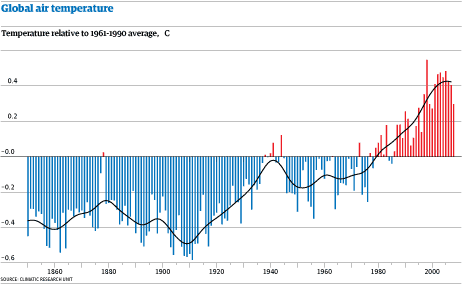
The analysis shows the relative stability in global temperatures in the last seven years is explained primarily by the decline in incoming sunlight associated with the downward phase of the 11-year solar cycle, together with a lack of strong El Niño events. These trends have masked the warming caused by CO2 and other greenhouse gases.
As solar activity picks up again in the coming years, the research suggests, temperatures will shoot up at 150% of the rate predicted by the UN's Intergovernmental Panel on Climate Change. Lean and Rind's research also sheds light on the extreme average temperature in 1998. The paper confirms that the temperature spike that year was caused primarily by a very strong El Niño episode. A future episode could be expected to create a spike of equivalent magnitude on top of an even higher baseline, thus shattering the 1998 record.
The study comes within days of announcements from climatologists that the world is entering a new El Niño warm spell. This suggests that temperature rises in the next year could be even more marked than Lean and Rind's paper suggests. A particularly hot autumn and winter could add to the pressure on policy makers to reach a meaningful deal at December's climate-change negotiations in Copenhagen.
Bob Henson, of the National Centre for Atmospheric Research in Colorado, said: "To claim that global temperatures have cooled since 1998 and therefore that man-made climate change isn't happening is a bit like saying spring has gone away when you have a mild week after a scorching Easter."
Temperature highs and lows
1998
Hottest year of the millennium
Caused by a major El Niño event. The climate phenomenon results from warming of the tropical Pacific and causes heatwaves, droughts and flooding around the world. The 1998 event caused 16% of the world's coral reefs to die.
1957
Most sunspots in a year since 1778
The sun's activity waxes and wanes on an 11-year cycle. The late 1950s saw a peak in activity and were relatively warm years for the period.
1601
Coldest year of the millennium
Ash from the huge eruption the previous year of a Peruvian volcano called Huaynaputina blocked out the sun. The volcanic winter caused Russia's worst famine, with a third of the population dying, and disrupted agriculture from China to France.
Uranium Contamination Haunts Navajo Country
By DAN FROSCH, NYTimes.com, July 26, 2009
TEEC NOS POS, Ariz. — It was one year ago that the environmental scientist showed up at Fred Slowman’s door, deep in the heart of Navajo country, and warned that it was unsafe for him to stay there.
The Slowman home, the same one-level cinderblock structure his family had lived in for nearly a half-century, was contaminated with potentially dangerous levels of uranium from the days of the cold war, when hundreds of uranium mines dotted the vast tribal land known as the Navajo Nation. The scientist advised Mr. Slowman, his wife and their two sons to move out until their home could be rebuilt.
“I was angry,” Mr. Slowman said. “I guess it was here all this time, and we never knew.”
The legacy wrought from decades of uranium mining is long and painful here on the expansive reservation. Over the years, Navajo miners extracted some four million tons of uranium ore from the ground, much of it used by the United States government to make weapons.
Many miners died from radiation-related illnesses; some, unaware of harmful health effects, hauled contaminated rocks and tailings from local mines and mills to build homes for their families.
Now, those homes are being demolished and rebuilt under a new government program that seeks to identify what are very likely dozens of uranium-contaminated structures still standing on Navajo land and to temporarily relocate people living in them until the homes can be torn down and rebuilt.
Stephen B. Etsitty, executive director of the Navajo Nation Environmental Protection Agency, and other tribal officials have been grappling for years with the environmental fallout from uranium mining.
“There were a lot of things people weren’t told about the plight of Navajos and uranium mining,” Mr. Etsitty said. “These legacy issues are impacting generations. At some point people are saying, ‘It’s got to end.’ ”
After a Congressional hearing in 2007, a cross-section of federal agencies committed to addressing the environmental and health impacts of uranium mining on the reservation. As part of that commitment, the federal Environmental Protection Agency and the Navajo Nation began working together to assess uranium levels in 500 structures through a five-year plan set to end in 2012.
Using old lists of potentially contaminated structures, federal and Navajo scientists have fanned out to rural reaches of the 27,000 square mile reservation — which includes swaths of Arizona, New Mexico and Utah — to measure levels of radium, a decay product of uranium that can cause lung cancer. Of 113 structures assessed so far, 27 contained radiation levels that were above normal.
“In these situations, you have contamination in somebody’s yard or in their house,” said Harry Allen, the E.P.A.’s section chief for emergency response in San Francisco who is helping lead the government’s efforts. “To us, that is somewhat urgent.”
Many structures that showed high levels of radiation were vacant; some families had already moved out after hearing stories of contamination in their homes. But eight homes still had people living in them, and the E.P.A. and Navajo officials have worked to convince residents that it would be unsafe to stay.
“People had been told they were living in contaminated structures, but nobody ever did anything about it,” said Will Duncan, an environmental scientist who has been the E.P.A.’s main representative on the reservation. “They would tell us, ‘We don’t believe you are going to follow through.’ ”
But with a budget of nearly $8 million, the E.P.A. has demolished all 27 contaminated structures and has begun building ones to replace those that had been occupied. Typically, the agency pays a Navajo contracting company to construct a log cabin or a traditional hogan in the structure’s stead, depending on the wishes of the occupants. Mr. Allen said the cost, including temporarily relocating residents, ran approximately $260,000 per dwelling and took about eight months.
The agency also offers $50,000 to those who choose not to have an old home rebuilt.
Lillie Lane, a public information officer with the Navajo Nation E.P.A. who has acted as a liaison between the federal government and tribal members, said the program held practical and symbolic importance given the history of uranium mining here.
Ms. Lane described the difficulty of watching families, particularly elders, leaving homes they had lived in for years. She told of coming upon two old miners who died before their contaminated homes could be rebuilt. “In Navajo, a home is considered sacred,” she said. “But if the foundation or the rocks are not safe, we have to do this work.”
Some families, Ms. Lane said, complained that their children were suffering from health problems and had wondered if radiation were to blame.
The E.P.A. has started sifting through records and interviewing family members to figure out whether mining companies that once operated on the reservation are liable for any damages, Mr. Allen said.
On a recent summer day, Fred and Clara Slowman proudly surveyed their new home, a one-level log cabin that sits in the quiet shadows of Black Rock Point, miles away from the bustle of Farmington, N.M., where the family has been living in a hotel.
Mr. Slowman said he suspected that waste materials from a nearby abandoned mine seeped into his house. The family plans on having a traditional Navajo medicine man bless their dwelling before they move in.
“In our traditional way, a house is like your mom,” he said. “It’s where you eat, sleep, where you’re taken care of. And when you come back from the city, you come back to your mom. It makes you feel real good.”
TEEC NOS POS, Ariz. — It was one year ago that the environmental scientist showed up at Fred Slowman’s door, deep in the heart of Navajo country, and warned that it was unsafe for him to stay there.
The Slowman home, the same one-level cinderblock structure his family had lived in for nearly a half-century, was contaminated with potentially dangerous levels of uranium from the days of the cold war, when hundreds of uranium mines dotted the vast tribal land known as the Navajo Nation. The scientist advised Mr. Slowman, his wife and their two sons to move out until their home could be rebuilt.
“I was angry,” Mr. Slowman said. “I guess it was here all this time, and we never knew.”
The legacy wrought from decades of uranium mining is long and painful here on the expansive reservation. Over the years, Navajo miners extracted some four million tons of uranium ore from the ground, much of it used by the United States government to make weapons.
Many miners died from radiation-related illnesses; some, unaware of harmful health effects, hauled contaminated rocks and tailings from local mines and mills to build homes for their families.
Now, those homes are being demolished and rebuilt under a new government program that seeks to identify what are very likely dozens of uranium-contaminated structures still standing on Navajo land and to temporarily relocate people living in them until the homes can be torn down and rebuilt.
Stephen B. Etsitty, executive director of the Navajo Nation Environmental Protection Agency, and other tribal officials have been grappling for years with the environmental fallout from uranium mining.
“There were a lot of things people weren’t told about the plight of Navajos and uranium mining,” Mr. Etsitty said. “These legacy issues are impacting generations. At some point people are saying, ‘It’s got to end.’ ”
After a Congressional hearing in 2007, a cross-section of federal agencies committed to addressing the environmental and health impacts of uranium mining on the reservation. As part of that commitment, the federal Environmental Protection Agency and the Navajo Nation began working together to assess uranium levels in 500 structures through a five-year plan set to end in 2012.
Using old lists of potentially contaminated structures, federal and Navajo scientists have fanned out to rural reaches of the 27,000 square mile reservation — which includes swaths of Arizona, New Mexico and Utah — to measure levels of radium, a decay product of uranium that can cause lung cancer. Of 113 structures assessed so far, 27 contained radiation levels that were above normal.
“In these situations, you have contamination in somebody’s yard or in their house,” said Harry Allen, the E.P.A.’s section chief for emergency response in San Francisco who is helping lead the government’s efforts. “To us, that is somewhat urgent.”
Many structures that showed high levels of radiation were vacant; some families had already moved out after hearing stories of contamination in their homes. But eight homes still had people living in them, and the E.P.A. and Navajo officials have worked to convince residents that it would be unsafe to stay.
“People had been told they were living in contaminated structures, but nobody ever did anything about it,” said Will Duncan, an environmental scientist who has been the E.P.A.’s main representative on the reservation. “They would tell us, ‘We don’t believe you are going to follow through.’ ”
But with a budget of nearly $8 million, the E.P.A. has demolished all 27 contaminated structures and has begun building ones to replace those that had been occupied. Typically, the agency pays a Navajo contracting company to construct a log cabin or a traditional hogan in the structure’s stead, depending on the wishes of the occupants. Mr. Allen said the cost, including temporarily relocating residents, ran approximately $260,000 per dwelling and took about eight months.
The agency also offers $50,000 to those who choose not to have an old home rebuilt.
Lillie Lane, a public information officer with the Navajo Nation E.P.A. who has acted as a liaison between the federal government and tribal members, said the program held practical and symbolic importance given the history of uranium mining here.
Ms. Lane described the difficulty of watching families, particularly elders, leaving homes they had lived in for years. She told of coming upon two old miners who died before their contaminated homes could be rebuilt. “In Navajo, a home is considered sacred,” she said. “But if the foundation or the rocks are not safe, we have to do this work.”
Some families, Ms. Lane said, complained that their children were suffering from health problems and had wondered if radiation were to blame.
The E.P.A. has started sifting through records and interviewing family members to figure out whether mining companies that once operated on the reservation are liable for any damages, Mr. Allen said.
On a recent summer day, Fred and Clara Slowman proudly surveyed their new home, a one-level log cabin that sits in the quiet shadows of Black Rock Point, miles away from the bustle of Farmington, N.M., where the family has been living in a hotel.
Mr. Slowman said he suspected that waste materials from a nearby abandoned mine seeped into his house. The family plans on having a traditional Navajo medicine man bless their dwelling before they move in.
“In our traditional way, a house is like your mom,” he said. “It’s where you eat, sleep, where you’re taken care of. And when you come back from the city, you come back to your mom. It makes you feel real good.”
Revealed: the secret evidence of global warming Bush tried to hide
Photos from US spy satellites declassified by the Obama White House provide the first graphic images of how the polar ice sheets are retreating in the summer. The effects on the world's weather, environments and wildlife could be devastating
By Suzanne Goldenberg and Damian Carrington, guardian.co.uk, July 26, 2009

Graphic images that reveal the devastating impact of global warming in the Arctic have been released by the US military. The photographs, taken by spy satellites over the past decade, confirm that in recent years vast areas in high latitudes have lost their ice cover in summer months.
The pictures, kept secret by Washington during the presidency of George W Bush, were declassified by the White House last week. President Barack Obama is currently trying to galvanise Congress and the American public to take action to halt catastrophic climate change caused by rising levels of carbon dioxide in the atmosphere.
One particularly striking set of images - selected from the 1,000 photographs released - includes views of the Alaskan port of Barrow. One, taken in July 2006, shows sea ice still nestling close to the shore. A second image shows that by the following July the coastal waters were entirely ice-free.
The photographs demonstrate starkly how global warming is changing the Arctic. More than a million square kilometres of sea ice - a record loss - were missing in the summer of 2007 compared with the previous year.
Nor has this loss shown any sign of recovery. Ice cover for 2008 was almost as bad as for 2007, and this year levels look equally sparse.
"These are one-metre resolution images, which give you a big picture of the summertime Arctic," said Thorsten Markus of Nasa's Goddard Space Flight Centre. "This is the main reason why we are so thrilled about it. One-metre resolution is the dimension that's been missing."
Disappearing summer sea ice poses considerable dangers, scientists have warned. Ice shelves are used by animals such as polar bears as platforms for hunting seals and other sea creatures. Without them, they could starve. In addition, ice reflects solar radiation. Without that process, the Arctic sea could warm up even more. The phenomenon threatens to set off runaway heating of the planet, say climatologists.
The latest revelations have triggered warnings from scientists that they no longer have the funds to keep a comprehensive track of climate change. Last week the head of the US's National Oceanic and Atmospheric Administration (NOAA), Professor Jane Lubchenco, warned that the gathering of satellite data - crucial to predicting future climate changes - was now at "great risk" because America's ageing satellite fleet was not being replaced.
"Our primary focus is maintaining the continuity of climate observations, and those are at great risk right now because we don't have the resources to have satellites at the ready and taking the kinds of information that we need," said Lubchenco, who was appointed by Obama. "We are playing catch-up."
Even before her warning, scientists were saying that America, the world's scientific superpower, was virtually blinding itself to climate change by cutting funds to the environmental satellite programmes run by the Oceanic and Atmospheric Administration and Nasa. A report by the National Academy of Sciences this year warned that the environmental satellite network was at risk of collapse.
In February, a Nasa satellite carrying instruments to produce the first map of the Earth's carbon emissions crashed near Antarctica only three minutes after lift-off.
The satellite would have measured carbon emissions at 100,000 points around the planet every day, providing a wealth of data compared to the 100 or so fixed towers currently in operation in a land-based network.
The NOAA is under additional pressure to provide environmental data because of the re-emergence of the El Niño climate phenomenon, where warming of the tropical Pacific causes heatwaves, droughts and flooding around the world. June's land and sea surface temperatures were the second hottest on record, and scientists are predicting this will be the warmest decade in recorded history. The last major El Niño was in 1998, the hottest year in recorded history.
The Obama administration has already taken steps to tackle America's flagging scientific lead. The president's economic recovery plan allotted $170m (£100m) to help close the gaps in climate modelling. The NOAA is seeking an additional $390m in its 2010 budget to upgrade environmental satellites, and help make data more available to researchers and government officials.
By Suzanne Goldenberg and Damian Carrington, guardian.co.uk, July 26, 2009
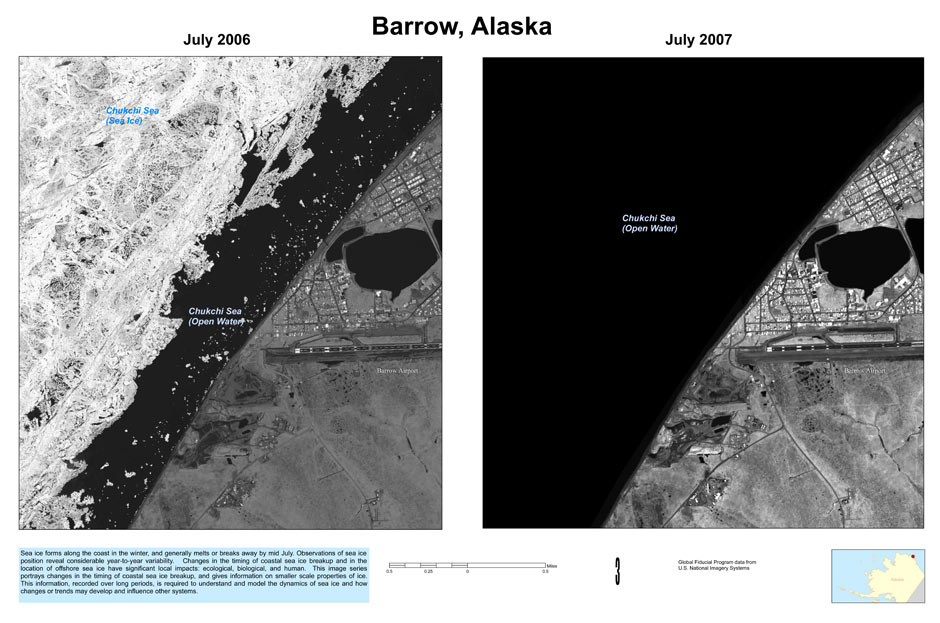
Graphic images that reveal the devastating impact of global warming in the Arctic have been released by the US military. The photographs, taken by spy satellites over the past decade, confirm that in recent years vast areas in high latitudes have lost their ice cover in summer months.
The pictures, kept secret by Washington during the presidency of George W Bush, were declassified by the White House last week. President Barack Obama is currently trying to galvanise Congress and the American public to take action to halt catastrophic climate change caused by rising levels of carbon dioxide in the atmosphere.
One particularly striking set of images - selected from the 1,000 photographs released - includes views of the Alaskan port of Barrow. One, taken in July 2006, shows sea ice still nestling close to the shore. A second image shows that by the following July the coastal waters were entirely ice-free.
The photographs demonstrate starkly how global warming is changing the Arctic. More than a million square kilometres of sea ice - a record loss - were missing in the summer of 2007 compared with the previous year.
Nor has this loss shown any sign of recovery. Ice cover for 2008 was almost as bad as for 2007, and this year levels look equally sparse.
"These are one-metre resolution images, which give you a big picture of the summertime Arctic," said Thorsten Markus of Nasa's Goddard Space Flight Centre. "This is the main reason why we are so thrilled about it. One-metre resolution is the dimension that's been missing."
Disappearing summer sea ice poses considerable dangers, scientists have warned. Ice shelves are used by animals such as polar bears as platforms for hunting seals and other sea creatures. Without them, they could starve. In addition, ice reflects solar radiation. Without that process, the Arctic sea could warm up even more. The phenomenon threatens to set off runaway heating of the planet, say climatologists.
The latest revelations have triggered warnings from scientists that they no longer have the funds to keep a comprehensive track of climate change. Last week the head of the US's National Oceanic and Atmospheric Administration (NOAA), Professor Jane Lubchenco, warned that the gathering of satellite data - crucial to predicting future climate changes - was now at "great risk" because America's ageing satellite fleet was not being replaced.
"Our primary focus is maintaining the continuity of climate observations, and those are at great risk right now because we don't have the resources to have satellites at the ready and taking the kinds of information that we need," said Lubchenco, who was appointed by Obama. "We are playing catch-up."
Even before her warning, scientists were saying that America, the world's scientific superpower, was virtually blinding itself to climate change by cutting funds to the environmental satellite programmes run by the Oceanic and Atmospheric Administration and Nasa. A report by the National Academy of Sciences this year warned that the environmental satellite network was at risk of collapse.
In February, a Nasa satellite carrying instruments to produce the first map of the Earth's carbon emissions crashed near Antarctica only three minutes after lift-off.
The satellite would have measured carbon emissions at 100,000 points around the planet every day, providing a wealth of data compared to the 100 or so fixed towers currently in operation in a land-based network.
The NOAA is under additional pressure to provide environmental data because of the re-emergence of the El Niño climate phenomenon, where warming of the tropical Pacific causes heatwaves, droughts and flooding around the world. June's land and sea surface temperatures were the second hottest on record, and scientists are predicting this will be the warmest decade in recorded history. The last major El Niño was in 1998, the hottest year in recorded history.
The Obama administration has already taken steps to tackle America's flagging scientific lead. The president's economic recovery plan allotted $170m (£100m) to help close the gaps in climate modelling. The NOAA is seeking an additional $390m in its 2010 budget to upgrade environmental satellites, and help make data more available to researchers and government officials.
You'd think water would be a basic right
By Peter Asmus, The Sacramento Bee, July 5, 2009
In the slums of Kibera in Nairobi, Kenya, about 1 million poor people pay up to 30 times more for water of dubious quality brought to them in old tanker trucks than middle-class citizens pay for clean and safe water provided by the local public water utility via standard household connections.
Some may be shocked by these disturbing disparities in the developing world, but a lack of access to safe, affordable and clean water is also an issue in California, particularly in the Central Valley and along the Central Coast. In these communities, more than 90 percent of drinking water is sucked from contaminated groundwater sources. All told, more than 150,000 California residents lack safe water for drinking, bathing and washing dishes; even more have water service disconnected because they cannot afford to pay their bill.
While the arid West – including California – has always suffered from more severe water challenges than the rest of the country, experts claim 36 states will experience local or regional water shortages over the next five years. Spain is also facing an extreme water crisis, with some wondering whether the Sahara Desert will cross the Mediterranean Sea from Africa. And droughts seem to have become a permanent way of life in Australia.
Society appears to face a global crisis in water supply as one in six people – more than 1 billion humans – do not have adequate potable water to meet their most basic survival needs. These facts have spurred efforts to enshrine the human right to water at the United Nations and in the national constitutions of countries such as South Africa and Ecuador.
Interestingly enough, the prime opponent of guaranteeing a human right to water on the international stage at the United Nations has been the United States, which, by the way, is also opposed to a human right to housing and food. It is this political dynamic of our federal government opposing human rights to water that makes Assembly Bill 1242 by Assemblyman Ira Ruskin, D-Los Altos, so interesting. The bill is moving through the California Legislature and a key vote is scheduled Monday.
International debate rages
"The language included in AB 1242 is typical of that used by organizations and campaigns around the world declaring a legal human right to water," said Jeff Conant, international research and communications coordinator for Food and Water Watch, one of the sponsors of the legislation. He went on to say that it would be up to state and local agencies to figure out how to "operationalize" this concept.
On the international stage, much of the discussion about a human right to water is wrapped up in the legal mechanics of treaties and policies at the United Nations. Patricia Jones, program manager for the environmental justice program of the Unitarian Universalist Service Committee, favors the concept of an "International Bill of Human Rights" that would be comprised of direct obligations and treaties that would make the human right to water both explicit and implicit. World Health Organization activists have been working on similar ideas but focused more on trying to stop the spread of endemic diseases, requiring regional governments to commit to the human right to water to receive funding for water projects.
"From a legal point of view, there most definitely is a human right to water, which is part of the right to an adequate standard of living," argues Thorsten Keifer, a human rights expert with Bread for the World, a 50-year-old German nonprofit organization. "The question of how such a right to water can finally be recognized is a very good one as there is nothing like an agreed-upon check list for recognition of implied or new human rights in international law."
From his vantage point, the right to water is not at all at odds with goals of efficiency, reduced water use and effective pricing. "The right to water does not mean that water should per se be for free, but that it should be affordable for all people," he said. "That the human right to water means that everyone should have access to water free of charge is a common misconception – propagated by a handful of activists – that has really interfered with discussions on the issue for far too long. Everyone who can pay should pay!"
So how does a corporation fulfill the human right to water? Coca-Cola has developed a "rights-based approach" because water is so fundamental to its business, and has such large impacts on ecosystems and people. This policy applies to existing and new production, and bottling plants.
"In essence, what this approach means is that our use of water should not infringe on the ability of humans to access water or impact the groundwater or the general population. Our presence as an economic entity should not raise the price of water and make water less affordable to the local community," said Greg Koch, global director, water stewardship, for the Coca-Cola Co.
Harry Ott, a retired Coca-Cola executive and a senior fellow with Future 500, a San Francisco-based organization, added this: "What I've learned is that one must meet with the local community on a regular basis, ideally, before you begin building or operating. One not only needs a government license, but a social license."
He noted that Coca-Cola's employees benefit from better water management. "If our employees have poor water quality at their homes, then they get sick and cannot work."
The California context
Californians will likely face escalating water bills to pay for facilities to treat contamination and to upgrade aging infrastructure. Many supporters of AB 1242 are concerned about the cost implications for disenfranchised citizens, particularly low- income Central Valley residents.
Some environmental organizations, such as the Natural Resources Defense Council, argue that we do not charge enough for water, and that's why so much is wasted.
"We need to decouple revenue from sales," argued Ronnie Cohen, water policy director for NRDC, referencing pricing strategies employed in the electricity sector in California. "The city of Los Angeles has such an adjustment mechanism to account for (water) conservative programs, but most water agencies lose money if people conserve too much. These water agencies need to sell water to collect revenue to run their programs."
California part of the conversation
AB 1242 does not delve into any of these specifics of water pricing or water management, but it is viewed as the first step in addressing water issues most pressing in the Central Valley akin to safety and cost issues more commonly witnessed in the developing world. California does not have a universal statewide lifeline water rate or allocation – one similar to our lifeline rates for energy and phone service – so when costs become excessive, families cannot pay their bills and risk losing water service entirely.
The issues facing the Central Valley are much more common in the developing world and China, where, oddly enough, multinationals often are better at cleaning up their acts than are local governments.
AB 1242's general affirmation of the human right to water is intended to address a specific challenge regarding groundwater contamination and access to affordable water in Central California. But it is also part of a much larger conversation.
Declaring a human right to water is one thing. Figuring out how to guarantee access to this elixir of life is a Rubik's cube. Yet we certainly must begin somewhere, and soon.
Peter Asmus is an environmental writer based in Stinson Beach and author of the new book "Introduction to Energy in California," published by the University of California Press.
In the slums of Kibera in Nairobi, Kenya, about 1 million poor people pay up to 30 times more for water of dubious quality brought to them in old tanker trucks than middle-class citizens pay for clean and safe water provided by the local public water utility via standard household connections.
Some may be shocked by these disturbing disparities in the developing world, but a lack of access to safe, affordable and clean water is also an issue in California, particularly in the Central Valley and along the Central Coast. In these communities, more than 90 percent of drinking water is sucked from contaminated groundwater sources. All told, more than 150,000 California residents lack safe water for drinking, bathing and washing dishes; even more have water service disconnected because they cannot afford to pay their bill.
While the arid West – including California – has always suffered from more severe water challenges than the rest of the country, experts claim 36 states will experience local or regional water shortages over the next five years. Spain is also facing an extreme water crisis, with some wondering whether the Sahara Desert will cross the Mediterranean Sea from Africa. And droughts seem to have become a permanent way of life in Australia.
Society appears to face a global crisis in water supply as one in six people – more than 1 billion humans – do not have adequate potable water to meet their most basic survival needs. These facts have spurred efforts to enshrine the human right to water at the United Nations and in the national constitutions of countries such as South Africa and Ecuador.
Interestingly enough, the prime opponent of guaranteeing a human right to water on the international stage at the United Nations has been the United States, which, by the way, is also opposed to a human right to housing and food. It is this political dynamic of our federal government opposing human rights to water that makes Assembly Bill 1242 by Assemblyman Ira Ruskin, D-Los Altos, so interesting. The bill is moving through the California Legislature and a key vote is scheduled Monday.
International debate rages
"The language included in AB 1242 is typical of that used by organizations and campaigns around the world declaring a legal human right to water," said Jeff Conant, international research and communications coordinator for Food and Water Watch, one of the sponsors of the legislation. He went on to say that it would be up to state and local agencies to figure out how to "operationalize" this concept.
On the international stage, much of the discussion about a human right to water is wrapped up in the legal mechanics of treaties and policies at the United Nations. Patricia Jones, program manager for the environmental justice program of the Unitarian Universalist Service Committee, favors the concept of an "International Bill of Human Rights" that would be comprised of direct obligations and treaties that would make the human right to water both explicit and implicit. World Health Organization activists have been working on similar ideas but focused more on trying to stop the spread of endemic diseases, requiring regional governments to commit to the human right to water to receive funding for water projects.
"From a legal point of view, there most definitely is a human right to water, which is part of the right to an adequate standard of living," argues Thorsten Keifer, a human rights expert with Bread for the World, a 50-year-old German nonprofit organization. "The question of how such a right to water can finally be recognized is a very good one as there is nothing like an agreed-upon check list for recognition of implied or new human rights in international law."
From his vantage point, the right to water is not at all at odds with goals of efficiency, reduced water use and effective pricing. "The right to water does not mean that water should per se be for free, but that it should be affordable for all people," he said. "That the human right to water means that everyone should have access to water free of charge is a common misconception – propagated by a handful of activists – that has really interfered with discussions on the issue for far too long. Everyone who can pay should pay!"
So how does a corporation fulfill the human right to water? Coca-Cola has developed a "rights-based approach" because water is so fundamental to its business, and has such large impacts on ecosystems and people. This policy applies to existing and new production, and bottling plants.
"In essence, what this approach means is that our use of water should not infringe on the ability of humans to access water or impact the groundwater or the general population. Our presence as an economic entity should not raise the price of water and make water less affordable to the local community," said Greg Koch, global director, water stewardship, for the Coca-Cola Co.
Harry Ott, a retired Coca-Cola executive and a senior fellow with Future 500, a San Francisco-based organization, added this: "What I've learned is that one must meet with the local community on a regular basis, ideally, before you begin building or operating. One not only needs a government license, but a social license."
He noted that Coca-Cola's employees benefit from better water management. "If our employees have poor water quality at their homes, then they get sick and cannot work."
The California context
Californians will likely face escalating water bills to pay for facilities to treat contamination and to upgrade aging infrastructure. Many supporters of AB 1242 are concerned about the cost implications for disenfranchised citizens, particularly low- income Central Valley residents.
Some environmental organizations, such as the Natural Resources Defense Council, argue that we do not charge enough for water, and that's why so much is wasted.
"We need to decouple revenue from sales," argued Ronnie Cohen, water policy director for NRDC, referencing pricing strategies employed in the electricity sector in California. "The city of Los Angeles has such an adjustment mechanism to account for (water) conservative programs, but most water agencies lose money if people conserve too much. These water agencies need to sell water to collect revenue to run their programs."
California part of the conversation
AB 1242 does not delve into any of these specifics of water pricing or water management, but it is viewed as the first step in addressing water issues most pressing in the Central Valley akin to safety and cost issues more commonly witnessed in the developing world. California does not have a universal statewide lifeline water rate or allocation – one similar to our lifeline rates for energy and phone service – so when costs become excessive, families cannot pay their bills and risk losing water service entirely.
The issues facing the Central Valley are much more common in the developing world and China, where, oddly enough, multinationals often are better at cleaning up their acts than are local governments.
AB 1242's general affirmation of the human right to water is intended to address a specific challenge regarding groundwater contamination and access to affordable water in Central California. But it is also part of a much larger conversation.
Declaring a human right to water is one thing. Figuring out how to guarantee access to this elixir of life is a Rubik's cube. Yet we certainly must begin somewhere, and soon.
Peter Asmus is an environmental writer based in Stinson Beach and author of the new book "Introduction to Energy in California," published by the University of California Press.
From Amazon to Andes: Indigenous struggle shakes up Peru
By Berta Joubert-Ceci, Workers World, June 21, 2009
On June 5, Peruvian President Alan Garcia unleashed his heavily armed repressive forces against Indigenous people in that country’s Amazonian region. They had been defending that enormous source of natural wealth against the voraciousness of transnational corporations. Ironically, that same day had been designated by the United Nations as World Environment Day to motivate awareness of environmental issues and encourage political action.
The attacks took place in the Curva del Diablo (Curve of the Devil), a section of the highway that links the jungle with the northern part of the country. For 10 days, thousands of Awajún and Wampis people had been occupying and blockading the road as a way to put pressure on the government.
At dawn, three Peruvian National Police helicopters flew over the region dropping teargas and shooting at the defenseless multitude. At the same time, police on the ground armed with rifles were also shooting at them. To this day, there is still no final and clear account of the casualties. The capitalist media, which has all along been hostile to the Indigenous people and loyal to the government, echoed Garcia’s accusation that the Indigenous are “terrorists” and reported that they had murdered 24 police, while only nine Indigenous had died.
However, a contradictory report appeared June 13 in Lucha Indígena magazine, edited by Hugo Blanco, from a person who was in Bagua—the site of the massacre. It replicates what many sources in the area are saying. “The corpses of the Natives were scattered throughout the nearby highway and in the vicinity of the Curve of the Devil. The police took control, imposed curfew, began to pile up the corpses, burning them in the highway, others were transferred to undetermined places, put in bags and transferred to the three police helicopters. Many of the corpses of these humble Peruvians were thrown into the Marañón and Utcubamba Rivers. The mestizos of Bagua Chica and Bagua Grande estimate a minimum of 200 to 300 dead civilians.” (www.luchaindigena.com)
Even though the police refused to allow journalists, relatives and other Indigenous persons into the area, an impressive amount of information has been provided by alternative sources, including a Belgian journalist who was present. It includes video footage on YouTube that has been seen around the world.
What caused the massacre?
On April 9, after futile attempts to negotiate with the government, the Interethnic Association for the Development of the Peruvian Jungle (AIDESEP)—an organization representing 300,000 Indigenous people and 1,350 communities—began mobilizing the Amazonian people. The issue was the government’s implementation of several laws that the Indigenous say will privatize and endanger the Amazon and the livelihood of the numerous Native communities.
They started taking over highways, small airports, and gas and oil pipelines and interrupting river transport. These actions effectively paralyzed the region and disrupted the production and transportation of hydrocarbons throughout the area.
The Amazonian people were especially demanding the repeal of the new Law on Forestry and Wildlife and the Law on Water Resources, decrees 1090 and 1064. These laws would open up the Amazon area to increasing mineral, oil, gas and timber exploitation.
To put this into context, the Peruvian people of the Amazon comprise 11 percent of the total population. They reside in the north, center and southeast of the country, in the largest of Peru’s three natural resources areas.
These laws were imposed illegally. Under both Peruvian and U.N. laws of protection for Indigenous people, it is required that any regulation that could affect their communities must be negotiated first with those affected communities.
Instead, President Garcia imposed them in order to satisfy the requirements of Peru’s Free Trade Agreement with the U.S. This agreement, called the United States-Peru Trade Promotion Agreement (PTPA) was signed in 2006 and took effect on Feb. 1. The PTPA website says this agreement will “result in significant liberalization of trade in goods and services between the U.S. and Peru.... Peru immediately eliminated most of its tariffs on U.S. exports.... [It also] includes important disciplines relating to ... trade facilitation, technical barriers to trade, government procurement, services, investment, telecommunications, electronic commerce, intellectual property rights, and labor and environmental protection.” (www.ustr.gov/trade-agreements)
Solidarity brings concessions
An outpouring of solidarity with the Indigenous followed in the form of both statements and demonstrations. This support from all organized social sectors and progressive parties not only in Peru but internationally forced a concession from the Garcia government. On the evening of June 15, it was announced that the government would take measures the following day to repeal decrees 1090 and 1064.
In reaction to this news, the acting president of AIDESEP, Daysi Zapata, stated that “The government reaction is late. We want to see realities. ... The people are tired of promises ... there is great distrust.” She demanded an end to the persecution of the four leaders of the organization and an end to the state of emergency in Bagua. Zapata has been at the forefront of the organization since June 9 when its president, Alberto Pizango, had to take political refuge in the Nicaraguan Embassy because of death threats.
Most likely the government’s decision was influenced by the many demands that Garcia and all his administration resign. The rise of general mobilizations throughout the whole country on behalf of the Amazonian people is something that has never happened before. Probably Garcia thinks that repealing the laws, if in fact it does happen, will exonerate him. However, protests continue to grow daily.
An article by Carlos Quiroz, a bilingual blogger based in Washington who has constant contact with the Peruvian organizations, reported an interview with Zapata on Monday night after the government’s decision was known. Zapata says: “They want to silence us by incarcerating us, but that is useless because when one leader goes to prison, many more leaders will rise after them.” Referring to the massive character of the protests, she said: “Not a single region is staying quiet; they are protesting for justice after the deaths of our brothers and sisters in Bagua and for the repeal of the Garcia decrees that are so negative to our Indigenous peoples.”
In the same article Quiroz mentions that “Indigenous leader Miguel Palacin had previously told me that [a new constitution] is one of the Indigenous movement’s goals right now, following the example of neighboring Ecuador and Bolivia.” (peruanista.blogspot.com)
Indigenous uprisings in both those countries led to the removal of right-wing neoliberal governments and the installation of progressive presidents who then, together with the input of the people, created new constitutions. Will it happen in Peru?
E-mail: bjceci@workers.org
Next: Who is Alan Garcia? Washington’s silence.
Articles copyright 1995-2009 Workers World. Verbatim copying and distribution of this entire article is permitted in any medium without royalty provided this notice is preserved.
Workers World, 55 W. 17 St., NY, NY 10011
Email: ww@workers.org
Subscribe wwnews-subscribe@workersworld.net
Support independent news http://www.workers.org/orders/donate.php
Web: http://workers.org
http://workersworld.net
On June 5, Peruvian President Alan Garcia unleashed his heavily armed repressive forces against Indigenous people in that country’s Amazonian region. They had been defending that enormous source of natural wealth against the voraciousness of transnational corporations. Ironically, that same day had been designated by the United Nations as World Environment Day to motivate awareness of environmental issues and encourage political action.
The attacks took place in the Curva del Diablo (Curve of the Devil), a section of the highway that links the jungle with the northern part of the country. For 10 days, thousands of Awajún and Wampis people had been occupying and blockading the road as a way to put pressure on the government.
At dawn, three Peruvian National Police helicopters flew over the region dropping teargas and shooting at the defenseless multitude. At the same time, police on the ground armed with rifles were also shooting at them. To this day, there is still no final and clear account of the casualties. The capitalist media, which has all along been hostile to the Indigenous people and loyal to the government, echoed Garcia’s accusation that the Indigenous are “terrorists” and reported that they had murdered 24 police, while only nine Indigenous had died.
However, a contradictory report appeared June 13 in Lucha Indígena magazine, edited by Hugo Blanco, from a person who was in Bagua—the site of the massacre. It replicates what many sources in the area are saying. “The corpses of the Natives were scattered throughout the nearby highway and in the vicinity of the Curve of the Devil. The police took control, imposed curfew, began to pile up the corpses, burning them in the highway, others were transferred to undetermined places, put in bags and transferred to the three police helicopters. Many of the corpses of these humble Peruvians were thrown into the Marañón and Utcubamba Rivers. The mestizos of Bagua Chica and Bagua Grande estimate a minimum of 200 to 300 dead civilians.” (www.luchaindigena.com)
Even though the police refused to allow journalists, relatives and other Indigenous persons into the area, an impressive amount of information has been provided by alternative sources, including a Belgian journalist who was present. It includes video footage on YouTube that has been seen around the world.
What caused the massacre?
On April 9, after futile attempts to negotiate with the government, the Interethnic Association for the Development of the Peruvian Jungle (AIDESEP)—an organization representing 300,000 Indigenous people and 1,350 communities—began mobilizing the Amazonian people. The issue was the government’s implementation of several laws that the Indigenous say will privatize and endanger the Amazon and the livelihood of the numerous Native communities.
They started taking over highways, small airports, and gas and oil pipelines and interrupting river transport. These actions effectively paralyzed the region and disrupted the production and transportation of hydrocarbons throughout the area.
The Amazonian people were especially demanding the repeal of the new Law on Forestry and Wildlife and the Law on Water Resources, decrees 1090 and 1064. These laws would open up the Amazon area to increasing mineral, oil, gas and timber exploitation.
To put this into context, the Peruvian people of the Amazon comprise 11 percent of the total population. They reside in the north, center and southeast of the country, in the largest of Peru’s three natural resources areas.
These laws were imposed illegally. Under both Peruvian and U.N. laws of protection for Indigenous people, it is required that any regulation that could affect their communities must be negotiated first with those affected communities.
Instead, President Garcia imposed them in order to satisfy the requirements of Peru’s Free Trade Agreement with the U.S. This agreement, called the United States-Peru Trade Promotion Agreement (PTPA) was signed in 2006 and took effect on Feb. 1. The PTPA website says this agreement will “result in significant liberalization of trade in goods and services between the U.S. and Peru.... Peru immediately eliminated most of its tariffs on U.S. exports.... [It also] includes important disciplines relating to ... trade facilitation, technical barriers to trade, government procurement, services, investment, telecommunications, electronic commerce, intellectual property rights, and labor and environmental protection.” (www.ustr.gov/trade-agreements)
Solidarity brings concessions
An outpouring of solidarity with the Indigenous followed in the form of both statements and demonstrations. This support from all organized social sectors and progressive parties not only in Peru but internationally forced a concession from the Garcia government. On the evening of June 15, it was announced that the government would take measures the following day to repeal decrees 1090 and 1064.
In reaction to this news, the acting president of AIDESEP, Daysi Zapata, stated that “The government reaction is late. We want to see realities. ... The people are tired of promises ... there is great distrust.” She demanded an end to the persecution of the four leaders of the organization and an end to the state of emergency in Bagua. Zapata has been at the forefront of the organization since June 9 when its president, Alberto Pizango, had to take political refuge in the Nicaraguan Embassy because of death threats.
Most likely the government’s decision was influenced by the many demands that Garcia and all his administration resign. The rise of general mobilizations throughout the whole country on behalf of the Amazonian people is something that has never happened before. Probably Garcia thinks that repealing the laws, if in fact it does happen, will exonerate him. However, protests continue to grow daily.
An article by Carlos Quiroz, a bilingual blogger based in Washington who has constant contact with the Peruvian organizations, reported an interview with Zapata on Monday night after the government’s decision was known. Zapata says: “They want to silence us by incarcerating us, but that is useless because when one leader goes to prison, many more leaders will rise after them.” Referring to the massive character of the protests, she said: “Not a single region is staying quiet; they are protesting for justice after the deaths of our brothers and sisters in Bagua and for the repeal of the Garcia decrees that are so negative to our Indigenous peoples.”
In the same article Quiroz mentions that “Indigenous leader Miguel Palacin had previously told me that [a new constitution] is one of the Indigenous movement’s goals right now, following the example of neighboring Ecuador and Bolivia.” (peruanista.blogspot.com)
Indigenous uprisings in both those countries led to the removal of right-wing neoliberal governments and the installation of progressive presidents who then, together with the input of the people, created new constitutions. Will it happen in Peru?
E-mail: bjceci@workers.org
Next: Who is Alan Garcia? Washington’s silence.
Articles copyright 1995-2009 Workers World. Verbatim copying and distribution of this entire article is permitted in any medium without royalty provided this notice is preserved.
Workers World, 55 W. 17 St., NY, NY 10011
Email: ww@workers.org
Subscribe wwnews-subscribe@workersworld.net
Support independent news http://www.workers.org/orders/donate.php
Web: http://workers.org
http://workersworld.net
Global warming causes 300,000 deaths a year, says Kofi Annan thinktank
Climate change is greatest humanitarian challenge facing the world as heatwaves, floods and forest fires become more severe
John Vidal, guardian.co.uk, May 29, 2009
Climate change is already responsible for 300,000 deaths a year and is affecting 300m people, according to the first comprehensive study of the human impact of global warming.
It projects that increasingly severe heatwaves, floods, storms and forest fires will be responsible for as many as 500,000 deaths a year by 2030, making it the greatest humanitarian challenge the world faces.
Economic losses due to climate change today amount to more than $125bn a year — more than all the present world aid. The report comes from former UN secretary general Kofi Annan's thinktank, the Global Humanitarian Forum. By 2030, the report says, climate change could cost $600bn a year.
Civil unrest may also increase because of weather-related events, the report says: "Four billion people are vulnerable now and 500m are now at extreme risk. Weather-related disasters ... bring hunger, disease, poverty and lost livelihoods. They pose a threat to social and political stability".
If emissions are not brought under control, within 25 years, the report states:
• 310m more people will suffer adverse health consequences related to temperature increases
• 20m more people will fall into poverty
• 75m extra people will be displaced by climate change.
Climate change is expected to have the most severe impact on water supplies . "Shortages in future are likely to threaten food production, reduce sanitation, hinder economic development and damage ecosystems. It causes more violent swings between floods and droughts. Hundreds of millions of people are expected to become water stressed by climate change by the 2030. ".
The study says it is impossible to be certain who will be displaced by 2030, but that tens of millions of people "will be driven from their homelands by weather disasters or gradual environmental degradation. The problem is most severe in Africa, Bangladesh, Egypt, coastal zones and forest areas. ."
The study compares for the first time the number of people affected by climate change in rich and poor countries. Nearly 98% of the people seriously affected, 99% of all deaths from weather-related disasters and 90% of the total economic losses are now borne by developing countries. The populations most at risk it says, are in sub-Saharan Africa, the Middle East, south Asia and the small island states of the Pacific.
But of the 12 countries considered least at risk, including Britain, all but one are industrially developed. Together they have made nearly $72bn available to adapt themselves to climate change but have pledged only $400m to help poor countries. "This is less than one state in Germany is spending on improving its flood defences," says the report.
The study comes as diplomats from 192 countries prepare to meet in Bonn next week for UN climate change talks aimed at reaching a global agreement to reduce greenhouse gas emissions in December in Copenhagen. "The world is at a crossroads. We can no longer afford to ignore the human impact of climate change. This is a call to the negotiators to come to the most ambitious agreement ever negotiated or to continue to accept mass starvartion, mass sickness and mass migration on an ever growing scale," said Kofi Annan, who launched the report today in London.
Annan blamed politians for the current impasse in the negotiations and widespread ignorance in many countries. "Weak leadership, as evident today, is alarming. If leaders cannot assume responsibility they will fail humanity. Agreement is in the interests of every human being."
Barabra Stocking, head of Oxfam said: "Adaptation efforts need to be scaled up dramatically.The world's poorest are the hardest hit, but they have done the least to cause it.
Nobel peace prizewinner Wangari Maathai, said: "Climate change is life or death. It is the new global battlefield. It is being presented as if it is the problem of the developed world. But it's the developed world that has precipitated global warming."
Calculations for the report are based on data provided by the World Bank, the World Health organisation, the UN, the Potsdam Insitute For Climate Impact Research, and others, including leading insurance companies and Oxfam. However, the authors accept that the estimates are uncertain and could be higher or lower. The paper was reviewed by 10 of the world's leading experts incluing Rajendra Pachauri, head of the UN's Intergovernmental Panel On Climate Change, Jeffrey Sachs, of Columbia University and Margareta Wahlström, assistant UN secretary general for disaster risk reduction.
John Vidal, guardian.co.uk, May 29, 2009
Climate change is already responsible for 300,000 deaths a year and is affecting 300m people, according to the first comprehensive study of the human impact of global warming.
It projects that increasingly severe heatwaves, floods, storms and forest fires will be responsible for as many as 500,000 deaths a year by 2030, making it the greatest humanitarian challenge the world faces.
Economic losses due to climate change today amount to more than $125bn a year — more than all the present world aid. The report comes from former UN secretary general Kofi Annan's thinktank, the Global Humanitarian Forum. By 2030, the report says, climate change could cost $600bn a year.
Civil unrest may also increase because of weather-related events, the report says: "Four billion people are vulnerable now and 500m are now at extreme risk. Weather-related disasters ... bring hunger, disease, poverty and lost livelihoods. They pose a threat to social and political stability".
If emissions are not brought under control, within 25 years, the report states:
• 310m more people will suffer adverse health consequences related to temperature increases
• 20m more people will fall into poverty
• 75m extra people will be displaced by climate change.
Climate change is expected to have the most severe impact on water supplies . "Shortages in future are likely to threaten food production, reduce sanitation, hinder economic development and damage ecosystems. It causes more violent swings between floods and droughts. Hundreds of millions of people are expected to become water stressed by climate change by the 2030. ".
The study says it is impossible to be certain who will be displaced by 2030, but that tens of millions of people "will be driven from their homelands by weather disasters or gradual environmental degradation. The problem is most severe in Africa, Bangladesh, Egypt, coastal zones and forest areas. ."
The study compares for the first time the number of people affected by climate change in rich and poor countries. Nearly 98% of the people seriously affected, 99% of all deaths from weather-related disasters and 90% of the total economic losses are now borne by developing countries. The populations most at risk it says, are in sub-Saharan Africa, the Middle East, south Asia and the small island states of the Pacific.
But of the 12 countries considered least at risk, including Britain, all but one are industrially developed. Together they have made nearly $72bn available to adapt themselves to climate change but have pledged only $400m to help poor countries. "This is less than one state in Germany is spending on improving its flood defences," says the report.
The study comes as diplomats from 192 countries prepare to meet in Bonn next week for UN climate change talks aimed at reaching a global agreement to reduce greenhouse gas emissions in December in Copenhagen. "The world is at a crossroads. We can no longer afford to ignore the human impact of climate change. This is a call to the negotiators to come to the most ambitious agreement ever negotiated or to continue to accept mass starvartion, mass sickness and mass migration on an ever growing scale," said Kofi Annan, who launched the report today in London.
Annan blamed politians for the current impasse in the negotiations and widespread ignorance in many countries. "Weak leadership, as evident today, is alarming. If leaders cannot assume responsibility they will fail humanity. Agreement is in the interests of every human being."
Barabra Stocking, head of Oxfam said: "Adaptation efforts need to be scaled up dramatically.The world's poorest are the hardest hit, but they have done the least to cause it.
Nobel peace prizewinner Wangari Maathai, said: "Climate change is life or death. It is the new global battlefield. It is being presented as if it is the problem of the developed world. But it's the developed world that has precipitated global warming."
Calculations for the report are based on data provided by the World Bank, the World Health organisation, the UN, the Potsdam Insitute For Climate Impact Research, and others, including leading insurance companies and Oxfam. However, the authors accept that the estimates are uncertain and could be higher or lower. The paper was reviewed by 10 of the world's leading experts incluing Rajendra Pachauri, head of the UN's Intergovernmental Panel On Climate Change, Jeffrey Sachs, of Columbia University and Margareta Wahlström, assistant UN secretary general for disaster risk reduction.
Police caught on tape trying to recruit Plane Stupid protester as spy
Climate change activist taped men who offered cash for information about group's members and activities
Paul Lewis, guardian.co.uk, April 24, 2009
Listen to the tapes and read the transcripts
Undercover police are running a network of hundreds of informants inside protest organisations who secretly feed them intelligence in return for cash, according to evidence handed to the Guardian.
They claim to have infiltrated a number of environmental groups and said they are receiving information about leaders, tactics and plans of future demonstrations.
The dramatic disclosures are revealed in almost three hours of secretly recorded discussions between covert officers claiming to be from Strathclyde police, and an activist from the protest group Plane Stupid, whom the officers attempted to recruit as a paid spy after she had been released on bail following a demonstration at Aberdeen airport last month.
Matilda Gifford, 24, said she recorded the meetings in an attempt to expose how police seek to disrupt the legitimate activities of climate change activists. She met the officers twice; they said they were a detective constable and his assistant. During the taped discussions, the officers:
• Indicate that she could receive tens of thousands of pounds to pay off her student loans in return for information about individuals within Plane Stupid.
• Say they will not pay money direct into her bank account because that would leave an audit trail that would leave her compromised. They said the money would be tax-free, and added: "UK plc can afford more than 20 quid."
• Accept that she is a legitimate protester, but warn her that her activity could mean she will struggle to find employment in the future and result in a criminal record.
• Claim they have hundreds of informants feeding them information from protest organisations and "big groupings" from across the political spectrum.
• Explain that spying could assist her if she was arrested. "People would sell their soul to the devil," an officer said.
• Warn her that she could be jailed alongside "hard, evil" people if she received a custodial sentence.
The meetings took place in a Glasgow police station last month and in a supermarket cafe on Tuesday. Gifford used a mobile phone and device sewn into her waistcoat to record what they described as a "business proposal" that she should think of as a job.
They intimated that in return for updates on Plane Stupid's plans she could receive large sums of money in cash.
When lawyers acting for Plane Stupid contacted Strathclyde police this week to establish the identities of the detective constable, they were initially told by the human resources department there was no record of his name.
But when the Guardian contacted the force, they acknowledged officers had had meetings with Plane Stupid activists.
In a statement last night, assistant chief constable George Hamilton said the force had "a responsibility to gather intelligence", and such operations were conducted according to the Regulation of Investigatory Powers Act (RIPA). The force would not comment on the identity of the officers.
"Officers from Strathclyde police have been in contact with a number of protesters who were involved with the Plane Stupid protests including Aberdeen airport," he said. "The purpose of this contact has been to ensure that any future protest activity is carried out within the law and in a manner which respects the rights of all concerned."
Gifford's lawyer, Patrick Campbell, said: "I have very considerable concerns about these events. There appears to be a covert operation that is running in some way with, or using, Strathclyde police's name. There appears to be a concerted effort to turn protesters to informants and possibly infiltrate peaceful protest movements.
He added: "The methods employed are disturbing, and more worrying yet is the lack of any clearly identifiable body responsible for this. These individuals seem to have some kind of police support or at the very least connections with the police – the access to police stations confirms that – but my concern is the lack of accountability and the threat to the individual and her right to protest."
Gifford intended to meet the officers for a third time on Thursday, taking a lawyer with her. But the officers did not appear at the rendezvous. However, she said she was later approached by the detective constable, who said he was disappointed in her. The man got into a car, leaving Gifford feeling shaken and intimidated.
She said last night that the initial approach from the officers was "an opportunity that fell out of the sky". She added: "Recording them seemed like the obvious thing to do. I was keen to find out what they had to offer, what they wanted to find out, and feed that back to the group in case other members of Plane Stupid were approached."
In a statement, Plane Stupid said: "Our civil liberties were invaded and our right to peaceful protest called into question simply to defend the interests of big business."
Listen to the tapes and read the transcripts
Paul Lewis, guardian.co.uk, April 24, 2009
Listen to the tapes and read the transcripts
Undercover police are running a network of hundreds of informants inside protest organisations who secretly feed them intelligence in return for cash, according to evidence handed to the Guardian.
They claim to have infiltrated a number of environmental groups and said they are receiving information about leaders, tactics and plans of future demonstrations.
The dramatic disclosures are revealed in almost three hours of secretly recorded discussions between covert officers claiming to be from Strathclyde police, and an activist from the protest group Plane Stupid, whom the officers attempted to recruit as a paid spy after she had been released on bail following a demonstration at Aberdeen airport last month.
Matilda Gifford, 24, said she recorded the meetings in an attempt to expose how police seek to disrupt the legitimate activities of climate change activists. She met the officers twice; they said they were a detective constable and his assistant. During the taped discussions, the officers:
• Indicate that she could receive tens of thousands of pounds to pay off her student loans in return for information about individuals within Plane Stupid.
• Say they will not pay money direct into her bank account because that would leave an audit trail that would leave her compromised. They said the money would be tax-free, and added: "UK plc can afford more than 20 quid."
• Accept that she is a legitimate protester, but warn her that her activity could mean she will struggle to find employment in the future and result in a criminal record.
• Claim they have hundreds of informants feeding them information from protest organisations and "big groupings" from across the political spectrum.
• Explain that spying could assist her if she was arrested. "People would sell their soul to the devil," an officer said.
• Warn her that she could be jailed alongside "hard, evil" people if she received a custodial sentence.
The meetings took place in a Glasgow police station last month and in a supermarket cafe on Tuesday. Gifford used a mobile phone and device sewn into her waistcoat to record what they described as a "business proposal" that she should think of as a job.
They intimated that in return for updates on Plane Stupid's plans she could receive large sums of money in cash.
When lawyers acting for Plane Stupid contacted Strathclyde police this week to establish the identities of the detective constable, they were initially told by the human resources department there was no record of his name.
But when the Guardian contacted the force, they acknowledged officers had had meetings with Plane Stupid activists.
In a statement last night, assistant chief constable George Hamilton said the force had "a responsibility to gather intelligence", and such operations were conducted according to the Regulation of Investigatory Powers Act (RIPA). The force would not comment on the identity of the officers.
"Officers from Strathclyde police have been in contact with a number of protesters who were involved with the Plane Stupid protests including Aberdeen airport," he said. "The purpose of this contact has been to ensure that any future protest activity is carried out within the law and in a manner which respects the rights of all concerned."
Gifford's lawyer, Patrick Campbell, said: "I have very considerable concerns about these events. There appears to be a covert operation that is running in some way with, or using, Strathclyde police's name. There appears to be a concerted effort to turn protesters to informants and possibly infiltrate peaceful protest movements.
He added: "The methods employed are disturbing, and more worrying yet is the lack of any clearly identifiable body responsible for this. These individuals seem to have some kind of police support or at the very least connections with the police – the access to police stations confirms that – but my concern is the lack of accountability and the threat to the individual and her right to protest."
Gifford intended to meet the officers for a third time on Thursday, taking a lawyer with her. But the officers did not appear at the rendezvous. However, she said she was later approached by the detective constable, who said he was disappointed in her. The man got into a car, leaving Gifford feeling shaken and intimidated.
She said last night that the initial approach from the officers was "an opportunity that fell out of the sky". She added: "Recording them seemed like the obvious thing to do. I was keen to find out what they had to offer, what they wanted to find out, and feed that back to the group in case other members of Plane Stupid were approached."
In a statement, Plane Stupid said: "Our civil liberties were invaded and our right to peaceful protest called into question simply to defend the interests of big business."
Listen to the tapes and read the transcripts
Wed., April 29 & Fri., May 1: Protest at Bank Of America HQ in Charlotte, NC
On Wed., April 29 & Fri., May 1, 2009:
Join the protests at Bank Of America for Economic & Environmental Justice
Unite with labor, students, environmental, anti-war, anti-racist, community activists & others
Wed., April 29, 2009 at 9 AM
BOA Shareholders Meeting
Blumenthal Performing Arts Center
130 N. Tryon Charlotte, NC
*******************
May Day Rally for Jobs, Housing, Healthcare, Education, Workers, & Immigrants Rights at Bank Of America National Headquarters
YES to: Jobs, Housing, Pro-Worker Immigration Reform, Employee Free Choice Act & Money for the People!
NO to: Raids, Deportations, 287(g), Imprisonment, Forced migration, Labor export, Racism, Foreclosures, & Bank Bail Outs!
Friday, May 1, 2009
Noon
Bank Of America HQ
Trade St & Tryon St
Charlotte, NC
March to Charlotte Mecklenburg Government Center & Mecklenburg Co Jail - Central around 6:00pm
On May 1st, join us and help build a movement to fight for the rights of working people. Join billions around the world who also demonstrate on May Day to build a powerful global movement that fights against the dire economic and social crisis people face here and around the world.
To endorse, volunteer, or for more info email may1charlotte@gmail.com or see Immigrant & Workers Rights Project http://immigrantworkers.blogspot.com
DONATE - Support our work by sending donations to Action Center For Justice, 7100 Mapleridge Dr, Charlotte, NC 28210
Working people here and worldwide are facing a growing crisis.
Unemployment is reaching record levels; nearly 20 million people are unemployed or underemployed. Tens of thousands of people have been thrown out of their homes as the foreclosure and eviction crisis grows. State and local budgets are being slashed, with draconian cuts in education, housing, and h ealthcare, while tuition, and transit fares increase. Every day we hear news of a new round of layoffs.
What is often not reported is the growing movement among working people to demand a real bail out--not handouts to wealthy CEOs, but immediate relief for the people. On April 3 & 4, thousands converged on Wall Street, Los Angeles, Raleigh, N.C ., and Seattle, to demand “Bail out the people, not the banks and corporations.” (See http://bailoutpeople.org/april3report.shtml for a report and video on the Wall Street protest.)
What’s next? Come out on May 1! In 2006, immigrants and their supporters marched in record numbers. They held some of the biggest demonstrations seen in decades, demanding an end to the repressive Sensenbrenner bill which penalized immigrant workers.
Since 2006, workers have marched to commemorate May 1, International Workers Day, even as the crisis is growing among immigrant workers. Department of Homeland Security and Immigration and Customs Enforcement raids are on the rise. Families are being ripped apart as parents are hauled away to detention centers without legal rights or due process. Children are often left stranded at school when their parents are swept up in this terror campaign.
The horrific raids and deportations, the criminalizing of workers, the beatings and killings are meant to not just to terrorize immigrant workers but to divide us, when we should join together and build a united movement.
There is now a great opportunity for working and progressive people to help continue to revive the legacy of May Day in the spirit of unity and common interest. Now, more than ever, it is vital that we work to build on the growing success of previous May Day demonstrations.
As all workers face a growing crisis, now is the time to unite and organize in our own name and for our own interests.
We’ve already seen Washington and Wall Street’s economic plan: trillions of dollars in bailouts for banks and giant financial institutions, while working people get service cuts, unemployment, and homelessness.
If we’re going to reverse this trend, we need to come out in record numbers on May 1 and beyond. Protests will be held nationwide--in the East, West, North and South.
May 1 marks the first 100 days of the Obama administration. A united movement of people with documents and without, Black, Latin a/o, Asian, Arab, Native and white, employed and unemployed, youth and seniors, women, men, LGBT or straight, able-bodied and disabled, will send a clear message to Washington and to Wall Street.
After May Day, the Bail Out the People Movement will continue to help to build a united movement to fight for working people’s rights. On May 31, just before the June 1-3 UN General Assembly Global Financial Summit, we will hold a Peoples’ Summit to focus the discussion on the real crisis.
On June 14-17, the Moratorium NOW! Coalition in Michigan, a member organization of the Bail Out the People Movement, will hold a Peoples' Summit during the National Business Summit. Activists are planning a tent city and other events to confront the big-business CEOs and politicians gathering for the Business Summit.
In September, the G20 will meet in New York City, to coincide with the UN General Assembly’s annual meeting. We will not let this meeting of heads of state, finance ministers, and corporate lobbyists go unchallenged. Bail Out the People Movement is already preparing for protests then to demand a bail out for people, not banks.
And since this is strictly a grassroots movement, we need to appeal to you—our friends and supporters—to donate to help build this vital movement.
We hope to see you on May Day.
In solidarity and with our thanks,
The Bail Out the People Movement staff
************************
Action Center For Justice
www.charlotteaction.blogspot.com
To be added send an email to actioncenter-subscribe@lists.riseup.net
Join the protests at Bank Of America for Economic & Environmental Justice
Unite with labor, students, environmental, anti-war, anti-racist, community activists & others
Wed., April 29, 2009 at 9 AM
BOA Shareholders Meeting
Blumenthal Performing Arts Center
130 N. Tryon Charlotte, NC
*******************
May Day Rally for Jobs, Housing, Healthcare, Education, Workers, & Immigrants Rights at Bank Of America National Headquarters
YES to: Jobs, Housing, Pro-Worker Immigration Reform, Employee Free Choice Act & Money for the People!
NO to: Raids, Deportations, 287(g), Imprisonment, Forced migration, Labor export, Racism, Foreclosures, & Bank Bail Outs!
Friday, May 1, 2009
Noon
Bank Of America HQ
Trade St & Tryon St
Charlotte, NC
March to Charlotte Mecklenburg Government Center & Mecklenburg Co Jail - Central around 6:00pm
On May 1st, join us and help build a movement to fight for the rights of working people. Join billions around the world who also demonstrate on May Day to build a powerful global movement that fights against the dire economic and social crisis people face here and around the world.
To endorse, volunteer, or for more info email may1charlotte@gmail.com or see Immigrant & Workers Rights Project http://immigrantworkers.blogspot.com
DONATE - Support our work by sending donations to Action Center For Justice, 7100 Mapleridge Dr, Charlotte, NC 28210
Working people here and worldwide are facing a growing crisis.
Unemployment is reaching record levels; nearly 20 million people are unemployed or underemployed. Tens of thousands of people have been thrown out of their homes as the foreclosure and eviction crisis grows. State and local budgets are being slashed, with draconian cuts in education, housing, and h ealthcare, while tuition, and transit fares increase. Every day we hear news of a new round of layoffs.
What is often not reported is the growing movement among working people to demand a real bail out--not handouts to wealthy CEOs, but immediate relief for the people. On April 3 & 4, thousands converged on Wall Street, Los Angeles, Raleigh, N.C ., and Seattle, to demand “Bail out the people, not the banks and corporations.” (See http://bailoutpeople.org/april3report.shtml for a report and video on the Wall Street protest.)
What’s next? Come out on May 1! In 2006, immigrants and their supporters marched in record numbers. They held some of the biggest demonstrations seen in decades, demanding an end to the repressive Sensenbrenner bill which penalized immigrant workers.
Since 2006, workers have marched to commemorate May 1, International Workers Day, even as the crisis is growing among immigrant workers. Department of Homeland Security and Immigration and Customs Enforcement raids are on the rise. Families are being ripped apart as parents are hauled away to detention centers without legal rights or due process. Children are often left stranded at school when their parents are swept up in this terror campaign.
The horrific raids and deportations, the criminalizing of workers, the beatings and killings are meant to not just to terrorize immigrant workers but to divide us, when we should join together and build a united movement.
There is now a great opportunity for working and progressive people to help continue to revive the legacy of May Day in the spirit of unity and common interest. Now, more than ever, it is vital that we work to build on the growing success of previous May Day demonstrations.
As all workers face a growing crisis, now is the time to unite and organize in our own name and for our own interests.
We’ve already seen Washington and Wall Street’s economic plan: trillions of dollars in bailouts for banks and giant financial institutions, while working people get service cuts, unemployment, and homelessness.
If we’re going to reverse this trend, we need to come out in record numbers on May 1 and beyond. Protests will be held nationwide--in the East, West, North and South.
May 1 marks the first 100 days of the Obama administration. A united movement of people with documents and without, Black, Latin a/o, Asian, Arab, Native and white, employed and unemployed, youth and seniors, women, men, LGBT or straight, able-bodied and disabled, will send a clear message to Washington and to Wall Street.
After May Day, the Bail Out the People Movement will continue to help to build a united movement to fight for working people’s rights. On May 31, just before the June 1-3 UN General Assembly Global Financial Summit, we will hold a Peoples’ Summit to focus the discussion on the real crisis.
On June 14-17, the Moratorium NOW! Coalition in Michigan, a member organization of the Bail Out the People Movement, will hold a Peoples' Summit during the National Business Summit. Activists are planning a tent city and other events to confront the big-business CEOs and politicians gathering for the Business Summit.
In September, the G20 will meet in New York City, to coincide with the UN General Assembly’s annual meeting. We will not let this meeting of heads of state, finance ministers, and corporate lobbyists go unchallenged. Bail Out the People Movement is already preparing for protests then to demand a bail out for people, not banks.
And since this is strictly a grassroots movement, we need to appeal to you—our friends and supporters—to donate to help build this vital movement.
We hope to see you on May Day.
In solidarity and with our thanks,
The Bail Out the People Movement staff
************************
Action Center For Justice
www.charlotteaction.blogspot.com
To be added send an email to actioncenter-subscribe@lists.riseup.net
Subscribe to:
Posts (Atom)