Pages

Showing posts with label Colombia. Show all posts

Israeli commandos in Honduras

By Dick Emanuelsson, The Palestine Telegraph, Aug. 17, 2009

Honduras - There are paramilitary structures that are working in coordination with the armed forces, says the undisputed leader of the human rights struggle in Honduras, Andrés Pavón, in regard to the latest casualty of the dictatorship of the Honduran putschists.

It's not that strange. The main professors of state terrorism come from the Zionist state in order to teach their methods of death, intelligence and terror, and they know how to sustain a state against a population that is fighting for its constitutional rights or recognition. Or, as in Honduras's case, for the re-establishment of democracy. The interview with Andrés Pavon follows and can also be heard here.

Tegucigalpa - August 2, 2009 - We're facing the COPEMH building, which is the professional association for middle education, and we also are speaking with Dr. René Andrés Pavón, who is the President of the Honduran Human Rights Commission (CODEH).

Dick Emanuelsson (DE): Yesterday CODEH put out a news release denouncing a variety of things, among them that Micheletti's de facto government has contracted with Israeli commandos or people to train the Honduran military/police forces. What we know from the civil war in Colombia is that these commandos have also been advising the Colombian military forces. What are the Israelis doing here?

Andrés Pavón (AP): Until now what we know is that their mission is to prepare the Armed Forces and the police to aggressively and violently dissuade the demonstrations, by committing crimes of a selective nature in order to build fear, staged terror, and achieve a dismantling of the resistance. Other actions they are undertaking involve certain employees of private security firms putting on police uniforms and acting aggressively against the demonstrators. The police have already sort of been trained to dissuade demonstrations and are a bit fearful about attacking the demonstrators so that it's as if a bit of their human rights training lingers. On the other hand, the security guards are being paid double and their immunity is guaranteed. These are the practices that they are developing, using the experience of the conflict in Palestine and after having put into practice some of these actions in Colombia.

DE: What's the count up to now, we're five weeks out from the coup d'etat - how many people have died and how many have been detained, tortured, beaten?

AP: We have a register that since the beginning of the curfew has registered more than 2,200 people arbitrarily detained and deprived of their freedom. And in direct actions undertaken to break up demonstrations we have registered more than 600 people. There are more than 120 people wounded, and three people have been killed in direct actions during demonstrations, with another three whose deaths are characteristic of deaths planned and directed by these groups.

For the first time we're going to announce the fact that during the curfew more than 37 homicides via firearms took place while the police and the army were in control of the streets. We are going to ask for the names of those victims in order to make the pertinent investigations in light of the fact that the main suspect is the State.

DE: As for the death of the young man, Pedro Magdiel, in El Paraíso on the 24th and 25th of July, now there's also a photo that came out in the La Tribuna newspaper the same day as the uprising, where a soldier can be seen dragging this boy who showed up dead the following day. How far has the investigation gone in this case?

AP: Yes, we have an investigation going in regard to Magdiel's case; he was the first to be taken by the police and it has the obvious characteristics of an extra-judicial murder. We know that in Danli, in El Paraiso, there are paramilitary groups who are working in coordination with the armed forces and the police there; we believe that this boy was delivered by the police to these groups who committed this barbaric crime. Today we also noted the death of another teacher who was stabbed in the same way as the killing at El Paraíso.

DE: Has there been another death?

AP: There's been another death, a teacher that supposedly left here at two in the morning, his name is Martín Flores Ribera Barrientos, he was killed in the Colonia Centroamérica neighborhood, he was going from here to his house and was stabbed in a taxi. This tells us that the state is providing a model of aggressive conduct.

Another strategy is that the Israelis are training a group to instill in people's minds the idea that those of us who are leaders in this movement have a terrorist past or that we're tied to the same structure as the police. That's what somebody told me yesterday who was trying to put up posters, sticking them on walls in order to create distrust in the part of the population that still lacks awareness about the leaders in this country. According to them, they want the people to think that way; it's a historic strategy in Latin America, and later they try to justify the death of certain leaders as a result of this contradiction.

DE: The reason all these people are here outside the COPEMH headquarters is that yesterday at 1 a.m., the 38 year old Roger Vallejo, a leader of this association, died as a result of a sniper's attack last Wednesday when the National Front Against the Coup D'Etat took the Tegucigalpa North Highway. What is known of that? Because it's already the second sniper-caused death. The first was at the airport on July 5 and now we have another death where a sniper supposedly shot this man.

AP: It's a premeditated killing with certain selective characteristics. They chose a teacher in order to affect one of the associations that presently makes up part of the resistance and has a lot of people tied to the resistance. Everything indicates that it was premeditated. The doctrine of the Rome Statute under which this may come to the International Criminal Court establishes that it's not necessary that the shooter's name be known - it is sufficient to know the name of the person who is directing the repressive policies against a large grouping of the civil population, with the intent to provoke a certain natural psychological reaction among the people. In that regard, well, no doubt, there will come a time when the premeditated act will be the object of a formal denunciation against the organizations who, certainly, in this country are tied to the repressive structures of the State. But that will allow us to prove to the prosecutor for the International Criminal Court that there is something happening here and that what's happening is State policy and that this State policy contributes to the generation of all the repressive acts we're presently experiencing.

DE: Could the selection of this gentleman [as a target] also have been an expression of the advice given by the Israelis?

AP: Yes, of course! It has much in common with the characteristics of the Colombian conflict where there is a confrontation with correlated forces that are somewhat similar to an armed conflict. Here in Honduras, the correlation of forces is not similar to those in Colombia, here there are civilians who are armed with a courageous conscience, truth, and the only type of self-defense exercised once in awhile is that of a stick or a stone. They also have their methods for intervening in situations like this, similar to what has happened in Gaza and the West Bank.

DE: Speaking of Colombia, when Obama became president, a lot of people had hopes that the warmongering policies of the United States would radically change. But what we've seen is that the Fourth Fleet, re-activated in July of last year, continues to sail from Alaska in the north to Patagonia in the south. Five new military bases are to be built in Colombia, among them three on the border with Venezuela and one in Málaga Bay, on the Pacific coast, between Central America and Ecuador. There's no sign that this war policy is going to end. If Hillary Clinton had wanted to do something with the Micheletti government, why have only the visas of four officials in the Micheletti government been canceled, something cosmetic? Or how should this be interpreted?

AP: What Obama says reflects a reality, and what his closest collaborators at the business level or this group known as the hawks have, is another discourse and practice. We read this as Mr. Obama encountering a conflict similar to that faced by other leaders in Latin America; here one has to bear in mind that there could also have been a coup in Bolivia, in Ecuador, in Nicaragua and El Salvador. It also is worth considering that there could be a coup in the United States sooner or later; these are things that seem impossible to dream of, but they could actually happen.

On the other hand there's still another reading of the conflict and this reading could be that the advisers closest to Obama are selling the idea that this is an opportunity to change policy and retake influence as Latin America's policeman. Because when we asked him not simply to withdraw visas we were practically asking for intervention in Honduras, so that we'd have a military intervention similar to what went down in Haiti and it's possible that in this way, Obama's government would try to gain prestige for itself in a situation like this.

I'm sure that if the Marines were to intervene in Honduras, they'd be applauded by a whole bunch of people that aren't here, without dreaming that we are opening the door to future interventions in Latin America and bringing back the Latin American police.

These are all possible details. Of course if that's what Obama's thinking, he's not going to do it right away, it would be a couple of months from now so that elections in Honduras could take place, completely tying up any possibility that President Zelaya might succumb to the social pressure which is demanding the creation of a national constituent assembly.

Dick Emanuelsson's blog can be found at: Latinamerika I Dag/LatinoAmérica de Hoy.

Machetera is a member of Tlaxcala, the network of translators for linguistic diversity. This translation may be reprinted as long as the content remains unaltered, and the source, author, and translator are cited.

Translation: Machetera

Bookmark and Share

U.S. Privatizes Colombian War with its Transnational Mercenaries

By Eva Golinger, Venezuelanalysis.com, Aug. 12, 2009

For the year 2009 the State Department of the United States will invest approximately $520 million in Plan Colombia. More than half of this money went to private North American contractors charged with developing, promoting and furthering irregular warfare in Colombian territory and in Latin America; this was revealed to the Bolivarian News Agency by the lawyer and researcher Eva Golinger.

"This constitutes the total privatization of the war in Colombia through the utilization and financing of transnational mercenaries that have no legal obligation to respond to any judicial system in the world. In other words, they enjoy complete immunity," explained Golinger.

Golinger explained that in certain declassified government documents she found a list of 31 American contractors that maintain relations with the State Department. This list contains the amounts of financing awarded by the administration in Washington to advance the war in Colombia.

"What jumps out here is their areas of responsibility and the amount of money which they receive for a period of 12 months," says Golinger.

Even though these are American companies contracted by the State Department, they are not subject to any American legal code, according to Golinger.

"As part of a bi-national accord, in Colombia they have total immunity, that is to say, they respond to nobody for their crimes, actions and operations," she emphasized.

Of the 31 companies on this list, Golinger has limited herself in this opportunity to mention the most important and those with a long history of belligerence in various parts of the world.

The Transnationals of War

The first on the list is Lockheed-Martin, one of the largest companies of the military-industrial complex in the United States. It is dedicated to producing weapons and technology, including war planes.

"Its contract includes $53 million in financing for the period of one year to provide logistical support and technical assistance to the national police of Colombia, in addition to training personnel for special operations," said Golinger.

Another company is Dyn Corp International, which also forms part of the American military-industrial apparatus. The State Department provides it with $164 million in financing to provide pilots, technicians and logistical support to the Colombian army.

"Similarly, the Arinc company, a private contractor of the military-industrial apparatus, received $8 million dollars to maintain, manage and train the Colombian national police in the task of intercepting signals and obtaining equipment associated with espionage," she says.

Also, Oackley Network received $5 million for the provision of software for monitoring the internet and to assist in espionage programs conducted by the crime division of the Colombian national police.

Similarly, one also encounters on the list ITT, a transnational telecommunication company that participated in the coup d'état against [Chilean president] Salvador Allende.

"In 2007 it received some $7 million to operate a hemispheric radar system, offer logistical support and provide radar equipment in Colombian territory that operate via satellite," said Golinger.

Echelon Espionage

Another company with global reach is the Rendón Group, which acquired a contract for $3.4 million to give communicational support to Plan Colombia and to counter narcotics operations.

"The Rendón Group, being a company of the Pentagon, is one of the most well known groups of experts in psychological operations dedicated to designing this type of campaign... it is this company that manages a great part of the media campaign against Venezuela and Ecuador," Golinger commented.

Moreover, she sustained that the contract stipulates the use of the Echelon system, the largest known espionage system, invented in the 1970s by the U.S. National Security Agency (NSA).

"It is a satellite system that has the capacity to monitor all worldwide communications. They enter a specific word in the system, and this is linked to the rest of the communications systems. If they find that someone used that word on the telephone, cell phone, or computer, attention is directed toward that place. It gives the exact location and permits the conversation to be monitored," she commented.

In conclusion, Golinger expressed that the financing implies a continuation of the escalated offensive and imperialist aggression against the region.

"We saw the coup d'état in Honduras, the resurgence of the Colombian-Venezuelan conflict and the concern on the part of the countries of the Bolivarian Alternative for the Peoples of Our America (ALBA) over the [new U.S.] military bases [in Colombia]... This is not the end of it," she affirmed.

Translated by Zachary Lown for Venezuelanalysis.com

Bookmark and Share

Colombia Peace News & Action Alert: Say No To U.S. Military Bases in Colombia

Action Alert: Colombia Military Bases, or South American Peace?

Tell Secretary Clinton you don't want military bases in Colombia!

The plan to increase the U.S. military's presence on Colombian bases is the wrong plan, and it is provoking intense opposition in Colombia and the rest of South America. The plan would prolong the failed drug war, expand the war within Colombia that has caused such suffering, destabilize already tense regional relations, create incentives for an arms race, and violate Colombian sovereignty through immunity for U.S. soldiers' crimes. It would also violate the Colombian constitution, which prohibits the presence of foreign soldiers except in transit (and even then only if approved by the Colombian senate).

Opposition in Latin America has surprised the Colombian and U.S. governments, but so far they appear determined to forward with the deal. Colombian officials announced Friday (August 14) they had reached agreement on the bases in Washington, and only need to work out technical issues in the weeks ahead.

Yet the two governments did not sign an accord, and disclosed no information about what was agreed. What's clear is that the U.S. and Colombian governments want to stem the broad opposition that has erupted throughout the hemisphere, and projecting the idea that the deal is sealed says that opposition is futile.

But the Fellowship of Reconciliation (FOR) also learned that the negotiations "encountered some difficulties" on at least five issues, even before South American opposition forced President Uribe to make a seven-nation tour to seek support for the plan.

We need to let Secretary of State Clinton know that this is not the way to address conflicts in the Andean nations or to help our compatriots who suffer from addiction.

Send a message to Hillary Clinton today.


Religious and Grassroots Leaders Urge Suspension of Base Talks

Bases deal "presents enormous dangers for entire hemisphere"

Over 100 religious, national, community organizations and leaders and academics called on Secretary of State Hillary Clinton August 13 to "suspend negotiations for expanded U.S. military access or operations in Colombia," a plan that has generated a swell of protest among Latin American countries, including Colombia.

"It is rational for regional leaders to see the installation of several U.S. military sites in Colombia as a potential threat to their security," the groups said, because of U.S. support for trans-border attacks from Colombia, reported violations of the expiring base agreement with Ecuador, a Pentagon statement that it seeks access for "contingency operations" in the region, and the painful history of U.S. military intervention in Latin America and the Caribbean.

"To broaden relationships with South America and value respect for human rights, the United States should not create a fortress in Colombia in concert with the region's worst rights violators, the Colombian military," the letter said.

Signatories included 20 national religious organizations and leaders and 32 U.S. peace and human rights groups, as well as community organizations, academics, and international NGOs. Opposition has come from other quarters in the United States also. The Washington Office on Latin America, Mingas FTA, and the Campaign for Peace and Development, among others, have spoken out against the base deal.

Many South American presidents also have expressed opposition to the increased U.S. military presence in Colombia. Brazilian President Lula da Silva urged President Obama to join presidents from the South American Union to discuss the issue later this month in Buenos Aires, and Venezuela President Hugo Chavez said that "the winds of war are blowing" because of the plan for U.S. troops to operate in seven Colombian bases.

Background documents on the military base negotiations between the United States and Colombia.

Obama's Choice: Documents Show U.S. Seeks Colombian Bases for Training & Operations

By John Lindsay-Poland

Published by Americas Program, Center for International Policy, 13 August 2009

President Obama was forced to address the growing clamor in South America in opposition to plans for U.S. military use of at least seven bases in Colombia. The base agreement proposes to carry out regional operations with a wide and ambiguous mandate and has raised concerns among governments throughout the region. "We have no intent in establishing a U.S. military base in Colombia," Obama said on August 7.

But the South American presidents who met in Quito on August 10 weren't buying it. They agreed to meet again later this month to discuss the bases in Colombia. Despite a seven-nation tour by Colombian President Álvaro Uribe the previous week, only Peru openly supports the proposal. President Lula da Silva of Brazil-the continent's superpower-called for President Obama to attend the meeting, and several Latin American presidents and Colombian leaders echoed the call. Obama needs to "explain in depth U.S. policy for the region," Lula said.

Southern Command Chief Douglas Fraser and Colombian armed forces chief Freddy Padilla meet on August 4. (Source: Daylife.com.)

His declaration came following an explosive exposé of base negotiations between the Pentagon and the State Department, and the Colombian government in the Colombian weekly Cambio. The report generated broad discontent in Colombia and the region. The article noted that the plan would include "filling the gaps left by the eventual cutting of [military] aid in Plan Colombia," according to sources cited in Washington and Bogotá.

Whether the bases are "U.S." in name matters little in practice. The proposal has always been for U.S. military use of national bases in Colombia, which is how the United States works at military bases in Honduras, Ecuador, and many other countries in the world. The Pentagon does not acknowledge having "U.S. bases" in Iraq, for example. In Ecuador, the U.S. government denied it had any military base, though now supporters of the military deal with Colombia claim the U.S. operations in Manta, Ecuador were "truly a gringo presence." Obama's announcement doesn't change the situation that has bothered so many Latin Americans and U.S. citizens who hoped for something better from Obama's government.

The issue is really the missions of U.S. forces at those bases and the message they send to Colombians and others in the region that the United States will respond militarily to every problem, from poverty to bilateral tensions. The State Department says the bases are to address narcotics trafficking and "should be viewed as nothing more than that." But the most recent military budget document and the Colombian government define the purposes much more broadly. The Pentagon seeks sites for "contingency operations, logistics, and training," and plans to deploy C-17 cargo aircraft-not used for counter-narcotics-at Palanquero air base in Colombia.

In fact, the facilities under negotiation appear to be aimed at replacing the former School of the Americas and other U.S. military training sites for Latin American armies. In a July 28 written response to Colombian senators, Interior Minister Fabio Valencia said that the agreement seeks to "deepen cooperation in areas such as: interoperability, joint procedures, logistics and equipment, training and instruction, strengthening monitoring and reconnaissance capacity, combined exercises, and especially exchange of intelligence information."

There will be an attempt to "expand training offered to other countries in the region through instruction of helicopter pilots and in human rights and international humanitarian law." Colombia is already imparting military training to jungle commandos and naval forces of other countries, Valencia says, and "plans to continue doing so with low-cost training of the same quality as that offered by countries such as the United States and the United Kingdom."

To read the rest of "Obama's Choice," click here.

Letter from the Field: "Yanquis Fuera!"

Bogotanians Protest U.S. military bases

By Sofia Larsson

It is easy to ignore things that don't affect us directly. It is easy to change TV channels if they show a war we don't want to see and it is more relaxing to listen to a good music channel on the radio than listen to a program informing us about injustices that make us uncomfortable. And even if we do listen and have opinions, most of us will not try to make the broader public listen to them.

On July 24, some 300 people gathered at the Bolivar Plaza in Colombia's capital city to protest the possible establishment of at least five U.S. military bases on Colombian territory. While negotiations between the U.S. and Colombian governments are taking place regarding the matter, political parties, NGOs, lawyer collectives, and other social movements in Colombia are working hard to inform the public about the risks that such an agreement would create -- risks they argue that many Colombians don't know about.

One of the protesters, a male student in his twenties, takes a break from the unison shouting of "Yankees, go home!" and "Multinationals out of the country!"

"After years of the war on drugs and enormous amounts of military aid from the U.S., there are still no real results," he tells me. "The drug trafficking is still big business in Colombia, so why do some people in this country want the war to continue? Why does the U.S. want the war to continue? Report after report shows that the previous military actions have not worked! As much as the military bases is an attempt to fight the drugs, it is a attempt to control this continent and the leftist governments of our neighboring countries. If this deal goes through, Colombia will end up being the Israel of Latin America!"

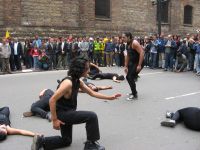
Four days later another protest against the American military bases takes place in the center of Bogotá. Many people stop by to look at the crowd that sings and jumps in order to convey their message to the onlookers.

One of the passersby, a middle-aged woman coming out from an office building, receives a flyer from one of the protesters. She reads it, starts shaking her head and asks me as I stand beside her: "Don't they understand that they are asking for the old Colombia back? Don't they understand that we need help to fight the guerrillas?" I don't have time to answer her as some of the protesters have heard what she said and one of them starts talking loudly in her direction: "The U.S. military have tried to help us solve the problem of drug dealing with war for many years already, without results! Why do you want our country to be a slave under the U.S. government? Why do you want to sell our country and worsen our country's relations with the rest of the continent even more? Why do you want to displace more people?" The woman shakes her head in response, says she is late for a meeting and starts walking away.

The protester who had been talking to the woman looks at me and says, "Sometimes people just don't seem to understand that there is more to Colombia than Bogotá. They don't see the war here anymore, so they think that the army and the gringos got rid of most of it, but that's not true."

I think to myself that he is right. I have worked in the field, where war and coca cultivation are very much present and cause immense problems and fear among the people living there. But that seems very far away when we're standing in the middle of a city where another kind of every-day life is taking place. So, regardless of whether one agrees or not with the message that the jumping loud crowd wants the rest of us to engage in, they remind us of problems we know exist, but can choose to ignore. They remind us of that this country needs us to stay informed and share our opinions, thoughts, and concerns.

British MPs Urge End to U.K. Military Aid

The Western hemisphere, and Colombia in particular, has recently come back into focus in British politics, culminating with a resolution in the House of Commons calling for an end to all British military aid to Colombia.

Over recent months, Britain's Foreign Office has appointed a new minister with responsibility for Latin America, Gillian Merron, and a new ambassador to Bogotá, John Dew. The changes in personnel have prompted several calls to transform British foreign policy towards Colombia, coinciding with the fallout from the so-called "false positives" scandal, whereby the Colombian army is suspected of killing over 1,000 civilians and dressing them up as guerrilla fighters killed in combat. The special envoy for the United Nations has called the practice "cold-blooded and premeditated murder" carried out in a "systematic" fashion.

These various currents converged at the end of March, when Foreign Secretary David Miliband announced the slashing of military aid to Colombia. In a letter to Liberal Democrat peer Lord Eric Avebury, Under-Secretary Merron said "our bilateral UK military project on human rights has ceased." The official British stance had previously been that military aid was destined exclusively for human rights training and assistance with de-mining. British-based NGOs such as Justice for Colombia and ABColombia had already cast doubt on this assertion. It appears that cabinet ministers now share their concerns.

Nonetheless, questions remain about the new British position. The principal reservation centres on the secretive nature of the assistance that London provides to support the "war on drugs," which has not ceased. The government will not even release the financial figures in question, such is the level of sensitivity surrounding the program. However, investigations carried out by Justice for Colombia concluded that some of the funds get mixed up in "counterinsurgency" efforts of the kind leading to the false positives.

There is pressure from within Westminster, too, to further revamp the position. A parliamentary Early Day Motion - used by backbench and opposition members of parliament (MPs) to influence and shape policy and legislation -- "calls on the Government to freeze UK military assistance to Colombia until the Colombian regime fully implements the repeated human rights recommendations made by the UN." This has attracted a large number of signatures from all sides of the House of Commons (242 at the time of writing), amounting to over one-third of all MPs.

It remains to be seen whether or not this continuing pressure will manifest itself in further changes to British foreign policy towards Colombia. It is conceivable, given the "ripe moment" for change that appears to have presented itself. The substantial further alterations called for also point the way for U.S. policymakers, since U.S. contributions to the Colombian military dwarf those of any other country, including Britain.

Protests in Colombia Increase Despite Oppression of Dissent

President Álvaro Uribe's official approval ratings may be high, but what the media tends not to report are the equally high numbers of social protests in Colombia, which undermine the claims of unwavering approval for Uribe. According to a report by the Center for Investigation and Popular Education (CINEP), social mobilization has increased during Uribe's mandate, in 2007 reaching the highest levels since 1975, amounting to an average of two protests a day.

Much of the social unrest is targeted at the president himself. CINEP's research, based upon an extensive database it has maintained since 1975, found that the national government has been the target of the majority of recent protests. The second most common target has been armed groups - military, paramilitary, and/or guerrilla - which CINEP interprets largely as protests against the failure of the government to solve the problem of the armed conflict.

Not only have numbers risen, but the motives for protests have changed in recent years. In departments (geographic regions) like Antioquia, which has one of the highest levels of social unrest in the country, the cause of the protests has changed in recent years from labor unrest to issues of human rights, justice, and reparations. Along those lines, recent years have seen a rise in protests by nontraditional social actors, like indigenous communities, afrocolombians, women, and the LGBT community. The Indigenous and Popular Minga in October of last year, a nationwide mobilization of hundreds of thousands of participants from the south department of Cauca all the way to Bogota, exemplifies the strength of such actors.

These increases are exciting, impressive, and inspiring given the Uribe administration's constant campaign to smear any opposition to his policies with the accusation of collaboration with the FARC, thus making protestors targets of retaliatory violence and unfounded legal persecution. Despite such oppression, these Colombians are bravely demanding a more just, secure, and democratic Colombia.

News Briefs

Anti-Mili

By Peter Cousins

Colombianos, las armas os han dado la independencia, las leyes os darán la libertad.
"Colombians, arms have given you independence, laws will give you freedom."

(Francisco de Paula Santander)

On the front of the Supreme Court of Justice in Bogotá's Boliva Plaza, are carved these words of General Santander, a hero of the independence era and later President of Gran Colombia. Colombia celebrates its "Proclamation of Independence" on July 20 each year. As in most countries, this sort of occasion turns into a day for the "great and the good" of State -- president, mayors, generals, flags -- to take center stage, with the added factor that, last month, the country commenced its take-off towards the bicentenary of the "Proclamation of Independence" in 2010. But in the midst of all this, Santander´s words transcend the years and have for a Colombia that is 199 years young a certain resonance, whose truth is in danger of being eclipsed. What do I mean by this? The historical and contemporary contexts will help us arrive at some sort of understanding.

To read the rest of Peter's essay, click here.

"Witness" paid to testify against Peace Community

by Moira Birss

The demobilized paramilitary chief known as "HH" testified that he gave money to Colombian army Colonel Nestor Duque to in order to bribe demobilized guerrillas into claiming that the FARC was responsible for the February 2005 massacre in which eight members of the Peace Community of San José de Apartadó were brutally murdered.

Read Moira Birss' blog post.

World Summit for Peace: Bogotá, Colombia-October 1-4, 2009

Pacifists Without Borders, with support from the Bogotá mayor's office, will trail blaze the pathway towards the World Summit for Peace, which will occur in the city of Bogotá, October 1-4, 2009. This citizen-led and -promoted initiative is a collective effort towards global peace and against violence, militarization, and injustice. The objective is to collectively construct a favorable setting for reflection, to exchange ideas and dialogue about peace as a social construction, derived from a system based on the principles of social justice and peaceful coexistence.

The World Summit for Peace will have two dimensions:

  1. The global dimension: It is crucial to lead a cultural process from Bogotá, Colombia and the Andean Region which is comprised of basic values such as nonviolence and pacifism. Bogotá will be converted into a stage from which a worldwide peace process will be constructed, promoted, and led within a global context. Moreover, the global dimension to the Summit will further permit the world community to be informed about the particular dimensions of the Colombian armed conflict.
  2. The local dimension: this proposed process looks to foster spaces for dialogue about the Colombian conflict and to develop strategies with the help from all international participants in order to search for a solution to the Colombian armed conflict. Furthermore, we look to provoke a collective reflection through an ample process of participation that will permit us to create the atmosphere for a solution and a post-conflict strategy.

During the summit, Bogotá will be the arena for artistic expressions. A host of such artistic expressions will permeate throughout the city, including concerts, dance presentations, theatrical performances, painting exhibitions, and alternative films from all reaches of the world. You too are invited to inundate the city with art in the name of the Global Peace!

The summit will produce five strategic documents. Three of them will be elaborated by well-known internationally recognized figures. These documents will be presented in the summit by their authors and they will be discussed in three large public assemblies. The three documents will address the central themes: justice, culture, and democracy, and their relationship to peace. We will make the effort to establish these documents as the basis for dialogue in the preliminary stages of the summit.

The fourth document is what we call the Bogotá Manifesto 2009. This will be a proposition that will emerge from the summit and will be elaborated by the promoting group and the facilitators of the event. The first draft of the manifesto will be presented and discussed through a permanent virtual online forum for a period of six months. Furthermore, the World Summit for Peace will project a strategy for the implementation of the Bogotá Manifesto as a post-summit strategy.

The fifth document will be the Pathway to Peace in Colombia: Conflict and Post-Conflict. This will be a collectively elaborated project with the wide participation of international and national participants. It will be signed by all participants as the first stage of a work in progress in order to achieve a political solution to the Colombian conflict.

There is no charge for participation in the Summit in Bogotá. To register, send an e-mail to: cumbredepaz@cumbremundialdepaz2009.org

The organizers want curiosity for the Summit to increase as the main event draws closer and likewise aspire to generate interest among the worldwide citizenry and institutions. Moreover, they hope to unite global support and commitment for this global cause. We hope to create strong alliances with the international media in order to promote the city's image as a city committed to Peace in Colombia and in the World.

World Peace Conference • www.pacifistassinfronteras.org • 011(571)368-1999

Please note new office address for FOR Task Force on Latin America:
Fellowship of Reconciliation • P.O. Box 72492, Oakland CA 94612 • Tel: 510-763-1403 Fax: 510-763-1409 • Web: http://www.forcolombia.org


Bookmark and Share

Latin America Threatened By US Military Bases In Colombia

By Eva Golinger, Postcards from the Revolution, Aug. 6, 2009

The announcement of the US occupation of more than 7 military bases in Colombia comes at a time when a dictatorship - supported, if tacitly by Washington - in Honduras is consolidating after almost a month and a half has passed since the violent coup d'etat forced Honduran President Manuel Zelaya from power. The increased US military presence in Latin America has been perceived by a majority of nations in this hemisphere as a threat to stability and peace in the region. How does the Obama administration justify increasing the Pentagon's budget and investing almost $1 billion in its Latin American military operations this year?

Well, maybe by trying to blame Venezuelan President Hugh Chávez of supporting, funding and arming "terrorist" leftist groups in Colombia and "facilitating drug trafficking". Both allegations have never been founded on solid evidence. In fact, yesterday, President Chávez gave a killer press conference to international media, deconstructing every accusation presented against his government by Colombia and Washington. The latest allegation involved Swedish missile launchers sold to Venezuela in the 1980s that apparently ended up in the hands of the Revolutionary Armed Forces of Colombia (FARC). The Uribe government in Colombia, together with Washington, was trying to blame Chávez for selling the weapons to the FARC, therefore justifying its increasing aggression and military presence in the region, to combat "terrorist threats". "You're either with us or against us..."

Chávez revealed a document - given to him previously by the Colombian government - dated 1996 after a FARC attack had taken place on Venezuelan soil against Venezuelan armed forces and a quantity of weapons had been stolen. The 1996 document detailed the named Swedish missile launchers as having been taken during that attack, more than 2 years before Chávez won office and became involved in government.

"Dirty, dirty tactics", said Chávez regarding Uribe's accusations against him. The Colombian government knows very well that those weapons were in the hands of the FARC well before Chávez became president. So why blame him now for something he has nothing to do with?

Cowardly and pathetic Colombian President Uribe is desperately trying to justify turning his country into the launching pad for Washington's war on Latin America - a war seeking to regain its domination and control over the region's vast natural and strategic resources, and to take out any seed of "socialism" remaining in the hemisphere.

But the military bases in Colombia and the coup in Honduras evidence a dangerous and clear intent of Empire to also crush the vibrant people's movements that have been surfacing all over Latin America during the past decade - revolutions seeking to build new models of social and economic justice.

Latin America is on high alert in response to this revived offensive emerging from Washington. Colombia, isolated in its efforts, is not backing down from opening its land to the vast and barbaric US military power. Where is the outcry inside the United States in response to hundreds of millions - billions - of dollars now directed towards waging war in Latin America? Don't wait until it's too late and another nation, like Panama 20 years ago, is bombed and invaded by US forces in order to secure Washington's long-term control over the region's strategic resources. Act now to resist and protest US military expansion in Latin America and US aggression against a humble people struggling for justice.

Bookmark and Share

Honduras At Standstill; Arias Proposal Of "San Jose Agreement" Rejected By Both Parties

By Eva Golinger, Postcards from the Revolution, July 23, 2009

President Zelaya is giving a press conference right now, presumably from Nicaragua. About one hour ago, President Oscar Arias of Costa Rica presented a new proposal, called the "San Jose Agreement" of 12 points, adding and modifying his previous 7-point proposal that was rejected by the coup regime on Sunday. The 12 points, available in Spanish here, incorporated several of the requests of the coup regime into Arias' original proposal.

Specifically, point number one was changed from calling for President Zelaya's immediate return to power to become a call for a "government of unity and reconciliation" to be composed of members of the coup regime together with representatives from each political party. Zelaya would have been returned to the presidency, but with his hands completely tied. The proposal again called for amnesty for the coup regime, and, in an inference to the coup regime's allegations against President Zelaya, also called for amnesty to be granted to him as well. This factor clearly legitimates the coup regime's theories.

Another point incredibly called on the Zelaya government and supporters to refrain from convening a constitutional assembly, directly or indirectly, and in fact also ordered a refrain from even holding any kind of consultation, survey or opinion poll on any issue remotely related to constitutional form. This is absolutely outrageous because no government has the right to usurp the people's sovereign right to choose their form and model of government. This is not a right that can be transferred or taken away, it is inalienable.

Another point called for presidential elections to be held in October instead of November, and then again prohibited the people from protesting such elections, regardless of outcome or process, or engaging in any kind of civil disobedience, insurrection or any kind of manifestation of discontent regarding the political process in the country. That is also a completely outrageous and unacceptable usurpation of the people's innate right to protest and manifest their will.

There were a series of other points which, once I translate (or someone else does ;-) ) the "San Jose Agreement", can be analyzed. For now, I just wanted to update on today's situation.

Again, no meetings were held today, just the proposal set forth by Oscar Arias to "resolve" the situation. The Zelaya delegation immediately rejected the agreement, declaring the mediation as failed and called upon the United Nations Security Council, the Central American Integrated System (SICA) and the Organization of American States (OAS) to convene immediately - tonight if possible - and implement extreme measures of pressure against the coup regime in Honduras.

The coup regime's delegation rejected Arias' proposal as well, but still based on their original disagreement relating to the return of President Zelaya to power.

Today, the insane coup Foreign Minister called on Venezuela to recognize their regime, stating that it was "inconceivable" that neighbor nations would not recognize their government as legitimate. The coup regime is being recognized now by both the right wing governments in Panama and Colombia, as well as the United States, in its own, underhanded way.

By the way, the leading military figure in the coup, School of the Americas graduate General Romeo Vasquez, is in Miami today, invited to speak at some evangelical conference funded by the Cuban mafia. So, the State Department hasn't revoked his visa, obviously, despite his clear role in kidnapping - at gun point - and forcing into exile the democratically elected president of Honduras. Yet another clear indication of Washington backing the coup.

Zelaya is calling for insurrection in Honduras. Personally, I think that is the only way to resolve this situation with dignity.

Bookmark and Share

Updates: Zelaya On Route To Honduras; U.S. Pumping Up Military Bases In Colombia

By Eva Golinger, Postcards from the Revolution, July 16, 2009

Honduran Foreign Minister (constitutional) Patricia Rodas has announced that President Manuel Zelaya is currently on route to Honduras to reunite with the people in resistance to the coup regime, now on its third week.

On Tuesday, President Zelaya issued an "ultimatum" to the coup regime, warning that if they do not step down by Saturday - during the next scheduled "mediation" meeting in Costa Rica - then he will consider the dialogue process, imposed by Washington, as a failure. And he will return and rescue constitutional order, along with the masses in the streets, by any means necessary.

The Department of State responded to Zelaya's statements, calling on him to have patience and "let the mediation process work". But as the Obama White House calls on a democratically elected president, who was violently kidnapped and forced into exile by a military force trained, armed and commanded by the Pentagon, the US Government continues to do absolutely nothing to tighten the pressure on an increasingly repressive coup regime in Honduras.

The Committee of Family Members of Detained and Disappeared in Honduras published a report today detailing more than 1155 cases of Human Rights violations committed by the coup regime since June 28, 2009. Of those, there have been 4 political assassinations, 6 gravely injured, 16 threatened with death, 59 injured, 13 media outlets closed or censored, 14 journalists detained, of which the majority have been expelled forcefully from the country, and 1046 arbitrary detentions. Where are the State Department reports on human rights violations now? They are always quick to condemn Venezuela for made up violations in order to demonize the government, but when real violations and crimes are committed by a repressive regime favored by Washington, then the policy is silence.

Meanwhile, Washington is busy moving its military installations from Manta, Ecuador, where it has maintained a Forward Operating Location (FOL) since 1999, to neighboring Colombia, pumping up its presence next to Venezuela. The base in Manta was established per a ten-year contract created in 1999, when the Pentagon formally closed its big air force base in Panamá (Howard Air Force Base) and proceeded to set up several Forward Operation Locations (FOLs) in the region - in Manta, Ecuador; Aruba and Curaçao, and Comalapa, El Salvador. At the same time, the Pentagon substantially increased its capacity in the Soto Cano air base in Honduras, which is at the center of the recent coup d'etat against President Zelaya (see my blog entries here).

President Rafael Correa of Ecuador refused to renew the Pentagon's contract to maintain its presence at the Manta base, forcing its ouster this year. The US began its move today. Despite the persistent denials by US Ambassador in Colombia, William Brownfield, regarding the Manta base's relocation to Colombia, Colombian President Alvaro Uribe confirmed the relocation today, stating, "obtaining agreements with countries like the United States, so that, with all due respect to the Colombian constitution, and Colombian autonomy, they help us in the war against terrorism, against drug trafficking, is in the best interests of our country." The agreement negotiated between Colombia and the US establishes the use of Colombian bases in Malambo (northern part of the country), Palanquero and Apiay (center of Colombia) by US military forces. Colombia is also offering use of two other bases in Larandia, in the Caquetá State and Tolemaida, in the center of the country. The agreement is for an initial 10-year period and authorizes the presence of 800 US military forces and 600 private security forces as contracted by the Pentagon. The US has pledged over $5 billion (US taxpayer dollars!!) to improve base operations and set up shop in the South American nation that rests right next door to both Venezuela and Ecuador, two nations considered "adversarial" by Washington.

This makes clear that the Obama Administration is continuing directly on the same militarization path as the previous administrations and it is paving the way for the provocation of a major conflict in the region. Will the empire never listen?

Bookmark and Share

U.S. Military Sites Set to Replace Plan Colombia

By John Lindsay-Poland, FOR Task Force on Latin America and the Caribbean, July 15, 2009

The United States is negotiating for the use of five military facilities in Colombia, in an agreement whose objectives include "filling the gaps left by the eventual cutting of [military] aid in Plan Colombia," according to sources in Washington and Bogotá cited by an explosive article published July 1 in the weekly Cambio magazine.

If such an agreement is reached, it could constitute an end run around the struggles waged for years by human rights, religious, peace, indigenous, Afro-Colombian, women's, and youth groups to demilitarize U.S. policy in Colombia.

The agreement would establish U.S. military operations for at least ten years on five sites -- at Palanquero, Puerto Salgar; Apiay, Meta; and Malambo (all air force bases); and in Cartagena and Malaga Bay (both naval bases). "Unlike the agreement for the U.S. military presence in Manta, the agreement at its start does not limit its application to counternarcotics operations in the Pacific, but extends to the Caribbean, and also includes assistance in the fight against terrorism -- that is, against the guerrillas," Cambio said.

The U.S. negotiators, the magazine says, "have made it known that even if they won't interfere in the exercise of command by Colombian officers on the bases, they will ensure the autonomy of U.S. military forces when operations go beyond Colombia's borders." So apart from U.S. soldiers' involvement in the Colombian army's decades-long counterinsurgency war, Colombian foreign policy in the region will be held hostage to U.S. actions in other countries that may be undertaken from the bases.

A point under negotiation is whether the agreement would be automatically renewed after ten years, or require a new agreement, as Colombian negotiators reportedly want. Either way, U.S. use of the base would extend until after the Obama administration is gone from the White House. Some people liken changing U.S. policy to turning around an aircraft carrier, which takes a long time. In this case, the aircraft carrier is dropping its anchors.

Another sticky point is judicial immunity for U.S. soldiers and contractors, sought by Washington. "Immunity = Impunity" wrote one reader on the Cambio site.

The locations of the bases under negotiation raise further questions. None of them are on the coast of the Pacific Ocean, where aircraft from the Manta base patrolled for drug traffic -- supposedly with great success, reflecting how traffic has increased in the Pacific. Three of the bases are clustered near each other on the Caribbean coast, not far from existing U.S. military sites in Aruba and Curacao -- and closer to Venezuela than to the Pacific Ocean. Why are U.S. negotiators apparently forgoing Pacific sites, if counternarcotics is still part of the U.S. military mission? What missions "beyond Colombia's borders" are U.S. planners contemplating?

Annual funding requests for Plan Colombia, especially in the "Foreign Operations" bill, have been a space for debate about funding the Colombian military and are subject to conditions and reports on human rights. But funding for U.S. military activities in Colombia faces no such discussion. Even Colombia desk officers at the State Department don't know how much Defense Department money is spent in Colombia. And Congress exercises almost no direct oversight on the activities of U.S. military bases around the world -- with the exception of a couple high-profile sites like the detention center in Guantanamo Naval Station.

Moreover, Washington's and the U.S. military's priorities in Colombia are evolving. Congressional staffers have told us that Plan Colombia is scheduled to be reduced, and even many conservatives believe drug policy must change. The foreign aid budget approved by the House on July 9, which included $520 million for Colombia spending, zeroed out purchases of spray aircraft. It substantially cut other eradication programs from last year, although they still account for at least $80 million in military aid. The Malaga Bay naval base that hosts maritime interdiction operations received a boost in the bill.

But funding for military training and other non-drug war military aid -- that is, for counterinsurgency -- increased slightly (to $1.7 million and $60 million, respectively). The U.S. military budget will also likely include more than $100 million in aid to the war, not including $46 million requested for upgrades on the base in Palanquero.

The negotiations are set to conclude soon, since operations in Manta must cease by November, and U.S. officials have already indicated they will shut down operations there before September.

With an increasingly unpopular drug war and a president enamored with special operations, the establishment in Colombia of five U.S. military facilities for at least ten years, whose missions include counterinsurgency and transcend Colombian borders, would be the worst thing to happen to U.S. policy in the Andes since Plan Colombia began a decade ago. We invite you to work with us in mobilizing opposition to these negotiations.

Bookmark and Share

Colombia Commits "Crimes Against Humanity" As Free Trade Pacts Are Debated

Dan Kovalik, The Huffington Post, May 13, 2009

Despite the claims of the Colombian government and those in the U.S., Canada and the EU eager to consummate "free trade" pacts with that regime, the human rights situation in that country is deteriorating fast. Indeed, by key measures -- the killing of unionists, extra-judicial killings by the military, and the forced displacement of civilians -- Colombia's human rights situation is amongst the worst in the world and getting worse. In the case of union killings, it remains the very worst.
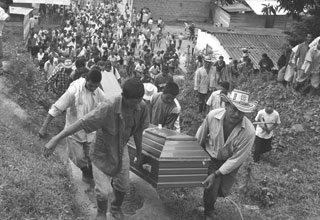
Funeral Procession After Military Massacre of Civilians in San Jose de Apartado (photo from Semana Magazine)

Union Killings and The Hand of the State

So far this year, 17 unionists have been killed in Colombia -- allowing Colombia to maintain its long-running title as "most dangerous country in the world for trade unionists," and putting Colombia on a pace to exceed the figure of union leaders killed last year (49) and the year before (39) - figures which motivated Barack Obama to oppose the Colombia FTA in the first place.

Francisco Javier Ricaurte Gomez, the President of the Labor Section of the Colombian Supreme Court, recently mentioned to me in a meeting we recently held in Pittsburgh, that he sees in these killings "the dark hand of the state." And indeed, the U.S. State Department continues to detail the strong connections between the Colombian state and military and the outlawed paramilitary groups which are largely responsible for these killings, making one wonder if those in charge of negotiating these trade pacts are actually reading their own governments' human rights reports.

According to the most recent 2009 State Department Country Report on Colombia, sectors of Colombia's official armed forces "collaborated with or tolerated the activities of new illegal groups or paramilitary members who refused to demobilize. Such collaboration often facilitated unlawful killings and may have involved direct participation in paramilitary atrocities."

Colombia's Crimes Against Humanity -- Extra-Judicial Killings


The State Department also reported (in its typical understated fashion for countries the U.S. is aligned with) that "[p]olitical and unlawful killings remained an extremely serious problem, and there were periodic reports that members of the security forces committed extrajudicial killings during the internal armed conflict." In fact, according to the AP, around 1,600 civilians have been the victim of extra-judicial killings by the Colombian military itself since President Uribe took over as President in 2002 - a massive increase from Uribe's predecessor. Indeed, the UN High Commissioner for Human Rights recently declared that these extra-judicial killings by the military are on such a scale that they amount to a "crime against humanity."

And, as the State Department explained, many of these killings involved the phenomenon of "false positives" - that is, of "military officials paying illegal groups to forcibly recruit young men, transport them to another town, and turn them over to local brigades who then killed them and presented them as guerillas killed in combat."

The Colombian Military's Role In Forced Displacements


Of equal concern is the continued displacement of Colombians by the Colombian military's aggressive counterinsurgency program. As noted by Garry Leech in the Colombia Journal, the well-respected Colombian human rights group CODHES reported 380,000 more Colombians displaced last year - a 24% increase over the prior year, adding to the already swelling ranks of the 4 million internally displaced Colombians. As it stands, Colombia ranks second only to the Sudan in terms of the number of internally displaced persons.

And, as Leech points out, the Norwegian Refugee Council directly attributes this worsening situation to "[t]he government's military strategy which was intended to be preventive, [but] is instead resulting in an increased displacement of people." Morever, if the U.S. and the E.U. consummate FTAs with Colombia, the problem of displacement (already the second in the world only after the Sudan) will only intensify. This is because the agricultural provisions of the FTA would allow cheap, subsidized farm products from the U.S. and the E.U. to flood Colombian markets tariff-free, undermining the livelihood of small Colombian farmers (who make up 23% of the Colombian population), many of whom will lose their land as a result and join the ranks of the displaced.

We saw this with small farmers in Mexico, 1.3 million of whom were displaced by similar NAFTA provisions - a phenomenon which has led to Mexico's status as a "failed state." The New York Times, in its March 24, 2009 piece entitled, "Nafta's Promise, Unfulfilled," noted this phenomenon, explaining that "Local farmers were priced out of the market by food imported tariff-free. Many Mexican farmers simply abandoned their land and headed north. Although one-quarter of Mexicans live in the countryside, they account for 44 percent of the migrants to the United States."

In short, basic concern for human rights militates against entering into free trade accords with Colombia. In the end, however, the interests of business appear to be trumping human rights in the current discussions over the FTA's, and indeed, businesses themselves continue to fuel the dire human rights situation in Colombia.

U.S. Corporate Complicity For Union Killings

This fact was brought home again last week when it was revealed (at least in the Spanish-speaking press though not in English) that top paramilitary leader Salvatore Mancuso (now in U.S. custody on drug charges) has given testimony to the Colombian Attorney General's office about Alabama-based Drummond Coal Company's connection with the 2001 murders of 3 top unionists by the AUC paramilitaries. Thus, Gerardo Reyes of El Nuevo Herald revealed Mancuso's testimony which confirmed that Drummond, through an individual named "Mr. Jim," paid the AUC paramilitaries to carry out these killings.

Mancuso had previously testified that major companies in Colombia, including U.S. companies Chiquita, Dole and Del Monte had also made payments to the AUC paramilitary group - an illegal group designated as "terrorist" by the U.S. State Department. Sadly, Dole, Del Monte and Drummond have never been charged for their role in supporting this terrorist organization in Colombia. And Chiquita, which admitted to paying paramilitaries over $1.7 million - leading, according to Colombian Attorney General Mario Iguaran, to the killing of over 4,000 civilians -- Chiquita was given the lightest of punishments, being fined $25 million which it was allowed to pay over 5 years.

The continued impunity given these companies, combined with the failure to fully acknowledge the facts about Colombia's worsening human rights crisis, greatly undermines the moral authority of the governments rushing to make a trade deal with Colombia. Those interested in labor and human rights must hold these governments accountable by pressing them to refrain from entering into such deals.

Bookmark and Share

Warning of an Imminent Massacre: Colombian's Call for International Support!

American Friends Service Committee, Oct. 17, 2008

Just a few weeks ago Colombia's President Uribe was in the United States with a delegation of 80 people claiming the human rights situation in Colombia is better. Events of the last week show that the situation is worse.

Violent and repressive tactics are being used against thousands of Indigenous people who are participating in a national mobilization to bring attention to the humanitarian crisis they face.

In Cauca where the most severe violence is occurring 35 people were wounded yesterday when the Colombian military and anti-riot police shot indiscriminately into a crowd of 12,000 who were blockading a road.

Yesterday, the Association of Indigenous Townships (ACIN) as well as the National Organization of Indigenous People (ONIC) warned of an imminent massacre at the hands of the Colombian army and anti-riot police.

Our e-mail boxes are flooded with requests for action and support. You can help by urging the U.S. Department of State and congress to work vigorously to ensure human rights conditions for U.S. military assistance to Colombia are being enforced.

Under U.S. legislation the Colombian military has to ensure that the Colombian Armed Forces are not violating the land and property rights of Colombia's Indigenous and Afro-Colombian communities, and that the Colombian Armed Forces are implementing procedures to distinguish between civilians, including displaced persons, and combatants in their operations."

Please call Susan Sanford, Colombia Desk Officer at the State Department at (202) 647-3142. Here is a script of a sample message:
"I am calling today to bring to your attention the violent tactics the Colombian army and anti-riot police are using against Indigenous protesters. The worst of this violence is taking place in southwestern Colombia, the department of Cauca. I want to urge you and your colleagues to ensure that human rights conditions for U.S. military assistance are being enforced. I also encourage you to call on the Colombian government to deal with the protesters through dialogue and in a peaceful manner."
Then call your member of Congress and urge them to take action to prevent further bloodshed in Colombia. (202) 224-3121 and ask the Capitol Switchboard operator to connect you to your member of Congress' office, or click here to enter your address and find your representative and their direct phone number. Here is a sample message:
"Just a few weeks ago Colombia's President Uribe was in the United States with a delegation of 80 people claiming the human rights situation in Colombia is better. But the Colombian army and anti-riot police are using repressive and violent tactics against indigenous protesters. 35 people were wounded, some possibly fatally, when the army shot indiscriminately into a crowd. Please call on the Department of State to take rigorous measures to ensure that human rights conditions for U.S. military assistance to Colombia are being enforced."


Natalia Cardona

Peacebuilding Unit

American Friends Service Committee

Tel: (215)241-7162

Fax: (215) 241-7000

www.afsc.org/colombia

www.tradeandwar.org

Thousands Come Out for Anti-Paramilitary March

Helda Martínez, IPS, March 6, 2008

BOGOTA, Mar 6 (IPS) - "I will march against the members of the security forces who have betrayed the honour of the military and the police, and have betrayed their fatherland, by selling themselves out to paramilitaries and drug traffickers to serve their interests," said Colombian Senator Juan Manuel Galán in a speech given at the spot where his father was assassinated in 1989.

He was addressing hundreds of protesters on their way to take part in Thursday’s demonstration that paid "homage to the victims of paramilitarism, parapolitics and crimes of the state" in more than 20 Colombian cities and another 100 around the world.

The peaceful nationwide demonstration took place without incident. But it basically went unreported by the mainstream media, by contrast with the heavy international coverage of the global Feb. 4 march against the Revolutionary Armed Forces of Colombia (FARC) guerrillas.

People displaced by Colombia’s four-decade civil war paid tribute Wednesday to former Liberal Party presidential candidate Luis Carlos Galán in the main square of Soacha, a poor suburb south of the capital where he was killed in 1989.

Soacha was one stop along their march, which began Tuesday in the fishing village of Flandes, 150 km southwest of the capital. On Thursday morning they continued on to the Plaza de Bolívar in central Bogotá, where they joined people affected by the war and by the U.S.-financed Plan Colombia counterinsurgency and anti-drug strategy in remote rural regions of the country.

Between 1982 and 2005, nearly four million people were forcibly displaced and lost their land, and at least 15,000 people fell victim to forced disappearance, according to a local human rights group, Justice and Peace.

Inspector general Edgardo Maya led the group of public employees who joined the march even though their participation was criticised by presidential adviser José Obdulio Gaviria.

"We are taking part in this peaceful march in homage to all of the victims of the conflict, and especially the victims of paramilitarism," Maya told IPS.

The far-right paramilitary militias, which in the 1980s joined the security forces in their fight against the leftist rebel groups that emerged in 1964, have been blamed by the United Nations for the lion’s share of the human rights crimes committed in the armed conflict.

In the last few years, the paramilitaries have taken part in a controversial partial demobilisation process negotiated with the rightwing government of Álvaro Uribe, in exchange for lenient sentences and a promise by the government not to extradite them to the United States, where many of them are wanted on drug trafficking charges.

Accompanying the public employees were 200 international observers, as well as former senator Luis Eladio Pérez, one of the four hostages released on Feb. 27 by the FARC. He was held in the jungle by the guerrillas for more than six years.

Also participating was "peace walker" Gustavo Moncayo, a high school teacher who has become a well-known activist calling for the release of his son, army corporal Pablo Emilio, who was captured by the FARC in December 1997, and the rest of the hostages.

Thousands of other Colombians took part in the march, many of them carrying signs with photos of their loved ones, victims of murder or forced disappearance.

"This is the first time that I have come out to protest in 15 years," 47-year-old María Rodríguez told IPS. "I always get this horrible feeling when I remember the men in camouflage who came to the farm and threatened me and killed my two nephews."

Of the 15,000 victims of forced disappearance reported between 1982 and 2005, at least 3,000 were buried in common graves, some of which have begun to be exhumed. It is impossible to know how many were thrown into rivers, a common paramilitary practice.

"Disappearance is a monstrous crime," former Bogotá mayor Antanas Mockus told IPS. "That is why…we started this march at the Magdalena river," he said, after accompanying hundreds of mainly indigenous and black people displaced by the war on the three-day march from Flandes.

"We were inspired by an audiovisual testimony by the artist Clemencia Echeverri, who recently showed, in a sophisticated Bogotá art gallery, a night-time recording taken from the two shores of the Cauca river" in the northwestern province of Antioquia, said Mockus. (Antioquia is a paramilitary stronghold.)

"On the recording, you hear the sound of the water flowing, and above that you hear the screams of peasant farmers and chainsaws running, and you can see people with sticks, fishing pieces of clothing out of the river," he added.

According to testimony from numerous survivors and members of paramilitary groups, the latter frequently used chainsaws to cut their victims up alive.

Jusice and Peace also reported that 1,700 indigenous people, 2,550 trade unionists and 5,000 members of the now-defunct leftist political party Patriotic Union were murdered between 1982 and 2005.

"The paramilitaries have perpetrated more than 3,500 massacres and stolen more than six million hectares of land, and since their demobilisation they have killed 600 people a year. They also achieved control over 35 percent of the seats in Congress," said the Movement of Victims of Crimes of the State (MOVICE), which organised Thursday’s nationwide march.

Guillermo Cano, director of the El Espectador newspaper, was murdered in 1986 after denouncing, in his column, the activities of "paramilitarism and drug trafficking carried out under the complicit silence of the government."

Human rights defender Héctor Abad Gómez was killed in 1987, as related by his son, journalist Héctor Abad Faciolince, in his book "El olvido que seremos" (The Oblivion We Shall Be).

Leftist politician José Antequera was murdered in 1989. His son José remembers that at the age of five he could not understand why his father was killed. And "today I can't either," he said in a vigil Sunday in the Plaza de Bolívar in which victims and survivors of the war gave their personal accounts of their suffering.

Leftist presidential candidates Bernardo Jaramillo and Carlos Pizarro were assassinated in 1990, and in 1994 Patriotic Union Senator Manuel Cepeda was killed.

Stories that repeat themselves over and over again, at all levels of Colombian society.

"Nicolás was 15 years old on May 1, 2005. He was marching calmly with students and other people when the army began to fire tear gas, for no reason, because there were no disturbances," read out one woman in the vigil.

"Nicolás, who had asthma, was unable to move because of the tear gas and was beaten by eight members of ESMAD (the anti-riot police). He died a few days later in a health clinic. And his father, who is here with us, has faced constant threats by the police, and survived an attempt on his life," she said.

Liberal Party Senator Juan Manuel Galán told the demonstrators in Soacha: "I will march against former army lieutenant Carlos Flores, (retired) general Miguel Maza Márquez, then director of the Administrative Security Department (the DAS intelligence agency), and general Oscar Peláez of the national police, who participated in the plot that ended my father’s life."

On Thursday, the columns of protesters reached the Plaza de Bolívar and slowly filed out to make room for other groups, in a climate free of tension but charged with emotion.

Marc Chernick, a professor from Georgetown University in Washington, DC who took part in the march, told IPS that "I feel relieved and happy to see that there are still people who want to make themselves heard, even though there was so much pressure to keep them from coming out on the streets." He said the demonstration helped open a door to democracy.

The head of MOVICE, Iván Cepeda, the son of the murdered senator, told the crowd: "Thank you Colombia. This is the start, not the end, of our struggle."

* With additional reporting by Constanza Vieira. (END/2008)

Colombia refuses to rule out future military raids into Ecuador & Venezuela

Latin American leaders face border crisis
Second FARC leader Ivan Rios killed in Colombia by own security chief
AP, msnbc.com, March 7, 2008

BOGOTA, Colombia - A summit of Latin American presidents aimed at defusing a growing border crisis turned into an angry showdown Friday, with finger-jabbing lectures, passionate speeches and a plea for goodwill that prompted stiff hand shakes between the leaders of Colombia, Ecuador and Venezuela.

The presidents of Colombia, Ecuador and Venezuela later joined other leaders in approving a declaration to end the crisis triggered by Colombia's cross-border military attack on a leftist rebel camp in Ecuador.

The dramatic high point of the hours-long passion play came when Dominican President Leonel Fernandez tried to calm things down by urging Colombian President Alvaro Uribe to shake hands with his antagonists. Uribe then marched around the table and shared stiff handshakes with Ecuador's Rafael Correa and Venezuela's Hugo Chavez.

But the appeal for harmony quickly dissolved, as Correa made yet another appeal to Uribe to respect their border, and never again act unilaterally to send commandos into his territory to bomb another rebel camp. If such an act is justified, then no border will be safe, Correa said, to perhaps the day's loudest applause.

The declaration adopted by the 20-nation Rio Group noted that Uribe had apologized for the raid last Saturday, which killed a Colombian rebel leader inside Ecuador's border, and that he pledged not to repeat the violation of national sovereignty.

The declaration, read by Fernandez, also reiterated the firm commitment by member governments to fight threats to national stability from "irregular or criminal groups."

Violent Friday
Adding another crushing blow to Latin America's oldest and strongest guerilla movement was the killing of the top rebel leader by his own chief of security on Friday. The security chief gave troops the leader's severed hand as proof, Colombia's defense minister said Friday.

Ivan Rios was the second member of the ruling secretariat of FARC to be killed in a week.

The guerrilla force was already shaken by the death Saturday of its spokesman, Raul Reyes, in a cross-border raid by Colombian troops into Ecuador.

"The FARC has suffered a new, major blow," Defense Minister Juan Manuel Santos said at a news conference.

Santos said troops launched an operation designed to capture Rios on Feb. 17 after receiving tips that he was in a mountainous area of the western province of Caldas.

On Thursday, he said, a guerrilla known as Rojas came to the troops with Rios' severed hand, laptop computer and ID, saying he had killed his boss.

It was unclear what motivated Rojas to kill his boss, but Santos said it was to "relieve the military pressure."

Santos did not say what happened to Rojas, and he didn't take questions.

The U.S. State Department had a standing bounty of $5 million for Rios, whose real name is Jose Juvenal Velandia. He has been charged with drug smuggling by the United States, and is on a U.S. Treasury Department list of terrorists and drug traffickers.

Youngest member of leadership
In a 1999 interview with The Associated Press, Rios said he joined the insurgency as a student in Colombia's second city of Medellin to avoid being killed by right-wing death squads that had attacked other student activists.

Rios became known across Colombia as one of the rebels' main negotiators in failed peace talks that ended in 2002. He was thought to be around 40 years old.

Rios commanded the FARC's central bloc, which operates throughout Colombia's northwestern coffee region. Security forces say he frequently accompanied the FARC's senior leader, Manuel "Sureshot" Marulanda, in recent years.

Rios "was the youngest member of the secretariat. He was very important to the rebels," said Alfredo Rangel of the Bogota-based think tank Security and Democracy. "This shows the army is capable of taking down the rebels' most important pillars and that any of the leaders can fall at any time."

Harsh words exchanged at summit
Meanwhile, in Santo Domingo, Dominican Republic, Uribe said Friday that Colombian rebels helped Correa get elected, citing as evidence a rebel's letter seized during the cross-border raid last week.

Correa walked out of the 20-nation Rio Group summit after the finger-wagging accusation, then returned and denounced the accusation as "infamy."

Uribe said his forces seized a letter during their raid Saturday on a rebel camp just across the border with Ecuador in which Raul Reyes — a rebel leader killed in the raid — told the guerrillas' top commander about "aid delivered to Rafael Correa, as instructed."

Uribe also said that he didn't give Correa advance warning of the attack on Ecuadorean soil because "we haven't had the cooperation of the government of President Correa in the fight against terrorism."

That prompted an angry exchange between the two, as other presidents sought to keep the dialogue civil.

Correa, who has broken off relations with Colombia and sent troops to the border over the incident, denounced Uribe as a liar, portrayed Ecuador as a victim of Colombia's conflict, and proposed an international peacekeeping force to guard their border.

"I reject this infamy that the government of Rafael Correa has collaborated with the FARC," Correa bellowed into the microphone as he accused Uribe of lying. His comments drew loud applause from other leaders, who met Uribe's speech with silence.

Crisis overshadows other summit issues
The summit was to have focused on energy and other issues, but those were overshadowed by the diplomatic crisis in the Andes after the deadly Colombian cross-border raid into Ecuador on Saturday that killed a senior Colombian rebel and 24 others.

It began quietly, with the host, Dominican President Leonel Fernandez, appealing for unity. Venezuelan President Hugo Chavez said it was time to cool tensions and predicted the summit "is going to be positive."

"People should go cool off a bit, chill out their nerves," Chavez said before the summit started. "I think the meeting today is going to be positive, because it is going to help the debate. We have to debate, talk, and this is the first step toward finding the road."

But the accusations began quickly, with Correa criticizing "the aggression of Colombia" and Uribe saying that Correa is a dishonest partner in the fight against the Revolutionary Armed Forces of Colombia, or FARC.

"We didn't inform him (of the raid) because we have not had cooperation from the government of President Correa in the fight against terrorism," Uribe said.

Latin American foreign ministers on Thursday drafted a statement saying national sovereignty must be respected. The draft, to be submitted to the presidents on Friday, mirrors one earlier in the week from the Organization of American States, said Chilean Foreign Minister Alejandro Foxley.

Military buildup on border
Chavez has ordered thousands of troops and tanks to Venezuela's border with Colombia and threatened to slash trade and nationalize Colombian-owned businesses. Correa has also sent troops to the border, although Uribe has said he won't do the same.

The summit marks the first face-to-face encounters between Chavez, Correa and Uribe since the international crisis began.

Correa told reporters he wants Uribe to apologize for the attack in Ecuadorean territory and give his "formal and firm commitment" that Colombia will never "violate" the sovereignty of another country.

On his arrival in Santo Domingo late Thursday, Chavez claimed the strike was "planned and directed by the United States." Later, he said he had information that "gringo soldiers" participated in the attack, but provided no evidence.

U.S. Southern Command spokesman Jose Ruiz neither confirmed or denied this week that the U.S. military took part in the attack. The latest body was discovered Thursday, according to Ecuador's security minister, Gustavo Larrea.

Uribe is hugely popular among Colombians for cracking down on the FARC, which finances itself through kidnapping and drug trafficking.

Nicaragua, a leftist ally of Venezuela and Ecuador, broke relations with Colombia on Thursday.

France's contacts with rebels cut
The attack also cut off all contacts between the rebels and France, where the freedom of French-Colombian hostage Ingrid Betancourt has become a national cause, French Foreign Minister Bernard Kouchner said Friday.

Uribe has refused to rule out future military incursions into Ecuador or Venezuela, saying he first needs assurances from Correa and Chavez that they are not harboring rebels.

One of the rare regional voices offering support for Colombia was Salvadoran President Tony Saca, who said the Colombian government should be able to defend its citizens.

"We need to understand Colombia has the legitimate right to go after terrorists ... wherever they may be, of course without harming the sovereignty of another country," Saca said.


This report includes information from Reuters and The Associated Press.

Ecuador, Venezuela demand condemnation

JORGE RUEDA, AP, March 5, 2008

CARACAS, Venezuela - Venezuela is starting to block billions of dollars in Colombian imports and investment under orders from President Hugo Chavez, threatening economic havoc in both nations in response to a Colombian military attack on rebels hiding in Ecuador.

Chavez and Ecuadorean President Rafael Correa demanded international condemnation of Colombia's U.S.-allied government on Wednesday night, while Chavez predicted a sharp fall in the $6 billion in annual Colombia-Venezuela trade: "That's coming down."

"We aren't interested in Colombian investments here," Chavez said, standing beside Correa. "Of the Colombian businesses that are here in Venezuela, we could nationalize some."

He said Venezuela will search for other countries like Ecuador, Brazil and Argentina to replace products imported from Colombia. Noting that Colombia traditional supplies food to Venezuela, he said now "we can't depend (on Colombia) not even for a grain of rice."

Though Venezuelan officials express confidence they will quickly find replacements for Colombian goods, government critics says the move is bound to worsen shortages of basic foods from milk to chicken that were an annoyance in Venezuela well before a dispute that has ballooned into one of South America's most serious diplomatic crises in years.

Chavez and Correa warned on Wednesday that a regional diplomatic crisis would not end without clear international condemnation of Colombia's government for Saturday's deadly cross-border strike against leftist rebels.

In a bid to defuse a dispute that has seen Venezuela move tanks and troops to its border, the Organization of American States on Wednesday approved a watered-down resolution calling the raid on the Revolutionary Armed Forces of Colombia camp a violation of Ecuador's sovereignty.

But Correa said that while welcome, the resolution was not enough and his government still wants explicit condemnation.

"The OAS resolution pleases us. We are pleased, but not satisfied," Correa said as he visited Chavez in Caracas. "This isn't going to cool down until the aggressor is condemned."

Chavez called the attack by Colombia's U.S.-allied government a "war crime." The bombing and raid killed a top rebel leader, Raul Reyes, and 23 other guerrilla fighters who had set up a base just over a mile from the border inside Ecuador.

Colombia has accused both Chavez and Correa of ties with the leftist rebels, and said that was shown by documents found on a laptop seized at the bombed rebel camp.

Colombian President Alvaro Uribe said he would not mobilize troops or allow his nation to be drawn into war with his neighbors.

Meanwhile, Venezuela said most of the 9,000 soldiers mobilized by Chavez had reached the Colombian border area Wednesday. Ecuador said it sent 3,200 soldiers to its border with Colombia on Monday.

Chavez blamed the crisis on the U.S. "empire and its lackeys" — Colombia's conservative government — saying they pose a constant threat of war in the region.

On Wednesday, the Washington-based OAS declared the attack a violation of Ecuador's sovereignty and called for OAS Secretary-General Jose Miguel Insulza to lead a delegation to both countries to ease tensions. But the resolution stopped short of explicitly condemning the assault. The United States was the only OAS nation offering Colombia unqualified support.

Reyes' captured laptop was full of documents that indicate FARC political ties to both Chavez and Correa, officials said.

"This is the first time that we've stumbled across something coming from the FARC drawing such a straight line" between the rebels and Chavez, said Assistant Secretary of State Thomas A. Shannon, who said American experts would soon examine the computer's hard drive. "

Chavez laughed as he dismissed Colombian accusations that the laptop's documents show he gave $300 million to the FARC and conspired with the rebels to embarrass Colombia's government.

Other documents released by Colombia suggest Reyes was secretly negotiating with representatives of France and other European nations to win freedom for hostages including French-Colombian politician Ingrid Betancourt and three American defense contractors.

French President Nicolas Sarkozy appealed directly to the rebels in an interview broadcast Wednesday night on Colombia's RCN television. He said Betancourt's release could persuade countries to no longer consider the FARC a terror group.

"If they let Ingrid Betancourt die, of course, there will be no discussion about that," he said in comments dubbed over in Spanish. "If they free Ingrid Betancourt, maybe some place in the world will see them a little differently."

In the Venezuelan town of San Antonio on Wednesday, soldiers marched through sugarcane fields with assault rifles, watching children dressed in school uniforms splash their way across the river that separates the two countries.

While many cargo trucks from Colombia have been turned away in recent days, traffic continued to flow across border bridges. And the military said it had no orders to close the border.

"Any disruption in the significant trade between Colombia and Ecuador/Venezuela will be temporary," predicted David Scott Palmer, director of Latin American studies at Boston University. For Colombia, he said, "there is political fallout in bilateral relations with Ecuador, and a renewal of tension with Venezuela, but I would expect both to be temporary."
___

Associated Press writers Christopher Toothaker in San Antonio, Venezuela; Toby Muse in Cucuta, Colombia; Nestor Ikeda in Washington; Gonzalo Solano in Quito, Ecuador; and Fabiola Sanchez and Ian James in Caracas contributed to this report.