UNEMPLOYED AND COMMUNITY ACTIVISTS TO DEMAND
MONEY FOR JOBS NOT WAR
AT 12 NOON IN FRONT OF WHITE HOUSE
“Fund A REAL JOBS PROGRAM instead of sending MORE TROOPS TO AFGHANISTAN!”
Unemployed people, along with groups representing the homeless and the poor from Washington, D.C., New York City, Boston, Detroit, Providence RI, Raleigh-Durham, NC, Cleveland, Baltimore, Virginia and elsewhere will protest directly in front of the White House at 12 noon on Thursday, Dec. 3 to declare the White House Jobs Summit too little and too late in the battle against depression level joblessness.
At 12 noon directly in front of the White House on Pennsylvania Ave. between 15th and 16th Streets, women and men suffering from the 'jobless recovery' will call for a real jobs program that is as ambitious in scope as the Work Progress Administration (WPA) established during the Great Depression of the 1930s.
The Protest will also draw attention to the sad and disappointing fact that the Government is perfectly ready to waste billions more dollars on the war in Afghanistan, but can only offer talk when it comes to the number one crisis in the country, rising joblessness.
In addition to the Bail Out the People Movement, the primary sponsor of the protest, other groups participating in the Jobs Summit protest are: The Rhode Island Unemployed Council; Picture The Homeless, NYC; The Moratorium NOW! Coalition to Stop Foreclosures, Evictions and Utility Shut Offs, Mich.; Peoples Organization for Progress, N.J.; Rev. Graylan Hagler, Pres., United Church of Christ Commission on Racial Justice; Rev. Tom Smith, Pres., Inter-religious Foundation for Community Organization; Anti-war Activist Cindy Sheehan; The National Network to Stop Foreclosures and Evictions; The Cleveland Family Center Connections; Charles Barron, N.Y. City Council Member; Chris Silvera, Sec.-Treas. Local 808 IBT, N.Y.; and the Rosa Parks Committee, Boston.
Sharon Black, jobs campaign organizer said, "We do not accept the argument that there is no money for a real jobs program." Black continued, "A government that can find literally trillions of dollars to bail out greedy and criminal bankers, and more money to fuel terrible wars, cannot maintain that there's no resources to bailout the unemployed. We must fund a real jobs program, not send more troops to Afghanistan."
A major jobs protest planned for spring will be announced.
For more information:
Bail Out the People Movement
Solidarity Center
55 W. 17th St. #5C
New York, NY 10011
212.633.6646
www.BailOutPeople.org
Email: http://bailoutpeople.org/cmnt.shtml
Showing posts with label unemployment. Show all posts
Showing posts with label unemployment. Show all posts


Steel & Electrical Workers Endorse March for Jobs and Tent City at G20 Summit in Pittsburgh - Register Today for the Tent City following the March
 | The March 4 Jobs before the G20 Summit is Growing! Breaking News Bulletin: United Steel Workers Union and United Electrical Workers have endorsed and are mobilizing. These are two powerhouse unions with a long and rich history with international headquarters in Pittsburgh Pa. |
Join USW – UE and many, many others on Sunday, Sept 20th, 2 p.m.
In front of Monumental Baptist Church, Soho Street & Wylie Avenue in Pittsburgh
In front of Monumental Baptist Church, Soho Street & Wylie Avenue in Pittsburgh
If your community, union or student group is not already on board—there is still time to get involved.
- Endorse – Organize – and Mobilize!
- Distribute flyers and send out email notices.
- Bring a bus, van or car from your city, town or neighborhood – tell us so we can plan parking.
- Donate $ so that those without funds can attend.
VERY IMPORTANT: Please REGISTER for the Tent City.
If you are going to be participating at the ‘Solidarity with the Unemployed’ Tent City following the March 4 Jobs—it’s critical to register to make sure there are resources and space available. Space is limited. Pre-registration is required.
Register at http://www.bailoutpeople.org/
We need your help:
- Funds are urgently needed to help subsidize buses and vans and to assist with organizing costs for the "March for Jobs." - http://bailoutpeople.org/
donate.shtml - Volunteer - http://www.bailoutpeople.org/
septg20volorgcents.shtml - Download leaflets at http://www.bailoutpeople.org/
pdfs/g20leaflecolor.pdf - Join the BOPM Facebook Group - http://www.facebook.com/
business/dashboard/?ref=sb#/ pages/Bail-Out-The-People- Movement/112781742929 - Follow BOPM on Twitter - http://twitter.com/
bailoutpeoplem


Jobless Crisis "Catastrophic"/ Momentum grows for Jobs March on Sept 20
Youth jobless stats “beyond scary; they’re catastrophic,” says NY Times Columnist Bob Herbert
Sept. 20 Pittsburgh march for jobs right on time
 On Sunday, Sept. 20 a National March for Jobs will step off from the historic Hill District in Pittsburgh, PA just prior to the G20 summit declaring that the unemployed, the homeless, the hungry and the poor must no longer be invisible and silent. This is particularly urgent for young workers as highlighted by New York Times columnist Bob Herbert this week. (www.nytimes.com/2009/08/11/opinion/11herbert.html)
Herbert wrote, “Two issues that absolutely undermine any rosy assessment of last week’s employment report are the swelling ranks of the long-term unemployed and the crushing levels of joblessness among young” workers. … The plight of young workers, especially young men, is particularly frightening. The percentage of young … men who are actually working is the lowest it has been in the 61 years of record-keeping, according to the Center for Labor Market Studies at Northeastern University in Boston.
“Only 65 of every 100 men aged 20 through 24 years old were working on any given day in the first six months of this year. … For male teenagers, the numbers were disastrous: only 28 of every 100 males were employed in the 16 through 19-year-old age group. For minority teenagers, forget about it. The numbers are beyond scary; they’re catastrophic.”
Herbert called the 0.1 percent unemployment drop in July “wildly deceptive,” because the decline was “not because more people found jobs, but because 450,000 people withdrew from the labor market. They stopped looking, so they weren’t counted as unemployed.”
Herbert noted that "The country has lost a crippling 6.7 million jobs since the Great Recession began in December 2007. No one is predicting a recovery in the foreseeable future powerful enough to replace the millions of jobs that have vanished in this historic downturn."
The magnitude of the jobs crisis is giving momentum to the September 20 National March for Jobs. On Monday, August 10, the San Francisco Labor Council unanimously passed a resolution endorsing the march, which reads in part:
There is much work to be done in the next few weeks. Here's how you can help:
Sept. 20 Pittsburgh march for jobs right on time
On Sunday, Sept. 20 a National March for Jobs will step off from the historic Hill District in Pittsburgh, PA just prior to the G20 summit declaring that the unemployed, the homeless, the hungry and the poor must no longer be invisible and silent. This is particularly urgent for young workers as highlighted by New York Times columnist Bob Herbert this week. (www.nytimes.com/2009/08/11/opinion/11herbert.html)Herbert wrote, “Two issues that absolutely undermine any rosy assessment of last week’s employment report are the swelling ranks of the long-term unemployed and the crushing levels of joblessness among young” workers. … The plight of young workers, especially young men, is particularly frightening. The percentage of young … men who are actually working is the lowest it has been in the 61 years of record-keeping, according to the Center for Labor Market Studies at Northeastern University in Boston.
“Only 65 of every 100 men aged 20 through 24 years old were working on any given day in the first six months of this year. … For male teenagers, the numbers were disastrous: only 28 of every 100 males were employed in the 16 through 19-year-old age group. For minority teenagers, forget about it. The numbers are beyond scary; they’re catastrophic.”
Herbert called the 0.1 percent unemployment drop in July “wildly deceptive,” because the decline was “not because more people found jobs, but because 450,000 people withdrew from the labor market. They stopped looking, so they weren’t counted as unemployed.”
Herbert noted that "The country has lost a crippling 6.7 million jobs since the Great Recession began in December 2007. No one is predicting a recovery in the foreseeable future powerful enough to replace the millions of jobs that have vanished in this historic downturn."
The magnitude of the jobs crisis is giving momentum to the September 20 National March for Jobs. On Monday, August 10, the San Francisco Labor Council unanimously passed a resolution endorsing the march, which reads in part:
"Whereas, there is no recovery in sight from the current economic crisis. Although government measures have enabled Wall Street to pocket hundreds of billions of taxpayer dollars, still unemployment, foreclosures and poverty continue to soar; andThe ILWU (International Longshore Workers Union) Local 10 and the Letter Carriers Union Local 214 have also passed similar resolutions in support of the March for Jobs.
Whereas, in September the eyes of the world will be on Pittsburgh, where the G20 countries will meet on what to do about the global crisis, and this will be an excellent opportunity for labor and its allies to present OUR workers’ recovery agenda; and...
Resolved, that the San Francisco Labor Council endorse the March for Jobs in Pittsburgh on September 20, 2009, and the Global Week in Solidarity with the Unemployed, on the occasion of the G20 summit in that city." (read the full resolution at : http://www.bailoutpeople.org/sflc.shtml)
There is much work to be done in the next few weeks. Here's how you can help:
* We need your help! Funds are urgently needed to help subsidize buses and vans and to assist with organizing costs for the "March for Jobs." - http://bailoutpeople.org/donate.shtmlBail Out the People Movement
* Become a local organizer - help organize a "Jobs or Income Now" caravan (cars, vans, bus, etc) to Pittsburgh for the G20. http://www.bailoutpeople.org/septg20volorgcents.shtml
* Volunteer - http://www.bailoutpeople.org/septg20volorgcents.shtml
* Download leaflets at http://www.bailoutpeople.org/pdfs/g20leaflecolor.pdf
* Join the BOPM Facebook Group - http://www.facebook.com/business/dashboard/?ref=sb#/pages/Bail-Out-The-People-Movement/112781742929
The Real Unemployment Rate Hits a 68-Year High
Comparing the Bureau of Labor Statistics’ “U-3” and “U-6” rates.
By John Miller, Dollars & Sense, July/August 2009 issue
Although you have to dig into the statistics to know it, unemployment in the United States is now worse than at any time since the end of the Great Depression.
From December 2007, when the recession began, to May of this year, 6.0 million U.S. workers lost their jobs. The big three U.S. automakers are closing plants and letting white-collar workers go too. Chrysler, the worst off of the three, will lay off one-quarter of its workforce even if it survives. Heavy equipment manufacturer Caterpillar and giant banking conglomerate Citigroup have both laid off thousands of workers. Alcoa, the aluminum maker, has let workers go. Computer maker Dell and express shipper DHL have both canned many of their workers. Circuit City, the leading electronics retailer, went out of business, costing its 40,000 workers their jobs. Lawyers in large national firms are getting the ax. Even on Sesame Street, workers are losing their jobs.
The official unemployment rate hit 9.4% in May—already as high as the peak unemployment rates in all but the 1982 recession, the worst since World War II. And topping the 1982 recession’s peak rate of 10.8% is now distinctly possible. The current downturn has pushed up unemployment rates by more than any previous postwar recession (see Table 1).
The comprehensive U-6 unemployment rate adjusts the official rate by adding marginally attached workers and workers forced to work part time for economic reasons to the officially unemployed. To find the U-6 rate the BLS takes that higher unemployment count and divides it by the official civilian labor force plus the number of marginally attached workers. (No adjustment is necessary for forced part-time workers since they are already counted in the official labor force as employed workers.)
Some groups of workers are already facing official unemployment rates in the double digits. As of May, unemployment rates for black, Hispanic, and teenage workers were already 14.9%, 12.7% and 22.7%, respectively. Workers without a high-school diploma confronted a 15.5% unemployment rate, while the unemployment rate for workers with just a high-school degree was 10.0%. Nearly one in five (19.2%) construction workers were unemployed. In Michigan, the hardest hit state, unemployment was at 12.9% in April. Unemployment rates in seven other states were at double-digit levels as well.
As bad as they are, these figures dramatically understate the true extent of unemployment. First, they exclude anyone without a job who is ready to work but has not actively looked for a job in the previous four weeks. The Bureau of Labor Statistics classifies such workers as “marginally attached to the labor force” so long as they have looked for work within the last year. Marginally attached workers include so-called discouraged workers who have given up looking for job-related reasons, plus others who have given up for reasons such as school and family responsibilities, ill health, or transportation problems.
Second, the official unemployment rate leaves out part-time workers looking for full-time work: part-time workers are “employed” even if they work as little as one hour a week. The vast majority of people working part time involuntarily have had their hours cut due to slack or unfavorable business conditions. The rest are working part time because they could only find part-time work.
To its credit, the BLS has developed alternative unemployment measures that go a long way toward correcting the shortcomings of the official rate. The broadest alternative measure, called “U-6,” counts as unemployed “marginally attached workers” as well as those employed “part time for economic reasons.”
When those adjustments are taken into account for May 2009, the unemployment rate soars to 16.4%. That is the highest rate since the BLS began calculating the U-6 rate in 1994. While not exactly comparable, it is also higher than the BLS’s earlier and yet broader adjusted unemployment rate called the U-7. The BLS began calculating the U-7 rate in 1976 but discontinued it in 1994 in favor of the U-6 rate. In the 1982 recession the U-7 reached 15.3%, its highest level. In fact, no bout of unemployment since the last year of the Great Depression in 1941 would have produced an adjusted unemployment rate as high as today’s.
 Why is the real unemployment rate so much higher than the official, or U-3, rate? First, forced part-time work has reached its highest level ever, going all the way back to 1956 and including the 1982 recession. In May 2009, 8.8 million workers were forced to work part time for economic reasons. Forced part-timers are concentrated in retail, food services, and construction; about a quarter of them are young workers between 16 and 24. The number of discouraged workers is high today as well. In May, the BLS counted 2.2 million “marginally attached” workers. That matches the highest number since 1994, when the agency introduced this measure.
With the economy in the throes of a catastrophic downturn, unemployment, no matter how it’s measured, will rise dramatically and impose yet more devastating costs on society and on those without a job or unable to find full-time work.
***********
Calculating the Real Unemployment Rate
The BLS calculates the official unemployment rate, U-3, as the number of unemployed as a percentage of the civilian labor force. The civilian labor force consists of employed workers plus the officially unemployed, those without jobs who are available to work and have looked for a job in the last 4 weeks. Applying the data found in Table 2 yields an official unemployment rate of 9.1%, or a seasonally adjusted rate 9.4% for April 2009.
Accounting for the large number of marginally attached workers and those working part-time for economic reasons raises the count of unemployed to 24.0 million workers for May 2009. Those numbers push up the U-6 unemployment rate to 15.9% or a seasonally adjusted rate of 16.4%.
John Miller teaches economics at Wheaton College and is a member of the Dollars & Sense collective.
Sources: U.S. Dept. of Labor, “The Unemployment Rate and Beyond: Alternative Measures of Labor Underutilization,” Issues in Labor Statistics, June 2008; John E. Bregger and Steven E. Haugen, “BLS introduces new range of alternative unemployment measures,” Monthly Labor Review, October 1995.
By John Miller, Dollars & Sense, July/August 2009 issue
Although you have to dig into the statistics to know it, unemployment in the United States is now worse than at any time since the end of the Great Depression.
From December 2007, when the recession began, to May of this year, 6.0 million U.S. workers lost their jobs. The big three U.S. automakers are closing plants and letting white-collar workers go too. Chrysler, the worst off of the three, will lay off one-quarter of its workforce even if it survives. Heavy equipment manufacturer Caterpillar and giant banking conglomerate Citigroup have both laid off thousands of workers. Alcoa, the aluminum maker, has let workers go. Computer maker Dell and express shipper DHL have both canned many of their workers. Circuit City, the leading electronics retailer, went out of business, costing its 40,000 workers their jobs. Lawyers in large national firms are getting the ax. Even on Sesame Street, workers are losing their jobs.
The official unemployment rate hit 9.4% in May—already as high as the peak unemployment rates in all but the 1982 recession, the worst since World War II. And topping the 1982 recession’s peak rate of 10.8% is now distinctly possible. The current downturn has pushed up unemployment rates by more than any previous postwar recession (see Table 1).
The comprehensive U-6 unemployment rate adjusts the official rate by adding marginally attached workers and workers forced to work part time for economic reasons to the officially unemployed. To find the U-6 rate the BLS takes that higher unemployment count and divides it by the official civilian labor force plus the number of marginally attached workers. (No adjustment is necessary for forced part-time workers since they are already counted in the official labor force as employed workers.)
Some groups of workers are already facing official unemployment rates in the double digits. As of May, unemployment rates for black, Hispanic, and teenage workers were already 14.9%, 12.7% and 22.7%, respectively. Workers without a high-school diploma confronted a 15.5% unemployment rate, while the unemployment rate for workers with just a high-school degree was 10.0%. Nearly one in five (19.2%) construction workers were unemployed. In Michigan, the hardest hit state, unemployment was at 12.9% in April. Unemployment rates in seven other states were at double-digit levels as well.
As bad as they are, these figures dramatically understate the true extent of unemployment. First, they exclude anyone without a job who is ready to work but has not actively looked for a job in the previous four weeks. The Bureau of Labor Statistics classifies such workers as “marginally attached to the labor force” so long as they have looked for work within the last year. Marginally attached workers include so-called discouraged workers who have given up looking for job-related reasons, plus others who have given up for reasons such as school and family responsibilities, ill health, or transportation problems.
Second, the official unemployment rate leaves out part-time workers looking for full-time work: part-time workers are “employed” even if they work as little as one hour a week. The vast majority of people working part time involuntarily have had their hours cut due to slack or unfavorable business conditions. The rest are working part time because they could only find part-time work.
To its credit, the BLS has developed alternative unemployment measures that go a long way toward correcting the shortcomings of the official rate. The broadest alternative measure, called “U-6,” counts as unemployed “marginally attached workers” as well as those employed “part time for economic reasons.”
When those adjustments are taken into account for May 2009, the unemployment rate soars to 16.4%. That is the highest rate since the BLS began calculating the U-6 rate in 1994. While not exactly comparable, it is also higher than the BLS’s earlier and yet broader adjusted unemployment rate called the U-7. The BLS began calculating the U-7 rate in 1976 but discontinued it in 1994 in favor of the U-6 rate. In the 1982 recession the U-7 reached 15.3%, its highest level. In fact, no bout of unemployment since the last year of the Great Depression in 1941 would have produced an adjusted unemployment rate as high as today’s.
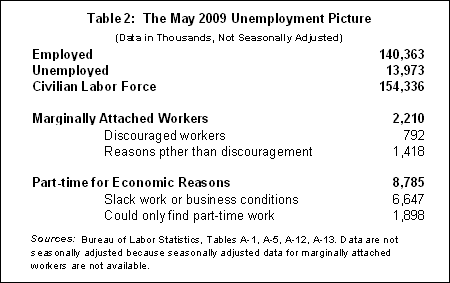 Why is the real unemployment rate so much higher than the official, or U-3, rate? First, forced part-time work has reached its highest level ever, going all the way back to 1956 and including the 1982 recession. In May 2009, 8.8 million workers were forced to work part time for economic reasons. Forced part-timers are concentrated in retail, food services, and construction; about a quarter of them are young workers between 16 and 24. The number of discouraged workers is high today as well. In May, the BLS counted 2.2 million “marginally attached” workers. That matches the highest number since 1994, when the agency introduced this measure.
With the economy in the throes of a catastrophic downturn, unemployment, no matter how it’s measured, will rise dramatically and impose yet more devastating costs on society and on those without a job or unable to find full-time work.
***********
Calculating the Real Unemployment Rate
The BLS calculates the official unemployment rate, U-3, as the number of unemployed as a percentage of the civilian labor force. The civilian labor force consists of employed workers plus the officially unemployed, those without jobs who are available to work and have looked for a job in the last 4 weeks. Applying the data found in Table 2 yields an official unemployment rate of 9.1%, or a seasonally adjusted rate 9.4% for April 2009.
Accounting for the large number of marginally attached workers and those working part-time for economic reasons raises the count of unemployed to 24.0 million workers for May 2009. Those numbers push up the U-6 unemployment rate to 15.9% or a seasonally adjusted rate of 16.4%.
John Miller teaches economics at Wheaton College and is a member of the Dollars & Sense collective.
Sources: U.S. Dept. of Labor, “The Unemployment Rate and Beyond: Alternative Measures of Labor Underutilization,” Issues in Labor Statistics, June 2008; John E. Bregger and Steven E. Haugen, “BLS introduces new range of alternative unemployment measures,” Monthly Labor Review, October 1995.
Still no recovery in sight for workers
By Fred Goldstein, Workers World, July 3, 2009
Bob Herbert, who is an op-ed columnist for the New York Times and also an African American, wrote in a recent piece: “There are now five unemployed workers for every job opening in the United States. The ranks of the poor are growing, welfare rolls are rising” and young male workers over a broad front “are falling into an abyss of joblessness.”
Herbert goes on to show that official unemployment, now 9.4 percent, is heading toward 10 percent at a good clip. He continues: “Economists are currently spreading the word that the recession may end sometime this year, but the unemployment rate will continue to climb. That’s not recovery. That’s mumbo jumbo.”
For the working class, employed and unemployed, truer words were never spoken.
Herbert shows that in November 2007 the officially unemployed numbered 7 million. Now the figure is about 14 million. He cites a study by the Center for Labor Market Studies at Northeastern University in Boston showing that, during this period, so-called “underutilized workers” had increased from more than 15 million to close to 30 million.
He points out that three quarters of the 6 million workers laid off in the last year were given permanent layoffs—meaning their jobs were destroyed. And he highlights the plight of young workers. Half of the 7 million job losses since November 2007 were sustained by workers under 30.
Herbert, one of the few Black voices allowed any expression by the rich-white-male-dominated New York Times, shows perplexed frustration: “Why rampant joblessness is not viewed as a crisis and approached with a sense of urgency and commitment the crisis warrants, is beyond me.”
To bosses, revival means profits
Of course, in a newspaper that is really one of the central organs of big business, it is natural that there could be no truthful discussion of this crisis. In the first place, the bosses regard this as a crisis of profits, of lost business. Uppermost in their minds and the minds of the vast majority of their economists and economic advisers is the revival of profits.
But in addition, this is a crisis of a new type. If there should be any sort of “capitalist recovery,” it will be a recovery for the capitalists, not the workers. This sort of recovery first showed itself after the 1991 downturn. It appeared again, even more strongly, after the 2000-2001 downturn in which the high-tech bubble had burst. These were the first “jobless recoveries.”
Herbert points out that the Obama administration is talking about a recovery this year—and yet, at the same time, the administration concedes that unemployment may go up to 10 percent!
The big business economists, when asked about this, mumble about the “lag” between the economic upturn and an upturn in employment. But, after the 1991 downturn, it took 18 months to get back to pre-downturn levels. After the 2001-2002 downturn, it took 27 months. During the present crisis, the drop of 7 million jobs in the 19 months of this recession is the biggest absolute decline and the largest percentage jump in the 68 years since the Great Depression ended. (Real Unemployment Rate Hits a 68-Year High, www.dollarsandsense.org)
What is behind this? There are many factors, but the most important is that this is the age of the scientific-technological revolution. The bosses are in a race to make more profits and reduce their labor costs; they do this by bringing in technology to replace workers. This shows itself in each boom-and-bust cycle.
Each new round of technology puts workers’ skills into machines. This lowers the workers’ skills required. Lower skills mean lower wages and more competition among workers. And the workers have less buying power.
At the same time the development of technology raises the productivity of labor. More goods and services are turned out in less time. With more productive labor, more commodities to sell and less buying power in society, it becomes more and more difficult for the capitalist system to start up the boom part of the boom-and-bust cycle.
It also means that it is harder and harder to bring jobs back into the economy after each bust is over.
With 30 million workers officially unemployed or underemployed—many of them discouraged from even looking for jobs or forced into part-time work— should there be an upturn in business (and that is not guaranteed at all!) massive unemployment will still remain, along with low wages.
Capitalism operates by the boom-and-bust cycle. But those cycles are changing—a lot less boom and a lot more bust, certainly as far as the workers are concerned. The bosses have more and more been relying on artificially created bubbles to revive the profit system. They increasingly rely on paper profits and speculation. This shows the sickness of the capitalist system, that it is in a stage of decline and decay.
Growth ‘based on bubbles’
This was expressed indirectly by one of the more renowned financial experts in the academic establishment, Nouriel Roubini of New York University. Roubini became a renowned figure after the present economic crisis broke out.
Prior to the crisis, in 2006, he challenged all the financial experts who said the housing bubble was no problem and would not really spill over into the economy. He predicted that the masses were overloaded with debt and that the problem was far larger than just the housing bubble. He predicted that the bubble would burst and be followed by a global economic crisis.
When he first put forward his prognosis at a conference of the International Monetary Fund, he was labeled “Dr. Doom.” Now, since the crisis he predicted in detail has materialized, he is one of the most celebrated economists on the lecture circuit.
An interview with Roubini by James Fallows, called “Dr. Doom Has Some Good News,” appeared in the April issue of the Atlantic Monthly. Toward the end of the interview, Fallows asked him about the economic future.
Roubini observed that “We have a growth model that has been based on bubbles. The only time we are growing is when there’s a big bubble. The question is, can the U.S. grow in a non-bubble way?”
When Fallows turned the question back to him, “he answered by returning to the damage caused by the boom-and-bust cycles and the need to find a different path.”
Capitalism has no “different path.” It has been following the boom-and-bust cycle since it began. Now the repetition of that cycle requires bigger and bigger bubbles which lead to bigger and bigger crises for the workers.
The bigger the crisis, the more the bosses try to push it off on the workers. Capital tries even harder to lower its labor costs as a means of restoring profits, lowering wages and replacing workers with machines. This destroys jobs, creating more poverty and more unemployment.
The working class needs a “different path,” all right. It needs a path that leads out of capitalist exploitation and production, a path out of this system where profits come before the rights and the very lives of the workers and the oppressed.
The present crisis must be fought by organizing, by international working class solidarity, by mass mobilization, by organizing the unemployed, by fighting to stop layoffs, by occupying plants before they can be shut down, by demanding the right to a good-paying job, by refusing to accept the capitalist scheme of things and, above all, by putting the rights of workers before the rights of bosses.
Articles copyright 1995-2009 Workers World. Verbatim copying and distribution of this entire article is permitted in any medium without royalty provided this notice is preserved.
Workers World, 55 W. 17 St., NY, NY 10011
Email: ww@workers.org
Subscribe wwnews-subscribe@workersworld.net
Support independent news http://www.workers.org/orders/donate.php
Web: http://workers.org
http://workersworld.net
Bob Herbert, who is an op-ed columnist for the New York Times and also an African American, wrote in a recent piece: “There are now five unemployed workers for every job opening in the United States. The ranks of the poor are growing, welfare rolls are rising” and young male workers over a broad front “are falling into an abyss of joblessness.”
Herbert goes on to show that official unemployment, now 9.4 percent, is heading toward 10 percent at a good clip. He continues: “Economists are currently spreading the word that the recession may end sometime this year, but the unemployment rate will continue to climb. That’s not recovery. That’s mumbo jumbo.”
For the working class, employed and unemployed, truer words were never spoken.
Herbert shows that in November 2007 the officially unemployed numbered 7 million. Now the figure is about 14 million. He cites a study by the Center for Labor Market Studies at Northeastern University in Boston showing that, during this period, so-called “underutilized workers” had increased from more than 15 million to close to 30 million.
He points out that three quarters of the 6 million workers laid off in the last year were given permanent layoffs—meaning their jobs were destroyed. And he highlights the plight of young workers. Half of the 7 million job losses since November 2007 were sustained by workers under 30.
Herbert, one of the few Black voices allowed any expression by the rich-white-male-dominated New York Times, shows perplexed frustration: “Why rampant joblessness is not viewed as a crisis and approached with a sense of urgency and commitment the crisis warrants, is beyond me.”
To bosses, revival means profits
Of course, in a newspaper that is really one of the central organs of big business, it is natural that there could be no truthful discussion of this crisis. In the first place, the bosses regard this as a crisis of profits, of lost business. Uppermost in their minds and the minds of the vast majority of their economists and economic advisers is the revival of profits.
But in addition, this is a crisis of a new type. If there should be any sort of “capitalist recovery,” it will be a recovery for the capitalists, not the workers. This sort of recovery first showed itself after the 1991 downturn. It appeared again, even more strongly, after the 2000-2001 downturn in which the high-tech bubble had burst. These were the first “jobless recoveries.”
Herbert points out that the Obama administration is talking about a recovery this year—and yet, at the same time, the administration concedes that unemployment may go up to 10 percent!
The big business economists, when asked about this, mumble about the “lag” between the economic upturn and an upturn in employment. But, after the 1991 downturn, it took 18 months to get back to pre-downturn levels. After the 2001-2002 downturn, it took 27 months. During the present crisis, the drop of 7 million jobs in the 19 months of this recession is the biggest absolute decline and the largest percentage jump in the 68 years since the Great Depression ended. (Real Unemployment Rate Hits a 68-Year High, www.dollarsandsense.org)
What is behind this? There are many factors, but the most important is that this is the age of the scientific-technological revolution. The bosses are in a race to make more profits and reduce their labor costs; they do this by bringing in technology to replace workers. This shows itself in each boom-and-bust cycle.
Each new round of technology puts workers’ skills into machines. This lowers the workers’ skills required. Lower skills mean lower wages and more competition among workers. And the workers have less buying power.
At the same time the development of technology raises the productivity of labor. More goods and services are turned out in less time. With more productive labor, more commodities to sell and less buying power in society, it becomes more and more difficult for the capitalist system to start up the boom part of the boom-and-bust cycle.
It also means that it is harder and harder to bring jobs back into the economy after each bust is over.
With 30 million workers officially unemployed or underemployed—many of them discouraged from even looking for jobs or forced into part-time work— should there be an upturn in business (and that is not guaranteed at all!) massive unemployment will still remain, along with low wages.
Capitalism operates by the boom-and-bust cycle. But those cycles are changing—a lot less boom and a lot more bust, certainly as far as the workers are concerned. The bosses have more and more been relying on artificially created bubbles to revive the profit system. They increasingly rely on paper profits and speculation. This shows the sickness of the capitalist system, that it is in a stage of decline and decay.
Growth ‘based on bubbles’
This was expressed indirectly by one of the more renowned financial experts in the academic establishment, Nouriel Roubini of New York University. Roubini became a renowned figure after the present economic crisis broke out.
Prior to the crisis, in 2006, he challenged all the financial experts who said the housing bubble was no problem and would not really spill over into the economy. He predicted that the masses were overloaded with debt and that the problem was far larger than just the housing bubble. He predicted that the bubble would burst and be followed by a global economic crisis.
When he first put forward his prognosis at a conference of the International Monetary Fund, he was labeled “Dr. Doom.” Now, since the crisis he predicted in detail has materialized, he is one of the most celebrated economists on the lecture circuit.
An interview with Roubini by James Fallows, called “Dr. Doom Has Some Good News,” appeared in the April issue of the Atlantic Monthly. Toward the end of the interview, Fallows asked him about the economic future.
Roubini observed that “We have a growth model that has been based on bubbles. The only time we are growing is when there’s a big bubble. The question is, can the U.S. grow in a non-bubble way?”
When Fallows turned the question back to him, “he answered by returning to the damage caused by the boom-and-bust cycles and the need to find a different path.”
Capitalism has no “different path.” It has been following the boom-and-bust cycle since it began. Now the repetition of that cycle requires bigger and bigger bubbles which lead to bigger and bigger crises for the workers.
The bigger the crisis, the more the bosses try to push it off on the workers. Capital tries even harder to lower its labor costs as a means of restoring profits, lowering wages and replacing workers with machines. This destroys jobs, creating more poverty and more unemployment.
The working class needs a “different path,” all right. It needs a path that leads out of capitalist exploitation and production, a path out of this system where profits come before the rights and the very lives of the workers and the oppressed.
The present crisis must be fought by organizing, by international working class solidarity, by mass mobilization, by organizing the unemployed, by fighting to stop layoffs, by occupying plants before they can be shut down, by demanding the right to a good-paying job, by refusing to accept the capitalist scheme of things and, above all, by putting the rights of workers before the rights of bosses.
Articles copyright 1995-2009 Workers World. Verbatim copying and distribution of this entire article is permitted in any medium without royalty provided this notice is preserved.
Workers World, 55 W. 17 St., NY, NY 10011
Email: ww@workers.org
Subscribe wwnews-subscribe@workersworld.net
Support independent news http://www.workers.org/orders/donate.php
Web: http://workers.org
http://workersworld.net
Hundreds Of Calif. Homeless March For Land Rights
By Richard Gonzales, NPR, July 2, 2009
click here to listen to audio
It has been about three months since city officials shut down a large "tent city" occupied by Sacramento's homeless people.
Now, some of the tent city's residents say they feel like refugees, with no place to go. They staged a loud demonstration Wednesday, in hopes of pressuring Sacramento officials to find them a new place to camp.
'Where Am I Supposed To Live?'
Philip Grice, 45, has been on the move ever since the tent city closed.
"When we moved out, we moved over to a private area two fields over. They wanted us off of there too. Just like shuttling cattle, that's all it is," said Grice, a carpenter by trade, who wears a T-shirt that reads, "Where am I supposed to live?" "We're supposed to be the eyesore, but actually we're citizens and we're human beings. We're supposed to have rights like everybody else; it don't matter what we have in our pockets."
Grice joined about 250 other homeless people and their supporters for a march through the northern end of Sacramento.
Their action coincided with the closure this week of a temporary shelter where many of the tent city residents had found a roof for the winter. Now these individuals say they need a year-round legal camp on what they call "safe ground."
Rodney Frazier, 43, a single father and disabled brick mason, participated in the march.
"A lot of these people are brick masons, they are tile setters, they are dentists, they had some very nice jobs," said Frazier. "They contribute to the world, to society, and they had a downfall in life. They need help getting up."
No Legal Place To Sleep
The march ended up in a hot and dusty city-owned lot next to a police station, where organizers set up a symbolic occupation. Val Jon Farris, founder of a group called iCare America, set up a tent on the lot.
"There is no legal place for people to live unless they own, rent or lease a home. So if you're homeless it's illegal to exist. You can't even lay your head anywhere without getting arrested, prosecuted or criminalized," said Farris. "So this is a demonstration in order to create a civil liberty that ought to already exist, which is [that] people have the right to be, to live without the threat of being incarcerated in their own country."
Sacramento police officer Mark Zoulas, who has served on the homeless beat for the past decade, said a legal campground makes sense to him.
"You need something for that immediate need," said Zoulas. "I like the winter shelter. I'm not saying that's the best answer in the world necessarily. But at least it gives you a choice. And that's now closed and everyone using it is out. And that leaves, for the minute, nothing, and nothing is never the answer."
The idea of a safe ground for homeless campers divides officials in city hall. The mayor, Kevin Johnson, has been receptive, but others, including the city manager, Ray Kerridge, is not. There is also a disagreement over how much it will cost at a time when the city and county are already slashing basic services.
What is not in dispute is that this week Sacramento has 200 more people with no place to sleep.
click here to listen to audio
It has been about three months since city officials shut down a large "tent city" occupied by Sacramento's homeless people.
Now, some of the tent city's residents say they feel like refugees, with no place to go. They staged a loud demonstration Wednesday, in hopes of pressuring Sacramento officials to find them a new place to camp.
'Where Am I Supposed To Live?'
Philip Grice, 45, has been on the move ever since the tent city closed.
"When we moved out, we moved over to a private area two fields over. They wanted us off of there too. Just like shuttling cattle, that's all it is," said Grice, a carpenter by trade, who wears a T-shirt that reads, "Where am I supposed to live?" "We're supposed to be the eyesore, but actually we're citizens and we're human beings. We're supposed to have rights like everybody else; it don't matter what we have in our pockets."
Grice joined about 250 other homeless people and their supporters for a march through the northern end of Sacramento.
Their action coincided with the closure this week of a temporary shelter where many of the tent city residents had found a roof for the winter. Now these individuals say they need a year-round legal camp on what they call "safe ground."
Rodney Frazier, 43, a single father and disabled brick mason, participated in the march.
"A lot of these people are brick masons, they are tile setters, they are dentists, they had some very nice jobs," said Frazier. "They contribute to the world, to society, and they had a downfall in life. They need help getting up."
No Legal Place To Sleep
The march ended up in a hot and dusty city-owned lot next to a police station, where organizers set up a symbolic occupation. Val Jon Farris, founder of a group called iCare America, set up a tent on the lot.
"There is no legal place for people to live unless they own, rent or lease a home. So if you're homeless it's illegal to exist. You can't even lay your head anywhere without getting arrested, prosecuted or criminalized," said Farris. "So this is a demonstration in order to create a civil liberty that ought to already exist, which is [that] people have the right to be, to live without the threat of being incarcerated in their own country."
Sacramento police officer Mark Zoulas, who has served on the homeless beat for the past decade, said a legal campground makes sense to him.
"You need something for that immediate need," said Zoulas. "I like the winter shelter. I'm not saying that's the best answer in the world necessarily. But at least it gives you a choice. And that's now closed and everyone using it is out. And that leaves, for the minute, nothing, and nothing is never the answer."
The idea of a safe ground for homeless campers divides officials in city hall. The mayor, Kevin Johnson, has been receptive, but others, including the city manager, Ray Kerridge, is not. There is also a disagreement over how much it will cost at a time when the city and county are already slashing basic services.
What is not in dispute is that this week Sacramento has 200 more people with no place to sleep.
Jobless rate at 9.5% - worst since 1983
By Tom Abate, San Francisco Chronicle, July 3, 2009
The U.S. unemployment rate rose to 9.5 percent in June, a 26-year high, as employers continued to slash payrolls, according to a Labor Department report that estimates 14.7 million Americans were out of work last month.
Employers cut 467,000 jobs in June, as construction and manufacturing continued to suffer big losses. Only health care bucked the downward trend and added jobs, the Labor Department said.
The United States has lost 6.5 million jobs since the recession began in December 2007. Employers have cut payrolls so deeply that the nation's job count has slipped to its May 2000 level, while 12.5 million adults have joined the labor force over the past nine years.
"This is the only recession since the Great Depression to wipe out all the job growth from the previous business cycle," said Heidi Shierholz with the Economic Policy Institute in Washington, D.C.
California will report its June job totals later this month. Thursday's bleak federal numbers suggest that the state unemployment rate, already at 11.5 percent, could head higher.
Despite rising unemployment, most economists think the recession is about to hit bottom and that the output of goods and services will begin to creep up by the end of the year.
"We're right about to turn the corner," said Lyle Gramley, a senior adviser with Stanford Washington Research Group.
But even this reasonably optimistic scenario envisions weak growth and a "jobless recovery" in which the U.S. unemployment rate will exceed 10 percent through 2010, before slowly declining over the next two to three years.
President Obama said Thursday he is "deeply concerned" about the job losses and understands that many families worry "whether they will be next."
Economist Nigel Gault with IHS Global Insight said Obama's stimulus package is only now starting to work its way into circulation and should start creating jobs in force by next year. But higher federal spending may simply offset state and local cutbacks in places like California that have their own budget woes.
"We may not get as big a jolt as we'd hoped but it would only be worse if the federal government hadn't stepped up spending," Gault said.
Thursday's Labor Department report shows no sign that the job market has hit bottom.
One indicator of weakness in the demand for labor is the number of hours in the average work week. It fell to 33 hours in June, the lowest on record since such measurements began in 1964, the Labor Department said.
That suggests that even when the demand for goods and services rebounds, employers will be able to meet it by adding hours for those already on payroll rather than creating jobs.
Mark Zandi, chief economist with Moody's Economy.com, said another worrisome indicator is the recent flattening of the average hourly wage.
Zandi said wages usually grow a few cents each month, and the flattening suggests that employers are finding it possible to cut their costs by lowering pay while workers are accepting reduced wages as preferable to layoffs.
Economist Heather Boushey with the Center for American Progress said the weak job market, and other factors like soft home prices, tend to make consumers cautious in an economy where their spending accounts for 70 percent of all activity. The reluctance to spend limits economic growth and puts more pressure on the job market in a downward spiral that has not yet run its course.
"It's pretty grim out there," Boushey said.
E-mail Tom Abate at tabate@sfchronicle.com.
This article appeared on page C - 1 of the San Francisco Chronicle
The U.S. unemployment rate rose to 9.5 percent in June, a 26-year high, as employers continued to slash payrolls, according to a Labor Department report that estimates 14.7 million Americans were out of work last month.
Employers cut 467,000 jobs in June, as construction and manufacturing continued to suffer big losses. Only health care bucked the downward trend and added jobs, the Labor Department said.
The United States has lost 6.5 million jobs since the recession began in December 2007. Employers have cut payrolls so deeply that the nation's job count has slipped to its May 2000 level, while 12.5 million adults have joined the labor force over the past nine years.
"This is the only recession since the Great Depression to wipe out all the job growth from the previous business cycle," said Heidi Shierholz with the Economic Policy Institute in Washington, D.C.
California will report its June job totals later this month. Thursday's bleak federal numbers suggest that the state unemployment rate, already at 11.5 percent, could head higher.
Despite rising unemployment, most economists think the recession is about to hit bottom and that the output of goods and services will begin to creep up by the end of the year.
"We're right about to turn the corner," said Lyle Gramley, a senior adviser with Stanford Washington Research Group.
But even this reasonably optimistic scenario envisions weak growth and a "jobless recovery" in which the U.S. unemployment rate will exceed 10 percent through 2010, before slowly declining over the next two to three years.
President Obama said Thursday he is "deeply concerned" about the job losses and understands that many families worry "whether they will be next."
Economist Nigel Gault with IHS Global Insight said Obama's stimulus package is only now starting to work its way into circulation and should start creating jobs in force by next year. But higher federal spending may simply offset state and local cutbacks in places like California that have their own budget woes.
"We may not get as big a jolt as we'd hoped but it would only be worse if the federal government hadn't stepped up spending," Gault said.
Thursday's Labor Department report shows no sign that the job market has hit bottom.
One indicator of weakness in the demand for labor is the number of hours in the average work week. It fell to 33 hours in June, the lowest on record since such measurements began in 1964, the Labor Department said.
That suggests that even when the demand for goods and services rebounds, employers will be able to meet it by adding hours for those already on payroll rather than creating jobs.
Mark Zandi, chief economist with Moody's Economy.com, said another worrisome indicator is the recent flattening of the average hourly wage.
Zandi said wages usually grow a few cents each month, and the flattening suggests that employers are finding it possible to cut their costs by lowering pay while workers are accepting reduced wages as preferable to layoffs.
Economist Heather Boushey with the Center for American Progress said the weak job market, and other factors like soft home prices, tend to make consumers cautious in an economy where their spending accounts for 70 percent of all activity. The reluctance to spend limits economic growth and puts more pressure on the job market in a downward spiral that has not yet run its course.
"It's pretty grim out there," Boushey said.
E-mail Tom Abate at tabate@sfchronicle.com.
This article appeared on page C - 1 of the San Francisco Chronicle
Gov’t giveaway plan: Trillions for Wall St., poverty for workers
By Fred Goldstein, http://workers.org
The so-called Public-Private Investment Plan, crafted and presented by Secretary of the Treasury Timothy Geithner, intends to make a trillion dollars available to the biggest banks, hedge funds, private equity funds and other investors, supposedly to get the banks to lend money to businesses and consumers again.
The essence of the plan has two sides to it. First, bribe hedge funds, private equity funds and others in the shadow banking system who have been sitting on the sidelines with trillions of dollars—by offering them government money and loan guarantees to purchase bad bank assets. Second, bribe the banks to sell investors these bad loans by offering to pay far more than they are worth.
So the rich get a deal from the Treasury both ways.
The banks are holding onto $2 trillion in bad loans resulting from their speculation on the great housing and real estate bubble. They don’t want to sell these bad loans at anywhere near their vastly reduced worth because they would have to declare them as big losses. Up to now they have been refusing to sell and have been holding out for more.
Meanwhile, hedge funds, private equity funds and other investors are holding onto trillions of dollars, which they keep in government bonds and other secure investments. They don’t want to lend this money to help workers or businesses or anybody. These moneybags are sitting on the sidelines, looking for mergers or buyouts, while clipping the interest coupons.
Geithner, Lawrence Summers—Obama’s chief economic adviser—and company came up with a brilliant modification of the plan to buy so-called “toxic assets” crafted by former Treasury Secretary Henry Paulson during the Bush administration.
Here is an illustration of one part of Geithner’s plan. “It works like this, according to the Treasury Department fact sheet: Imagine that a bank wants to sell mortgage loans with a $100 million face value. The FDIC [Federal Deposit Insurance Corporation] would auction the loans to private bidders. Suppose the winning bidder offered $84 million. The private investor would put up $6 million, Treasury would put up $6 million, and the FDIC would guarantee $72 million worth of loans.” (Washington Post, March 23)
No matter if things go well or bad—in other words, whether the assets can be sold at close to $84 million or if they completely fail and not a penny can be collected—the bank still gets its $84 million. If things go well, the investors make a killing on a $6 million investment. If things go bad, the government gets stuck with the loan to pay off, while the investors walk away with a minimum loss (which they will write off their taxes). In addition, the private fund managers get to retain control over the investment.
There is another type of deal in the plan in which the government matches the private investors dollar-for-dollar and also provides loans to go with it. This is for the bad mortgage-backed securities.
Make a trillion dollars subject to these giveaway terms and it is guaranteed to send the stock market through the roof—at least for a moment.
Giveaway vs. ‘nationalize’
There are so many problematical issues involved with this plan that its prospect for success, even on the terms projected by Geithner and his allies, seems highly doubtful to more cautious sections of the ruling class.
The giveaway plan represents a victory of the Geithner/Larry Summers faction over the “nationalization” current in the ruling class establishment. In this sense it represents a victory of the faction closest to the big banks on Wall Street that are in the deepest trouble.
The nationalization current, more properly described as those for receivership, is not so closely tied to the direct interests of these banks and has a broader view of the needs of their class and the financial system in this present crisis. Their views are sharply opposed to the Geithner/Summers adventure.
This current wants to stop pouring money indiscriminately into banks that are already insolvent, change the management, force them to declare losses, restructure them, take a stake in the banks and then hand them back to private owners and collect dividends. This view was recently propounded by Thomas M. Hoenig, president of the Federal Reserve Bank of Kansas City, in a paper entitled “Too Big Has Failed.” It is easy to see how unpalatable such a view would be to Citigroup and other large banks.
It is the normal function of the capitalist state and the bourgeois political parties to protect the interests of the capitalist class as a whole and their system. This is the way the state has conducted itself, by and large, during previous lesser crises: the Latin American debt crisis, which endangered the U.S. banking system during the Reagan administration; the savings and loan crisis of the late 1980s and early 1990s; and the 1995 Mexican bailout crisis, when U.S. investors were threatened by the collapse of the Mexican peso.
A ruling class consensus was arrived at on each occasion and the Treasury Department and Federal Reserve System took the necessary measures to deal with the situation and avert a collapse.
Crisis has deep roots
But the magnitude of this global crisis is so vast, and the power of the banks involved, the extraordinary deterioration of their financial conditions, and their desperation to save themselves at all costs is so great, that the Obama administration has been dragged into a most questionable scheme.
The administration has become entrapped by the narrow interests of Goldman Sachs, Citigroup, AIG, Merrill Lynch and their ilk to the point of throwing trillions of dollars at them to keep these specific banks afloat, at the expense of using these funds to bolster the system as a whole.
This could have dire political consequences in the long run for President Barack Obama himself.
Not that any amount of funding could significantly turn this capitalist crisis around in the long run. It is fundamentally caused by a global crisis of capitalist overproduction, which has been aggravated and intensified by the financial crisis.
The present crisis is profound. It represents the end of a 70-year era of upward development of the productive forces by U.S. and world capitalism that was propelled by military spending, imperialist globalization, destruction of the standard of living of the workers of the world, technological attacks on jobs, devastation of the environment, plus massive credit and indebtedness. These forces have run their course and no bailout or stimulus package can change these fundamentals.
But a trillion dollars is a lot of money. It could fund measures to ameliorate the crisis to some extent if strategically placed—particularly if it were given directly to the masses, either as wages for a jobs program or as direct assistance or to cancel the mortgages of the millions facing foreclosure and to restore the foreclosed families to their homes.
What workers won in the 1930s
One need go back to the administration of Franklin D. Roosevelt to get a sense of the kind of temporary relief for the workers that could be administered—even though Roosevelt was never able to solve the crisis of capitalist overproduction, except through war.
Economist James Galbraith in a Washington Monthly article of March 9, “No Return to Normal,” cites one study showing that the Roosevelt government “hired about 60 percent of the unemployed in public works and conservation projects that planted a billion trees, saved the whooping crane, modernized rural America, and built such diverse projects as the Cathedral of Learning in Pittsburgh, the Montana state capitol, much of the Chicago lakefront, New York’s Lincoln Tunnel and Triborough Bridge complex, the Tennessee Valley Authority and the aircraft carriers Enterprise and Yorktown. It also built or renovated 2,500 hospitals, 45,000 schools, 13,000 parks and playgrounds, 7,800 bridges, 700,000 miles of roads, and a thousand airfields. And it employed 50,000 teachers, rebuilt the country’s entire rural school system, and hired 3,000 writers, musicians, sculptors and painters, including Willem de Kooning and Jackson Pollock.”
No faction of any significance in the ruling class is debating this question for now because the class struggle is dormant and the masses have not yet risen up against their conditions as they did during the Great Depression. But that is because the crisis is only in its early stages. Roosevelt is known for his concessions to the workers because the workers won those concessions by mass struggle. Obama has no such situation right now and is hewing to a generally conservative line of approach. This could change.
In addition, the issue of the AIG bonuses has sharpened the political situation. Fearing the masses and because their own connections to the big banks are coming out, the Democratic Party politicians in the House of Representatives became hysterical in their denunciations of the bonuses to AIG executives, as did a significant number of Republicans. They all engaged in a public attack on corporate bosses and, by implication, on their own paymasters.
The situation may be quieted somewhat now that some of the executives are returning the bonuses. But this political outburst showed that the right-wing forces are straining at the bit to become champions of the “little people” and supposed adversaries of the “greedy bankers” as a way of getting at the Obama administration. They hope crisis will create an opening for a right-wing, racist revival. The working class must be on the alert for this and not be sucked in by any of this demagogy.
‘A dangerous year’
The entire government plan is predicated on a revival of the capitalist economy and the housing market. This is what will presumably make the bad assets go up in value, when people start buying houses again and bidding up the prices. In fact, an announcement that first-time housing sales went up helped fuel a buying frenzy on Wall Street.
But the Wall Street Journal of March 23 wrote about the rise in home sales that “nearly half of the sales occurred in the foreclosure/vulture market. So, home sales are up, but it’s heavily dominated by bottom fishing.”
More important was a statement by the head of the World Bank, Robert Zoellick, that 2009 would be a “dangerous year.” He said on March 21 that the global economy would shrink by 1 to 2 percent during the year: “We haven’t seen a figure like that globally since the end of World War II, which really means the Great Depression.” In addition the World Bank was projecting that global trade was set to slide the most in 80 years, a decline in exports of 2.1 percent, not seen since 1982. The European economy will shrink by 3.2 percent (raised from an earlier forecast of 2 percent). Japan’s economy is projected to shrink by 5.8 percent and the U.S. economy by 2.6 percent.
Of course these projections are always subject to correction, but they have been consistently revised in a negative direction. They are confirmed by a report about global manufacturing. In Europe industrial production is down 12 percent from a year ago. In Brazil it is down 15 percent, in Taiwan a staggering 43 percent. Manufacturing fell in India for the first time in years. China’s manufacturing is down by 25 percent.
The three largest imperialist economic blocs—Europe, Japan and the U.S.—are all predicted to shrink their economies. And three of the most populous countries in the world, representing two-fifths of the world’s population, are showing a decline in industrial output.
It is clear that, despite the momentary euphoria of the profiteers on Wall Street, this crisis is not about to be solved. Even if the banks were to start lending again, the population is in ruins. No one is credit worthy because they are in debt, losing their jobs, paying medical bills, paying student loans, paying their credit card loans and/or are behind in their mortgages.
The idea that it is necessary to give these banks trillions in order to solve the crisis is either a grand illusion or outright fraud. The bailout is calculated first and foremost to save the banks while the masses sink deeper into the real crisis—the crisis of unemployment, homelessness and poverty.
The only solution is a mass mobilization to fight back against the capitalist system that is robbing people of their incomes, their homes and their very lives. The sanctity of capitalist profits is what is at the bottom of bailouts, layoffs and foreclosures. It is time to say no to capitalism.
Published Mar 29, 2009 9:00 PM
Articles copyright 1995-2009 Workers World. Verbatim copying and distribution of this entire article is permitted in any medium without royalty provided this notice is preserved.
Workers World, 55 W. 17 St., NY, NY 10011
Email: ww@workers.org
Subscribe wwnews-subscribe@workersworld.net
Support independent news http://www.workers.org/orders/donate.php
**********************
Bail Out the People Movement
http://www.bailoutpeople.org
But a trillion dollars is a lot of money. It could fund measures to ameliorate the crisis to some extent if strategically placed—particularly if it were given directly to the masses, either as wages for a jobs program or as direct assistance or to cancel the mortgages of the millions facing foreclosure and to restore the foreclosed families to their homes.There is nothing like the smell of a trillion-dollar bonanza to send the stock market through the roof. Wall Street has struck it rich with the Obama administration’s blatantly pro-banker, pro-investor program to revive the capitalist economy.
What workers won in the 1930s
One need go back to the administration of Franklin D. Roosevelt to get a sense of the kind of temporary relief for the workers that could be administered—even though Roosevelt was never able to solve the crisis of capitalist overproduction, except through war.
Economist James Galbraith in a Washington Monthly article of March 9, “No Return to Normal,” cites one study showing that the Roosevelt government “hired about 60 percent of the unemployed in public works and conservation projects that planted a billion trees, saved the whooping crane, modernized rural America, and built such diverse projects as the Cathedral of Learning in Pittsburgh, the Montana state capitol, much of the Chicago lakefront, New York’s Lincoln Tunnel and Triborough Bridge complex, the Tennessee Valley Authority and the aircraft carriers Enterprise and Yorktown. It also built or renovated 2,500 hospitals, 45,000 schools, 13,000 parks and playgrounds, 7,800 bridges, 700,000 miles of roads, and a thousand airfields. And it employed 50,000 teachers, rebuilt the country’s entire rural school system, and hired 3,000 writers, musicians, sculptors and painters, including Willem de Kooning and Jackson Pollock.”
No faction of any significance in the ruling class is debating this question for now because the class struggle is dormant and the masses have not yet risen up against their conditions as they did during the Great Depression. But that is because the crisis is only in its early stages. Roosevelt is known for his concessions to the workers because the workers won those concessions by mass struggle. Obama has no such situation right now and is hewing to a generally conservative line of approach. This could change.
The so-called Public-Private Investment Plan, crafted and presented by Secretary of the Treasury Timothy Geithner, intends to make a trillion dollars available to the biggest banks, hedge funds, private equity funds and other investors, supposedly to get the banks to lend money to businesses and consumers again.
The essence of the plan has two sides to it. First, bribe hedge funds, private equity funds and others in the shadow banking system who have been sitting on the sidelines with trillions of dollars—by offering them government money and loan guarantees to purchase bad bank assets. Second, bribe the banks to sell investors these bad loans by offering to pay far more than they are worth.
So the rich get a deal from the Treasury both ways.
The banks are holding onto $2 trillion in bad loans resulting from their speculation on the great housing and real estate bubble. They don’t want to sell these bad loans at anywhere near their vastly reduced worth because they would have to declare them as big losses. Up to now they have been refusing to sell and have been holding out for more.
Meanwhile, hedge funds, private equity funds and other investors are holding onto trillions of dollars, which they keep in government bonds and other secure investments. They don’t want to lend this money to help workers or businesses or anybody. These moneybags are sitting on the sidelines, looking for mergers or buyouts, while clipping the interest coupons.
Geithner, Lawrence Summers—Obama’s chief economic adviser—and company came up with a brilliant modification of the plan to buy so-called “toxic assets” crafted by former Treasury Secretary Henry Paulson during the Bush administration.
Here is an illustration of one part of Geithner’s plan. “It works like this, according to the Treasury Department fact sheet: Imagine that a bank wants to sell mortgage loans with a $100 million face value. The FDIC [Federal Deposit Insurance Corporation] would auction the loans to private bidders. Suppose the winning bidder offered $84 million. The private investor would put up $6 million, Treasury would put up $6 million, and the FDIC would guarantee $72 million worth of loans.” (Washington Post, March 23)
No matter if things go well or bad—in other words, whether the assets can be sold at close to $84 million or if they completely fail and not a penny can be collected—the bank still gets its $84 million. If things go well, the investors make a killing on a $6 million investment. If things go bad, the government gets stuck with the loan to pay off, while the investors walk away with a minimum loss (which they will write off their taxes). In addition, the private fund managers get to retain control over the investment.
There is another type of deal in the plan in which the government matches the private investors dollar-for-dollar and also provides loans to go with it. This is for the bad mortgage-backed securities.
Make a trillion dollars subject to these giveaway terms and it is guaranteed to send the stock market through the roof—at least for a moment.
Giveaway vs. ‘nationalize’
There are so many problematical issues involved with this plan that its prospect for success, even on the terms projected by Geithner and his allies, seems highly doubtful to more cautious sections of the ruling class.
The giveaway plan represents a victory of the Geithner/Larry Summers faction over the “nationalization” current in the ruling class establishment. In this sense it represents a victory of the faction closest to the big banks on Wall Street that are in the deepest trouble.
The nationalization current, more properly described as those for receivership, is not so closely tied to the direct interests of these banks and has a broader view of the needs of their class and the financial system in this present crisis. Their views are sharply opposed to the Geithner/Summers adventure.
This current wants to stop pouring money indiscriminately into banks that are already insolvent, change the management, force them to declare losses, restructure them, take a stake in the banks and then hand them back to private owners and collect dividends. This view was recently propounded by Thomas M. Hoenig, president of the Federal Reserve Bank of Kansas City, in a paper entitled “Too Big Has Failed.” It is easy to see how unpalatable such a view would be to Citigroup and other large banks.
It is the normal function of the capitalist state and the bourgeois political parties to protect the interests of the capitalist class as a whole and their system. This is the way the state has conducted itself, by and large, during previous lesser crises: the Latin American debt crisis, which endangered the U.S. banking system during the Reagan administration; the savings and loan crisis of the late 1980s and early 1990s; and the 1995 Mexican bailout crisis, when U.S. investors were threatened by the collapse of the Mexican peso.
A ruling class consensus was arrived at on each occasion and the Treasury Department and Federal Reserve System took the necessary measures to deal with the situation and avert a collapse.
Crisis has deep roots
But the magnitude of this global crisis is so vast, and the power of the banks involved, the extraordinary deterioration of their financial conditions, and their desperation to save themselves at all costs is so great, that the Obama administration has been dragged into a most questionable scheme.
The administration has become entrapped by the narrow interests of Goldman Sachs, Citigroup, AIG, Merrill Lynch and their ilk to the point of throwing trillions of dollars at them to keep these specific banks afloat, at the expense of using these funds to bolster the system as a whole.
This could have dire political consequences in the long run for President Barack Obama himself.
Not that any amount of funding could significantly turn this capitalist crisis around in the long run. It is fundamentally caused by a global crisis of capitalist overproduction, which has been aggravated and intensified by the financial crisis.
The present crisis is profound. It represents the end of a 70-year era of upward development of the productive forces by U.S. and world capitalism that was propelled by military spending, imperialist globalization, destruction of the standard of living of the workers of the world, technological attacks on jobs, devastation of the environment, plus massive credit and indebtedness. These forces have run their course and no bailout or stimulus package can change these fundamentals.
But a trillion dollars is a lot of money. It could fund measures to ameliorate the crisis to some extent if strategically placed—particularly if it were given directly to the masses, either as wages for a jobs program or as direct assistance or to cancel the mortgages of the millions facing foreclosure and to restore the foreclosed families to their homes.
What workers won in the 1930s
One need go back to the administration of Franklin D. Roosevelt to get a sense of the kind of temporary relief for the workers that could be administered—even though Roosevelt was never able to solve the crisis of capitalist overproduction, except through war.
Economist James Galbraith in a Washington Monthly article of March 9, “No Return to Normal,” cites one study showing that the Roosevelt government “hired about 60 percent of the unemployed in public works and conservation projects that planted a billion trees, saved the whooping crane, modernized rural America, and built such diverse projects as the Cathedral of Learning in Pittsburgh, the Montana state capitol, much of the Chicago lakefront, New York’s Lincoln Tunnel and Triborough Bridge complex, the Tennessee Valley Authority and the aircraft carriers Enterprise and Yorktown. It also built or renovated 2,500 hospitals, 45,000 schools, 13,000 parks and playgrounds, 7,800 bridges, 700,000 miles of roads, and a thousand airfields. And it employed 50,000 teachers, rebuilt the country’s entire rural school system, and hired 3,000 writers, musicians, sculptors and painters, including Willem de Kooning and Jackson Pollock.”
No faction of any significance in the ruling class is debating this question for now because the class struggle is dormant and the masses have not yet risen up against their conditions as they did during the Great Depression. But that is because the crisis is only in its early stages. Roosevelt is known for his concessions to the workers because the workers won those concessions by mass struggle. Obama has no such situation right now and is hewing to a generally conservative line of approach. This could change.
In addition, the issue of the AIG bonuses has sharpened the political situation. Fearing the masses and because their own connections to the big banks are coming out, the Democratic Party politicians in the House of Representatives became hysterical in their denunciations of the bonuses to AIG executives, as did a significant number of Republicans. They all engaged in a public attack on corporate bosses and, by implication, on their own paymasters.
The situation may be quieted somewhat now that some of the executives are returning the bonuses. But this political outburst showed that the right-wing forces are straining at the bit to become champions of the “little people” and supposed adversaries of the “greedy bankers” as a way of getting at the Obama administration. They hope crisis will create an opening for a right-wing, racist revival. The working class must be on the alert for this and not be sucked in by any of this demagogy.
‘A dangerous year’
The entire government plan is predicated on a revival of the capitalist economy and the housing market. This is what will presumably make the bad assets go up in value, when people start buying houses again and bidding up the prices. In fact, an announcement that first-time housing sales went up helped fuel a buying frenzy on Wall Street.
But the Wall Street Journal of March 23 wrote about the rise in home sales that “nearly half of the sales occurred in the foreclosure/vulture market. So, home sales are up, but it’s heavily dominated by bottom fishing.”
More important was a statement by the head of the World Bank, Robert Zoellick, that 2009 would be a “dangerous year.” He said on March 21 that the global economy would shrink by 1 to 2 percent during the year: “We haven’t seen a figure like that globally since the end of World War II, which really means the Great Depression.” In addition the World Bank was projecting that global trade was set to slide the most in 80 years, a decline in exports of 2.1 percent, not seen since 1982. The European economy will shrink by 3.2 percent (raised from an earlier forecast of 2 percent). Japan’s economy is projected to shrink by 5.8 percent and the U.S. economy by 2.6 percent.
Of course these projections are always subject to correction, but they have been consistently revised in a negative direction. They are confirmed by a report about global manufacturing. In Europe industrial production is down 12 percent from a year ago. In Brazil it is down 15 percent, in Taiwan a staggering 43 percent. Manufacturing fell in India for the first time in years. China’s manufacturing is down by 25 percent.
The three largest imperialist economic blocs—Europe, Japan and the U.S.—are all predicted to shrink their economies. And three of the most populous countries in the world, representing two-fifths of the world’s population, are showing a decline in industrial output.
It is clear that, despite the momentary euphoria of the profiteers on Wall Street, this crisis is not about to be solved. Even if the banks were to start lending again, the population is in ruins. No one is credit worthy because they are in debt, losing their jobs, paying medical bills, paying student loans, paying their credit card loans and/or are behind in their mortgages.
The idea that it is necessary to give these banks trillions in order to solve the crisis is either a grand illusion or outright fraud. The bailout is calculated first and foremost to save the banks while the masses sink deeper into the real crisis—the crisis of unemployment, homelessness and poverty.
The only solution is a mass mobilization to fight back against the capitalist system that is robbing people of their incomes, their homes and their very lives. The sanctity of capitalist profits is what is at the bottom of bailouts, layoffs and foreclosures. It is time to say no to capitalism.
Published Mar 29, 2009 9:00 PM
Articles copyright 1995-2009 Workers World. Verbatim copying and distribution of this entire article is permitted in any medium without royalty provided this notice is preserved.
Workers World, 55 W. 17 St., NY, NY 10011
Email: ww@workers.org
Subscribe wwnews-subscribe@workersworld.net
Support independent news http://www.workers.org/orders/donate.php
**********************
Bail Out the People Movement
http://www.bailoutpeople.org
Region's worst jobless rate strains Chester Co.
In hard-hit S.C. county, the only thing scarcer than jobs is hope
By Clay Barbour, charlotte.com, March 21, 2009
click here for photo slideshow
CHESTER, S.C. Every month Tammy Waters sits down at her kitchen table and writes out a list of bills on a piece of notebook paper.
Delinquent utilities: $1,050
Truck payment: $400
Groceries for two: $300
Gas: $160
Furniture payment: $190
Medical: $1,000
Waters then writes down what she has to cover them, $1,000 – the total of her monthly unemployment benefits.
“No matter how you add it up, there just isn't enough,” she says. “But I guess I'm lucky. I don't know what I'd do if I didn't have my unemployment.”
Waters, 40, is one of thousands of Chester County residents out of work. The county's unemployment rate has climbed to 19.6 percent.
That figure represents those receiving benefits. Experts say the true number is closer to 40 percent.
Last week, Mark Sanford became the first governor to turn down part of his state's share of federal economic stimulus money. For South Carolina, that meant losing about $700 million.
That money would have extended unemployment pay by another 13 weeks and, for the first time, given jobless benefits to part-time employees.
State legislators have said they plan to override the governor, but it is still unclear if they have the authority.
Sanford made national news. But behind the headlines, 66 miles from the Statehouse, sits Chester County. Here, half the residents receive food stamps and the only thing scarcer than jobs is hope.
“There is just a general sense of helplessness,” says Willy Sherrod, a consultant with the county's Department of Social Services. “They can't find jobs and they can't afford to move. They feel trapped and scared, and they don't see things changing anytime soon.”
Benefits gone; need remains
It's 10 a.m. and the Chester County Employment Security Commission office is packed.
On one side, people wait to speak with counselors or use the agency's computers.
On the other, a crowd sits patiently to interview for jobs at a new Bojangles'.
The franchise owner has 50 spots to fill. By the end of the day he will meet more than 150 applicants.
S.C. residents are eligible for a maximum of 46 weeks of unemployment benefits, topping out at $351 a week.
Zachary Booker, Chester's assistant ESC director, said many people here have already exhausted their eligibility. Still, they come for help.
“That's probably the toughest thing we deal with,” he says. “How do you tell people that there is just no money left to give?”
The job market has gotten so bad that the county's three temporary employment agencies have closed.
DSS plans to fill that void by creating its own version of a temp agency.
“The hope is, word will get around and people who need yard work done or something built can call us and we can go to the list,” Sherrod says. “It's not much, but in this economy you do what you can.”
DSS is a common stop for the unemployed. The county has some 32,000 residents. About 16,000 receive food stamps.
“They are knocking our doors down, looking for help with food, medicine, baby diapers. We try to do as much as we can, but …” Sherrod says, leaving the sentence hanging in the air.
‘It's a ghost town now'
It wasn't always this way.
For years the county about 50 miles south of Charlotte enjoyed relative prosperity.
A person could work in one of the textile mills, like Springs, Pillowtex or J.P. Stevens, and make a decent living.
Today teachers at Chester High School are forced to advise their students to not only get a good education, but to leave town.
“We have to be realistic,” says guidance counselor Phyllis Williams. “There has to be something to come back to, and there just isn't.”
Census data show that in 2000 the county had 11,798 jobs and 34,000 people, with a median age of 36.
In 2008, the latest available numbers, the jobs had dropped to 9,703 and the population to 32,000. The median age rose to almost 40.
Ed Scates, 59, worked in the mills ever since he came back to Chester from Vietnam. He was a material manager at Springs for 21 years, until the company phased out his job. Then he went to work for Roush Industries, another plant in town.
That plant closed four years ago. Ever since Scates has been scratching out a living minding the Cox Auction Co., an auction house and antique store in downtown Chester.
“I'm just barely getting by” Scates says, in between bites of fried chicken and mashed potatoes at Gene's restaurant, a local landmark. “But what are you gonna do? Things ain't ever going to be like they were.”
Drive through one of Chester's neighborhoods and you'll pass several stately Southern homes; many are boarded up or in disrepair.
Downtown, the buildings are as clean and colorful as a box of crayons. But there is little activity.
Scates points to Gadsden Street, the city's main thoroughfare.
It's almost 1 p.m. and the street is nearly empty. The occasional car passes by. Every so often a person crosses the street, never looking up to see if it's safe.
“It's a ghost town now,” says Cathy Devett, a waitress standing nearby.
Without jobs or prospects
Even Gov. Sanford's most ardent supporters in Chester were stung by his rejection of the stimulus money.
“I guess he has his reasons,” says Johnny Fleming. “But we sure as hell could have used that money around here.”
Fleming, 42, worked for Springs for 12 years. He was laid off two years ago and ever since has been “scheming and scamming and doing what I can just to make a living.”
He used up his unemployment more than a year back. Since then Fleming and his wife, Brenda, have run a consignment store in downtown Chester, along with three other former mill workers.
The couple lives in a trailer left to him by his parents. Otherwise, Fleming says, they could be homeless.
“My last year at Springs, with overtime, I made $64,000,” he says. “These days I am robbing Peter to pay Paul. I am hustling, but that is all I can do.”
U.S. Sen. Lindsey Graham, R-S.C., says he has heard such stories many times. He said the governor is right to worry about the long-term effects of changing the state's rules regarding unemployment, but Graham said he is also worried about the people without jobs or prospects.
“It is tough all across the state,” he says. “You have a lot of people getting up early and staying up late, and they can't find work.”
Officials in Chester have tried to attract new development. In October the Institute for Business and Home Safety announced it would open a facility here, hiring about 18 people. The company breaks ground next month and is expected to be up and running in a year.
Southeastern Petroleum is scheduled to open a processing plant in six months that should employ 10.
For now, the economy has cost the county anything bigger. The new JRS Custom Fabrication plant was supposed to mean 170 jobs. So far the company has hired five and, according to Karlisa Parker, the county economic development director, the project is on hold.
Even worse, Poly-America, a plastics company, had announced plans for a center that could mean 400 new jobs, but that project is also on hold, Parker says.
“We are starting to have people feeling us out again,” she says. “But even at that, they tell us it will take some time.”
Stress takes its toll
Tammy Waters has always taken pride in being independent. She's held a job since she was 15, managed to put two kids through college and attended night school to get her accounting degree.
Being out of work and broke has been hard
For seven years she worked as a customer-service representative in Charlotte, with a company that handled photos for Wal-Mart.
During that time she watched her oldest daughter graduate from USC Spartanburg, her youngest daughter start college there and her son, J.T., grow into a young man.
In November 2007, her company went bankrupt. Sears bought it out, and she lost her job.
Since then, Waters has watched her savings dry up and fallen behind on her bills.
Because she worked in Charlotte, she receives unemployment from North Carolina. The state recently accepted its stimulus money, which has extended maximum unemployment benefits to 72 weeks. But Waters knows it's only a matter of time before that runs out.
“I have applied for hundreds of jobs, online and in person,” she says. “Something has to change soon. It just has to.”
Waters now lives on a tight budget. No Internet. No cable. No home phone. She receives food stamps and clips coupons. If her 15-year-old son wants to see a movie, she has to save up for it.
The stress from the past year has taken its toll.
Last month Waters had to go to the doctor for what seemed like heart problems. The bill from the visit topped $800.
“I am barely holding on and trying to keep a positive face,” Waters says. “I don't want J.T. to see what I am going through. But Lord, I don't know how much more of this I can take.”
cbarbour@charlotteobserver.com
http://www.charlotteobserver.com/597/story/612647.html
By Clay Barbour, charlotte.com, March 21, 2009
click here for photo slideshow
Waters, 40, is one of thousands of Chester County residents out of work. The county's unemployment rate has climbed to 19.6 percent.
That figure represents those receiving benefits. Experts say the true number is closer to 40 percent.
Last week, Mark Sanford became the first governor to turn down part of his state's share of federal economic stimulus money. For South Carolina, that meant losing about $700 million.
That money would have extended unemployment pay by another 13 weeks and, for the first time, given jobless benefits to part-time employees.
CHESTER, S.C. Every month Tammy Waters sits down at her kitchen table and writes out a list of bills on a piece of notebook paper.
Delinquent utilities: $1,050
Truck payment: $400
Groceries for two: $300
Gas: $160
Furniture payment: $190
Medical: $1,000
Waters then writes down what she has to cover them, $1,000 – the total of her monthly unemployment benefits.
“No matter how you add it up, there just isn't enough,” she says. “But I guess I'm lucky. I don't know what I'd do if I didn't have my unemployment.”
Waters, 40, is one of thousands of Chester County residents out of work. The county's unemployment rate has climbed to 19.6 percent.
That figure represents those receiving benefits. Experts say the true number is closer to 40 percent.
Last week, Mark Sanford became the first governor to turn down part of his state's share of federal economic stimulus money. For South Carolina, that meant losing about $700 million.
That money would have extended unemployment pay by another 13 weeks and, for the first time, given jobless benefits to part-time employees.
State legislators have said they plan to override the governor, but it is still unclear if they have the authority.
Sanford made national news. But behind the headlines, 66 miles from the Statehouse, sits Chester County. Here, half the residents receive food stamps and the only thing scarcer than jobs is hope.
“There is just a general sense of helplessness,” says Willy Sherrod, a consultant with the county's Department of Social Services. “They can't find jobs and they can't afford to move. They feel trapped and scared, and they don't see things changing anytime soon.”
Benefits gone; need remains
It's 10 a.m. and the Chester County Employment Security Commission office is packed.
On one side, people wait to speak with counselors or use the agency's computers.
On the other, a crowd sits patiently to interview for jobs at a new Bojangles'.
The franchise owner has 50 spots to fill. By the end of the day he will meet more than 150 applicants.
S.C. residents are eligible for a maximum of 46 weeks of unemployment benefits, topping out at $351 a week.
Zachary Booker, Chester's assistant ESC director, said many people here have already exhausted their eligibility. Still, they come for help.
“That's probably the toughest thing we deal with,” he says. “How do you tell people that there is just no money left to give?”
The job market has gotten so bad that the county's three temporary employment agencies have closed.
DSS plans to fill that void by creating its own version of a temp agency.
“The hope is, word will get around and people who need yard work done or something built can call us and we can go to the list,” Sherrod says. “It's not much, but in this economy you do what you can.”
DSS is a common stop for the unemployed. The county has some 32,000 residents. About 16,000 receive food stamps.
“They are knocking our doors down, looking for help with food, medicine, baby diapers. We try to do as much as we can, but …” Sherrod says, leaving the sentence hanging in the air.
‘It's a ghost town now'
It wasn't always this way.
For years the county about 50 miles south of Charlotte enjoyed relative prosperity.
A person could work in one of the textile mills, like Springs, Pillowtex or J.P. Stevens, and make a decent living.
Today teachers at Chester High School are forced to advise their students to not only get a good education, but to leave town.
“We have to be realistic,” says guidance counselor Phyllis Williams. “There has to be something to come back to, and there just isn't.”
Census data show that in 2000 the county had 11,798 jobs and 34,000 people, with a median age of 36.
In 2008, the latest available numbers, the jobs had dropped to 9,703 and the population to 32,000. The median age rose to almost 40.
Ed Scates, 59, worked in the mills ever since he came back to Chester from Vietnam. He was a material manager at Springs for 21 years, until the company phased out his job. Then he went to work for Roush Industries, another plant in town.
That plant closed four years ago. Ever since Scates has been scratching out a living minding the Cox Auction Co., an auction house and antique store in downtown Chester.
“I'm just barely getting by” Scates says, in between bites of fried chicken and mashed potatoes at Gene's restaurant, a local landmark. “But what are you gonna do? Things ain't ever going to be like they were.”
Drive through one of Chester's neighborhoods and you'll pass several stately Southern homes; many are boarded up or in disrepair.
Downtown, the buildings are as clean and colorful as a box of crayons. But there is little activity.
Scates points to Gadsden Street, the city's main thoroughfare.
It's almost 1 p.m. and the street is nearly empty. The occasional car passes by. Every so often a person crosses the street, never looking up to see if it's safe.
“It's a ghost town now,” says Cathy Devett, a waitress standing nearby.
Without jobs or prospects
Even Gov. Sanford's most ardent supporters in Chester were stung by his rejection of the stimulus money.
“I guess he has his reasons,” says Johnny Fleming. “But we sure as hell could have used that money around here.”
Fleming, 42, worked for Springs for 12 years. He was laid off two years ago and ever since has been “scheming and scamming and doing what I can just to make a living.”
He used up his unemployment more than a year back. Since then Fleming and his wife, Brenda, have run a consignment store in downtown Chester, along with three other former mill workers.
The couple lives in a trailer left to him by his parents. Otherwise, Fleming says, they could be homeless.
“My last year at Springs, with overtime, I made $64,000,” he says. “These days I am robbing Peter to pay Paul. I am hustling, but that is all I can do.”
U.S. Sen. Lindsey Graham, R-S.C., says he has heard such stories many times. He said the governor is right to worry about the long-term effects of changing the state's rules regarding unemployment, but Graham said he is also worried about the people without jobs or prospects.
“It is tough all across the state,” he says. “You have a lot of people getting up early and staying up late, and they can't find work.”
Officials in Chester have tried to attract new development. In October the Institute for Business and Home Safety announced it would open a facility here, hiring about 18 people. The company breaks ground next month and is expected to be up and running in a year.
Southeastern Petroleum is scheduled to open a processing plant in six months that should employ 10.
For now, the economy has cost the county anything bigger. The new JRS Custom Fabrication plant was supposed to mean 170 jobs. So far the company has hired five and, according to Karlisa Parker, the county economic development director, the project is on hold.
Even worse, Poly-America, a plastics company, had announced plans for a center that could mean 400 new jobs, but that project is also on hold, Parker says.
“We are starting to have people feeling us out again,” she says. “But even at that, they tell us it will take some time.”
Stress takes its toll
Tammy Waters has always taken pride in being independent. She's held a job since she was 15, managed to put two kids through college and attended night school to get her accounting degree.
Being out of work and broke has been hard
For seven years she worked as a customer-service representative in Charlotte, with a company that handled photos for Wal-Mart.
During that time she watched her oldest daughter graduate from USC Spartanburg, her youngest daughter start college there and her son, J.T., grow into a young man.
In November 2007, her company went bankrupt. Sears bought it out, and she lost her job.
Since then, Waters has watched her savings dry up and fallen behind on her bills.
Because she worked in Charlotte, she receives unemployment from North Carolina. The state recently accepted its stimulus money, which has extended maximum unemployment benefits to 72 weeks. But Waters knows it's only a matter of time before that runs out.
“I have applied for hundreds of jobs, online and in person,” she says. “Something has to change soon. It just has to.”
Waters now lives on a tight budget. No Internet. No cable. No home phone. She receives food stamps and clips coupons. If her 15-year-old son wants to see a movie, she has to save up for it.
The stress from the past year has taken its toll.
Last month Waters had to go to the doctor for what seemed like heart problems. The bill from the visit topped $800.
“I am barely holding on and trying to keep a positive face,” Waters says. “I don't want J.T. to see what I am going through. But Lord, I don't know how much more of this I can take.”
cbarbour@charlotteobserver.com
http://www.charlotteobserver.com/597/story/612647.html
Subscribe to:
Posts (Atom)