Pages

Showing posts with label Russia. Show all posts

U.S. to Resume Training Georgian Troops

By THOM SHANKER, NYTimes.com, Aug. 13, 2009

WASHINGTON — The United States is resuming a combat training mission in the former Soviet republic of Georgia to prepare its army for counterinsurgency operations in Afghanistan, despite the risks of angering Russia, senior Defense Department officials said Thursday.

The training effort is intended to prepare Georgian troops to fight at NATO standards alongside American and allied forces in Afghanistan, the Pentagon officials said.

Russian officials have been informed, American officials said. The training should not worry the Kremlin, they said, because it would not involve skills that would be useful against a large conventional force like Russia’s.

“This training mission is not about internal defenses or any capabilities that the Georgians would use at home,” said Geoff Morrell, the Pentagon press secretary. “This is about the United States supporting Georgia’s contribution to the war in Afghanistan, which everybody can recognize is needed and valued and appreciated.”

At the same time, officials in Washington said, the Georgians should not see the new training mission as a military counterweight to Russian influence along Georgia’s borders and within the separatist regions they fought over.

A year ago, the republic’s brief, disastrous war with Russia froze a similar American training operation that prepared Georgian troops for deployments to Iraq.

The new training mission is scheduled to begin Sept. 1. The first members of a Marine Corps training and advising team are to arrive in Georgia on Sunday or Monday, and the number of trainers will fluctuate between 10 and 69 over the next six months.

Georgia has pledged an army battalion — about 750 troops — to Afghanistan, and it should be ready to deploy next spring, perhaps by March.

It is unlikely that Kremlin officials could offer a convincing argument that training a single Georgian Army battalion amounted to a threat to Russian security. But the new training could be seen as a launching pad for increased military relations among Washington, NATO members and a former Soviet republic that aspires to NATO membership.

The Kremlin vehemently opposes any extension of NATO’s defensive umbrella over former Soviet republics, in particular Georgia and Ukraine. At the same time, some NATO officials view Georgia’s behavior before the war last year as needlessly provocative, and have said it harmed the country’s chances for alliance membership.

Shortly after taking office, President Obama ordered the doubling of American forces in Afghanistan, to about 68,000, and the administration has sought, with little success, to persuade NATO allies to add to their combat forces.

In contrast to some NATO allies that impose restrictions on where their forces can go and what they can do in Afghanistan, the Georgian military will send its troops with none of these so-called caveats, a decision viewed by American officials as intended to indicate Georgia’s worthiness for potential alliance membership.

Officials said Georgia’s troops would probably be assigned to operations in areas of Afghanistan under Marine command, so the training mission begins that partnership.

The United States has so far rebuffed requests from Georgia to rearm its military after its humiliating defeat by Russia. When the war began, Georgia recalled an army brigade serving in Iraq and never sent it back, and the Americans training the Georgians returned home.

Georgian troops that join the Afghan mission will bring their own small-caliber weapons, but the United States and other allies will supply vehicles, including armored transports, as well as logistical support and daily supplies, according to senior Defense Department officials.

Any weapons provided to the Georgians would stay in Afghanistan, the officials said.

Some military ties between the United States and Georgia resumed after the war with Russia, but they focused on officer development, improvement of command-and-control systems, and other such areas, officials said. There have been visits by senior American military officers and government leaders — most recently Vice President Joseph R. Biden Jr. — and NATO has conducted some military exchanges.

Administration officials familiar with discussions with Russia said American officials emphasized that Russia had endorsed the international security assistance mission in Afghanistan. For example, Russia allows overflight rights and land access for the coalition supply mission for Afghanistan.

A senior Pentagon official, speaking on the condition of anonymity in order to describe the diplomatic communications with Russia, acknowledged that “this is delicate for us — because while we want to be supportive of the Georgians, and look forward to their contribution in Afghanistan, we don’t want to be perceived incorrectly as supplying lethal capabilities that would elicit a Russian response.”

A version of this article appeared in print on August 14, 2009, on page A4 of the New York edition.

Bookmark and Share

The grassroots takeover technique: "Color revolution" fails in Iran

By Thierry Meyssan, Voltaire Network, June 27, 2009

Tehran’s "green revolution" is the latest version of the "color revolutions" which have allowed the United States to impose subservient governments in several countries without needing to use force. Thierry Meyssan, who advised two governments facing this type of crisis, analyses this method and the reasons for its failure in Iran.

"Color revolutions" are to revolutions what Canada Dry is to beer. They look like the real thing, but they lack the flavor. They are regime changes which appear to be revolutions because they mobilize huge segments of the population but are more akin to takeovers, because they do not aim at changing social structures. Instead they aspire to replace an elite with another, in order to carry out pro-American economic and foreign policies. The "green revolution" in Tehran is the latest example of this trend.

Origin of the concept

This concept appeared in the 90s, but its roots lie in the American public debate of the 70s-80s. After a string of revelations about CIA instigated coups around the world, as well as the dramatic disclosures of the Church and Rockefeller Senate Committees [1], admiral Stansfield Turner was given the task by President Carter to clean up the agency and to stop supporting "local dictatorships". Furious, the American Social Democrats (SD/USA) left the Democratic party and sided with Ronald Regan. They were brilliant Trotskyist intellectuals [2], often linked to Commentary magazine. After Regan was elected, he charged them with pursuing the American interference policy, this time using different methods. This is how the National Endowment for Democracy (NED) was created in 1982 [3] and the United States Institute for Peace (USIP) in 1984. Both of these institutions are organically intertwined: NED administrators sit on the USIP board of directors and vice versa.

Legally the NED is a not-for-profit organization under US law, financed by an annual grant voted by Congress as part of the State Department budget. In order to operate, this organization is co-financed by the US Agency for International Development (USAID), which is part of the State Department. This legal structure is used jointly as a cover by the American CIA, the British MI6 and the Australian ASIS (and occasionally by Canadian and New Zealand secret services).

The NED presents itself as an agency promoting democracy. It intervenes either directly or using one of its four tentacles: one designed to subvert unions, the second responsible for corrupting management organizations, the third for left-wing parties and the fourth for right-wing parties. It also intervenes through friendly foundations, such as the Westminster Foundation for Democracy (UK), the International Center for Human Rights and Democratic Development (Canada), the Fondation Jean-Jaurès and the Fondation Robert-Schuman (France), the International Liberal Center (Sweden), the Alfred Mozer Foundation (Netherlands), the Friedrich Ebert Stiftung, the Friedrich Naunmann Stiftung, the Hans Seidal Stiftung and the Heinrich Boell Stiftung (Germany). The NED thus claims to have corrupted over 6000 organizations throughout the world over roughly 30 years. All of this, of course, under the disguise of training and assistance programs.


As for the USIP, it is an American national institution. It is financed annually by Congress as part of the Defense Department budget. Contrary to the NED which serves as a cover for the three allied states, the USIP is exclusively American. Under the guise of political science research, it can pay salaries to foreign politicians.

As soon as it commanded resources, the USIP financed a new and discrete structure, the Albert Einstein Institution [4]. This small association for the promotion of nonviolent action was initially charged with designing a form of civil defense for the populations of Western Europe in case of an invasion by the Warsaw Pact. It quickly became autonomous and designed a model following which a state, whatever its nature, can lose its authority and collapse.

First attempts

The first attempted "color revolution" failed in 1989. The goal was to overthrow Deng Xiaoping by using one of his close collaborators, the Chinese Communist Party secretary-general Zhao Ziyang, in order to open Chinese markets to American investors and to bring China into the US orbit. Young supporters of Zhao invaded Tiananmen square [5]. They were presented in the Western media as unpoliticized students fighting for freedom against the party’s Conservative wing, when in fact this was infighting within the Deng entourage between pro-American and nationalist factions. After having ignored provocations for a long time Deng decided to use force. Depending on sources, the repression ended with 300 to 1000 dead. 20 years later, the Western version of this failed coup has not changed. Western media which recently covered the anniversary of that event presented it as a "popular uprising" and expressed surprise that people in Beijing do not remember the event. This is because there was nothing "popular" about this struggle for power within the Party. This was not a concern for people.

The first successful "color revolution" succeeded in 1990. As the Soviet Union was disintegrating, state secretary James Baker went to Bulgaria to participate in the electoral campaign of the pro-American party, heavily financed by the NED [6]. However, despite pressure from the UK, the Bulgarians – afraid of the social consequences induced by the transformation from soviet union to market economy – made the unforgivable mistake to elect in Parliament a post communist majority. While European community observers testified to the legality of the voting process, the pro-American opposition screamed that electoral fraud had occurred and took to the streets. They set up camp in the center of Sofia and threw the country into chaos for the following six months, until pro-American Zhelyu Zhelev was elected president by the parliament.

"Democracy": selling your country to foreign interests behind the people’s back

Since then, Washington has kept instigating regime changes everywhere in the world, using street unrest rather than military juntas. It is important here to understand what is at stake. Behind the soothing rhetoric of "the promotion of democracy", Washington’s actions aim to impose regimes that are opening their markets to the US without conditions and which are aligning themselves to their foreign policy. However, while these goals are known by the leaders of the "color revolutions", they are never discussed and accepted by the mobilized demonstrators. In the event when these takeovers succeed, citizens soon rebel against the new policies imposed on them, even if it is too late to turn back. Besides, how can opposition groups who sold their country to foreign interests behind their populations’ backs be considered "democratic"?

In 2005, the Kyrgyz opposition contested the legislative elections and brought to Bishkek demonstrators from the south of the country. They toppled President Askar Akayev. This was the "Tulip Revolution". The national assembly elected Kurmanbek Bakiyev as president. Unable to control his supporters who were looting the capital, he announced having chased the dictator and pretended that he intended to create a national union government. He pulled General Felix Kulov (former Bishkek Mayor) out of prison and named him prime minister. After the situation was back under control, Bakiyev got rid of Kulov and sold the country’s few resources to US companies with no invitation to tender but with significant backhanders. He set up a US military base in Manas. The population’s standard of living had never been lower. Felix Kulov offered to get the country back on its feet by federating it to Russia as it used to be. He was quickly sent back to jail.

A blessing in disguise?

It is sometimes objected that for states which were subjected to repressive regimes, even if these "color revolutions" only bring the appearance of democracy, they nonetheless constitute an improvement for their populations. Experience shows however that this is far from certain. The new regimes can turn out to be far more repressive than the old ones.

In 2003, Washington, London and Paris [7] organized the "Rose Revolution" in Georgia [8]. According to a classic scheme, the opposition blew the whistle about electoral fraud during legislative elections and took to the streets. The demonstrators forced president Eduard Shevardnadze to flee and they seized power. His successor, Mikheil Saakashvili, opened the country to US economic interests and broke off from his Russian neighbor. The economic aid that Washington promised to replace Russian aid never came. The already weakened economy collapsed. In order to continue to please his backers, Saakashvili needed to impose a dictatorship [9]. He shut down the media and filled up the prisons, which did not prevent Western media from continuing to describe him as a "democrat". Continuing on his collision course, Saakashvili decided to bolster his popularity by engaging in a military adventure. With the help of the Bush administration and of Israel to which he rented air bases, he ordered the bombing of the population of South Ossetia, killing 1600 people, most of whom also held Russian citizenship. Moscow struck back. American and Israeli advisers fled [10]. Georgia was left devastated.

Enough!

The main mechanism of the "color revolutions" consists in focusing popular anger on the desired target. This is an aspect of the psychology of the masses which destroys everything in its path and against which no reasonable argument can be opposed. The scapegoat is accused of all the evils plaguing the country for at least one generation. The more he resists, the angrier the mob gets. After he gives in or slips away, the normal division between his opponents and his supporters reappears.

In 2005, in the hours following the assassination of former prime minister Rafik Hariri, a rumor spread in Lebanon according to which he was killed by "the Syrians". The Syrian army, which had been maintaining order since the end of the civil war according to the Taëf agreement, was now booed. Syrian president Bashar al-Assad was personally accused by the US authorities, which was as good as proof for the public opinion. To those who noted that Rafik Hariri, despite stormy episodes, had always been useful to Syria and that his death deprived Damascus of a central collaborator, it was answered that the "Syrian regime" is so fundamentally evil that it cannot help but killing even its friends. The Lebanese people were calling for the G.I.s to come and get rid of the Syrians. But to everyone’s surprise, Bashar al-Assad, considering that the costly deployment of his army was not welcome in Lebanon any longer, decided to pull it back. Legislative elections were organized in which the "anti-Syrian" coalition triumphed. This was the "Cedar Revolution". After the situation calmed down everyone realized that even if Syrian generals had looted the country in the past, the departure of the Syrian army did not change anything to the country’s economic situation. Furthermore, the country was now in danger: it was not able to defend itself from the expansionism of the Israeli neighbor. The main "anti-Syrian" leader, general Michel Aoun, thought better of it and joined the opposition. Furious, Washington multiplied assassination plans to get rid of him. Michel Aoun formed an alliance with Hezbollah on a patriotic platform. It was about time: Israel attacked.

In every case, Washington prepared the "democratic" government in advance, which confirms that these are takeovers in disguise. The names composing the new team are kept secret for as long as possible. This is why the pointing out of the scapegoat is always done without suggesting a political alternative.

In Serbia, young pro-US "revolutionaries" chose a logo that belonged to the Communist popular imagination (the raised fist) to hide their subordination to the United States. They used "he is done!" as a slogan, which federated the anger against the personality of Slobodan Milosevic, who was held responsible for the bombing of the country even though it was done by NATO. This model was replicated numerous times, for example by the Pora! group in Ukraine, or by Zubr in Bielorussia.

The deceiving appearance of nonviolence

The PR staff members of the State Department maintain the non-violent image of the "color revolutions". They all put forward the theories of Gene Sharp, who founded the Albert Einstein Institution. Yet nonviolence is a combat method used to persuade authorities to a political change. In order for a minority to seize power and to exercise it, it must always use violence at some point. All "color revolutions" did.

In 2000, Slobodan Milosevic called for anticipated elections despite still having a year to run as president. After the first round, neither he nor his principal opponent, Vojislav Koštunica, had secured a majority of the votes. Without waiting for the second round, the opposition claimed voting fraud and took to the streets. Thousands of demonstrators walked on the capital, including the miners from Kolubara. Their daily salaries were paid indirectly by the NED, without them realizing that they were paid by the United States. The pressure from the demonstration was insufficient so the miners started attacking buildings with bulldozers that they had brought, hence the name "bulldozer revolution".

In cases when the tension is just dragging on, and when counterdemonstrations are being organized, the only solution for Washington is to throw the country into chaos. Inciting agents are then placed in both camps to fire on the crowd. Each party can then observe that the others are shooting while they are peacefully advancing. The confrontation spreads.

In 2002, Caracas’ upper-class took to the streets to protest the social policies of President Hugo Chavez [11]. Using clever manipulation, private TV stations created the impression of a human tidal wave. There were 50,000 people according to observers and 1 million according to the press and the State Department. Then there was the Llaguno Bridge incident. TV stations clearly showed armed pro-Chavez supporters firing on the crowd. In a press conference, the National Guard general and vice minister of domestic security confirmed that the "Chavez militias" fired and killed 19 people. He resigned and called for the dictator to be overthrown. The president was quickly arrested by military rebels. However millions of people descended in the capital’s streets and constitutional order was restored.

A subsequent journalistic investigation went over the details of the massacre of the Llaguno Bridge. It brought to light a deceptive picture manipulation, where chronological order was modified as proved by the protagonists’ watch dials. In reality, the pro-Chavez supporters were under attack and after having fallen back, they were trying to escape by using their weapons. The inciting agents were local policemen trained by a US agency [12].

In 2006, the NED reorganized the opposition to Kenyan President Mwai Kibaki. It funded the creation of the Orange party of Raila Odinga. He received the support of Senator Barack Obama, who was accompanied by destabilization experts (Mark Lippert, current chief of staff for the national security adviser, and general Jonathan S. Gration, current US special envoy to Sudan). During a meeting with Odinga, the Illinois Senator invented a vague family relationship with the pro-US candidate. However Odinga was defeated during the 2007 legislative elections. Supported by Senator John McCain as president of the IRI (the NED’s Republican pseudopod), he disputed the validity of the vote and called for his supporters to take to the streets. This is when anonymous text messages were sent en masse to ethnic Luo voters. "Dear Kenyans, the Kikuyu have stolen the future of our children… we must treat them in the only way that they understand… with violence". The country, despite being one of the most stable in Africa, suddenly erupted in violence.

After days of rioting, president Kibaki was forced to accept the mediation of Madeleine Albright as president of the NDI (the NED’s Democrat pseudopod). A prime minister position was created and offered to Odinga. Since the hate text messages had not been sent from the Kenyan installations, one can wonder which foreign power was behind them.

Mobilizing the international public opinion

During the last few years, Washington had the opportunity to instigate "color revolutions" with the understanding that they would fail to seize power but that they would help manipulate public opinion and international institutions.

In 2007, many Burmans were up in arms because of the domestic fuel price increase. Demonstrations spread as Buddhist monks took a leading role in the protest. This was the "Saffron Revolution" [13]. Washington could not care less about the Rangoon regime; however they were interested in orchestrating the people of Burma in order to exercise pressure on China which holds strategic interests in Burma (pipelines and military bases for electronic intelligence gathering). It was therefore crucial to distort people’s perception of reality. Pictures and films shot on mobile phones started to appear on YouTube. They were anonymous, impossible to verify and without context. It was precisely their lack of reliability that gave them authority, and allowed the White House to fit them with their interpretation of the situation.

More recently, a 2008 student demonstration brought Greece to a grinding halt following the murder of a 15 year old young man by a policeman. Hoodlums were soon seen rioting. They had been recruited in neighboring Kosovo and brought in by bus. The city centers were devastated. Washington was trying to scare foreign investors away in order to secure a monopoly on the investments in the gas terminals that were being built. The weak Karamanlis government was portrayed as being iron fisted. Facebook and Twitter were used to mobilize the Greek Diaspora. Demonstrations spread to Istanbul, Nicosia, Dublin, London, Amsterdam, The Hague, Copenhagen, Frankfurt, Paris, Rome, Madrid, Barcelona, etc.

The Green Revolution

The operation conducted in 2009 in Iran belongs to the long list of pseudo revolutions. First, a 400 million dollar budget was voted in 2007 by Congress to orchestrate a "regime change" in Iran. This was in addition to the ad hoc budgets of the NED, the USAID, the CIA & Co. How this money is being used is unclear, but the three main recipients are the following: the Rafsanjani family, the Pahlavi family and the People’s Mujahedin of Iran.

The Bush Administration decided to instigate a "color revolution" in Iran after confirming a decision by the Joint Chiefs of Staff not to conduct a military attack of that country. This choice was then approved by the Obama Administration. The plans for a "color revolution" which had been drawn up by the American Enterprise Institute in 2002 with Israel were then reopened. I had published an article at that time regarding this plan [14]. In it, one can identify the current protagonists: that plan has not changed much since then. A Lebanese chapter was added which predicted an uprising in Beirut in case of a victory of the patriotic coalition (Hezbollah, Aoun), but it was later cancelled.

The script included huge support for the candidate chosen by Ayatollah Rafsanjani, the disputing of the presidential election results, widespread bombings, the toppling of president Ahmadinejad and of Supreme Leader Ayatollah Khamenei, setting up a transition government headed by Mousavi, restoring the Monarchy and creating a government headed by Sohrab Sobhani.

According to the 2002 plans, the operation was overseen by Morris Amitay and Michael Ledeen. It mobilized in Iran the Irangate network. Here is a necessary quick historical background: the Irangate (Iran–Contra affair) was an illegal arms deal. The White House wished to supply weapons to the rebels in Nicaragua (to fight against Sandinistas) and to Iranians (in order to drag the Iran-Iraq war for as long as possible), but was prevented from doing so by Congress. Israelis then offered to act as subcontractors for both operations. Ledeen, who has both US and Israeli citizenships, served as a link in Washington, while Mahmoud Rafsanjani (the brother of the Ayatollah) was his counterpart in Tehran. This took place over a background of widespread corruption. When the scandal broke out in the United States, an independent inquiry committee was headed by Senator Tower and General Brent Scowcroft (Robert Gates’ mentor) to investigate.

Michael Ledeen is an old fox involved in many secret operations. He could be found in Rome during the assassination of Aldo Moro. He also appears to have been linked to the fake Bulgarian connection after the assassination attempt on John Paul II, or more recently to the fake claims of Nigerian uranium supply to Saddam Hussein. He currently works for the American Enterprise Institute [15] (with Richard Perle and Paul Wolfowitz) and for the Foundation for the Defense of Democracies [16].

Morris Amitay is a former director of the American Israel Public Affairs Committee (AIPAC). He is today the vice president of the Jewish Institute for National Security Affairs (JINSA) and the director of a consulting company for the weapon industry.

On April 27, Morris and Ledeen held a seminar on Iran with Senator Joseph Lieberman at the American Enterprise Institute, regarding the Iranian elections. On May 15, a new seminar was held. The public part of the event consisted of a round table discussion headed by Senator John Bolton about the "haggling" over Iran: would Moscow agree to end its support of Tehran in exchange for Washington renouncing its missile shield project in Central Europe? French expert Bernard Hourcade took part in the debates. At the same time, the Institute launched a website, intended for the press, about the coming crisis: IranTracker.org. The website includes a section on the Lebanese elections.

In Iran, the responsibility for overthrowing old rival Ayatollah Khamenei rested on Ayatollah Rafsanjani. Born in a family of farmers, Hashemi Rafsanjani built his fortune on real estate speculation during the time of the Shah. He became the main pistachio dealer in Iran, and increased his wealth during the Irangate. His assets are estimated to several billion dollars. After he became the wealthiest man in Iran, he became successively president of the parliament, president of the Republic, and now chairman of the Assembly of Experts (an arbitration body for the parliament and the Guardian Council of the Constitution). He defends the interests of Tehran’s merchant class. During the electoral campaign, Rafsanjani required Mir-Hossein Mousavi, his former adversary who became his protégé, to promise he would privatize the oil sector.

With no connection to Rafsanjani, the People’s Mujahedin of Iran have been used by Washington [17]. This organization, protected by the Pentagon, is considered a terrorist organization by the State Department and has been considered as such by the European Union. Indeed, it is responsible for dreadful operations in the 80s, including a huge bombing which killed Ayatollah Beheshti, four department heads, six department head assistants and one fourth of the parliamentary group of the Islamic Republic party. The People’s Mujahedin of Iran is headed by Massoud Rajavi, who first married the daughter of former President Abol-hassan Banisadr and then the cruel Maryam. Its headquarters are located outside of Paris and its military bases in Iraq, first under the orders of Saddam Hussein, are now under the Defense Department. The People’s Mujahedin provided the logistics for the bombing attacks which took place during the electoral campaign [18]. They were responsible for instigating clashes – which they probably did – between Pro Ahmadinejad supporters and their opponents.

Should chaos have followed, the Supreme Leader could have been overthrown. A transition government, headed by Mir-Hossein Mousavi, would have privatized the oil sector and brought back the Monarchy. The son of the former Shah, Reza Cyrus Pahlavi, would have ascended to the throne and would have nominated Sohrab Sobhani as prime minister. With this in mind, Reza Pahlavi published in February a number of interviews with French journalist Michel Taubmann, the director of Arte’s information office in Paris, and who presides the Cercle de l’Observatoire, the club for French neo conservatives. It is useful to remember that Washington had made similar plans for the restoration of the Monarchy in Afghanistan. Mohammed Zahir Shah was supposed to ascend to the throne again and Hamid Karzai would have become prime minister. Unfortunately, at age 88, the pretender had become senile. Karzai thus became president. Both Sobhani and Karzai hold United States citizenships. Both were involved in the Caspian sea’s oil sector.

As far as propaganda was concerned, the initial plan had been given to Benador Associates, a public relations firm. But it evolved with the influence of Goli Ameri, the United States Assistant Secretary of State for Educational and Cultural Affairs. This American Iranian woman is John Bolton’s former colleague. As a new media specialist, she implemented infrastructure and Internet training programs for Rafsanjani’s friends. She also developed radio and television programs in Farsi for the State Department propaganda, in conjunction with the BBC.

Iran’s destabilization failed because the main drive behind the "color revolutions" was not appropriately initiated. Mir-Hossein Mousavi did not manage to make Mahmoud Ahmadinejad the focus of popular anger. The Iranian people did not fall into the trap; they did not hold the outgoing president responsible for the United States’ economic sanctions against the country. Therefore the protests were limited to the northern suburbs of Tehran. The authorities refrained from creating counter demonstrations, and let the plotters expose themselves.

However, it must be noted that the propaganda was successful with the Western media. International public opinions really believed that two million Iranians took to the streets, when the real figure was ten times lower. The fact that foreign correspondents were under house arrest facilitated these exaggerations because they were exempt from having to provide evidence for their allegations.

Having given up war, and having failed at overthrowing the regime, what is Barack Obama’s remaining option?

Thierry Meyssan - Journalist and writer, president of the Voltaire Network.

Footnotes:

[1] The numerous reports and documents published by these committees are available online on the following website: The Assassination Archives and Research Center.

[2] "New York Intellectuals and the invention of neo-conservatism", Denis Boneau, Voltaire Network, November 26 2004.

[3] "The NED, the networks of democratic interference", Thierry Meyssan, Voltaire Network, January 22 2004.

[4] "The Albert Einstein Institution: non-violence according to the CIA", Thierry Meyssan, Voltaire Network, January 4 2005.

[5] "Tiananmen, 20 ans après", professor Domenico Losurdo, Réseau Voltaire, June 9 2009.

[6] At the time, the NED was relying in Eastern Europe on the Free Congress Foundation (FCF), operated by Republicans. Later on, this organization disappeared and was replaced by the Soros Foundation, operated by Democrats, with the assistance of which the NED would plot new « regime changes ».

[7] Concerned with smoothing out relations between France and the US, French president Jacques Chirac tried to establish better relations with the Bush Administration on Georgia’s back, all the more because of French economic interests in Georgia. Salomé Zourabichvili, number 2 in the French secret services, was nominated as ambassador in Tbilisi. She then switched nationalities and became the Foreign Secretary for the « Rose Revolution ».

[8] "The Secrets of the Georgian Coup", Paul Labarique, Voltaire Network, January 7 2004.

[9] "Géorgie : Saakachvili jette son opposition en prison" (Georgia: Saakachvili jails the opposition) et "Manifestations à Tbilissi contre la dictature des roses" (Protests in Tbilisi against the dictatorship of the roses), Réseau Voltaire, September 12 2006 and September 30 2007.

[10] The Bush Administration was hoping that this conflict would act as a smoke screen. Israeli bombers were supposed to take off simultaneously to strike neighboring Iran. But even before attacking Georgian military installations, Russia bombed the airports that had been rented out to Israel, pinning its planes to the ground.

[11] "Opération manquée au Venezuela" (Failed operation in Venezuela), Thierry Meyssan, Réseau Voltaire, May 18 2002.

[12] Llaguno Bridge. Keys to a Massacre. Documentary by Angel Palacios, Panafilms 2005.

[13] "Birmanie : la sollicitude intéressée des États-Unis" (Burma: United States’ selfish concern), Thierry Meyssan, Réseau Voltaire, November 5 2007.

[14] "False reasons to intervene in Iran", Thierry Meyssan, Voltaire Network, February 12 2004.

[15] "The American Enterprise Institute in the White House", Voltaire Network, June 21 2004.

[16] "Les trucages de la Foundation for the Defense of Democracies" (The Foundation for the Defense of Democracies’ tricks), Réseau Voltaire, February 2 2005.

[17] "Les Moudjahidin perdus" (The lost Mujahedin), Paul Labarique, Réseau Voltaire, February 17 2004.

[18] "Le Jundallah revendique des actions armées aux côtés des Moudjahidines du Peuple" (The Jundallah claims responsibility for actions with the People’s Mujahedin), Réseau Voltaire, June 13 2009.

Bookmark and Share

Network Attack Weapons Emerge from Pentagon

David A. Fulghum, Aviation Week, May 21, 2009

Devices to launch and control cyber, electronic and information attacks are being tested and refined by the U.S. military and industry in preparation for moving out of the laboratory and into the warfighter's backback.

It's a part of a technology race that is already well underway. The Russian attack on Georgia last year showed weaknesses in some combat areas, but not in cyberwarfare, say U.S. analysts.

"The Russians conducted a cyberattack that was well coordinated with what Russian troops were doing on the ground," says a longtime specialist in military information operations. "It was obvious that someone conducting the cyber[war] was talking to those controlling the ground forces. They knew where the [cyber]talent was [in Russia], how to use it, and how to coordinate it.

"That sophisticated planning at different levels of cyberwarfare surprised a lot of people in the Defense Dept.," he says. "It looked like a seamless, combined operation that coordinated the use of a range of cyberweapons from the sophisticated to the high school kids that thought it was cool to deface official web sites. The techniques they used everybody knows about. The issue was how effective they were as part of a combined operation."

The U.S. is looking for a tool to duplicate that kind of attack. Moreover, the Defense Advanced Research Projects Agency has awarded several contracts to information technology (IT) companies to design a cyberattack range. Candidate sites include Naval Air Warfare Center's China Lake, Calif., radar cross-section facility and the U.S. Air Force radar cross-section range at Holloman AFB, N.M.

Several future attack devices are being built in a U.S. cyberwarfare attack laboratory. The one shown to Aviation Week & Space Technology is a software framework for locating digital weaknesses. It combines cybersleuthing, technology analysis and tracking of information flow. It then offers suggestions to the operator on how best to mount an attack and, finally, reports on success of the effort.

Right now, electronic and cyberattacks are conducted and understood by a very few. To make the capability part of the warfighter's arsenal it has to be configured and packaged so that a non-expert could use it on the battlefield.

The heart of this attack device is its ability to tap into satellite communications, voice over Internet, proprietary Scada networks--virtually any wireless network. Scada (supervisory control and data acquisition) is of particular interest since it is used to automatically control processes at high-value targets for terrorists such as nuclear facilities, power grids, waterworks, chemical plants and pipelines. The cyberattack device would test these supposedly inviolate networks for vulnerabilities to wireless penetration.

"If you think about the explosion of capability in the commercial electronics sector, it's obvious that for not too much money, anybody can set up a fairly robust WiFi capability and just ride the backbone of the Internet," says a U.S.-based, network attack researcher. "We're tying together the protection and the reaction side with this device which will serve for planning, execution and penetration testing."

A by-product of the project is that it offers a start to weaponizing cyberattack for the non-cyberspecialist, military user.

There are four broad objectives in designing the attack device: Capture expert knowledge but keep humans in the loop.

*Quantify results so that the operator can put a number against a choice.

*Enhance execution by creating a tool for the nonexpert that puts material together and keeps track of it.

*Create great visuals so missions can be executed more intuitively.

This particular network attack prototype has a display at the operator's position that shows a schematic of the network of interest and identifies its nodes.

"You could be talking about thousands and thousands of nodes being involved in a single mission," says a second network attack researcher. "Being able to visualize that without a tool is practically impossible."

A touch-screen dashboard beneath the network schematic display looks like the sound mixing console at a recording studio. The left side lists cyberattack mission attributes such as speed, covertness, attribution and collateral damage. Next to each attribute is the image of a sliding lever on a long scale. These can be moved, for example, to increase the speed of attack or decrease collateral damage.

Each change to the scales produces a different list of software algorithm tools that the operator needs. "Right now, all that information is in the head of a few guys that do computer network operations and there is no training system," says the first specialist.

Experts are combining digital tools that even an inexperienced operator can bring into play. In the unclassified arena there are algorithms dubbed Mad WiFi, Air Crack and Beach. For classified work, industry developers also have a toolbox of proprietary cyberexploitation algorithms.

Air Crack, for example, uses open source tools to crack the encryption key for a wireless network. Some cracks are quick, but require injecting a lot of data into the network, which makes the attack noisy and easy to trace. Others are very passive and slow--taking a couple of days or even months. But no one is aware of the intrusion. A passive dictionary attack can find passwords such as common English words, names or birthdays, but it is considered a brute force attack.

Cryptoattacks use more sophisticated techniques to cut through the password hash. "It runs faster and you usually get a better result," says an IT specialist. "But you have to take a more active role, capture different types of data and send the right information to get a proper response."

A de-authorization capability can kick all the nodes off a network temporarily so that the attack system can watch them reconnect. This provides information needed to quickly penetrate the network.

In one prototype attack device, a colored bar is at the right of each scale. Green means the effect is better than specified; blue, that it is equal; and red signifies it does not meet the user's criteria.

The three major elements of a cyberattack system are its toolbox, planning and execution capabilities. The toolbox is put together by the hardware and software experts in any organization to address specific missions. They maintain the database of available capabilities.

The planning capability takes input from other planning systems--for example, network situational awareness--and incorporates it. The planner weighs the attack device's capabilities, the target to be attacked along with the style of execution and then ranks the solutions. But the final decision is left to the operator.

The output of planning is a course of action--the sequence of steps that must happen. This blueprint can be reviewed, modified and approved by a supervisor. It is then taken to the field and executed or exported to some other cyberattack system.

Bookmark and Share

MOVIE: Afghan Women: A History Of Struggle

click here for screenings & movie trailer

Kathleen Foster’s latest film, Afghan Women: A History of Struggle, is a feature-length documentary that captures the resilience and courage of a group of remarkable women who risk their lives daily to stand up for their rights. Rare archival footage illustrates the disturbing and amazing stories of their struggle for equality, reflected in the history of this Central Asian country during the past quarter-century of political turmoil. The women shed light on the little-known story of the last battle of the Cold War that was played out on Afghan soil, and the role of the CIA in the creation of the terrorist groups that plague the world today.

The film goes inside a women's prison and records the drafting of an Afghan Women's Bill of Rights by women from across Afghanistan at a conference in Kandahar in 2003. In scenes like these, women debunk the commonly-held myth that the U.S. intervention and the fall of the Taliban brought Afghan women freedom, and expose "Operation Freedom" as a euphemism for U.S. domination of the region with its oil and gas reserves.

In its short history, Afghan Women: A History of Struggle has been very well received by the general public, generating interest even before it was completed. That attention led to several screenings, some followed by lively discussions with the audience.

click here for reviews, screenings, trailer, & more info

Bookmark and Share

U.S. hidden hand pushes Ossetia war

Sara Flounders, Workers World, Aug. 13, 2008

Aug. 13—Long before Aug. 8, when the leaders of Georgia, a country in the Caucasus Mountains south of Russia, attacked a small autonomous region known as South Ossetia, the U.S. military was deeply involved in Georgia. Washington is no innocent bystander in this bloody struggle, which provoked a response by Russia that now dominates the news.

Georgia’s well-organized and massive military assault set the city of Tskhinvali, South Ossetia’s capital, aflame within hours, destroying the parliament building, the university and the main hospital. According to AP interviews with survivors, there was hardly a single building left undamaged. Eduard Kokoity, the South Ossetian leader, estimated that more than 1,400 civilians were killed in the assault. (Reuters, Aug. 8)

Russian military forces then struck back at Georgia’s military bases, airfields and the main Black Sea port of Poti. Most news coverage in the West, however, is slanted to give the impression that Russia initiated the conflict with Georgia.

Many of the hundreds of recent articles detail the significance of Georgia as a strategic transit point for oil and gas from the Caspian Sea. But what connection this conflict may have to other U.S. maneuvers in this strategic region is barely mentioned.

Even as Russia is preoccupied with a war on its border and world attention is focused on South Ossetia, the Bush administration has sent two additional U.S. Navy carrier groups to the seas around Iran.

U.S. armed, trained Georgia’s army

Washington does not claim credit for the invasion of South Ossetia ordered by Georgian President Mikheil Saakashvili, especially now that his forces have been routed. The roads back to the Georgian capital of Tbilisi are littered with tanks and other military vehicles abandoned by Georgian soldiers in their mad scramble to return home. (BBC News, Aug. 12)

But at the time of the invasion, the White House made clear its political support for Saakashvili and Georgia has been closely allied with the U.S. military in its war in Iraq.

The U.S. and NATO have heavily armed and trained the Georgian military. There are U.S. military “advisers” in Georgia today. A thousand U.S. Marines from the Third Battalion, 25th Marine Regiment just finished three weeks of joint maneuvers there called “Operation Immediate Response.”

In the period leading up to Georgia’s attack on South Ossetia, the Pentagon had supplied Georgia with hundreds of tanks, armored vehicles, artillery weapons, rocket launchers and dozens of combat helicopters and anti-aircraft missile systems. Hundreds of other weapons systems have poured in from other NATO members and from Israel. (Interfax, Aug. 7)

In exchange Georgia had provided the third-largest military force in the U.S. occupation of Iraq. But on Aug. 10 the U.S. began ferrying the 2,000 Georgian troops out of Iraq to the war zone in Georgia.

Along with the “advisers” and U.S. troops sent for maneuvers, U.S.-origin mercenaries and privatized military trainers function in Georgia. Tens of thousands of “civil society” operatives, international consultants, policy experts and technical assistants operate in Georgia, Ukraine and other former Soviet Republics.

NATO divided over Georgia

NATO, a U.S.-dominated alliance of imperialist military powers, has been divided over Washington’s demands for expansion. The April 2-4 NATO summit in Bucharest, Romania, nearly broke up over Washington’s provocative proposals.

The U.S. demanded further expansion of NATO eastward to include Ukraine and Georgia, two countries that were once part of the Soviet Union and that both border Russia. Despite deep popular opposition in Poland and the Czech Republic, the U.S. military also pushed ahead with a plan to place a U.S. anti-missile system in each of these two countries, raising another threat to Russia.

At the Bucharest meeting, Germany, France, Spain, Italy, Belgium, the Netherlands and Luxemburg strongly and openly opposed Bush’s demands to include Ukraine and Georgia in NATO. Some of these governments said they felt apprehensive about U.S. recognition of Kosovo’s secession from Serbia. This secession was in direct violation of United Nations agreements and even the conditions the U.S. imposed on Serbia in the cease-fire agreement in 1999, which ended NATO’s terror bombing of Yugoslavia.

NATO postponed its decision on the status of Georgia and Ukraine until December. But Washington has refused to wait until the December NATO meeting. U.S. Secretary of State Condoleezza Rice visited Georgia on July 10 and strongly reiterated U.S. support for Georgia’s membership in NATO.

NATO expansion

For 40 years the NATO military alliance was comprised of wealthy, industrialized imperialist countries that had prospered from generations of colonial plunder. It was essentially an anti-Soviet alliance to halt the spread of socialist revolutions in Europe. NATO used military might, nuclear blackmail, economic sabotage, espionage and terror to protect and expand the private corporate wealth of its members.

Using the 1992-1999 war against Yugoslavia to justify its expansion and intervention, NATO has now grown from 16 members before that war to 26 members and 38 nations in four different “partnership” arrangements, as Canadian Gen. Ray Henault of the NATO Military Committee boasted in his Chairman’s Report in April. NATO has spread its field of intervention far beyond its original North Atlantic area to Eastern Europe, Africa and Afghanistan.

Many of the new members and “partners” of this military bloc are former socialist countries from Eastern Europe and the former Soviet Union that have become captured ministates—economic colonies of European and U.S. imperialism.

However, the reestablishment of capitalist private ownership over the resources and production of this vast region of the globe did not pacify U.S. imperialism, which sees competing capitalist development in Russia also as a threat. U.S. corporate power is determined to allow only dependent colonial subjects. Any country seeking to control its own development or resources, regardless of its social system, is targeted. This is as true for Russia as it is for Iran, China or Venezuela.

Since the collapse of the Soviet Union, U.S. corporate power has attempted to establish control over the vast energy resources of Central Asia and the nations of the Caucasus region, the Caspian Sea and Black Sea.

Through NATO’s military expansion, the Pentagon has sought to encircle Russia. Again and again U.S. corporations have used Washington’s intelligence agencies and U.S.-based, corporate-funded nongovernmental organizations to cynically manipulate national antagonisms, tensions and claims throughout Eastern Europe, the Balkans and the former Soviet Republics.

Ossetia’s status

For 70 years South Ossetia, though bordered on three sides by Georgia, held the status of an Autonomous Oblast (Region) within the Soviet Federation. Its population is 70,000. The neighboring Republic of North Ossetia-Alania has maintained its status as an autonomous republic within the present-day Russian Federation. The Ossetians have a distinct Persian-related language and culture. Schools, publishing houses and theaters helped preserve Ossetian nationality within the Soviet Union.

With the collapse of socialist planning in the Soviet Union, socialist solidarity among its constituent nations broke down. The capitalist market brought chaos and upheaval that hit hardest at the many small nationalities as the Soviet Union ended. Contending gangs of privatizers seeking to grab hold of nationally owned property fueled and manipulated nationalist sentiment.

The reactionary, pro-capitalist leadership in Georgia suddenly abolished South Ossetia’s autonomous status and rights and annexed the small nation, as they did with Abkhazia, another small, autonomous nation strategically located on the Black Sea and surrounded by Georgia. In the resulting struggle, South Ossetia and Abkhazia each declared their independence from Georgia in 1991.

This led to a 17-year standoff, with both Georgian and Russian “peacekeepers” stationed in South Ossetia. The latest Georgian attack ended the standoff with a de facto attempt at annexation.

Abkhazia has similarly declared its independence from Georgia. Georgia’s military onslaught against South Ossetia could well have spilled over into an attack on Abkhazia.

Given the scope of the operation and the active influence of U.S. forces in Georgia, it is hard to believe that Washington could have been uninformed of Saakashvili’s decision to launch an all-out war against South Ossetia.

Within the United Nations Security Council, U.S. and British representatives blocked a Russian-drafted resolution calling on Georgia and South Ossetia to immediately put down their weapons. The U.S. rejected the three-sentence statement that would have required both sides “to renounce the use of force.” It was a clear confirmation of U.S. support for Georgia’s continued “use of force” against the small Ossetian nationality.

However, Russia succeeded in repelling Georgia’s invasion of South Ossetia. So as of Aug. 13, Georgia and Russia agreed to a “peace plan” brokered by French President Nicolas Sarkozy.

Saakashvili is already criticizing the West generally, and the Bush administration in particular, for not coming to his aid—indicating that this puppet of Washington, who spent his time as a New York lawyer before being set up as a politician in post-Soviet Georgia, may believe he had the go-ahead from his imperialist masters to carry out a reckless attack on both Russians and Ossetians in the small autonomous region.

Russian bomber again intercepted near U.S. Navy ship

Reuters, March 5, 2008

WASHINGTON (Reuters) - A Russian bomber aircraft approached a U.S. aircraft carrier off the Korean coast on Wednesday and was intercepted by American fighter jets -- the second such incident in less than a month, U.S. defense officials said.

According to the U.S. officials, a Russian bomber came within three to five nautical miles and flew 2,000 feet (610 meters) above the USS Nimitz aircraft carrier and its accompanying ships.

Two U.S. F/A-18 fighters were launched to intercept the Russian aircraft and escort it out of the area, according to one defense official.

Russian bombers over the past year have increased their flights near U.S. territory and U.S. naval assets, demonstrating their long-range strike capability.

In February, two Russian bombers approached the Nimitz near Japan and one flew over the carrier, escorted by a U.S. fighter jet. That was the first Russian overflight of a U.S. carrier since 2004.

Those operations come as Russian officials say they will revive some of the military power and reach allowed to collapse with the Soviet Union.

U.S. defense officials on Wednesday said they did not consider the Russian bomber flight a threat or concern.

(Reporting by Kristin Roberts, Editing by Cynthia Osterman)

Russia could use force in Kosovo

BBC News, Feb. 22, 2008

Russia's ambassador to Nato, Dmitry Rogozin, has warned that Russia could use military force if the Kosovo independence dispute escalates.

"If the EU develops a unified position or if Nato exceeds its mandate set by the UN, then these organisations will be in conflict with the UN," he said.

In that case Russia would "proceed on the basis that in order to be respected we need to use brute force", he said.

Many EU members have recognised Kosovo, but several oppose recognition.

Russia, a permanent member of the UN Security Council, backs Serbia, which has condemned the independence declaration issued by the Kosovo parliament on 17 February.

On Tuesday members of the Serb minority in Kosovo attacked two border posts staffed by UN personnel and Kosovo police.

The violence led the Nato troops in Kosovo - known as K-For - to reinforce the border with Serbia.

Kosovo's majority ethnic Albanians are following a plan drawn up by UN special envoy Martti Ahtisaari for "supervised independence", which was rejected by Serbia.

Russian media outcry

The EU will soon deploy 2,000 officials to strengthen law and order in Kosovo, which has a population of about two million. Russia argues that the mission has no legal basis.

There has been a furious reaction in some Russian media to Kosovo's declaration of independence.

A commentary in the Vesti Plus analytical programme, on state-run television, called the assassinated former Serbian Prime Minister, Zoran Djindjic, a Western puppet who had "received a well-deserved bullet".

It said Djindjic had sold national heroes to the International War Crimes Tribunal in The Hague.

The programme concluded that Serbia - and not only Serbia - must now decide whether to acquiesce in what has happened, or resist.

Russian Deputy PM reiterates support for Serbia over Kosovo

www.chinaview.cn, Feb. 25, 2008

BELGRADE, Feb. 25 (Xinhua) -- Russian First Deputy Prime Minister Dmitry Medvedev Monday reiterated his country's support for Serbia over the unilateral declaration of independence by Kosovo.

"Our stance is that Serbia is an indivisible state whose jurisdiction extends to the whole of its territory and we will stick to this principled stance," Medvedev said at a joint news conference with Serbian Prime Minister Vojislav Kostunica after their meeting.

Medvedev's short visit to Serbia, just a week after its Southern province declared independence, was aimed, among other things, to show support for Serbia at a time when Belgrade was outraged at the U.S. and some western countries over their recognition of Kosovo's independence.

"Moscow thinks the unilaterally declared independence of Kosovo violates Serbia's sovereignty and territorial integrity, and it is not in accordance with principles of international law, Resolution1244, the U.N. Charter and the Helsinki Final Act," Medvedev said, warning that Kosovo's independence has complicated the situation there and may have negative consequences on other regions in Europe and worldwide.

Kostunica told reporters that Serbia is grateful to Russia and President Vladimir Putin for their support for Serbia on defending its sovereignty and territorial integrity.

Kostunica said Serbia will continue to work with Russia to have Kosovo's unilateral declaration of independence annulled at the U.N. Security Council.

There will be "no normalization of relations with those countries that have recognized Kosovo, until they annul their decisions," he said.

During his talks with Serbian President Boris Tadic, Medvedev was told that Belgrade would never recognize the independence of Kosovo and would continue to fight for its legitimate interests by peaceful, diplomatic and legal means.

The two agreed that the economic cooperation of the two countries was progressing and that bilateral relations were developed in the interests of both Russia and Serbia.

Medvedev, who is also the Russian gas giant Gazprom's chairman of the board of directors, attended Monday a signing ceremony, in which Gazprom and Serbia's state-owned gas company signed an agreement to create a joint company that will build the Serbian stretch of the South Stream gas pipeline.

The 10-billion-euro (14.65-billion-U.S. dollar) South Stream project by Gazprom and Italy's ENI is designed to bring Siberian gas to Western Europe.

Editor: Yan Liang

Serbia: US 'Culprit' in Kosovo Violence

By DUSAN STOJANOVIC and SLOBODAN LEKIC, AP, Feb. 23, 2008

KOSOVSKA MITROVICA, Kosovo (AP) — Serbia's hard-line leaders on Saturday called the U.S. "the main culprit" in the violence that has broken out since Kosovo declared independence.

Several thousand Serbs chanting "Kosovo is Serbia!" and "Russia, Vladimir Putin!" protested peacefully in the ethnically divided town of Kosovska Mitrovica, the sixth day of demonstrations against Kosovo's break with Serbia. Russia backs Serbia's fierce resistance to Kosovo's secession.

On Thursday night, protesters in the Serbian capital Belgrade set fire to the U.S. embassy, angered by Washington's recognition of Kosovo. The U.S. and the European Union responded by demanding Serbia protect foreign embassies.

"The United States is the main culprit ... for all those violent acts," Serbia's Minister for Kosovo Slobodan Samardzic said in Belgrade.

Other Serbian leaders have called for calm after the riots. But an aide to hard-line Serbian Prime Minister Vojislav Kostunica said any future violence also will be blamed on the U.S.

"If the United States sticks to its present position that the fake state of Kosovo exists ... all responsibility in the future will be on the United States," Kostunica adviser Branislav Ristivojevic said in a statement.

The comments were an indication that Serbia is drifting further from the West and more toward ally Russia.

The vast majority of Kosovo's population is ethnic Albanian and Serbs represent about 10 percent of the region's 2 million people. Kosovo's minority Serbs have staged protests daily since the territory's ethnic Albanian leadership proclaimed independence last Sunday. They have vented their anger by destroying U.N. and NATO property as well.

In the divided town of Kosovska Mitrovica in Serb-dominated northern Kosovo, a few protesters hurled firecrackers as U.N. police in riot gear formed a cordon across the main bridge separating the Serb and ethnic Albanian sides. Demonstrators waved Serbian and Russian flags and chanted in support of Moscow's refusal to recognize Kosovo's independence.

The protest was far less violent than one on Friday, when angry demonstrators hurled stones, glass bottles and firecrackers at U.N. forces protecting the bridge.

In the Serb enclave of Strpce in southern Kosovo, about 100 Serbs also marched peacefully Saturday. They carried Serbian flags to a nearby church, where they rang the bells to sound their disapproval of Kosovo's statehood. Some carried posters reading "Kosovo is Serbia" and "Kosovo will never be Albania."

"The whole nation is angry," said Sinisa Tasic, one of the organizers. "We are furious with the Americans. Wherever they go they create problems."

There, too, solidarity with Moscow was on display.

"For the first time ever, Serbia is not alone — it has Russia by its side. Sooner or later, Serbia will get Kosovo back," added Radojko Kecic, 48.

Dmitry Medvedev, Putin's chosen successor and the man expected to easily win Russia's presidential election March 2, is scheduled to visit Belgrade on Monday.

On Friday, the State Department ordered between 80 and 100 nonessential embassy employees, their families and the families of American diplomats in Belgrade to leave Serbia.

"We are not sufficiently confident that they are safe here," U.S. Ambassador Cameron Munter said in an interview.
The U.S. and the EU have warned Serbia to boost protection of foreign diplomats and missions, and the U.N. Security Council has unanimously condemned the attacks on foreign missions.

EU representative Pieter Feith said Saturday he recalled his staff from Kosovo's restive north.

There have been scattered protests against Kosovo's independence in other countries as well. In Athens, Greece, about 2,000 pro-Communist demonstrators marched to the U.S. embassy on Saturday. And in Germany, about 1,200 people demonstrated in a square in downtown Stuttgart and 500 others protested in Frankfurt.

In Belgrade, the chief Serbian state prosecutor said Saturday that authorities were searching for participants in Thursday night's riots when the U.S. embassy was attacked. Police said have they arrested nearly 200 rioters in the worst anti-Western violence seen since the ouster of former strongman Slobodan Milosevic in 2000.

Protesters torched several offices of the U.S. Embassy's consular section and attacked the missions of Germany, Belgium, Turkey, Croatia and other countries. One person died and more than 150 were injured in the violence.

Authorities identified the dead person as Zoran Vujovic, 21, of the northern Serbian city of Novi Sad. Serbian media said Vujovic used to live in Kosovo, but fled Kosovo in the wake of Kosovo's 1998-99 war between Serbian forces and ethnic Albanian separatists.

Slobodan Lekic reported from Belgrade, Serbia. Associated Press writers William J. Kole in Pristina; Nebi Qena in Strpce; and Jovana Gec in Belgrade, contributed to this report.

China accuses US of double standards over satellite strike

James Randerson in Washington and Mark Tran guardian.co.uk
Feb. 21, 2008

China today accused Washington of double standards after the US navy fired a missile to destroy a failed satellite 150 miles above the Pacific.

Beijing - which was criticised by the US and others when it shot down one of its own satellites last year - turned the tables on the Bush administration after the satellite was shot down today.

"The United States, the world's top space power, has often accused other countries of vigorously developing military space technology," the People's Daily, the ruling Communist party's newspaper, said.

"But faced with the Chinese-Russian proposal to restrict space armaments, it runs in fear from what it claimed to love."

Earlier this month, Russia and China proposed a treaty to ban weapons in space and the use or threat of force against satellites and other spacecraft.

Washington rejected the proposal as unworkable, saying it favoured confidence-building efforts, US reports said.

At a regular news conference, the Chinese foreign ministry spokesman, Liu Jianchao, said: "The Chinese side is continuing to closely follow the US action, which may influence the security of outer space and may harm other countries."

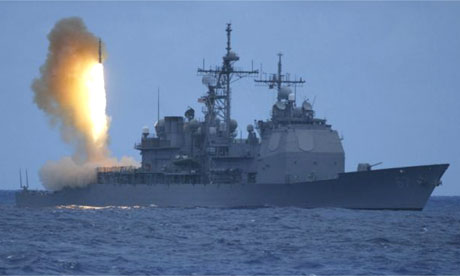
US defence officials said they were confident that a missile, fired from the USS Lake Erie, had hit its target, destroying a tank of toxic fuel on the satellite, which failed soon after being launched in 2006.

Video footage released by the Pentagon showed a fireball when the missile struck the satellite, indicating that the fuel tank - containing hydrazine - had exploded.

"All indications are that it was a successful intercept," General James Cartwright said. The official added that it could take another 24-48 hours to know for certain whether the tank had been destroyed.

The missile was fired at 3.26am GMT, despite earlier reports that the operation would be postponed because of bad weather in the Pacific.

The modified tactical standard missile 3 (SM-3) hit the satellite at an altitude of 150 miles (247km) while it was travelling at approximately 17,000mph.

Two other ships, the USS Decatur and the USS Russell, were close by, and part of the task force, run by the Army Space and Missile Defence Command in Colorado Springs. If the initial shot had missed the satellite, they could have provided back up missiles.

Pentagon officials insisted the operation was necessary to prevent possible deaths following the satellite's re-entry into the earth's atmosphere. The craft, a spy satellite, was carrying around 450kg of toxic hydrazine fuel.

The successful launch proved that the US navy's Aegis anti-missile radar system could be quickly adapted to shoot down satellites.

When China shot down a defunct weather satellite last January, there were protests from western governments.

In the aftermath of the exercise, Gordon Johndroe, a White House spokesman, said: "The US believes China's development and testing of such weapons is inconsistent with the spirit of cooperation that both countries aspire to in the civil space area.

"We and other countries have expressed our concern regarding this action to the Chinese."

Downing Street also expressed its concern at the time, condemning what it said was a "lack of consultation".

The Chinese action was also criticised because of the millions of pieces of orbiting space junk, created by the satellite's destruction, which could damage other satellites or the space shuttle while in orbit.

However, space junk should not be a problem from today's space shot though. Because of the satellite's relatively low altitude, debris began re-entering the atmosphere almost straight away, the US defence department said.

Most debris should re-enter the atmosphere within 48 hours, and the remaining pieces will leave orbit within 40 days.

Scientists and groups opposed to the militarisation of space backed China's criticism of the US exercise.

Professor Michio Kaku, the distinguished physicist and author of Physics of the Impossible, said: "With a certain amount of justification, the Chinese claim there is a double standard … this latest move can be seen as provocative, since the US has refused to renegotiate and strengthen the 1987 outer space treaty.

"What is needed is a comprehensive ban on the militarisation of outer space … arming the heavens will only put us one step closer to a disastrous war in space that no one can win."

Satellite Shootdown is a Star Wars-ASAT Test

Effort to Shoot Down Satellite Could Inform Military Strategy
Marc Kaufman and Walter Pincus, Washington Post, Feb. 20, 2008

The Bush administration's attempt to shoot down an out-of-control spy satellite as early as this evening will help the military advance its anti-missile and anti-satellite planning and technology, according to space weapons experts and analysts. Both fields are of high interest to the military and of high concern for many other nations.

While U.S. officials have depicted the attempt solely as a precaution against the slim chance that the satellite's hazardous rocket fuel could harm people on Earth, the test will inherently have spillover military consequences, the experts said.

To accomplish this week's task, for example, the Navy has modified its Aegis anti-missile radar system for satellite tracking, making clear that a system designed for missile defense can be transformed into an anti-satellite system in a short time.

The attempted shoot-down will also enable the Pentagon to practice using, in an urgent scenario, key elements of its space defense apparatus, including the Joint Space Operations Center at Vandenberg Air Force Base in California and its sophisticated space identification, tracking and targeting system.

The attempt will further provide an unscripted opportunity to see whether ship-based missiles can blow up the satellite just as it reenters Earth's atmosphere -- a key moment in any attempt to intercept an intercontinental missile that might someday be launched against the United States.

"Whatever their motivation for shooting down the satellite, it's clear that this will be quite useful to the military," said Joan Johnson-Freese, an expert on military space issues and a department head of the Naval War College in Newport, R.I.

The targeting of the satellite follows several decades of effort by the Defense Department to develop weaponry to shoot down enemy satellites or missiles.

In 1985, the Air Force successfully tested an air-launched missile to shoot down a satellite, and in 2004, it called for ensuring American "space superiority" in an official policy statement, a phrase meant to cover the denial of enemy access to space when needed.

The Pentagon now spends more than $12 billion annually to develop weapons capable of shooting down missiles entering or leaving space, but it has no dedicated U.S. anti-satellite weapons program in its latest unclassified budget. The military has also worked on a laser project in New Mexico that could have anti-satellite capabilities, and has launched two small satellites that independent experts speculate could be modified to attack, or defend, larger spacecraft.

International treaties, opposition from Congress and concerns about future space debris from anti-satellite tests have all complicated these efforts. The incoming spy satellite, some believe, offers an opportunity to avoid some of those constraints and to test what amounts to an anti-satellite defense.

The Navy has said that it may take as many as three shots at the satellite, and Johnson-Freese said "that will give them data they've never had before," adding: "They're taking a missile defense system and using it as an anti-satellite system, and now they'll be able to see how well it works."

David Wright, a senior scientist with the Union of Concerned Scientists, said "there's a real concern among people here and in other nations that the U.S. is trying to develop space weapons in the guise of other systems." The plan to shoot down the satellite, he says, "fuels the flames for those who think we want to build anti-satellite capabilities." Both China and Russia have criticized the planned satellite intercept.

Paul B. Stares, a senior fellow at the Council on Foreign Relations who has written books about anti-satellite technology and space security, said the skills to be demonstrated in the attempt emphasize how important military activity in space has become. "It's hard to imagine how, as the use of space for military purposes increases, the interest in anti-satellite weaponry won't increase at a similar pace," he said.

Stares said that the first American anti-satellite weapons in the early 1960s were nuclear-armed and designed to destroy or disable satellites across vast expanses of space. Nuclear tests in the atmosphere, however, made clear that these weapons were impractical, because the explosions knocked out useful satellites as well as the targets and severely disrupted ground communications. The United States and former Soviet Union signed a treaty banning nuclear tests in space in 1963.

The United States and Russia have intermittently pursued anti-satellite programs since then, and also have occasionally respected informal moratoriums on testing. The Russian program involved launching smaller craft to follow a target and get close enough to blow it up. Early last year, China demonstrated its own capability by shooting a ground-based missile at an old satellite 600 miles in space. That test produced thousands of pieces of potentially damaging space debris and brought condemnation from much of the world.

The potential vulnerability of U.S. satellites to foreign weaponry is well known to officials at home and abroad. When asked last week about Chinese and Russian capabilities to harm our satellites, Thomas Fingar, deputy director of national intelligence for analysis, told the House Armed Services Committee, "It would not be that difficult to inflict significant, serious damage to our capabilities over [a] couple of days."

Since the United States abrogated the Anti-Ballistic Missile Treaty in 2002, both China and Russia have pushed for a new treaty that would ban weapons in space. The United States has opposed the proposal at the United Nations disarmament conference.

SATELLITE SHOOT DOWN NOTHING MORE THAN ANTI-SATELLITE TEST

Bruce Gagnon, Global Network Against Weapons & Nuclear Power in Space
Feb. 19, 2008

The planned Pentagon shoot down of the wayward U.S. military satellite is nothing more than an opportunity to test new Star Wars anti-satellite weapons (ASAT) technology says the Global Network Against Weapons & Nuclear Power in Space.

“The Bush administration is magnifying the risk to justify the testing of new dangerous and provocative offensive space warfare technologies,” says Bruce Gagnon, Coordinator of the Global Network, which is based in Maine.

“At the time when we need to be constraining space debris-creating ASAT testing, this test will throw open the door to a new arms race in space.”

The Strategic Command’s (StratCom) high-tech Global Operations Center, buried beneath Offutt AFB in Omaha, Nebraska, will play the lead role in coordinating the ASAT test. StratCom now heads all military space operations since merging with the U.S. Space Command in 2002.

"The decision to destroy the American satellite does not look harmless as they try to claim, especially at a time when the U.S. has been evading negotiations on the limitation of an arms race in outer space," a Russian Defense Ministry statement has concluded.

For many years Russia and China have gone to the United Nations General Assembly with a resolution calling for a treaty to ban all weapons in space. The U.S. and Israel have annually voted against the treaty while every other nation in the world supports such a new legal ban on space weapons. The U.S. aerospace industry says that Star Wars will be the largest industrial project in the history of the planet Earth.

Global Network board member Stacey Fritz, Coordinator of No Nukes North in Alaska where so-called missile defense interceptors have been deployed says, “A culmination of events this month reveals the true direction of space weapons technology. China and Russia have formally proposed a new ban on space weapons on the heels of polls showing widespread public support for such a treaty in both the U.S. and Russia. Not only does the U.S. refuse to consider the ban, but also after denying for years that these systems have offensive capabilities, the rogue Bush administration proposes to demonstrate missile defense's anti-satellite technology. The doors of the Trojan horse are spilling open and the new arms race is on."

Three U.S. Navy Aegis destroyers, outfitted with missile interceptors, will fire at the satellite as it falls back to Earth from positions just off Hawaii. These same Aegis ships are now being home ported by the Navy throughout the Asian-Pacific region giving the U.S. the ability to encircle China’s coast. These Aegis ships could give the U.S. the ability to intercept China’s twenty nuclear missiles that today are capable of reaching the west coast of the continental U.S. The Pentagon has been war-gaming a U.S. first-strike attack on China, set in 2016, for the past several years. In that attack the Aegis ships would negate China’s nuclear retaliatory force by intercepting their missiles in the boost phase.

The Global Network is made up of more than 140-affiliated peace groups around the world working to halt the nuclearization and weaponization of space.

For more information see www.space4peace.org

"Threatening the Foundations of a World Order" The Independence of Kosovo

By GARY LEUPP, CounterPunch, Feb. 19, 2008

Russia has repeatedly made it very clear that it will not recognize nor accept an independent Kosovo but rather uphold Serbia's historic claim to the province.

Recall how World War I broke out after a Serbian nationalist assassinated the Austro-Hungarian archduke in 1914 in Sarajevo, Bosnia. When the Austro-Hungarian Empire declared war on Serbia, Russia came to the defense of its ally. The alliance system kicked in; Germany and the Ottoman Empire joined the Austro-Hungarian, while France and Britain joined Russia. That system is long gone, but the relationship between Russia and Serbia, deeply rooted in ethnic and religious ties, should not be taken lightly.


Recall how Bill Clinton's big war was "Operation Allied Force," conducted by a somewhat reluctant NATO at U.S. insistence in 1999. Building upon NATO's "Operation Deliberate Force" targeting Serbian fighters in Bosnia four years earlier, it resulted in the aerial bombing of a European capital (Belgrade) for the first time since 1945. Human Rights Watch concluded in 2000 that between 488 and 527 Yugoslav civilians were killed as a result of the bombing, which forced Belgrade to obey Washington and withdraw its troops from the heart of the Serbian homeland.

That heart, of course, is Kosovo. Since the seventh century, when the Serbs pressing eastward from Dalmatia established themselves in the old Roman province of Upper Moesia, Kosovo has been the spiritual core of the Serbian nation. The Serbs have shared it with others, notably Albanians, and the Serbian gene-pool is itself complex and changing over time. But Serbian identity was shaped by the Battle of Kosovo Polje (The Field of Blackbirds) against the Ottoman Turks in 1389, in which both Serbian King Lazar and the Ottoman sultan Murad were killed. Modern historians differ about whether this was a draw or heroic defeat of the Serbs; nationalist mythology depicts it as the latter.

During over four centuries of Muslim Turkish rule the Serbs preserved their Orthodox religious identity, maintaining the Gracanica Monastery and at least half a dozen other religious centers which have survived from the fourteenth century to the present day---threatened though they have been in recent years by desecration, vandalization and destruction.

On Sept. 13, 1999, the Church of Saints Cosma and Damian, built in 1327, was obliterated by a bomb blast. The initials of the Kosovo Liberation Army were painted at the site. By that time some 20 Serbian religious sites had been blown up, including the Dormition of Mother of God parish church, built in 1315. Another 40 others had been attacked or looted. All of this took place after Serbia's capitulation to Washington in June 1999, and the arrival of the NATO-led "peacekeeping force" (Kosovo Force; KFOR) presiding over NATO's new protectorate. KFOR, currently 16,000 strong in a province of two million, has provided some protection for Serbian holy sites; in June 1999 French troops prevented the rape and murder of nuns and a priest at Devic Monastery after the fifteenth century structure had been desecrated and looted by KLA militants. But NATO basically empowered and legitimated forces that proceeded to destroy or desecrate over 70 churches or monasteries by October 1999 (21 in the U.S. zone of responsibility). Meanwhile more than 200,000 Serbs fled the province. During the summer of 1999, 40,000 Serbs fled Pristina.

The destruction continued; 35 sites were attacked in 2004. Last March Decani Monastery (founded in 1327) came under mortar attack. Such incidents are seen by Serbs as not only as assaults on their culture and history but efforts to erase that history.

Some Albanians claim that they were the original inhabitants of Kosovo, a land four-fifths the size of Connecticut. They claim descent from the ancient Illyrians who inhabited the area from about the fourteenth century BCE. It appears as likely they migrated from what is now Albania during the Ottoman period, coming to outnumber the Serbs. One hundred years ago, however, migration into the region brought the Serb population up to the level of the ethnic Albanian: 50/50. Thereafter the greater Albanian birthrate reduced the Serb population to a mere 10% of the total. Following the ethnic cleansing of the last decade, the figure's down to maybe 4%.

Kosovo was the poorest region in Tito's Yugoslavia, but it enjoyed the status of an autonomous province and was treated as a de facto republic in accordance with Tito's philosophy that "Weak Serbia equals strong Yugoslavia." Following Tito's death in 1980, there were large demonstrations demanding full republic status. When ethnic Serbs were targeted, the little-known politician Slobodan Milosevic postured as defender of Kosovo's Serbs. As president of Serbia, he (foolishly) withdrew Kosovo's autonomy in 1989, provoking Albanian protests and the formation of the KLA in 1995. The KLA targeted police, army and civil officials, taking control of about one-quarter of the province.

Belgrade hesitated for several years before taking firm action against the KLA. After the rebels failed to seize the town of Orahovac in the summer of 1998, it launched an offensive, regaining control of almost all the province. At this point Washington became actively involved. President Clinton had sent a special envoy, Robert Gelbard, to the region in February 1998. At that time he stated that the KLA was, "without any questions, a terrorist group" in Washington's view. Indeed the State Department had concluded it was a heroin-financed terrorist group with some ties to al-Qaeda (Washington Times, May 4, 1999). A few months later, however, Gelbard was meeting with KLA leaders; the organization was soon removed from Washington's terror list. Later that year another U.S. special envoy to Kosovo, Richard Holbrooke, was photographed with KLA leaders, further encouraging their violent secessionist movement.

Yugoslavia ("land of the southern Slavs) had been a peaceful, nonaligned nation with cordial relations with both the Soviet bloc and the West for decades. But from 1991 the federation began to fall apart. First Slovenia declared independence. The U.S. Secretary of State, James Baker, was unhappy with the move thinking (correctly) that it would lead to regional destabilization. But reunited, powerful Germany encouraged the breakup. Croatia and Macedonia followed suite, then Bosnia-Herzegovina descended into civil war. Washington recognized Bosnian independence in 1994. Accusing Serbian forces of atrocities, NATO bombed Bosnia in August and September 1995, paving the way for the Dayton Agreement in November and the deployment of NATO forces in Bosnia. Now Bill Clinton and his Secretary of State Madeleine Albright, accustomed to making demands and being obeyed, demanded that Milosevic cease his offensive against the KLA. He did.

Following a ceasefire in October 1998, by agreement with Milosevic, peace monitors from the Organization for Security and Co-operation in Europe (OSCE) arrived in Kosovo. But the ceasefire broke down with a few months. Washington then demanded that Milosevic withdraw his troops from Kosovo. That is to say, it demanded that a sovereign state remove its troops from one of its provinces where a group the U.S. had earlier termed "terrorist" was waging a war for secession.

Washington summoned the "Contact Group" (including the UK, France, Germany, Italy and Russia) as well as Belgrade and Albanian secessionist representatives to Rambouillet, France in February and March 1999. The "Rambouillet Accords" were signed by all parties---except forYugoslavia and Russia. The agreement specified that Kosovo would obtain autonomy but remain part of Serbia. That was the one concession to Belgrade, and an initial cause for the KLA representatives to balk. But the separatists were won over, no doubt realizing that they would gain independence in time. (They just declared that, with Washington's approval, February 17.)

The Accords dictated that Belgrade accept a NATO force with liberty to act throughout the territory of Yugoslavia. It was a demand no sovereign state could accept. A top French official accused the U.S. of behaving like a hyper-puissance ("hyper-power"); NATO itself was divided and disturbed by U.S. demands. (The Spaniards, Italians and Greeks in particular were troubled about the NATO bombing of Belgrade.) Washington was calling for an organization founded to defend western Europe from Soviet attack to intervene in a friendly, non-threatening country, to force it to accept further dismemberment. From March 24 to June 10 NATO air forces, including the German Luftwaffe deployed for the first time since 1945, bombed Yugoslavia.

I didn't think at the time that Clinton's actions resulted from some geo-strategic designs on Kosovo. (There's not that much there, other than lots of coal.) But had he done nothing, and the violence continued, he would have been criticized for failing to use American power ("to prevent genocide") and left the door open for other interested parties (Germany) to take unilateral action. He had to rally NATO to send a message to the world that the U.S. remained the leader and policeman of the western camp. Ongoing chaos in the Balkans would have suggested that the U.S. was sloughing off the responsibilities of power. Strong action would signal allies, as well as the Russian Federation, that the U.S. facing an increasingly united and competitive Europe could continue to deploy NATO in pursuit of its own aims. (Similarly the use of NATO in Afghanistan after 9-11 has served to bind the alliance around a U.S.-dictated agenda, while the public in member states increasingly questions the value and logic of the mission.)

We associate the Bush administration and its neocons with the systematic dissemination of disinformation designed to justify war. But the Clinton administration used the same tactic as it prepared to bomb Yugoslavia. There were horror stories about "ethnic cleansing," and Yugoslav government forces' attacks on innocent Bosnians. Defense Secretary William Cohen, echoed Sen. Joseph Biden (D-Del.), Sen. Chuck Hagel (R-Neb.), and former Sen. Bob Dole accused Belgrade of "genocide." "We've now seen about 100,000 military-aged men missing... They may have been murdered," warned Cohen. "There are indications genocide is unfolding in Kosovo," declared State Department spokesman Jamie Rubin.

But German reports told a different story. Four German court opinions from October 1998 to March 1999; two Foreign Office intelligence reports in January 1999; and one report from the Foreign Office to the Administrative Court in Mainz in March 1999 all challenged such accusations. According to the Opinion of the Upper Administrative Court at Munster (March 11, 1999), "Ethnic Albanians in Kosovo have neither been nor are now exposed to regional or countrywide group persecution in the Federal Republic of Yugoslavia."

After the glorious victory of NATO over Yugoslavia, it was discovered that as few as 2,108 people were actually killed in the province during 1998-9 before the bombardment began. Quite likely more Serbs have been killed by Albanians than vice versa since 1998. The "genocide" charge (reminiscent of the rhetoric of those urging U.S. intervention in Darfur) had been exaggerated, if not contrived; the depiction of Milosevic as a "new Hitler" (reminiscent of the hysterical characterization of Saddam Hussein) equally overblown.
Washington got what it wanted, almost. It destroyed the Yugoslav state, hauled

Milosevic to a kangaroo court at the Hague (where after enhancing his reputation among Serbs by a spirited defense, he died of a heart attack), and planted NATO in what had once been proudly nonaligned European territory. But in the closing days of NATO's war on Yugoslavia in June 1999 Russia dispatched troops based in Bosnia to Kosovo's capital of Pristina, where they took control of the airport. It was a clear statement that Russia would not concede total control of the former Yugoslavia to NATO. It shocked Madeleine Albright, and disturbed Gen. Wesley Clark enough to order an airborne assault on the Russians. But the British general heading the NATO force at the time, Michael Jackson, told Clark: "Sir, I'm not starting World War Three for you."

Thus the Russians were included in the post-bombing "peace-keeping" mission in Kosovo and have since been regarded as the protectors of the remaining Serbs in the Serbian province. Their opposition to Kosovo's independence might be perceived as a slight irritation in Washington among those eager to establish a new client-state and drag it into NATO. But this move comes on the heels of U.S. meddling in Georgia, Belarus, and the Ukraine, the relentless eastward expansion of NATO, and moves to locate missile defense systems in Poland and the Czech Republic. The Russian government is in effect saying: "Look, you intervene at will in Latin America, forming and toppling governments as you will, arguing it's necessary for your 'national security.' We who have been invaded many times from the west have legitimate reasons to support our friends in the Balkans, including the Serbs whom you've maligned and mistreated disgracefully. Do you really think you can just wrench away a province from a Slavic country friendly to us, through brutal military force, and expect us to take it lying down?"
I have the feeling that Washington blew it here---and that there will be some blowback. It is all very nice for a people comprising 90% of the inhabitants of a land to form their own state after decades of aspiration and (under Milosevic) undeniable national oppression. But look at this video on youtube: Watch the young Albanian try to rip down the cross from a burning Serbian church in March 2004. Look at this one of the gutted interior of the Manastir Devic monastery, built up in 1434 and torched in March 2004. Or this, showing an ancient Serbian cemetery desecrated in April 2005.

One can find equally ugly images of Serbian actions no doubt, and both Kosovar-Albanian nationalism and Serbian nationalism retain the potential for further destruction. But the leadership in Pristina hoisted into power by U.S. action looks especially unsavory and apt to produce disaster.

The leadership of the newly declared nation of Kosovo is rooted in the KLA; Hashim Thaçi, the new Prime Minister, was a member of its inner circle. The Government of Serbia alleges that he met with Osama bin Laden in Tirana in 1995.

He has been accused of connections with the Albanian, Czech and Macedonian mafia, and of membership in the Drenica Group, controlling 10-15% per cent of criminal activities in Kosovo including arms smuggling, car theft, prostitution and illegal trafficking in oil and cigarettes.

Yugoslav courts in 1997 and 1998 found him guilty of terrorism charges, including attacks on Serbian policemen, but he was a Kosovar Albanian representative at the Rambouillet talks. With the disbanding of the KLA in 1999 he became head of largest party in Kosovo, the Democratic Party. Meanwhile former KLA members have become involved in ethnic Albanian insurgencies elsewhere in the Presevo Valley in Serbia and in Macedonia. (The Albanian population in Macedonia is now about 25% of the total.) An "Albanian National Liberation Army of Macedonia" waged war on Macedonian security forces until the Ohrid Agreement was signed in August 2001, meeting some of its demands. Another armed group headed by Avdil Jakupi ("Commander Cakalla") was formed in 2003, while another, led by Agim Krasniqi, held a village outside Skopje for six months in 2004.

Those dreaming of a "Greater Albania" (optimally to include Albania, Kosovo and other parts of Serbia, and parts of Macedonia, Montenegro and Greece), taking heart at Kosovar independence, may redouble their efforts throughout the region. There are potential religious dimensions to Albanian nationalism; while the Albanians (like Bosnians) are overwhelmingly secular Muslims, the product of generations of atheistic education in Albania and Yugoslavia, they are indeed Muslims. So there are now, aside from Turkey, two Muslim European countries: Albania and Kosovo. (Bosnia-Hezegovina's Muslim population is under 50%). The Saudis, Kuwaitis and others have been pouring money into mosque construction in Albania and Kosovo, encouraging fundamentalist forms of Islam. The Saudi Joint Committee for the Relief of Kosovo has repaired 190 damaged mosques in Kosovo and the Saudis have built mosques there. (One, for a time, was actually named the Bin Laden Mosque.)

Whether intended to do so or not, these efforts to spread Salafi-style Islam dovetail with al-Qaeda's efforts to exploit instability in the Balkans. The organization was active in Bosnia during the war in the early '90s, and surely endorses the idea of "Greater Albania" and a jihad to realize it. What better vehicle for the propagation of its ideology than an ethnic-based web of insurgencies coordinated from Kosovo?

That's one blowback possibility traceable to NATO's 1999 war and events in Kosovo in its aftermath. Another is the emboldening of the Albanian regime in Tirana. Serbia has indicated that it will now beef up security in the Serb-majority areas of what it continues to consider its province. Some might see this as an effort to divide Kosovo. Albanian Foreign Minister Besnik Mustafaj declared in March 2006, "If Kosovo is divided, we can no longer guarantee its borders with Albania, or the border of the Albanian part of Macedonia." In other words, Albania might take military action to do some regional re-dividing itself, backed up, perhaps, by Turkey.

Meanwhile Vladimir Putin, shrewd and careful, considers how to use this blow to pan-Slavic pride to revive Russian influence in the Balkans. His Foreign Ministry declares that Kosovo's claim to independence threatens "the foundations of a world order that has developed over decades." That is true of course. Even before Bush and his neocons came to power Washington was playing with those foundations, gleefully undermining them, flushed with post-Cold War triumphantalism. Time and again there has been blowback.

NATO, as military historian Andrew J. Bacevich has recently written, is in its twilight. Secretary of Defense Gates complains about European lack of zeal in pursuing the enemy in Afghanistan. This of course reflects European public opinion that now sees Afghanistan as a fruitless counterinsurgency mission imposed on Europe by Washington on the heels of other questionable missions resulting from U.S. policy.

The U.S., deeply bogged down in Southwest Asia, has left the Europeans holding the ball in Bosnia; Germany contributes 800 of the 3000 European Union Force (EUFOR) peacekeeping troops. The 16,000-strong KFOR in Kosovo includes 2,567 Italians, 2,374 Germans and 2,269 French troops (but only 1,456 U.S.) Having invaded Iraq, the U.S. urged NATO countries to send troops, and Britain continues to oblige with some 4,500. Others with sizeable commitments (such as Spain, with 1,300; the Netherlands, with 1345; and Italy, with 3,300), have all withdrawn from Iraq.

In Afghanistan, the International Security Assistance Force (ISAF) consists of 28,600 troops trying to stabilize a country the size of Texas with a population of 30 million. The U.S. supplies 15,000 troops; the UK, 7,800; Germany, 3,210; Italy, 2,880; Canada, 2,500; the Netherlands, 1,650; France, 1,515; Poland, 1,100. ISAF military fatalities have increased every year since 2003 (57) to 2007 (232) as the Taliban has revived.

Public opinion in Canada and Germany has turned decisively against the Afghan deployments. Last year a poll conducted by the German magazine Focus found that 63% of Germans believe the current deployment in northern Afghanistan does not serve German interests and 84 percent of Germans oppose sending combat troops to the south as requested by the U.S. In a Canadian poll last May, 55% of respondents favored a pullout from Afghanistan, while 67% agreed that the presence of Canadian troops there makes Canada more vulnerable to a terrorist attack.

U.S. allies weary of efforts to drag them into U.S. wars. U.S. imperialism confronts something of a crisis as its partners rethink where their real interests lie. The GDP of the EU now exceeds the U.S. figure. The euro is much stronger than the dollar. People everywhere hate the U.S. government, which they associate with war-promoting lies and general savagery. Bush is out of political capital, domestically and internationally, as Kosovo announces its independence, made possible by U.S. lies and bloody intervention, "threatening," as the Russians put it, "the foundations of a world order."

Everything dies eventually. Hitler's "New Order in Europe," Japan's "New Order in East Asia," George H. W. Bush's "New World Order" proclaimed as he launched the first Gulf War in 1990. The present world order is profoundly unfair and deserves to be threatened, by the right people, with a better alternative. But the assault on Yugoslavia in 1999 brought nothing positive; rather, more intolerance and suffering, more ethnic cleansing. A new regime emerges, applauded by its American sponsors and most of the EU (but rejected by Greece, Cyprus, Romania, Slovakia, Spain and Bulgaria). It is wrapped in smoke, in a legacy of smoldering churches. Smells like the cremation of a world order.

Gary Leupp is Professor of History at Tufts University, and Adjunct Professor of Comparative Religion. He is the author of Servants, Shophands and Laborers in in the Cities of Tokugawa Japan; Male Colors: The Construction of Homosexuality in Tokugawa Japan; and Interracial Intimacy in Japan: Western Men and Japanese Women, 1543-1900. He is also a contributor to CounterPunch's merciless chronicle of the wars on Iraq, Afghanistan and Yugoslavia, Imperial Crusades.

He can be reached at: gleupp@granite.tufts.edu