By Mark Seibel, McClatchy Newspapers, June 12, 2010
WASHINGTON — The Coast Guard has told oil giant BP that its proposed plan for containing the runaway Deepwater Horizon well does not take into account new higher estimates of how much oil is gushing into the Gulf of Mexico and demanded that the company provide a more aggressive plan within 48 hours.
In a letter dated Friday and released Saturday, Coast Guard Rear Adm. James A. Watson also said that BP was taking too much time to ready ships to capture oil spewing from the well.
"You indicate that some of the systems you have planned to deploy may take a month or more to bring online," Watson, who is the federal on-scene coordinator for the Deepwater Horizon disaster, wrote Doug Suttles, BP's chief operating officer. "Every effort must be expended to speed up the process."
The 48-hour deadline is the second the Coast Guard has given BP in the past week and indicates a growing recognition on the part of the Coast Guard that both BP and the Obama administration underestimated for weeks the amount of oil pouring from the well, which began leaking when an April 20 explosion shattered the Deepwater Horizon drilling rig, killing 11 workers. The rig sank two days later, taking a mile of well pipeline with it.
For weeks, the Obama administration and BP said the spill was leaking 5,000 barrels a day — about 210,000 gallons. On May 27, a government task force of scientists revised that estimate to a minimum of 12,000 to 25,000 barrels a day, and possibly much more. Then on Thursday, the government doubled those estimates to between 20,000 and 50,000 barrels a day, saying those, too, may understate the size of the leak because a decision to shear off the well's riser pipe to add a "top hat" containment device may have unleashed more oil.
The intervention by the Coast Guard comes as the oil continues to spread across the Gulf. Alabama advised residents not to swim in areas near the Florida border and in the Mississippi Sound. An access route to the Inter-Coastal Waterway, the Pensacola Pass, was closed Saturday evening during flood tide until further notice to keep oil from entering the bay. And tar-ball fields detected in the Gulf appear to be headed toward the Florida Straits.
Watson said the new estimates were the reason for the new deadline, saying the plan Suttles outlined was only "consistent with previous flow rate estimates."
"Because those estimates have now been revised . . . it is clear that additional capacity is urgently needed," he said.
BP said it would respond to Watson's letter "as soon as possible."
The White House was asked Saturday what action it would take if BP doesn’t speed up its effort to containment.
”This isn’t open for discussion,” a senior administration official said. “BP must do better to plan a more aggressive response. In the same way we pushed for second relief well, additional redundancy, more transparency, paying for the berms, etc…we will push them to find better answers to contain the oil.”
The official, who asked not be named as a matter of policy, said the letter to BP was “a unanimous Obama team decision.”
BP and Coast Guard representatives have been meeting throughout the week, Coast Guard officials have said, to refine the plan, which Suttles outlined in a letter to Watson dated Wednesday — before the new flow rate estimates were released. In his letter, Suttles said the plan had been outlined on Tuesday to Interior Secretary Ken Salazar and Energy Secretary Steven Chu. "No objections were raised," he wrote.
Under that proposal, BP outlined two phases — a temporary one involving three recovery ships and a jerry-rigged system combining the "top hat" containment device with hoses already in place from the "top kill" procedure that failed to stanch the well last month, and a more permanent one that involves construction of two new risers from the well that would be serviced by two large recovery ships that are en route to the site now.
BP said that the temporary phase would bring the amount of oil captured to 20,000 to 28,000 barrels a day by the end of next week. Most of that oil would be recovered by the Discoverer Enterprise drilling ship, which has been collecting around its stated 15,000-barrels-per-day capacity through the "top hat" but that Coast Guard officials believe can be pushed to 18,000 barrels a day. The remaining 5,000 to 10,000 barrels per day would be taken up by a second vessel, the Q4000 drilling platform, which would burn the oil in a rarely used, if not unprecedented, procedure. BP vice president Kent Wells said Friday that burning could begin as soon as Monday.
The burning idea has provoked some experts to raise questions about the health and environmental effects of the process.
Containment capacity would be pushed further during the temporary phase by the addition of a third vessel, the drill ship Discoverer Clear Leader, which would take on an additional 5,000 to 10,000 barrels a day when it is operational in mid July, Suttle wrote.
In the second, more permanent phase, Suttles said BP was building two permanent floating risers to provide oil to the Taisa Pisces and the Helix Producer recovery ships. Each riser takes about a month to complete, Suttles said. One is expected to be finished next week. Work on the second began Monday, June 7. Once operational, the new risers and ships would have capacity to receive between 40,000 and 50,000 barrels per day, BP said.
The plan foresees both the Q4000 and the Discoverer Clear Leader discontinuing operations once the new floating risers are operational, but says the Discoverer Enterprise would remain on site and could provide additional capacity, if needed.
In offering an estimate of the total capacity of the temporary phase, BP's plan is more cautious than numbers Coast Guard Adm. Thad Allen used in press briefings with reporters. On Friday, Allen said capacity would reach 38,000 barrels a day once the Discoverer Clear Leader is operational.
BP's numbers may be more realistic, however. While Allen has said that the Discoverer Enterprise could be pushed to receive 18,000 barrels per day, the actual amount it's recovered has declined by a few hundred barrels since it peaked at 15,800 barrels on Wednesday. On Thursday, the ship recovered 15,400 barrels and on Friday, it recovered 15,500 barrels, BP reported Saturday.
How much oil will flow to the Q4000 and the Discoverer Clear Leader is also uncertain. Neither vessel will be "pumping" the oil up from the sea, but instead will rely on the oil's natural pressure to push it up through hoses that were originally used to push drilling mud into the well's dysfunctional blowout preventer during the "top kill" effort. Based on the size of the hoses, the maximum amount likely to flow through to those ships would be 10,000 barrels per day, but could be less, depending on the oil reservoir's pressure.
Both Suttles and Wells warned that there could be additional delays in the plans because of adverse weather and conditions at the drill site, which officials describe as crowded with dozens of ships.
It was also unclear how soon additional equipment could be made available. The Q4000 was under contract to another oil company and only began working the Deepwater Horizon spill after that company agreed to release it. A tanker that will work with the Taisa Pisces to shuttle the captured oil ashore, the Loch Rannoch, is available only because BP has shut down for maintenance the North Sea well it was working, oil industry publications said. BP has yet to identify a second tanker needed to work with the Helix Producer.
Showing posts with label Mexico. Show all posts
Showing posts with label Mexico. Show all posts


In Mexico, Zelaya Criticizes "Weakness" of the International Community
By Laura Carlsen, Americas MexicoBlog, Aug. 5, 2009
* Zelaya tells Mexican supporters "patience is running out"
* Says Army had instructions to "eliminate" him
* Asks Calderon to discuss Honduran coup with Obama at North American Summit
President Zelaya spoke to hundreds of Mexican supporters in Mexico City on August 5, to affirm his commitment to restore democracy in his country and underline the importance of the Mexican and U.S. governments in ending the coup.
The Mexico City government, which earlier presented Zelaya with the keys to the city, organized the event with members of grassroots organizations. Hundreds of men, women and children from the urban popular movement, debtors' organizations, unions and universities waved Honduran flags in the elegant Teatro de la Ciudad, frequently breaking into the speech to shout cheers and slogans. The setting contrasted sharply with the international diplomatic forums he has appeared in since being ousted by a military coup on June 28.
"This is almost the first coup of the 21st century, the first to be condemned by the international community, the first to have massive sanctions applied," Zelaya told the crowd. He called the current stalemate in spite of diplomatic actions a reflection of the "weakness of the international community," and appealed for the right of the people to peaceful resistance.
Zelaya said, "Our people have the right to resist repression with all the arms of our democratic system but also peaceful insurrection... Patience has limits—I'm advising all the recalcitrant right from Washington to Tierra del Fuego." At the same time he reaffirmed that theirs is a "peaceful, civic and tolerant struggle, but patience is running out."
"International solidarity has been extraordinary against the coup but we think that it is insufficient. There is still more to do in the international arena to build support, to repudiate this event that has shamed our country, but with the shame falling on the shoulders of the groups that exercise illegitimate power."
In one of his most political speeches, Zelaya detailed the achievements of his government in growth and raising the minimum wage, saying that despite the advances, the elites "didn't want to share."
He explained the principle of "poder cuidadano"—citizen power. This principle combines two concepts, he said, empowerment and citizenship. He went through the conflicts leading up to the coup, particularly the decision to consult the population on voting in November elections on whether to convoke a Constitutional Assembly. He noted that the law of citizen participation gives the people the power to be consulted on major decisions and was a critical step to "pass from a representative democracy to a participatory democracy."
"A president can't resolve the problems of the country alone. You need the large majorities, to listen to them, not just in elections—you need to listen to them in decisions. The people aren't just there to elect, but also to decide... on development plans, on international trade treaties..."
He told the audience that the economic and political elite "erred in every sense of the word. They were wrong about the people—they thought the people wouldn't resist like in the last century. They were wrong about the country—Honduras is no longer willing to put up with a return to arms... They got the wrong century—they don't realize that in the 21st century, the citizens of the world have a different awareness, different training" and that "we have a humble people, often vulnerable, but determined to struggle for guarantees of their constitutional rights, their human rights and their universal rights."
"And they were wrong about the president." Zelaya said the coup offered him money to stay in exile, which he refused. He plans to return to the border with Nicaragua to prepare to return to Honduras.
Later Zelaya revealed that the head of Honduran Armed Forces, General Romeo Vasquez, called him in Nicaragua. In the conversation, Zelaya said Vasquez told him, "'Mr. President, we received instructions that you were to be eliminated in the capture (eliminated meaning assassinated). And we decided then, the Joint Command, that are your friends (Zelaya paused to question the term friends) that to preserve your life we had to take you out of the country.'"
Zelaya told the audience, "I'm telling you this because the radical positions of the traitorous right came to this extreme."
U.S. Role is Critical
Zelaya both affirmed the role of the international community in ending the coup while pointing out that the persistence of the coup in power in Honduras demonstrates its "weakness" and the need for a stronger U.S. leadership role.
"I recognize the force of the international community. When Sec. Hillary Clinton proposed Oscar Arias to me, I agreed because I wanted the U.S. to play a leading role."
"Many of the fundamental actors of the coup d'etat in Honduras did not come out of the government of Barack Obama but did come from the hawks in Washington who promoted them." He gave the specific example of U.S. congressional representatives "who have said publicly that the coup is good because it halts the social reforms of President Chavez, President Morales, Rafael Correa and Daniel Ortega in Central America."
But he went on to express his frustration at the mediation process. "I think that apart from the good-faith efforts of Pres. Oscar Arias, who won a Nobel Peace Prize, they have treated the coup with kid gloves. This is a good time to clamp down."
"If President Barack Obama really wants to turn back this coup, these coup leaders will last all of five minutes because the economy of Honduras, all our military, commercial and migration activities, depend on the United States." Emphasizing how the Honduran coup is a test case for the new government, he added, "We'll see the extent of his sincerity, force and democratic conviction."
Zelaya announced that he spoke with Mexican President Felipe Calderon who offered his support. Calderon received the ousted Honduran president with full state honors yesterday. On this point, Zelaya had a tough audience. At the mention of the Mexican president's name, the crowd broke out in boos that scarcely let him continue. The uproar revealed the still-simmering resentment against what many people in this country, especially the poor and popular organizations that filled the theater, still consider the elections of 2006 to have been stolen and see Calderon's leadership as an illegitimate presidency.
Zelaya continued anyway. "[Calderon] will be with President Obama in Guadalajara and the force with which the United States decides to take effective actions will also depend on this meeting." On August 9, Obama will be in Mexico for a meeting of North American leaders on NAFTA's Security and Prosperity Partnership and other issues. He said that Mexicans must keep a close watch on the talks between Calderon and Obama, because they will have an impact "on the destiny of Latin America."
Courting Calderon to intervene with Obama is a strategic move at this stage of defeating the coup. Zelaya openly referred to something Washington insiders have been saying as the world tries to pinpoint what has seemed a vacillating position within the Obama administration. With U.S. forces consolidating in favor and against the coup and a marked difference in tone between the president and his Secretary of State, many have emphasized the major influence of the U.S.'s two most powerful allies in the region—Mexico and Brazil—in deciding to soften or strengthen pressures against the coup. There are powerful interests close to the government that prefer the coup to Zelaya, but one thing the Obama administration does not want to do is alienate these two countries.
Following the meeting with Zelaya yesterday, Calderon confirmed support for the Arias mediation process and asserted his "full support for restitution and pacification."
His remarks send a message to Washington but fall short of Brazil's position. Brazil has already come out saying there should be no conditions set on Zelaya's return and that any concessions to the coup in the framework of the mediation process would encourage further coups in the region. This contrasts with the Arias proposal to form a coalition government including coup supporters.
Nearing the end, Zelaya noted the strength of the Honduran resistance. "Today I want to express my solidarity with the Honduran people. We are 37 days into a teachers' strike... It's not just to protest the coup—what the teachers say is that they can't go to the classroom to teach the children how coups are made, they want to teach them how to revert coups d'etat in the streets."
Honduran organizations are now on the frontline of the battle to defeat the coup in their country. Zelaya noted the determination of unions, women and workers in carrying out more than 100 peaceful civilian road blockades and called on the international community to support Radio Globo, almost alone, he noted, in reporting on repression by the coup and currently facing closure by the coup regime that controls the media in the country.
To the enthusiastic crowd, Zelaya framed his dilemma as a struggle without borders. "When the struggle is for a value, a principle, there are no borders, there are no countries."

* Zelaya tells Mexican supporters "patience is running out"
* Says Army had instructions to "eliminate" him
* Asks Calderon to discuss Honduran coup with Obama at North American Summit
President Zelaya spoke to hundreds of Mexican supporters in Mexico City on August 5, to affirm his commitment to restore democracy in his country and underline the importance of the Mexican and U.S. governments in ending the coup.
The Mexico City government, which earlier presented Zelaya with the keys to the city, organized the event with members of grassroots organizations. Hundreds of men, women and children from the urban popular movement, debtors' organizations, unions and universities waved Honduran flags in the elegant Teatro de la Ciudad, frequently breaking into the speech to shout cheers and slogans. The setting contrasted sharply with the international diplomatic forums he has appeared in since being ousted by a military coup on June 28.
"This is almost the first coup of the 21st century, the first to be condemned by the international community, the first to have massive sanctions applied," Zelaya told the crowd. He called the current stalemate in spite of diplomatic actions a reflection of the "weakness of the international community," and appealed for the right of the people to peaceful resistance.
Zelaya said, "Our people have the right to resist repression with all the arms of our democratic system but also peaceful insurrection... Patience has limits—I'm advising all the recalcitrant right from Washington to Tierra del Fuego." At the same time he reaffirmed that theirs is a "peaceful, civic and tolerant struggle, but patience is running out."
"International solidarity has been extraordinary against the coup but we think that it is insufficient. There is still more to do in the international arena to build support, to repudiate this event that has shamed our country, but with the shame falling on the shoulders of the groups that exercise illegitimate power."
In one of his most political speeches, Zelaya detailed the achievements of his government in growth and raising the minimum wage, saying that despite the advances, the elites "didn't want to share."
He explained the principle of "poder cuidadano"—citizen power. This principle combines two concepts, he said, empowerment and citizenship. He went through the conflicts leading up to the coup, particularly the decision to consult the population on voting in November elections on whether to convoke a Constitutional Assembly. He noted that the law of citizen participation gives the people the power to be consulted on major decisions and was a critical step to "pass from a representative democracy to a participatory democracy."
"A president can't resolve the problems of the country alone. You need the large majorities, to listen to them, not just in elections—you need to listen to them in decisions. The people aren't just there to elect, but also to decide... on development plans, on international trade treaties..."
He told the audience that the economic and political elite "erred in every sense of the word. They were wrong about the people—they thought the people wouldn't resist like in the last century. They were wrong about the country—Honduras is no longer willing to put up with a return to arms... They got the wrong century—they don't realize that in the 21st century, the citizens of the world have a different awareness, different training" and that "we have a humble people, often vulnerable, but determined to struggle for guarantees of their constitutional rights, their human rights and their universal rights."
"And they were wrong about the president." Zelaya said the coup offered him money to stay in exile, which he refused. He plans to return to the border with Nicaragua to prepare to return to Honduras.
Later Zelaya revealed that the head of Honduran Armed Forces, General Romeo Vasquez, called him in Nicaragua. In the conversation, Zelaya said Vasquez told him, "'Mr. President, we received instructions that you were to be eliminated in the capture (eliminated meaning assassinated). And we decided then, the Joint Command, that are your friends (Zelaya paused to question the term friends) that to preserve your life we had to take you out of the country.'"
Zelaya told the audience, "I'm telling you this because the radical positions of the traitorous right came to this extreme."
U.S. Role is Critical
Zelaya both affirmed the role of the international community in ending the coup while pointing out that the persistence of the coup in power in Honduras demonstrates its "weakness" and the need for a stronger U.S. leadership role.
"I recognize the force of the international community. When Sec. Hillary Clinton proposed Oscar Arias to me, I agreed because I wanted the U.S. to play a leading role."
"Many of the fundamental actors of the coup d'etat in Honduras did not come out of the government of Barack Obama but did come from the hawks in Washington who promoted them." He gave the specific example of U.S. congressional representatives "who have said publicly that the coup is good because it halts the social reforms of President Chavez, President Morales, Rafael Correa and Daniel Ortega in Central America."
But he went on to express his frustration at the mediation process. "I think that apart from the good-faith efforts of Pres. Oscar Arias, who won a Nobel Peace Prize, they have treated the coup with kid gloves. This is a good time to clamp down."
"If President Barack Obama really wants to turn back this coup, these coup leaders will last all of five minutes because the economy of Honduras, all our military, commercial and migration activities, depend on the United States." Emphasizing how the Honduran coup is a test case for the new government, he added, "We'll see the extent of his sincerity, force and democratic conviction."
Zelaya announced that he spoke with Mexican President Felipe Calderon who offered his support. Calderon received the ousted Honduran president with full state honors yesterday. On this point, Zelaya had a tough audience. At the mention of the Mexican president's name, the crowd broke out in boos that scarcely let him continue. The uproar revealed the still-simmering resentment against what many people in this country, especially the poor and popular organizations that filled the theater, still consider the elections of 2006 to have been stolen and see Calderon's leadership as an illegitimate presidency.
Zelaya continued anyway. "[Calderon] will be with President Obama in Guadalajara and the force with which the United States decides to take effective actions will also depend on this meeting." On August 9, Obama will be in Mexico for a meeting of North American leaders on NAFTA's Security and Prosperity Partnership and other issues. He said that Mexicans must keep a close watch on the talks between Calderon and Obama, because they will have an impact "on the destiny of Latin America."
Courting Calderon to intervene with Obama is a strategic move at this stage of defeating the coup. Zelaya openly referred to something Washington insiders have been saying as the world tries to pinpoint what has seemed a vacillating position within the Obama administration. With U.S. forces consolidating in favor and against the coup and a marked difference in tone between the president and his Secretary of State, many have emphasized the major influence of the U.S.'s two most powerful allies in the region—Mexico and Brazil—in deciding to soften or strengthen pressures against the coup. There are powerful interests close to the government that prefer the coup to Zelaya, but one thing the Obama administration does not want to do is alienate these two countries.
Following the meeting with Zelaya yesterday, Calderon confirmed support for the Arias mediation process and asserted his "full support for restitution and pacification."
His remarks send a message to Washington but fall short of Brazil's position. Brazil has already come out saying there should be no conditions set on Zelaya's return and that any concessions to the coup in the framework of the mediation process would encourage further coups in the region. This contrasts with the Arias proposal to form a coalition government including coup supporters.
Nearing the end, Zelaya noted the strength of the Honduran resistance. "Today I want to express my solidarity with the Honduran people. We are 37 days into a teachers' strike... It's not just to protest the coup—what the teachers say is that they can't go to the classroom to teach the children how coups are made, they want to teach them how to revert coups d'etat in the streets."
Honduran organizations are now on the frontline of the battle to defeat the coup in their country. Zelaya noted the determination of unions, women and workers in carrying out more than 100 peaceful civilian road blockades and called on the international community to support Radio Globo, almost alone, he noted, in reporting on repression by the coup and currently facing closure by the coup regime that controls the media in the country.
To the enthusiastic crowd, Zelaya framed his dilemma as a struggle without borders. "When the struggle is for a value, a principle, there are no borders, there are no countries."
UPDATE DAY 2: 11:17AM; VIOLENCE IN FRONT OF THE PRESIDENTIAL PALACE IN HONDURAS
By Eva Golinger, Postcards from the Revolution, June 29, 2009
ALERT: There is an irregular situation occurring outside the presidential palace in Tegucigalpa, Honduras. Soldiers in riot gear are surrounding the palace, preparing for the coup leaders arrival. But the soldiers are not there to prevent the coup leaders from entering the palace, rather to facilitate their entry and the prevent protesters from nearing the palace grounds. The soldiers are in full riot gear with major weapons on hand and a potential major violent repression is about to occur.
Foreign Minister Patricia Rodas, previously kidnapped, beaten and forced into midnight exile by the coup leaders is giving declarations from her forced exile in Mexico. She confirmed she will be going together with Mexican president Felipe Calderon to the meetings in Nicaragua today. She reaffirmed the government she represents of President Manuel Zelaya remains the legitimate government of Honduras. President Calderon of Mexico, a right-wing president, has offered his help to dialogue with the coup leaders in Honduras in order to restore constitutional order.
ALERT: There is an irregular situation occurring outside the presidential palace in Tegucigalpa, Honduras. Soldiers in riot gear are surrounding the palace, preparing for the coup leaders arrival. But the soldiers are not there to prevent the coup leaders from entering the palace, rather to facilitate their entry and the prevent protesters from nearing the palace grounds. The soldiers are in full riot gear with major weapons on hand and a potential major violent repression is about to occur.
Foreign Minister Patricia Rodas, previously kidnapped, beaten and forced into midnight exile by the coup leaders is giving declarations from her forced exile in Mexico. She confirmed she will be going together with Mexican president Felipe Calderon to the meetings in Nicaragua today. She reaffirmed the government she represents of President Manuel Zelaya remains the legitimate government of Honduras. President Calderon of Mexico, a right-wing president, has offered his help to dialogue with the coup leaders in Honduras in order to restore constitutional order.
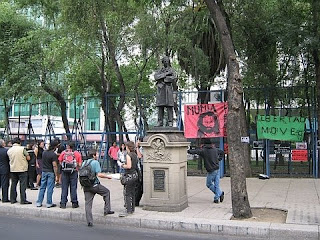
Photos: Mexico City MOVE 9 demo
Hey everyone, I'm sending some pics of a demonstration about 20 of us did at the United States Embassy here in Mexico City this afternoon in support of the MOVE 9, Mumia and other pps and to demand justice for the May 13 massacre. Of course we couldn't pass up the opportunity to oppose Plan Mexico, Mexican military and police training by the US and Israel, and the new FBI center they're building on the border for hundreds of agents. Love and OnaMOVe, Carolina


Swine flu, pigs and profits
By Hillel Cohen, Workers World, April 29, 2009
Fear of a swine flu pandemic is spreading much faster than the virus itself.
While it’s too soon to predict how widespread and deadly this new variation of influenza virus will be, information about the likely origin of the outbreak is starting to surface. A huge factory-farm pig operation owned by U.S. corporate giant Smithfield and operated by its Mexican subsidiary, Granjas Carroll de Mexico, may have spawned this new threat to public health.
Local residents from the towns of La Gloria and Perote in the Mexican state of Veracruz have been fighting the pork-breeding giant for years.
Producing close to a million hogs annually, the company maintains huge lagoons of hog manure as well as open-air dumps for rotting remains of hogs that die before being slaughtered. Fumes from the hog waste foul the air for miles and residents believe that their ground water may have also been contaminated. Swarms of flies that feed on the manure are in close reach of the towns.
It is well known that flies can spread avian flu by carrying material from infected bird droppings from place to place. It is possible that flies feeding on the hog manure may also be in contact with bird droppings and became the mechanism for mixing virus material from hogs, birds and humans, which is now causing the outbreak.
According to reports from the Mexican newspaper La Jornada, local residents tried to block the construction of the farm as early as 2005. A year ago, several activists were arrested by Veracruz authorities, who have worked closely with Granjas Carroll to suppress opposition to the huge hog operation.
Long before the swine flu outbreak made it into the international news, hundreds of La Gloria residents were complaining of severe respiratory infections, with many developing into pneumonia. Pneumonia is one of the severe complications of influenza infection. Veratect, a U.S. private company that monitors health outbreaks around the world for its subscribers, noticed the outbreak in Veracruz over a month ago and called the U.S. Centers for Disease Control (CDC). With its attention still on alleged—and non-existent—bioterrorism, the CDC ignored these calls for several weeks.
The first confirmed case of the new swine flu virus was that of a young boy in La Gloria, who has since recovered. The outbreak has spread to Mexico City and other Mexican areas as well as some cases in New York, California, Texas and other locations in the U.S., as well as around the world. At this writing at least 1,500 suspected cases in Mexico have resulted in over 150 deaths. While cases in the U.S. have so far been milder, one or two suspected deaths have already been recorded.
Health officials believe that the current strain of virus is a mix of genetic material from viruses that infect hogs and birds as well as humans. For almost a decade, world and U.S. health officials have focused on so-called avian or bird flu—labeled H5N1—which has spread around the world but has not “jumped” to human populations. Although some people contracted bird flu from close proximity to poultry and water foul, no human-to-human transmission has been reported.
This new swine flu is a variation of H1N1, which is much more common in human flu. It’s already clear that it is spreading by human-to-human transmission.
Because the largest number of cases have come from Mexico, some right-wing commentators on the Fox network have already tried to blame Mexican immigrants for bringing the virus across the border and may use the fear over swine flu to whip up even more immigrant bashing.
The fact that the U.S. cases seem to be among tourists from this country or those close to tourists has so far limited the attacks on immigrants. So far, however, relatively little attention in the big business mass media has been given to the Smithfield connection or the fact that similar huge and hazardous plants can be found in North Carolina, Utah and elsewhere.
An article in Rolling Stone magazine in 2006 estimated that Smithfield alone produced 26 million TONS of animal waste a year—the byproduct of over $11 billion in sales. So-called “free-trade” agreements like NAFTA have enabled corporate giants like Smithfield to set up their hazardous shops in Mexico with little or no regulation and at the expense of the local people.
Will the corporate criminals who have profited from this environmental and public health disaster be held responsible?
Cohen is a doctor of public health.
Fear of a swine flu pandemic is spreading much faster than the virus itself.
While it’s too soon to predict how widespread and deadly this new variation of influenza virus will be, information about the likely origin of the outbreak is starting to surface. A huge factory-farm pig operation owned by U.S. corporate giant Smithfield and operated by its Mexican subsidiary, Granjas Carroll de Mexico, may have spawned this new threat to public health.
Local residents from the towns of La Gloria and Perote in the Mexican state of Veracruz have been fighting the pork-breeding giant for years.
Producing close to a million hogs annually, the company maintains huge lagoons of hog manure as well as open-air dumps for rotting remains of hogs that die before being slaughtered. Fumes from the hog waste foul the air for miles and residents believe that their ground water may have also been contaminated. Swarms of flies that feed on the manure are in close reach of the towns.
It is well known that flies can spread avian flu by carrying material from infected bird droppings from place to place. It is possible that flies feeding on the hog manure may also be in contact with bird droppings and became the mechanism for mixing virus material from hogs, birds and humans, which is now causing the outbreak.
According to reports from the Mexican newspaper La Jornada, local residents tried to block the construction of the farm as early as 2005. A year ago, several activists were arrested by Veracruz authorities, who have worked closely with Granjas Carroll to suppress opposition to the huge hog operation.
Long before the swine flu outbreak made it into the international news, hundreds of La Gloria residents were complaining of severe respiratory infections, with many developing into pneumonia. Pneumonia is one of the severe complications of influenza infection. Veratect, a U.S. private company that monitors health outbreaks around the world for its subscribers, noticed the outbreak in Veracruz over a month ago and called the U.S. Centers for Disease Control (CDC). With its attention still on alleged—and non-existent—bioterrorism, the CDC ignored these calls for several weeks.
The first confirmed case of the new swine flu virus was that of a young boy in La Gloria, who has since recovered. The outbreak has spread to Mexico City and other Mexican areas as well as some cases in New York, California, Texas and other locations in the U.S., as well as around the world. At this writing at least 1,500 suspected cases in Mexico have resulted in over 150 deaths. While cases in the U.S. have so far been milder, one or two suspected deaths have already been recorded.
Health officials believe that the current strain of virus is a mix of genetic material from viruses that infect hogs and birds as well as humans. For almost a decade, world and U.S. health officials have focused on so-called avian or bird flu—labeled H5N1—which has spread around the world but has not “jumped” to human populations. Although some people contracted bird flu from close proximity to poultry and water foul, no human-to-human transmission has been reported.
This new swine flu is a variation of H1N1, which is much more common in human flu. It’s already clear that it is spreading by human-to-human transmission.
Because the largest number of cases have come from Mexico, some right-wing commentators on the Fox network have already tried to blame Mexican immigrants for bringing the virus across the border and may use the fear over swine flu to whip up even more immigrant bashing.
The fact that the U.S. cases seem to be among tourists from this country or those close to tourists has so far limited the attacks on immigrants. So far, however, relatively little attention in the big business mass media has been given to the Smithfield connection or the fact that similar huge and hazardous plants can be found in North Carolina, Utah and elsewhere.
An article in Rolling Stone magazine in 2006 estimated that Smithfield alone produced 26 million TONS of animal waste a year—the byproduct of over $11 billion in sales. So-called “free-trade” agreements like NAFTA have enabled corporate giants like Smithfield to set up their hazardous shops in Mexico with little or no regulation and at the expense of the local people.
Will the corporate criminals who have profited from this environmental and public health disaster be held responsible?
Cohen is a doctor of public health.
At the U.S. Border, the Desert Takes a Rising Toll
By RANDAL C. ARCHIBOLD, New York Times, Sept. 15, 2007
SASABE, Ariz. — “I can’t breathe,” Felicitas Martínez Barradas gasped to her cousin as they stumbled across the border in 100-degree heat. “The sun is killing me.”
They had been walking for a day and a half through the Sonoran Desert in southern Arizona, the purgatory that countless illegal immigrants pass through on their way from Mexico to the United States.
Ms. Martínez was 29 and not fit. A smuggler handed her a can of carbonated energy drink and caffeine pills. But she only got sicker and passed out, said her cousin, Julio Díaz.
There, near a mesquite tree a little over 10 miles from the border, Ms. Martínez died, her eyes open to the starry sky, her arms across her chest and Mr. Díaz, 17, at her side.
Gone was her dream of making enough money in the United States for a house for her four young children in Mexico.
“She was very set in her ways,” said a sister in Mexico, Ely, who had tried to persuade Ms. Martínez not to leave. “Once she decided to do something, there was no stopping her.”
The Border Patrol has reported a large drop in the number of illegal immigrants apprehended at the border with Mexico this year, the consequence, the agency says, of additional agents and the presence of National Guard troops. Yet the number of migrants dying while trying to cross here in Pima County is on pace to set a record, according to the county medical examiner.
Pima County, which includes the Tucson area, is one of the busiest areas for illegal crossings along the 2,000-mile border. The medical examiner’s office handled 177 deaths of border crossers in the first eight months of this year, compared with 139 over the same period last year and 157 in 2005, the year the most such deaths were registered.
The death of Ms. Martínez in July illustrates a primary reason that immigration scholars, the Border Patrol and government officials in the United States and Mexico believe people continue dying at such high rates: As they increasingly avoid heavily patrolled urban areas, they cross with little or no knowledge of the desert, whose heat, insects, wildlife and rugged terrain make it some of the most inhospitable terrain on the planet.
Like Ms. Martínez, who had worked cleaning houses in Mexico, many crossers arrive from central and southern Mexico, which is cooler and wetter than Arizona and where people are less familiar with the desert and its perils.
Before entering the Sonoran Desert, she had completed a three-day trip to the Mexican side of the border, part of the marathon trek from her lush, verdant subtropical village of Tepetlán, a four-hour drive northeast from Mexico City in Veracruz state.
Her cousin, Mr. Díaz, said they stayed in a room at the border with 15 other crossers and were each given two cans of tuna, a bag of tortilla chips, and six liters of water — a gallon and a half — by a smuggler before setting off for the desert.
The growing death toll here in recent years follows a Border Patrol clampdown in California and Texas. The goal was to drive migrant traffic away from cities like San Diego and El Paso and into the remote desert on the assumption it would act as a deterrent. But while there is no way of knowing its overall effect, the strategy is serving at least in part as a funnel for untold numbers of migrants.
The Government Accountability Office, in a report last year that analyzed Border Patrol statistics, said the annual number of reported deaths of border crossers doubled to 472 between 1995 and 2005, with the majority of those deaths in the desert near Tucson. The report suggested the agency has undercounted deaths because of inconsistent classification.
Border Patrol officials say that as the agency continues to add agents, as recently authorized by Congress, they will be better able to patrol the toughest areas of the Sonoran Desert. It said commanders recently met to finalize better methods to count migrant deaths.
“We are well aware of the perils of crossing the desert,” said Lloyd Easterling, an agency spokesman. “That’s why we are trying to get people to places to deter people from crossing to begin with.”
At the Mexican consulate in Tucson, a map is adorned with yellow and blue pieces of tape, for females and males, marking where migrants have died. Ms. Martínez is yellow No. 114.
Jerónimo García Ceballos, a consular official, maintains the map and devotes much of his work to identifying the dead and arranging for their bodies to be returned to Mexico.
Mr. García’s office is adorned with posters with slogans like “Don’t leave your life in the desert; your family asks you not to,” an example of the public service announcements that both Mexico and the United States Border Patrol have used along known migrant trails.
Ms. Martinez had telephoned home as she hopscotched across Mexico with Mr. Díaz. They rode in a smuggler’s sport utility vehicle to Xalapa, took a bus to Mexico City and then another, three-day bus trip to Altar, a ragged town that is a major staging area for migrants 50 miles south of the border.
“I would tell her it’s not too late to come back, I would work to pay off the smuggler,” said Ms. Martínez’s father, Vicente Martínez Ortega, recalling his telephone conversations with her along the way.
From Altar, they were driven toward the border in a van, Mr. Díaz said, and once they got close, they began walking. They headed along a known smuggling route toward Route 86 in Arizona, where migrants are often picked up and eventually carried to points across the United States.
Mr. Díaz said they were assured it would be a day or so of walking but Border Patrol agents say from the border to Route 86 is more like a three- or four-day walk.
Ms. Martínez’s last call home came a couple of days before she died. “She said, ‘Daddy, I’ve reached the border,’ ” Mr. Martínez said.
Tepetlán, a village of 1,800 people on a high plateau in the southeastern flanks of the Sierra Madre Oriental, has shrunk in population in recent years as scores of its citizens head “al otro lado,” to the other side, as the United States is called.
Family and friends there said Ms. Martínez had chosen to believe, like many others who try to cross, that nothing ill would come to her.
Her younger brother had successfully made a similar journey eight months before and found work at a factory in Georgia, but said he had told his sister of the exhausting, broiling march in the desert and warned her not to do it.
“I told her work here is hard and sometimes there isn’t any,” her brother Vicente, 24, said in a telephone interview from Georgia, where his job helps support his parents, wife and two young children in Tepetlán. “But she thought everything would come out all right.”
Her father had crossed several years ago in San Diego, scrambling away from Border Patrol agents tracking him and his group with helicopters and floodlights. He found field work in California and Nebraska and sold ice cream pops in Chicago before tiring of the climate and intermittent work and returning home to harvest coffee in Tepetlán.
Mr. Díaz, too, had made the trek just a year before, but said he was caught by the Border Patrol and immediately deported.
The Martínez family lives modestly in a two-room house in Tepetlán. It sits on an unpaved road where rural scenes naturally unfold: men riding burros, boys playing with a captured armadillo, and fish and fruit vendors hawking wares from battered pickup trucks.
Ms. Martínez had worked cleaning houses in Veracruz and at the airport there for a year but she found it hard to make enough money to care for her children, ages 6 to 13.
Her personal life, too, had been turbulent for years. Family members describe her as somewhat rebellious and headstrong.
She had dropped out of high school at 14, was married and pregnant by 15 and had left the father of her four children last year, after several fights.
She had remarried and was looking for ways to make big money for a new house.
Ms. Martínez had heard that Mr. Díaz was planning to make another try, through a smuggler who was a distant relative, and borrowed money from a lender in town. The cost would be $3,000, half paid up front, half after a successful crossing.
But it was not. Around 11 a.m. on July 6, Border Patrol Agent Kelly Kirby got a call about a young migrant reporting his cousin possibly dead in the desert. Every time a call about a migrant in distress comes in, Agent Kirby says he hopes for the best but knows to expect the worst.
Mr. Díaz said Ms. Martínez died just before sunset the night before. He cried and was scared, he said, and built a fire, hoping to be spotted.
He set off in the morning to find help, eventually flagging down a passing Border Patrol agent.
Agent Kirby responded and with Mr. Díaz’s help quickly found Ms. Martínez.
She was wearing jeans and a blouse. Foam around her mouth was evidence of a seizure. Though she had only walked about a day and a half, her physical condition and the insufficient water and food she had consumed made her susceptible to a desert death.
“She did about as much as she could to not make it,” Agent Kirby said.
When Ms. Martínez’s body was returned to Tepetlán, the coffin was brought into the house for a wake. Her father opened the lid and looked at his daughter’s face.
“I had to look, to see her,” Mr. Martínez said.
Mr. Martínez, with the help of a friend who is a mason, is completing work on a tomb, which includes a sculpture of the town church where Ms. Martínez’s mother took her for a blessing before she left for the United States.
Watching the work on the tomb from a distance one afternoon in late August, Mr. Díaz spoke of his life since his cousin’s death and the possibility of another attempt to cross.
“Not right now,” he said, “but who knows, later on?”
SASABE, Ariz. — “I can’t breathe,” Felicitas Martínez Barradas gasped to her cousin as they stumbled across the border in 100-degree heat. “The sun is killing me.”
They had been walking for a day and a half through the Sonoran Desert in southern Arizona, the purgatory that countless illegal immigrants pass through on their way from Mexico to the United States.
Ms. Martínez was 29 and not fit. A smuggler handed her a can of carbonated energy drink and caffeine pills. But she only got sicker and passed out, said her cousin, Julio Díaz.
There, near a mesquite tree a little over 10 miles from the border, Ms. Martínez died, her eyes open to the starry sky, her arms across her chest and Mr. Díaz, 17, at her side.
Gone was her dream of making enough money in the United States for a house for her four young children in Mexico.
“She was very set in her ways,” said a sister in Mexico, Ely, who had tried to persuade Ms. Martínez not to leave. “Once she decided to do something, there was no stopping her.”
The Border Patrol has reported a large drop in the number of illegal immigrants apprehended at the border with Mexico this year, the consequence, the agency says, of additional agents and the presence of National Guard troops. Yet the number of migrants dying while trying to cross here in Pima County is on pace to set a record, according to the county medical examiner.
Pima County, which includes the Tucson area, is one of the busiest areas for illegal crossings along the 2,000-mile border. The medical examiner’s office handled 177 deaths of border crossers in the first eight months of this year, compared with 139 over the same period last year and 157 in 2005, the year the most such deaths were registered.
The death of Ms. Martínez in July illustrates a primary reason that immigration scholars, the Border Patrol and government officials in the United States and Mexico believe people continue dying at such high rates: As they increasingly avoid heavily patrolled urban areas, they cross with little or no knowledge of the desert, whose heat, insects, wildlife and rugged terrain make it some of the most inhospitable terrain on the planet.
Like Ms. Martínez, who had worked cleaning houses in Mexico, many crossers arrive from central and southern Mexico, which is cooler and wetter than Arizona and where people are less familiar with the desert and its perils.
Before entering the Sonoran Desert, she had completed a three-day trip to the Mexican side of the border, part of the marathon trek from her lush, verdant subtropical village of Tepetlán, a four-hour drive northeast from Mexico City in Veracruz state.
Her cousin, Mr. Díaz, said they stayed in a room at the border with 15 other crossers and were each given two cans of tuna, a bag of tortilla chips, and six liters of water — a gallon and a half — by a smuggler before setting off for the desert.
The growing death toll here in recent years follows a Border Patrol clampdown in California and Texas. The goal was to drive migrant traffic away from cities like San Diego and El Paso and into the remote desert on the assumption it would act as a deterrent. But while there is no way of knowing its overall effect, the strategy is serving at least in part as a funnel for untold numbers of migrants.
The Government Accountability Office, in a report last year that analyzed Border Patrol statistics, said the annual number of reported deaths of border crossers doubled to 472 between 1995 and 2005, with the majority of those deaths in the desert near Tucson. The report suggested the agency has undercounted deaths because of inconsistent classification.
Border Patrol officials say that as the agency continues to add agents, as recently authorized by Congress, they will be better able to patrol the toughest areas of the Sonoran Desert. It said commanders recently met to finalize better methods to count migrant deaths.
“We are well aware of the perils of crossing the desert,” said Lloyd Easterling, an agency spokesman. “That’s why we are trying to get people to places to deter people from crossing to begin with.”
At the Mexican consulate in Tucson, a map is adorned with yellow and blue pieces of tape, for females and males, marking where migrants have died. Ms. Martínez is yellow No. 114.
Jerónimo García Ceballos, a consular official, maintains the map and devotes much of his work to identifying the dead and arranging for their bodies to be returned to Mexico.
Mr. García’s office is adorned with posters with slogans like “Don’t leave your life in the desert; your family asks you not to,” an example of the public service announcements that both Mexico and the United States Border Patrol have used along known migrant trails.
Ms. Martinez had telephoned home as she hopscotched across Mexico with Mr. Díaz. They rode in a smuggler’s sport utility vehicle to Xalapa, took a bus to Mexico City and then another, three-day bus trip to Altar, a ragged town that is a major staging area for migrants 50 miles south of the border.
“I would tell her it’s not too late to come back, I would work to pay off the smuggler,” said Ms. Martínez’s father, Vicente Martínez Ortega, recalling his telephone conversations with her along the way.
From Altar, they were driven toward the border in a van, Mr. Díaz said, and once they got close, they began walking. They headed along a known smuggling route toward Route 86 in Arizona, where migrants are often picked up and eventually carried to points across the United States.
Mr. Díaz said they were assured it would be a day or so of walking but Border Patrol agents say from the border to Route 86 is more like a three- or four-day walk.
Ms. Martínez’s last call home came a couple of days before she died. “She said, ‘Daddy, I’ve reached the border,’ ” Mr. Martínez said.
Tepetlán, a village of 1,800 people on a high plateau in the southeastern flanks of the Sierra Madre Oriental, has shrunk in population in recent years as scores of its citizens head “al otro lado,” to the other side, as the United States is called.
Family and friends there said Ms. Martínez had chosen to believe, like many others who try to cross, that nothing ill would come to her.
Her younger brother had successfully made a similar journey eight months before and found work at a factory in Georgia, but said he had told his sister of the exhausting, broiling march in the desert and warned her not to do it.
“I told her work here is hard and sometimes there isn’t any,” her brother Vicente, 24, said in a telephone interview from Georgia, where his job helps support his parents, wife and two young children in Tepetlán. “But she thought everything would come out all right.”
Her father had crossed several years ago in San Diego, scrambling away from Border Patrol agents tracking him and his group with helicopters and floodlights. He found field work in California and Nebraska and sold ice cream pops in Chicago before tiring of the climate and intermittent work and returning home to harvest coffee in Tepetlán.
Mr. Díaz, too, had made the trek just a year before, but said he was caught by the Border Patrol and immediately deported.
The Martínez family lives modestly in a two-room house in Tepetlán. It sits on an unpaved road where rural scenes naturally unfold: men riding burros, boys playing with a captured armadillo, and fish and fruit vendors hawking wares from battered pickup trucks.
Ms. Martínez had worked cleaning houses in Veracruz and at the airport there for a year but she found it hard to make enough money to care for her children, ages 6 to 13.
Her personal life, too, had been turbulent for years. Family members describe her as somewhat rebellious and headstrong.
She had dropped out of high school at 14, was married and pregnant by 15 and had left the father of her four children last year, after several fights.
She had remarried and was looking for ways to make big money for a new house.
Ms. Martínez had heard that Mr. Díaz was planning to make another try, through a smuggler who was a distant relative, and borrowed money from a lender in town. The cost would be $3,000, half paid up front, half after a successful crossing.
But it was not. Around 11 a.m. on July 6, Border Patrol Agent Kelly Kirby got a call about a young migrant reporting his cousin possibly dead in the desert. Every time a call about a migrant in distress comes in, Agent Kirby says he hopes for the best but knows to expect the worst.
Mr. Díaz said Ms. Martínez died just before sunset the night before. He cried and was scared, he said, and built a fire, hoping to be spotted.
He set off in the morning to find help, eventually flagging down a passing Border Patrol agent.
Agent Kirby responded and with Mr. Díaz’s help quickly found Ms. Martínez.
She was wearing jeans and a blouse. Foam around her mouth was evidence of a seizure. Though she had only walked about a day and a half, her physical condition and the insufficient water and food she had consumed made her susceptible to a desert death.
“She did about as much as she could to not make it,” Agent Kirby said.
When Ms. Martínez’s body was returned to Tepetlán, the coffin was brought into the house for a wake. Her father opened the lid and looked at his daughter’s face.
“I had to look, to see her,” Mr. Martínez said.
Mr. Martínez, with the help of a friend who is a mason, is completing work on a tomb, which includes a sculpture of the town church where Ms. Martínez’s mother took her for a blessing before she left for the United States.
Watching the work on the tomb from a distance one afternoon in late August, Mr. Díaz spoke of his life since his cousin’s death and the possibility of another attempt to cross.
“Not right now,” he said, “but who knows, later on?”
US's new World Bank pick, Zoellick, threatens Venezuela
Zoellick warns Venezuela is heading for trouble
By Noel Randewich, June 16, 2007
MEXICO CITY (Reuters) - Robert Zoellick, almost certain to be the next head of the World Bank, on Saturday took aim at Venezuela's leftist president, Hugo Chavez, warning that his oil-fueled socialist revolution was headed for trouble.
"It's a country where economic problems are mounting, and as we're seeing also on the political and press side it's not moving in a healthy direction," Zoellick told reporters during a visit to Mexico.
President Bush, a fervent foe of Chavez, nominated Zoellick to lead the World Bank, and the former U.S. trade representative and deputy secretary of state is expected to be confirmed before the end of the month.
Chavez has used surging oil revenues to pay for a socialist revolution in the OPEC nation and gain influence with other countries in Latin America at the expense of the United States.
He has said he wants to withdraw Venezuela, the world's No. 5 oil supplier, from the World Bank and the International Monetary Fund, blaming their decades-old economic recipes of tight budget control, privatizations and open markets for poverty across Latin America.
"If a country feels it doesn't need or want the services of the international financial institutions, that's their choice," Zoellick said. "I've found no shortage of countries interested in trying to work with the World Bank."
The World Bank would focus on rebuilding in war-torn countries like Sudan, Haiti and Afghanistan under his leadership, Zoellick said.
After last month's forced resignation of Paul Wolfowitz as World Bank president over a high-paying promotion for his companion, Zoellick was put forward as the candidate of the United States, which traditionally chooses the head of the institutional lender.
No other nominee had been made as of Friday's deadline, making Zoellick a shoe-in for the job at the World Bank.
Chavez is popular among Venezuela's poor majority for his efforts to redistribute billions of dollars in oil wealth but has often drawn international criticism for treading on the rights of opponents.
In May, he closed down an opposition television channel and threatened to take another off the air.
Heavy spending of oil revenues has heated up Venezuela's economy, pushing the inflation rate to almost 20 percent and leading the government to impose price controls on basic goods.
Venezuela put its withdrawal from the IMF on hold this month because of concerns the move could trigger a technical default on its sovereign debt.
By Noel Randewich, June 16, 2007
MEXICO CITY (Reuters) - Robert Zoellick, almost certain to be the next head of the World Bank, on Saturday took aim at Venezuela's leftist president, Hugo Chavez, warning that his oil-fueled socialist revolution was headed for trouble.
"It's a country where economic problems are mounting, and as we're seeing also on the political and press side it's not moving in a healthy direction," Zoellick told reporters during a visit to Mexico.
President Bush, a fervent foe of Chavez, nominated Zoellick to lead the World Bank, and the former U.S. trade representative and deputy secretary of state is expected to be confirmed before the end of the month.
Chavez has used surging oil revenues to pay for a socialist revolution in the OPEC nation and gain influence with other countries in Latin America at the expense of the United States.
He has said he wants to withdraw Venezuela, the world's No. 5 oil supplier, from the World Bank and the International Monetary Fund, blaming their decades-old economic recipes of tight budget control, privatizations and open markets for poverty across Latin America.
"If a country feels it doesn't need or want the services of the international financial institutions, that's their choice," Zoellick said. "I've found no shortage of countries interested in trying to work with the World Bank."
The World Bank would focus on rebuilding in war-torn countries like Sudan, Haiti and Afghanistan under his leadership, Zoellick said.
After last month's forced resignation of Paul Wolfowitz as World Bank president over a high-paying promotion for his companion, Zoellick was put forward as the candidate of the United States, which traditionally chooses the head of the institutional lender.
No other nominee had been made as of Friday's deadline, making Zoellick a shoe-in for the job at the World Bank.
Chavez is popular among Venezuela's poor majority for his efforts to redistribute billions of dollars in oil wealth but has often drawn international criticism for treading on the rights of opponents.
In May, he closed down an opposition television channel and threatened to take another off the air.
Heavy spending of oil revenues has heated up Venezuela's economy, pushing the inflation rate to almost 20 percent and leading the government to impose price controls on basic goods.
Venezuela put its withdrawal from the IMF on hold this month because of concerns the move could trigger a technical default on its sovereign debt.
Subscribe to:
Posts (Atom)